Van's Air Force

The definitive Van's Aircraft support community! Buying, building or flying an RV? Join our exclusive family of mentors and enthusiasts!

Increased cooling by blocking front two cylinders

Ed_Wischmeyer

Well Known Member
Patron
Thought I had the RV-9A cooling tolerable, but yesterday cylinder #3 ran way hot for no apparent reason.

On Saturday, I saw an RV-7 under construction with relatively small pieces of aluminum to block airflow directly into the #1 and #2 cylinders, more or less where the head and the barrel meet.

How well do those actually work? I kind of understand the theory...
 
it forces the air up and around instead of through that barrel. it will lower the temp of the back cyls but will raise the temp of the front cyls. #1 normally runs colder than the others so the dam raises that cyls temp and helps lower #3 which is normally the hottest running cyl.


by playing with the size of the dam you can balance the cyl temps pretty well.


bob burns
rv-4 N82RB
 
Last edited:
Can any one suggest a distance between the air blocking dam and the front of the cylinder
 
Foil tape works too - simple approach to test different sizes at least, before doing anything permanent.

Good idea, I will try that. I have made removable ones and now need to trim to right size. Your idea will save me the time of removing top cowl.
 
Don?t forget that adding a washer between the rear baffle and # 3 cylinder at the # 8 screw attachment is a huge help. This allows air to flow down behind #3 cylinder where as stock it has no path. This has been discussed many times on this site and it works. A .032 washer lowered my #3 cylinder 20+ degrees if memory serves me correctly.

As suggested already install some tape 1inch wide to start on the front cylinders and see what happens to the temps. Adjust until the front and rear are the same, then if you want replace with metal.

Put the space between the #3 cyl and baffle first, It maybe all you need to do??

Larry
 
It's funny how things from vary from engine to engine and geographic location.

My hottest cylinders have always been 1&2 and over time, I've been cutting down the air dams. I've ALMOST got it where it needs to be but it's a little difficult in the upper midwest where the flying temperatures can vary by as much as 100 degrees over the course of the year.
 
My CHT balance on #1 and #3 is pretty good. I cut down the air dam about 1/2". The balance on #2 and #4 is still +20 degrees with #2 being the hottest and #4 being the coolest. I've cut down the air dam on #2 even more and it really hasn't done much. Both of the front cylinders (#1 and #2) are the hotter ones, even with all of that cool air hitting them first. It would be nice to have some better way to direct that air down through the front cylinders rather than up and over.
 
A strip of adhesive backed foil ('Speedtape') works well as a temporary dam whilst you are working out how high to make the dams. In fact so well, some years later, it is still there, just punctured by a few flies :eek:
 
Found more to the story today. Three cylinders had massive leaks due to failed intake manifold gaskets - the other cylinder had a new gasket. High EGTs don't help the CHTs. Along with redoing the panel, we're doing so much work that we're going to go ahead and annual the plane.
 
I appreciate the discussion and ideas here... Since I am quite new to these engines and the RV-7... can someone post or point me to some pictures? I baught a 2005 RV-7 with a 0-360-A1D
 
Engine cooling is a prevalent concern among many on this forum, but it's a deeper subject than can be covered in a few forum posts. If you're a new owner and new to aircraft maintenance, you may have a steep learning curve ahead of you. Don't freak out, because we were all there at one time. I would suggest that you purchase and read some books to begin with. Any of the books by Mike Busch or Vic Syracuse on aircraft maintenance are worth reading.

Vic's books are strongly tailored to the Van's RV models, so that may be your best starting point. They're available on the EAA website, at Aircraft Spruce, and probably other places. None of the books are cheap, but they're very informative with lots of photos. And when you consider the cost of doing something wrong, the books can easily pay for themselves many times over.

Once you start getting a feel for what all of this stuff is, there are also some excellent videos on specific topics. EAA Hints for Homebuilders are very helpful with specific skills, and YouTube has a plethora of videos as well. Just make sure that you're getting information from reputable sources, and not somebody that ignores standard practices and procedures.

If possible, pair up with other knowledgeable RV owners and pick their brains. Help them with some maintenance or even a Condition Inspection. This will all help to build your knowledge base and confidence.

Hope some of this helps you with your concerns.
 
I appreciate the discussion and ideas here... Since I am quite new to these engines and the RV-7... can someone post or point me to some pictures? I baught a 2005 RV-7 with a 0-360-A1D
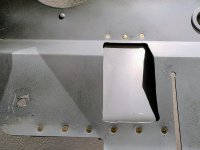
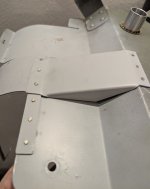
Pics of my engine baffles in the front - RV6, O-360 (carbed).
First pic - the air blocker plates as delivered with the baffle kit from Vans.
Second pic (if you zoom in) - the blocker plate in front of my #1 cylinder as modified during phase 1 for CHT control.

The plate in front of #1 has been pretty much been cut off. My #1 was getting very hot during full power climbs at first. Now it it still shares the hottest cylinder with #4 in climb, but runs very close to #2 & #3 in cruise running lean. #4 is the hottest by about 15* in all phases of flight. I now have a butterfly valve in that 3” scat opening feeding cooling airflow to my oil cooler on the firewall. Closing the butterfly in flight has very little effect on #4 CHT, and it’s fully closed about 6 months out of the year. That has mostly to do with the uneven fuel/air distribution in my carbureted engine. My #2 runs the coolest in all phases of flight with the blocking plate untouched from original.

Every airplane is different, with carbureted ones usually being the most varied in CHT’s. I’m surprised my 1, 2, & 3 are so close together in cruise flight - within 5* normally.
 

Attachments

  • IMG_2241.jpeg
    IMG_2241.jpeg
    3.1 MB · Views: 181
  • IMG_3342.jpeg
    IMG_3342.jpeg
    3 MB · Views: 173
Pics of my engine baffles in the front - RV6, O-360 (carbed).
First pic - the air blocker plates as delivered with the baffle kit from Vans.
Second pic (if you zoom in) - the blocker plate in front of my #1 cylinder as modified during phase 1 for CHT control.

The plate in front of #1 has been pretty much been cut off. My #1 was getting very hot during full power climbs at first. Now it it still shares the hottest cylinder with #4 in climb, but runs very close to #2 & #3 in cruise running lean. #4 is the hottest by about 15* in all phases of flight. I now have a butterfly valve in that 3” scat opening feeding cooling airflow to my oil cooler on the firewall. Closing the butterfly in flight has very little effect on #4 CHT, and it’s fully closed about 6 months out of the year. That has mostly to do with the uneven fuel/air distribution in my carbureted engine. My #2 runs the coolest in all phases of flight with the blocking plate untouched from original.

Every airplane is different, with carbureted ones usually being the most varied in CHT’s. I’m surprised my 1, 2, & 3 are so close together in cruise flight - within 5* normally.
Thank You for the Pictures. I like how you used a gray sealant instead of the messy orange sealant that was used on my engine. I will keep an eye and examine my baffles next time cowling come off.
 
Thank You for the Pictures. I like how you used a gray sealant instead of the messy orange sealant that was used on my engine. I will keep an eye and examine my baffles next time cowling come off.
The one thing I'd advise against is consulting the typical airport A&P about baffles. The typical Cessna and Piper have VERY leaky baffles.. and a HUGE inlet. So they work fine with a ton of leaks. The A&P learns that a bunch of holes/leaks is totally fine. THAT DOESN'T WORK WITH ANY RV. We have small cowl inlets, and the baffling needs to be really tight.

The more RV guys you have look, the more issues you'll find in the baffles.

This is part of why the planes are fast... we don't intake and slow down a bunch of cooling air needlessly.
 
Just to play devils advocate. One thing I learned many years ago from John Deakin, Walter Atkinson, George Braly & Tim Roehl is you cannot assume what you think airflow will do is actually what it will do. In other words they found it often does the exact opposite.

Probably 30 years ago now, GAMI was wanting to solve the Bonanza cylinder 6 issue. You can read about them here https://gami.com/liquidair/liquidair.php
The project involved GAMI tufting the entire engine bay and Walter being a dental surgeon (back before we had all the tiny digital cameras we have now) mounted controllable cameras in the engine bay and was able to record their observations. The cylinder 6 was modified to include 12 thermocouples so they could map thermal results and do modelling and FEA on the cylinders. They learned round pistons in egg shaped cylinders and distorting heads was they problem. Hence the baffle mods they developed.

Anyway...... with this knowledge I looked at the RV10 baffle plates and realised "conventional wisdom was to be ignored. I cut ours down and generally now on customers planes we never rivet them in, saves work later. So below are my CHT's that are typical for 2400hours and an engine that was still doing great for leak downs (72-76) and could well go a few hundred more in its new home on a military experimental drone project.

C1=342 C2=333 C3=332 C4=331 C5=345 C6=346

There was no C5 baffle mods beside a washer spacer. We have learned the big oil cooler outlet affects C6 and the new engine going in will have a much better oil cooler mousetrap, that will come to market soon as part of a bigger project, but just assume there are gains to be had there.

So...........the takeaway............. ditch those stupid C1/2 air dams and then seal up other things. The way the engine cowls suck matter more than how they are force fed. Also remember that 60+% of the air that comes in the front goes back out near the spinner and over the windscreen, not through the engine. So the better you get the suck the better the cooling. How do you get that? Get the lower deck sucking and keep the high pressure above and not sneaking around.

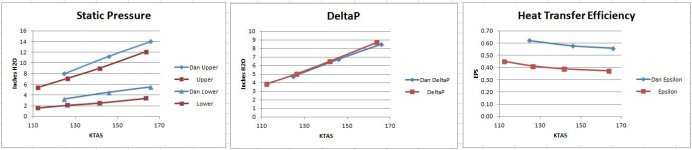
Dan Horton has a heap of stuff on this scattered across VAF so look at those posts as well as any by Kevin Horton (no relative I think).

As always, be careful of advice, even mine, but stick to data backed facts where you can.

 
My purchased RV with an IO-320 has deteriorating foil tape across parts of the front-facing cooling fins of cylinders 1 & 2. No current cooling concerns, but I'm wondering if I should remove or replace it. If replace, what exactly is this stuff?
 
Just to play devils advocate. One thing I learned many years ago from John Deakin, Walter Atkinson, George Braly & Tim Roehl is you cannot assume what you think airflow will do is actually what it will do. In other words they found it often does the exact opposite.

Probably 30 years ago now, GAMI was wanting to solve the Bonanza cylinder 6 issue. You can read about them here https://gami.com/liquidair/liquidair.php
The project involved GAMI tufting the entire engine bay and Walter being a dental surgeon (back before we had all the tiny digital cameras we have now) mounted controllable cameras in the engine bay and was able to record their observations. The cylinder 6 was modified to include 12 thermocouples so they could map thermal results and do modelling and FEA on the cylinders. They learned round pistons in egg shaped cylinders and distorting heads was they problem. Hence the baffle mods they developed.

Anyway...... with this knowledge I looked at the RV10 baffle plates and realised "conventional wisdom was to be ignored. I cut ours down and generally now on customers planes we never rivet them in, saves work later. So below are my CHT's that are typical for 2400hours and an engine that was still doing great for leak downs (72-76) and could well go a few hundred more in its new home on a military experimental drone project.

C1=342 C2=333 C3=332 C4=331 C5=345 C6=346

There was no C5 baffle mods beside a washer spacer. We have learned the big oil cooler outlet affects C6 and the new engine going in will have a much better oil cooler mousetrap, that will come to market soon as part of a bigger project, but just assume there are gains to be had there.

So...........the takeaway............. ditch those stupid C1/2 air dams and then seal up other things. The way the engine cowls suck matter more than how they are force fed. Also remember that 60+% of the air that comes in the front goes back out near the spinner and over the windscreen, not through the engine. So the better you get the suck the better the cooling. How do you get that? Get the lower deck sucking and keep the high pressure above and not sneaking around.

Dan Horton has a heap of stuff on this scattered across VAF so look at those posts as well as any by Kevin Horton (no relative I think).

As always, be careful of advice, even mine, but stick to data backed facts where you can.

Not surprised with anything you stated. However, I removed the metal dams on my 6 and experimented with foil tape and each iteration changed the CHT ranges of the #2 cylinder it was applied to. Not going to call that data, but saw clear cause and effect. I never reinstalled the dams, just left the foil tape and add a new layer each year as it develops holes. Didn't see any real changes on #1, so left it off. That probably falls into your "not whats expected" theory.
 
Back
Top