Van's Air Force

The definitive Van's Aircraft support community! Buying, building or flying an RV? Join our exclusive family of mentors and enthusiasts!

I need Suction air leak test ideas

Larry DeCamp

Well Known Member
FM-150 system runs full power with boost pump on. Boost off, runs rough and wont maintain power above 2000 RPM in flight. I suspect suction air leak (bubbles) between boost pump and mechanical pump intake.
Appreciate suggestions on leak identification.
 
Pulling and capping the line to the fuel servo would allow pressure testing from boost pump to servo.
That’s pretty easy, the hard part is capping the lines to the fuel tank and pressure testing everything else.
Sounds like a pretty serious problem, would be surprised if it really was a leak you wouldn’t spot some blue dye evidence.
 
Your fuel pressure gage should be measuring fuel pressure after the mechanical pump. Make sure you have 20 psi min with the electric pump off. At 15 psi, the servo won’t operate properly. Below 15 PSI, the engine quits.
 
I had the exact same issue with the non FI fuel pump on a FI engine. They are different.
Ran fin with boost pump, ran horrible with engine pump only.
Make sure you have the correct fuel pump.
 
Pulling and capping the line to the fuel servo would allow pressure testing from boost pump to servo.
That’s pretty easy, the hard part is capping the lines to the fuel tank and pressure testing everything else.
Sounds like a pretty serious problem, would be surprised if it really was a leak you wouldn’t spot some blue
 
The pump is from AFP with the FM-150 system and it does produce 24+ psi compared to boost pump 30+ psi. So on my Garmin issued sensor on G3X, both pumps are working as expected . Kyle, at AFP, advised to confirm delivery pressures at full throttle with a steam gauge on the ground in case my G3X sensor is incorrect and mechanical pump pressure is too low.
Will do the plumbing and see what find . We will also look for blue stains on fittings between bost and engine pump. Thanks for your support !
 
I had a similar issue and ran a clear hose to the inlet of my fuel rail and watched for bubbles in the line. I did not have a mechanical fuel pump, but 2 electric pumps so didn't need to run the engine so easier test. Easier of course to look for blue stains but for me a leak on the suction side of the pump since it's located above the fuel level in the tanks no blue showed up. Sucked small amounts of air but did not let fuel escape so no blue no smell of octane. My engine ran fine with the minor amount of air bubbles but eventually the bubbles would bounce the seat of the fuel pressure regulator, damage it and cause fuel pressure issues at different manifold pressures.
 
If you have leaks significant enough to make your engine rough and not run over 2000 rpm, it should be leaking like a sieve when the boost pump is on. There would be a lot of blue stains. I would be looking at a failing mechanical fuel pump. Imho, this is not from sucking air into the fuel lines.
 
I just went through this grief & aggravation. Get a cheap automotive electric pump (facet etc.), clear tubing, connect tubing to the line that goes to the servo, then to the pump, then more line to your bucket/jug/etc. This will suck through all the lines... a rare bubble is probably (?) ok, but consistently getting bubbles will cause the FI fits. I had no fuel leaks anywhere. Culprit was either the original fuel valve (apparently those imperial valves often leak air at the shaft) and/or a bad o-ring on the fuel filter. In both cases these are between the tanks and the boost pump and so they only see a little static pressure. I also found a flare that wasn't the best....

Also try switching tanks while sucking the system and try turning the fuel selector off. A leaky fuel selector shaft may be ok ... until you move it.
 
Last edited:
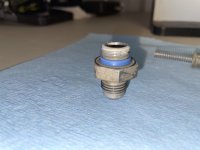
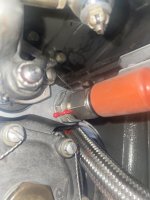
I've had a lot of issues with the fuel system in the plane after I bought it. One issue is the outlet fitting in the mechanical pump. You have to screw it almost all the way in, then hold the clocking position with a wrench while tightening the jam nut against the fuel pump body. The jam nut in mine was not tight, and the fitting was free to rotate. There should be an o-ring between the jam nut plate and the fuel pump body. Be sure to follow the torque spec for these in the Lycoming manual - they require much less torque than the B-nuts, and Lycoming warns you that you'll damage the threads if you don't back up the fitting while torquing the B-nuts.

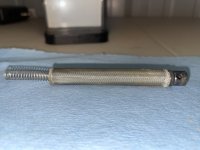
The other place I had issues was fuel seepage at the fuel servo inlet. There are two o-rings there that I ended up replacing. It's extremely important that these o-rings go in perfectly clean and the sealing surfaces inside the servo need to be perfectly clean as well. I learned this the hard way, because after cleaning out the inlet screen and re-installing with new o-rings, I still had seepage at the mating face. After the 3rd time pulling the fitting, I put on some 16x power magnifying glasses to get a real close look at the sealing surfaces, and there was all kinds of contamination that wasn't visible to the nake eye. After cleaning all that crap out and re-installing, it's now leak-free. Lycoming also has a torque spec for this fitting, and they warn you to back it up with a wrench while tightening up the B-nut to prevent damage to the fitting threads.

With all these o-rings, you'll also want to inspect them for cleanliness, along with their respective sealing surfaces. Mine had fine fibers and other particulate contamination that I had to clean out. I ultimately decided to replace all the o-rings. You'll want to make sure you use DC-4 to lube the rings when you install them, so they don't grip the sealing surfaces and twist as you tighten them.

In my case, there were no fuel stains. The seepage was so miniscule that I almost didn't notice it till I looked really closely with a flashlight at an angle. There was the ever so slight bit of wetness just barely around the perimeter of the fittings, so look closely and use a really good light at several different angles to try and catch the leak.

As for torquing B-nuts, I've also had issues with those leaking, and using the flats method turned out to be really helpful and fixed all my leaky B-nut problems.
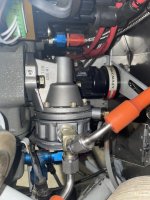
3C0E3A5C-47E1-4B55-997C-E9D7845EE946_1_105_c.jpeg
1AB1F399-2298-41EC-8286-097D8083A2FA_1_105_c.jpeg78C90E87-EF72-4D19-961D-D028C3CD54F8_1_105_c.jpeg
775A4EF0-ADFB-4DBD-A7FF-CE6C8A1D5D3A_1_105_c.jpeg
 
Last edited:
Back
Top