Van's Air Force

The definitive Van's Aircraft support community! Buying, building or flying an RV? Join our exclusive family of mentors and enthusiasts!

High oil temp on relatively new engine

At what altitude can you run LOP with that percentage? I was able to go LOP about 80F with my standard 390 up to 12-13K elevation and as I went higher this would reduced till I changed my nuzzles to .024 which helped a great deal up to 17k. With my FM200 (EXP119) this is not as much and even though I have gone down to .0255, at about 15k I get only about 15-25F LOP. The fuel burn is still pretty good, about 8G at 162k. I understand if I change my fuel pump to a higher pressure than I could go to a smaller nuzzle but at this point I am satisfied with the setup.
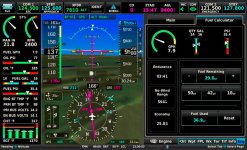
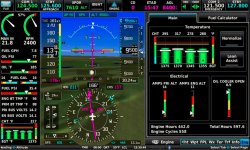
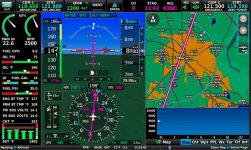
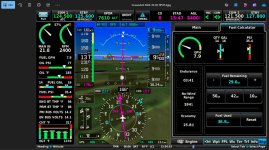
I've run LOP up to 14,000 ft. This is the earlier 390 rated at 210 hp. I've been able to run as low as 7 GPH very LOP when I was trying to milk the range to make it non-stop Florida to Ohio. My 14A is a little fat but very comfortable. Gross weights on the upper end of the scale. (2 people) Below screen shots. Would be interested in seeing others screen shots.

Screenshot 2025-06-16 201130.jpgScreenshot 2025-06-16 200654.jpgScreenshot 2025-06-16 200427.jpgScreenshot 2025-06-16 200156.jpg
 
This is very close to what I was getting with my 210HP 390. On my last trip to AZ, and my existing 14 gives me the same numbers. For accuracy and I calculate the fuel at fill up to fill up and my TAS has been verified to be darn accurate. I am running PMAGs
 
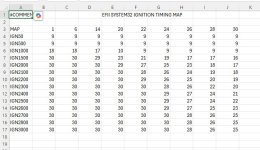
See attached, for the higher RPM/MP settings (above 24 sq.) I've been thinking of dialing it back a tad for Florida summer flying.

View attachment 90327

Consider setting the entire 1" column to 20 from 1000 up, as a guard against manifold pressure sensor failure. I don't know how the System 32 would default, but we've seen a lot of Lightspeeds dialing in full advance when a bad sensor outputs a low value.

You can have a moderately effective rev limiter by changing the entire 2800 RPM row to 18, and the 3000 row to 10.

I'm surprised to see you're cranking at 9 degrees. Metal prop?

As for the rest, I doubt you would notice a performance difference if you pulled all the bins back quite a bit in the normal operating range. Do it and report.
 
See attached, for the higher RPM/MP settings (above 24 sq.) I've been thinking of dialing it back a tad for Florida summer flying.

View attachment 90327
Those seem a bit aggressive for an angle valve. I thought 20 was recommended at high power. This table would be ok for lop operations, but climbing to 8000 rop, you are going to have too much advance and produce a lot of heat.

Your table lookscsimilar to mine, but i am pv and also can reduce advance when rop.
 
I have the same setup including oil cooler, 5” scat, and now with the warmer days my oil temperature are moderately high. Today saw 223°F after completing a climb to 8000’ with an OAT of 71°F. I live in Colorado in the thinner air. After getting into cruise at 65% power, the OT dropped down to only 221°F.

I’m looking for ideas in addition to:
1) removing the tunnel cowl flap to increase exit air.
2) cut a hole in the bottom cowl to increase exit air
3) insert Antisplat electric cowl flap on the bottom of the lower cowl.

Engine has 60 hours, oil consumption is nominal, CHTs about 360°F.

Any other suggestions?

Today, I removed the tunnel cowl flap on the RV-14A and took the plane up for a test flight in 57 degree(F) ambient air temperature. I definitely saw a difference in a side-by-side comparison with another flight in the same ambient air, same power settings, similar altitude (~7500'). I am seeing a 12 degree drop in oil temp and a 40 degree drop in CHT's without the cowl flap installed versus with installed a month ago.

I'm not convinced the RV-14 cowl flap is all that effective in warmer temperatures. May have to think about winter operations or high altitude considerations.
 
Today, I removed the tunnel cowl flap on the RV-14A and took the plane up for a test flight in 57 degree(F) ambient air temperature. I definitely saw a difference in a side-by-side comparison with another flight in the same ambient air, same power settings, similar altitude (~7500'). I am seeing a 12 degree drop in oil temp and a 40 degree drop in CHT's without the cowl flap installed versus with installed a month ago.

I'm not convinced the RV-14 cowl flap is all that effective in warmer temperatures. May have to think about winter operations or high altitude considerations.
Did you remove only the flap or the entire tunnel cover? It is not a surprise to see lower temp especially if you have removed the entire cover, just increased your exit area by many folds. But removing that, will increase your drag and some of the benefit that this version of the cowl has.
 
Did you remove only the flap or the entire tunnel cover? It is not a surprise to see lower temp especially if you have removed the entire cover, just increased your exit area by many folds. But removing that, will increase your drag and some of the benefit that this version of the cowl has.
I removed the entire cover. As far as loss of benefits, I think it’s a wash as the cowl flap had to be open all the time.
 
"""...Here is the circumstance, the engine will get to 220F range in about 10-15 minute run on the ground, they saw a 235F at the runup and thought it would cool down if flown, one turn in the pattern the oil got to 245F when they decided to land..."
I know I'm late to the party here but I just want to throw out there to make people aware; The manual for my IO390 says that maximum allowable oil temp is 235, not the more common 245 we're used to on the IO360.
 
Consider setting the entire 1" column to 20 from 1000 up, as a guard against manifold pressure sensor failure. I don't know how the System 32 would default, but we've seen a lot of Lightspeeds dialing in full advance when a bad sensor outputs a low value.
Agree. The lightspeed (and SDS) MAP sensor is GM based. The typical failure defaults to Zero MAP/Full advance. One will never get to zero MAP in the real world so hard loading a safe advance value in that slot does not impact utility and goes a long way toward safety in the event of a MAP failure
 
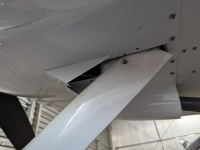
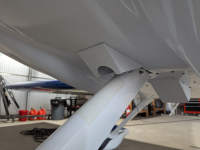
If you haven't seen my posts on this topic already, I suggest you build one of these. It was a big help for our ground ops and overall oil temps.

1755718272146.png1755718282981.png
 
If you haven't seen my posts on this topic already, I suggest you build one of these. It was a big help for our ground ops and overall oil temps.

View attachment 95484View attachment 95485

If you haven't seen my posts on this topic already, I suggest you build one of these. It was a big help for our ground ops and overall oil temps.

View attachment 95484View attachment 95485
What oil temp difference do you see with this? If memory serves me right, I saw about 5-7F difference with the slot open and was thinking of making one that retracts. I did not check to see what the speed penalty was.
 
What oil temp difference do you see with this? If memory serves me right, I saw about 5-7F difference with the slot open and was thinking of making one that retracts. I did not check to see what the speed penalty was.
I believe it was 8-10 deg. The speed loss was negligible.
 
Back
Top