Van's Air Force

The definitive Van's Aircraft support community! Buying, building or flying an RV? Join our exclusive family of mentors and enthusiasts!

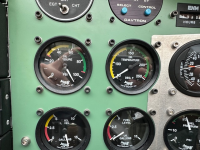
High Oil Pressure

Title is to attract attention but I suspect it is only an indication issue.

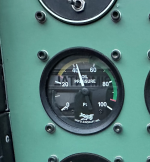
Engine @ 1000RPM = ~105 PSI indication.
Engine not running = ~ 42 PSI indication.

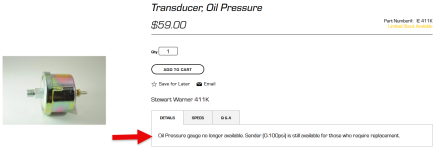
The oil pressure transducer (Stewart Warner 411K) was R&R'd with identical results. The wiring has been inspected with no anomalies noted.

I have done some dumpster diving in the airforce forums and my guess is the culprit would be the gauge but would like your input. Another thought - is there a procedure to calibrate/adjust the gauge?

If you also agree that the gauge is most likely the culprit, does anyone have one lying around from an upgrade, as the Mothership no longer supports the gauge?

Thanks in advance!
-Billy D.

1731334818121.png

1731334960315.png

1731334986438.png
 
If the gauge is not reading 0 when power is off, it is the issue. Easy way to test is disconnect the sensor lead from the back of the gauge. When power is applied it should be at 0 (resting on the pin). Use a jumper and bridge the sensor lead to the ground lead, it should move past 100 some distance. If it sticks at 40, some people have had success by exercising the gauge (letting it climb and letting it fall by alternating with the jumper to the ground lead. This removes oxidation on the gauge wiper arm. It will never be like new, but could get you a bit more time on the gauge.
 
If the gauge is not reading 0 when power is off, it is the issue. Easy way to test is disconnect the sensor lead from the back of the gauge. When power is applied it should be at 0 (resting on the pin). Use a jumper and bridge the sensor lead to the ground lead, it should move past 100 some distance. If it sticks at 40, some people have had success by exercising the gauge (letting it climb and letting it fall by alternating with the jumper to the ground lead. This removes oxidation on the gauge wiper arm. It will never be like new, but could get you a bit more time on the gauge.
Thanks for the guidance and troubleshooting advice!

Just to clarify, when you say "power is off" - you mean electrical power, correct?

I may also add - I tested it in all 3 conditions and these are the results:
  1. Electrical and engine power off: the needle is resting on the pin (0 PSI).
  2. Electrical power on, engine off: the needle indicates ~42 PSI.
  3. Electrical power on, engine on: the needle indicates ~105 PSI @ 1000 RPM.
 
It’s either the gauge or the sender. I had a vans fuel gauge do the same thing. Turned out to be the gauge itself.
 
One other thing to test is the ground return from the gauge to the ground bus. An added resistance in the ground line looks like an above zero pressure reading to the gauge.

I had one of Van’s oil pressure gauges get a bit wonky, and start drifting high and low compared to normal expected reading. Turned out it wasn’t the gauge, wasn’t the pressure sender, but was somewhere in the ground return path. A bit strange since the return path was 1 continuous wire from the gauge to the forest of tabs common ground point. Even tried replacing the crimped on ring terminal and fast-on terminal…..same oil pressure behavior. Installed a new wire run between the gauge and ground….problem went away. Never could find any kind of damage or failure in the original wire. Weird. 🤨
 
Thanks for the guidance and troubleshooting advice!

Just to clarify, when you say "power is off" - you mean electrical power, correct?

I may also add - I tested it in all 3 conditions and these are the results:
  1. Electrical and engine power off: the needle is resting on the pin (0 PSI).
  2. Electrical power on, engine off: the needle indicates ~42 PSI.
  3. Electrical power on, engine on: the needle indicates ~105 PSI @ 1000 RPM.

Yes, electrical.

Sounds like you may have a bad ground or a bad sender wire. You can test two ways.

1st > Remove the existing sender wire from the gauge and the sender. Run a temporary wire and test with engine off/running. If this works, your sender wire is probably cracked / partially grounded.

2nd > Reconnect the sender wires on both sides. Use the temp wire and connect it to the gauge ground and electrical tape the other end to the body of the oil pressure sender. This ensures the sender is grounded. On mine, I actually added a wire to the body and zip tied it on to the ground bus on the hot side of the firewall.

It is going to be one of the two that is the issue.
 
Thank you for the detailed troubleshooting advice!!!!

I will perform the tests and report back with the results.
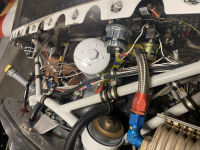
Here is a pic of how I ensured my senders were properly grounded to the firewall side of the ground bus. That is a zip tie holding the connector to the sender body. I have since upgraded to an EI CGR-30P, but this got rid of random fluctuations for me.
 

Attachments

  • tempImageuvVKWr.png
    tempImageuvVKWr.png
    13.4 MB · Views: 58
Last edited:
Here is a pic of how I ensured my senders were properly grounded to the firewall side of the ground bus. That is a zip tie holding the connector to the sender body. I have sense upgraded to an EI CGR-30P, but this got rid of random fluctuations for me.
You're the man!! Thank you!
 
Good morning, Van's Family!

I completed the suggested troubleshooting and still no luck.

  1. Grounded the transducer using the firewall ground bus and the case of the transducer. Same results (~40 psi indication with the engine off).
  2. Unhooked the transducer wire and ran a new wire to the gauge. Same results (~40 psi indication with the engine off)

    I also went through and checked all of the other wiring to the gauge (power/ground). No issues found.

    I am almost certain it is the gauge, but I am having a difficult time finding one. I may make another post asking if anyone has one they could spare.
 
Back
Top