Van's Air Force

The definitive Van's Aircraft support community! Buying, building or flying an RV? Join our exclusive family of mentors and enthusiasts!

GRT Mini-X Heading Anomaly

F18Sailor

Well Known Member
Patron
I'm curious if anyone here has a Mini-X installed next to either a Dynon or Garmin primary EFIS system? My Mini-X heading is often 20°, sometimes 50° off from my Dynon setup; the Dynon setup makes sense (east is actually east, for example), and the winds aloft vector computed by the Dynon setup also makes sense. I have dual ADAHRS for the Dynon, both an SV-ADAHRS-200 and -201. I primarily leave both screens on the 200, at some point I should check the 201 but I suspect its of little consequence here.

1) I performed a magnetometer calibration on my Mini-X back in the spring, this then basically disabled the magnetometer (for some odd reason).
2) GRT were great and RMA'd my magnetometer for a low cost.
3) I reinstalled said magnetometer, and have done several calibrations while following their instructions, at different locations. The latest calibration was completed on a compass rose at a nearby airfield; little change from my local field.

What is odd is the offset; you start calibrating the Mini-X mag while tracking north. Hence, while flying north, both the Dynon and Mini-X are within 1° of each other. During the first hour of flight, at headings other than due north, I've seen up to 50° off on the Mini-X (particularly bad east or west bound). Any thoughts?
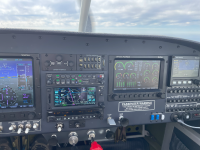
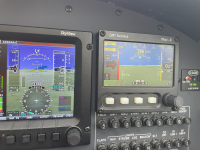
IMG_1807.png

IMG_2963.png
 
Last edited:
Have you noticed a difference when charging or NOT charging your phone or tablet?

On the ground, right after calibrations, with as many things off as possible, are they all pretty much indicating the same headings?
 
Where are your magnetometers?

What are your x, y and z readouts? Does the GRT "know" it has an issue? My plane had a magnetized item near the magnetometer that caused the EFIS to tell me on messages / alerts there was an anomoly. I sent the set menu values in a short video to Jeff and he set me in the right direction.

Degaussed the errant item, fun hunt , re calibrated, has been solid for years and I get very accurate wind display.
 
Have you noticed a difference when charging or NOT charging your phone or tablet?

On the ground, right after calibrations, with as many things off as possible, are they all pretty much indicating the same headings?
Interesting question. On most of my flights, I'm not charging using the port on the right side of the aircraft (https://powerwerx.com/panel-mount-usb-65w-qc40-typec-pd). The one on the left side is commonly plugged into my iPad; that charger is an IFDr/Guardian dual USB-A, FAA approved charger (https://skysupplyusa.com/guardian-d...I_ss_rLKEbd_e9lRkV2sech5LaliqxZfSt1g9AYeqy5M1). Of course, to your point, the internal iPad charging circuitry could be noisy.

I performed calibrations on the ground in my typical flight configuration, i.e NOT with as many things off as possible, rather with the iPad charging, but lights/fuel pump off.

The Dynon ADHARS modules (magnetometers internal) are mounted about 1' behind the baggage compartment bulkhead, suspended from the fuselage top in a cage.

IMG_1872.png

The GRT magnetometer is located further aft, located under the tail fairing in front of the VS spar.

I don't have errant errors from the Mini-X; I would say "all pretty much the same heading" after a ground based calibration is meh; readings are generally within 10°, but 5° would be more acceptable.

I will go ahead and pull some log data/try and grab the x,y,z values. Magnetic items near the magnetometer are worth a check for sure!
 
Two feet of left rudder cable were my degaussing target. Same GRT magnetometer location, under the vert stab fairing!

Does p-static/inflight slipstream induce magnetism?

Shadepole bathroom fan guts and a wood dowel guide, easy access by dropping the cable at the rudder pedal.

Found with a spare aircraft compass and cell phone field app.
 
Intriguing...I do have some old school magnetic compasses floating around...

I have been wondering about static wicks...that topic has been raised on these forums before, and the consensus is "you don't need them, we don't fly fast enough"...well, we fly faster than a 172, Grumman Tiger etc. and those birds have anti-static wicks (along with proper grounding straps between the control surfaces and airframe). I tend to think engineers in that day knew a thing or two...
 
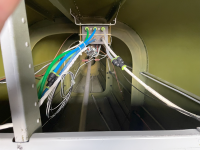
My 2 cents. I see a lot of wires running under and close to the boxes. I see a loop of black and white wires that looks like an electromagnet to me. I’d run all these wires straight sideways to the sides of the fuselage, then forward. Flatten that loop, then twist it a few times.
 
Intriguing...I do have some old school magnetic compasses floating around...

I have been wondering about static wicks...that topic has been raised on these forums before, and the consensus is "you don't need them, we don't fly fast enough"...well, we fly faster than a 172, Grumman Tiger etc. and those birds have anti-static wicks (along with proper grounding straps between the control surfaces and airframe). I tend to think engineers in that day knew a thing or two...
Just guessing, but were these "Cessnas and Grummans" built in the "Loran" days?
Back in the early '90s when I built my first -6, I noticed that many Mooneys had static wicks but some did not. I surmised that the RV was in the same speed range. I was told that every Mooney that left the factory with Loran installed got static wicks. No Loran, no wicks!

I wouldn't think that static wicks would help your magnetometer.
 
Last edited:
My 2 cents. I see a lot of wires running under and close to the boxes. I see a loop of black and white wires that looks like an electromagnet to me. I’d run all these wires straight sideways to the sides of the fuselage, then forward. Flatten that loop, then twist it a few times.
Bob, I concur with your suggestion (not my original installation), however I would expect this to be causing issues with the magnetometers inside the Dynon ADAHRS units (said boxes nearby), and be less of an issue with the GRT Mini-X magnetometer located ~8ft aft of this. Could be wrong-the compass check will be fun!
 
Last edited:
Just guessing, but were these "Cessnas and Grummans" built in the "Loran" days?
Back in the early '90s when I built my first -6, I noticed that many Mooneys had static wicks but some did not. I surmised that the RV was in the same speed range. I was told that every Mooney that left the factory with Loran installed got static wicks. No Loran, no wicks!

I wouldn't think that static wicks would help your magnetometer.
You learn something new everyday! Certainly the Tigers were...the C172SP G1000 still leaves the factory with static wicks. Maybe Cessna aren't worried about the drag and more concerned about maintaining the configuration the original aircraft was certified in? Mooney was pretty obsessive with drag so I'm not surprised they ditched the wicks if they didn't think they were needed.

And yep, I highly doubt static is the cause of my magnetometer errors, but its interesting to figure out why a rudder cable became magnetized in the case of

moosepileit's aircraft.​

.The most likely cause is chafe/rubbing causing tribo-magnetization. If you want to geek out on that phenomenon: https://www.sciencedirect.com/scien...:~:text=1.,magnetized mainly in one direction
 
Update here: my left rudder cable was reading an absolute value > 300 uT on the phybox. This compares with a free-atmosphere value <50 uT. The right rudder cable was reading <60 uT. I de-gaussed the left rudder cable with a soldering gun, and managed to reduce the peak reading to under 100 uT, with most of the cable reading less than 75. I haven't had a chance to test/re-calibrate the magnetometer, but this certainly explains the symptoms, and hopefulyl results in a fix!
 
Back
Top