


Van's Air Force

The definitive Van's Aircraft support community! Buying, building or flying an RV? Join our exclusive family of mentors and enthusiasts!

Go down, speed up, stall out...

Thanks to the guys who have dedicated so much time and energy to this important subject. The amount of misinformation out there regarding how a wing behaves is truly staggering. One of the most highly regarded training voices in the industry is violently opposed to the very idea of teaching energy management at the basic pilot certification levels. I was at Sun & Fun and having a little chat with a representative from one of the AOA system providers. I mentioned that I am all in favor of a technical solution and am looking forward to outfitting my A/C with AOA information. At the same time I indicated that a technological solution alone will always be partial at best. It MUST be accompanied by real training that provides the knowledge and skill set to recognize corner situations and their escape techniques. For example, as Mark mentioned, its often the case that people representing themselves as expert witnesses lack the fundamental knowledge they should have down cold. When I asked this marketing representative his thoughts about the relationship between elevator/stick position and AOA he declared with a self assurance I found stunning "There is NO connection between elevator position and critical AOA". When this level of ignorance is rampant in our ranks we face an uphill battle on several fronts.
 
I think the L/D max tone is a good thing to have that angle of attack in the Dyson or GRT systems won’t give you. Say you have an engine out or loss of power situation. You pitch for best glide. It is amazing how a slight variation in speed will change how far you can go engine out. This could mean making the runway or not. But the L/D max changes depending on the weight. So just using an airspeed won’t be as accurate. And 5 knots off L/D max makes a huge difference in this situation.

Would also be good in a multi engine in those single engine max climb scenarios. Many times you are struggling for 100’/min climb. Being exactly on max lift to drag would be a good help. Wish it would also tell you the exact yaw to bank needed for single engine operations.
 
Long thread about the perils of relying on airspeed and how AoA is superior (yes!)

But not one mention of "stalling stick position."

I don't think I'll ever understand why stalls in GA airplanes have been taught by reference to airspeed, rather than by reference to stick position.

In our simple airplanes, within the normal flight envelope, there's a very direct relationship between AoA and stick position, and a "stalling stick position" corresponding to the critical AoA. Effectively: The stick position is an analog AoA indicator.

It doesn't matter how fast or slow you're going, what your pitch attitude or bank angle is, how heavy you are, how much trim-force there is on the stick, where your c-of-g is, or what your power setting is; If your stick is aft of the stalling position you'll stall, and if it's forward of the stalling position you won't.

If stall training is performed by reference to airspeed, everything gets very complicated when the student asks about why the stall speed changes based on how much fuel you have on board, or why you can coast over the top of a loop at 25 knots without stalling even though the stall speed is 43 knots.

If a pilot is imbued with awareness of the stalling stick position and a spidey-sense tingle when they're approaching it, they'll never have a stall/spin accident.

(the designers of the Ercoupe knew this; they made an un-stallable airplane simply by setting the control stops so that you couldn't move the yoke aft of the stalling stick position)

- mark
I've actually done a few flights to test this out. I was able to prove to myself that my RV-6 would stall at various G-loads from about 1/2 G up to about 3.5 G, at exactly the same stick position. Not the same "pull force" on the stick, but the same stick "position". Various bank angles from zero to about 70 degrees. Don't confuse stick FORCE with stick POSITION. Very repeatable, and enjoyable test flights!

Why not go out and try it for yourself? (Takes me back to my USN F-4 and A-4 days! ..... Oh, yeah, and to my Alon Aircoupe flying, as well!)
 
I've actually done a few flights to test this out. I was able to prove to myself that my RV-6 would stall at various G-loads from about 1/2 G up to about 3.5 G, at exactly the same stick position. Not the same "pull force" on the stick, but the same stick "position". Various bank angles from zero to about 70 degrees. Don't confuse stick FORCE with stick POSITION. Very repeatable, and enjoyable test flights!

Why not go out and try it for yourself? (Takes me back to my USN F-4 and A-4 days! ..... Oh, yeah, and to my Alon Aircoupe flying, as well!)

How did shifts in CG impact the stick position?
 
I'll add my pitch for flying AOA, this is absolutely the "right" way to do it in any airplane. All my time in the T-38A, F-15C, F-15E, F-16C, and F-35, not to mention RV-6, will back up that statement. The Dynon D10 has a great start for AOA aural tones, and Vac's system is a great leap forward for practical use of AOA in RVs. Recommend!
 
I've actually done a few flights to test this out. I was able to prove to myself that my RV-6 would stall at various G-loads from about 1/2 G up to about 3.5 G, at exactly the same stick position. Not the same "pull force" on the stick, but the same stick "position". Various bank angles from zero to about 70 degrees. Don't confuse stick FORCE with stick POSITION. Very repeatable, and enjoyable test flights!

Why not go out and try it for yourself? (Takes me back to my USN F-4 and A-4 days! ..... Oh, yeah, and to my Alon Aircoupe flying, as well!)
I wouldn't know how to fly stick position.

I don't understand how to judge stick position.

Perhaps I am confused but a stick position is now equivalent to critical AOA?

Logically, a simple linear encoder reading the stick's pitch postion could replace any AOA system.

What am I missing here?

Max
 
I wouldn't know how to fly stick position.
I don't understand how to judge stick position.
Perhaps I am confused but a stick position is now equivalent to critical AOA?
Logically, a simple linear encoder reading the stick's pitch postion could replace any AOA system.
What am I missing here?

You're not missing anything: You're completely right, modulo delay/hysteresis.

Perhaps it's more accurate to say that the stick position corresponds to the commanded AoA. It takes the airplane a little while to catch up with what the pilot has asked for (in the order of a second or two, usually)

A simple linear encoder reading the stick's pitch position would be an accurate and reliable way of producing a "commanded AoA" display.

(most of us already have linear encoders reading the stick's pitch position, built in to our autopilot servos. Maybe that's a worthwhile feature request for the EFIS vendors!)

- mark
 
Perhaps it's more accurate to say that the stick position corresponds to the commanded AoA. It takes the airplane a little while to catch up with what the pilot has asked for (in the order of a second or two, usually)
That might make it an excellent warning device... If there's a delay between input and response, that gives time to alert before the bad stuff(tm) happens.
 
If it's all about stick position why not just set the elevator stops so you can't stall? Maybe a small linear actuator for a stop. Off for acro flying and on when your in the pattern.
 
You're not missing anything: You're completely right, modulo delay/hysteresis.

Perhaps it's more accurate to say that the stick position corresponds to the commanded AoA. It takes the airplane a little while to catch up with what the pilot has asked for (in the order of a second or two, usually)

A simple linear encoder reading the stick's pitch position would be an accurate and reliable way of producing a "commanded AoA" display.

(most of us already have linear encoders reading the stick's pitch position, built in to our autopilot servos. Maybe that's a worthwhile feature request for the EFIS vendors!)

- mark
If we're that easy we would have abandoned other ways of measuring AOA long ago.
 
If we're that easy we would have abandoned other ways of measuring AOA long ago.
There is allot more to this than is being promoted here. People way smarter than me will have to chime in to explain it but you are exactly right. It is not that simple or NASA, the military, Space X, the airlines and many other manufacturers would be using this method.
 
If it's all about stick position why not just set the elevator stops so you can't stall? Maybe a small linear actuator for a stop. Off for acro flying and on when your in the pattern.
A couple of my remote control planes have this. It limits aileron and elevator travel so no matter what I enter in the remote control, the surfaces can only deflect so far. I turn it on and off with a switch. Helps a lot when I'm teaching someone new. Maybe that's next once AOA becomes the norm and we're looking for the next way to stop people from crashing. It's called SAFE https://www.spektrumrc.com/spm-bs-safe.html


FLIGHT ENVELOPE PROTECTION​

This is the most significant benefit SAFE technology delivers. SAFE uses attitude awareness to create an electronic flight envelope for a model that prevents extreme or unusual attitudes. For example, SAFE technology in a typical trainer aircraft creates a beginner flight envelope, preventing extreme bank and pitch angles with assists with takeoffs and landings. All SAFE-equipped models will roll, pitch, or yaw as fast or as slow as designed but remain within the limits of the flight envelope, or mode, selected.
 
A couple of my remote control planes have this. It limits aileron and elevator travel so no matter what I enter in the remote control, the surfaces can only deflect so far. I turn it on and off with a switch. Helps a lot when I'm teaching someone new. Maybe that's next once AOA becomes the norm and we're looking for the next way to stop people from crashing. It's called SAFE https://www.spektrumrc.com/spm-bs-safe.html


FLIGHT ENVELOPE PROTECTION​

This is the most significant benefit SAFE technology delivers. SAFE uses attitude awareness to create an electronic flight envelope for a model that prevents extreme or unusual attitudes. For example, SAFE technology in a typical trainer aircraft creates a beginner flight envelope, preventing extreme bank and pitch angles with assists with takeoffs and landings. All SAFE-equipped models will roll, pitch, or yaw as fast or as slow as designed but remain within the limits of the flight envelope, or mode, selected.

Ultimately this the way to go but I think you need a fly by wire system.
I know the F22 has a complicated set of flight rules so the aircraft stays in the envelope.
It must take a lot engineering and flight testing to get there.
 
Ultimately Auto GCAS is the ticket. FAA team working on the project is at OSH.


Meantime, aural alpha and solid energy maneuverability skills is the next best thing without automatic flight controls. Part of that skill set is “elbow memory” and managing the flight path of the airplane.

Fly safe,

Vac
 
There is allot more to this than is being promoted here. People way smarter than me will have to chime in to explain it but you are exactly right. It is not that simple or NASA, the military, Space X, the airlines and many other manufacturers would be using this method.

The necessary qualifier I inserted on my first post on the subject: "In our simple airplanes, within the normal flight envelope, ..."

In our simple airplanes, within the normal flight envelope, there really isn't a lot more to this than is being promoted here.

- mark
 
Hi all, do the development team have any approx idea when we maybe able to purchase or assemble the latest version of this great piece of development work?
Thanks
Robbie
 
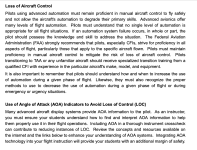
I'm doing the FIRC again (2 years passed already again??? :mad: ) to renew my CFI certificates and look what came up tonight, very appropriate.
 

Attachments

  • Screenshot 2024-07-22 at 7.32.38 PM.png
    Screenshot 2024-07-22 at 7.32.38 PM.png
    358.5 KB · Views: 78
That's exactly 100% what they did on the Ercoupe. "The unstallable airplane."

- mark
Yup. Full stall landings no longer possible, but at those speeds, and with that gear, no biggie. And it’s not like most of us in stallable airplanes always do full stall landings anyway. 🤣

See also Langewiesche’s “Stick and Rudder” and the story about the guy who attached a little chain to his stick so that it couldn’t be pulled back too far.
 
Anyone attend the talk ? How was it. Anything new on hardware etc?

Max
Someone from the PPC was recording it, so may be available somewhere eventually. Vac had a sample of the gen2v4 hardware on hand and mentioned plans to someday produce and sell it (in addition to making the designs available) but updated software is not yet ready for it.
 
Someone from the PPC was recording it, so may be available somewhere eventually. Vac had a sample of the gen2v4 hardware on hand and mentioned plans to someday produce and sell it (in addition to making the designs available) but updated software is not yet ready for it.
Thanks
Max
 
Back
Top
