Van's Air Force

The definitive Van's Aircraft support community! Buying, building or flying an RV? Join our exclusive family of mentors and enthusiasts!

Go down, speed up, stall out...

Vac

Well Known Member
Ambassador

Got alpha?

The video is an example of what intuitively appears to be a benign condition: the airplane is speeding up, and the flight path is below the horizon—how could I run out of lift with that much energy? Turns out, it’s easy…all I have to do is exceed the wing’s ability to generate lift.

I can’t say this any better than Vince “Duck” Wawrzynski so I won't try: “Years of training to speed approximations for wing efficiency have created a culture that is inherently susceptible to dangerous flight excursions.” Loss of control is an equal opportunity killer, and we’ve lost too many good pilots in the last eight decades for what remains the leading cause of GA/EAB fatalities. Most of those mishaps occur during day, VMC, light wind conditions.

The two fundamental skills required to fly an airplane are controlling lift and energy, but we can’t see lift looking out the window or at a set of conventional instruments, and the cockpit lacks an energy state gauge. Angle of attack is the “how hard the wing is working” and “power required” parameter. AOA and speed are joined at the hip, so it’s not a debate about which one is better, it’s a matter of providing accurate, timely, ergonomic, directive information directly to the pilot that makes flying easier and safer.

Come and learn more about AOA and energy maneuverability at Oshkosh this year. On Wednesday afternoon, beginning at 1300, the EAA is conducting an afternoon dedicated to AOA academics, discussion and simulator sessions. We are also conducting forums at the National Association of Flight Instructors tent on Monday morning, and in Forum 1 Monday afternoon. And on Friday morning, we’ll dive into the physics and engineering implementation behind accurate pressure-derived AOA theory at the Homebuilder’s Hangar.

Fly safe,

Vac and the FlyONSPEED/TLAR team

FlyONSPEED.org is an all-volunteer, non-profit, open-source organization dedicated to reducing loss of control mishap risk for our EAB and VAF community. Our objective is to lead from the front by demonstrating what is in the art of the doable.
 
Last edited:
AOA is a wonderful tool to have in your belt, this is good stuff.
 
I have had an AOA indicator in my RV since first flight almost 20 years ago. I refer to all the time especially in the pattern to land.
 
In addition to Vac, there are a lot of aviation “heavy hitters” showing up to promote AoA flying on Wednesday afternoon at the PPC - smack in the middle of the Airventure week! EAA, NAFI, the FAA…..everyone is getting behind the effort to spread the word that flying by AoA is safer and more efficient. AoA flying isn’t new - what’s new is the fact that AoA indicators are now available and easy to use in most GA cockpits - and Experimental aviation is leading the way!

Got an EFIS? You’ve got AoA! Come learn how to use it….
 
Vac gave a great demonstration at our Pensacola, FL EAA chapter last year. As Paul said if you have an EFIS you have AOA capability. If you're at OSH make one of the presentations a must.
 
How do I get a gen2 for Garmin if I don't want to build one? I can manage the software side.
 
Last edited:
Chuck Yeager..

Kate, that's a stupid instrument. If you don't know what your angle of attack is, you shouldn't be fly'n.

Yup - good ‘Ol Chuck - know lots of guys that flew with him, and never heard anything bad about his stick skills!

However, every pilot who thinks that they are as good as he was on the controls need to understand that statistically, half of us are below average…..and AoA might just give you the edge you’re looking for when the chips are down!
 
OnSpeed AOA is the best hands down. Sadly due to health reasons I've been self grounding and haven't enjoyed it as much, but that ends soon !
 
I wonder if Bill Anders would still be around if he had used an AOA while practicing his flight demonstration talents?


Even astronauts can get behind their aircraft.

Be Safe Out There,
Larosta
If I recall he tried a Split-S at too low an altitude. Under those circumstances, how would having an angle of attack indicator have made any difference?

Everyone wants to promote safe flying, but does anyone have a real-world flying experience where having an angle of attack instrument actually saved their lives? I can't recall ever having come across one.

I think what Chuck Yeager is saying is if you are at the extreme edge of "the envelope" you'll know it long before this instrument does you any good.
 
I think what Chuck Yeager is saying is if you are at the extreme edge of "the envelope" you'll know it long before this instrument does you any good.
The idea is that by using the sight and sound of the AOA, you don't have to get to that extreme edge of the envelope since you know where that edge is at any flight angle and speed.
 
I believe the concept is that flying by speed doesn't provide as much insight into effectiveness of your lift at any particular time as AOA. It's widely accepted that people have unknowingly gotten too slow and stalled even when IAS may seem acceptable. AOA provides additional knowledge on how the lift/wing is working. Become accustomed to flying by AOA and your flying with more knowledge. Why wouldn't you want that? Although not perfect, Nexrad provides more info than a stormscope - many find the extra knowledge invaluable.

It's not a black and white issue. Use all the knowledge you can to lower your risk. I certainly have AOA on my -10 and would like onspeed when it's avail for Garmin and I don't have to build the hardware.
 
If I recall he tried a Split-S at too low an altitude. Under those circumstances, how would having an angle of attack indicator have made any difference?

Everyone wants to promote safe flying, but does anyone have a real-world flying experience where having an angle of attack instrument actually saved their lives? I can't recall ever having come across one.

I think what Chuck Yeager is saying is if you are at the extreme edge of "the envelope" you'll know it long before this instrument does you any good.
Look, I’’m not going to speculate on a recent accident for which an investigation has just been started, so let’s not go there.

You won’t find many accident reports for folks that had AoA keep them out of the aerodynamic weeds because, well - they didn’t fall over the edge and crash - hence, no investigation! But ask Jerry VanGrunsven about his base-to-final turn around an eagle’s nest that distracted him - he’ll flat out tell you that his AoA saved his bacon. I’ll tell you that I have been alerted by the AoA when I was distracted by mounting problems with the airplane and got a little too tight trying to make the runway. If you fly long enough, and are willing to publicly admit that you’re susceptible to making mistakes, you’ll have stories as well. Sit around the campfire with experienced pilots and you’ll find many similar tales - it happens.

Best thing you can do if you’re a skeptic and find yourself in Oshkosh on Wedensday afternoon durign the show is hike on up to the PPC (its at the HQ museum building - a good excuse to visit the museum while you’re there, and its air conditioned!) and sit in on some sessions to learn about it. More and more, flying by AoA is being accepted by experienced aviators and the instructor community. Flying by AoA is not new - but the ubiquitous availability of AoA indicators is. Use every tool in your box, and you stand a good chance of flying until you can’t pass the medical.

What Chuck failed to acknowledge was that not all pilots were as gifted as he was. Well, actually, saying things the way he did was his way of saying “well if you were as good as me, you’d be able to …..”

Admitting that we don’t know it all and can make mistakes is the first step to learning!
 
I love flying with the OnSpeed system because it gives both visual and auditory cues.

Maybe the OnSpeed engineering team with give us an update soon on the next generation of hardware.

The Onspeed box I fly is wonderful.

Unfortunately, they stopped making a key chip during the pandemic.

It would nice to see others add OnSpeed to their plane.
 
I would have bought one a long time ago if there was a pre-made option. I just cant make sense of what I need to buy, and then what I need to do with the parts that I buy
Most of us in the group have helped others build their units, just have to ask, however until the newer version comes out though nobody can build new ones. That's why my unit has been in the last 4 planes I've owned, I just remove it and reinstall it with a new AOA pitot tube in my next plane.
 
Last edited:
Count me in for the upcoming version.

If you fly long enough, and are willing to publicly admit that you’re susceptible to making mistakes, you’ll have stories as well.

Some years ago I took off in a strange airplane without removing the pitot cover (yeah, dumb). Realized it had an AOA system, so I did a stall to see how it worked, then went about my business. Later, back at the airport, the approach and landing was entirely comfortable.
 
I don’t know how the various systems out there work but after center punching a large grasshopper with the pitot probe AOA was also lost. I think most of the EFIS synthetic AOA displays require the pitot tube. This is not ideal and I would prefer a stand alone system. GPS is the best backup plus a feel for normal approach and landing attitude If you have a synthetic or derived AOA system. If you have a standalone like my RV6 had your golden.
 
I don’t know how the various systems out there work but after center punching a large grasshopper with the pitot probe AOA was also lost. I think most of the EFIS synthetic AOA displays require the pitot tube. This is not ideal and I would prefer a stand alone system. GPS is the best backup plus a feel for normal approach and landing attitude If you have a synthetic or derived AOA system. If you have a standalone like my RV6 had your golden.
The easy solution if this worries you is to use two pitot tubes - one for ASI, one for AoA. It would take some very bad luck to plug them both at the same time. But I can list numerous available AoA systems that don’t use the same pitot tube or AoA source as the ASI … and you can always use the pop rivet AoA port on the leading edge if you are on a real budget. So yes - just like our single engine, single prop, single throttle cable, most folks are flying around with a zero-fault-tolerant AoA system.

It is important to realize than NONE of the AoA proponents are saying that pilots don’t need to learn how to fly, how to fly by feel, or how to fly without an AoA system. What we’re saying is that having an AoA system (especially one with audio) gives you more margin, especially when you are distracted by other things. While we’d like to think that every pilot has perfect aircraft feel and will recognize when they are getting close to the edge, over a century of fixed-wing powered flight tells us that just isn’t true. You know what they say about doing the same thing the same way over and over again and expecting different results….so let’s look for something new!

Paul
 
IMG_3361.jpg
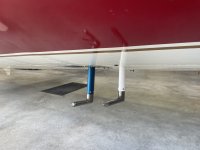
There is still a possibility that two suicidal bugs in route formation could take 'em both out...

Aerodynamics (thus AOA performance) occur when the tubes are in the same flow field :). There is an art to sensor placement when the objective is accurate performance and good transient response. I had to fly a vibration test last week with the system disconnected. As a proud tone cripple (hate to fly without it) it was horrific to actually have to look at the airspeed indicator...survived. Barely.
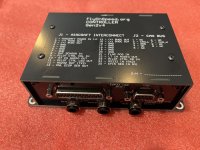
We have a brand new hardware design ready to go. Unfortunately, the CPU in our previous hardware succumbed to COVID. The new hardware is based on an ESP32 engine using RTOS (real-time operating system). The bad news is we have to re-write software to accommodate the new configuration. Lenny designed a clever manifold that replaces all of the previous brass plumbing. Performance should improve slightly with the increase in compute and RTOS, but we won't know until we test it. And we won't run out of suitable grounds.

IMG_0869.JPG

Terry and I had the pleasure of presenting the project at the 53d European Society of Experimental Test Pilots Symposium last week where we managed to punch above our weight class and were awarded best paper out of 22 projects presented. We preceded "F-35 - Ultra Beast Mode" on the schedule by displaying the mighty RV-4 in full "Ultra Tone Mode":


I just re-cut this video and added a full energy display for some academic work to support Oshkosh, so you can see airspeed and g during maneuvering at a (relatively) constant on speed condition. Pretty caveman simple, you takeoff on speed, you approach on speed and you (mostly) "max perform" maneuver on speed. The Royal Navy hit it out of the park when they developed an aural AOA cue back in the Stone Age.

Fly safe,

Vac
 
Last edited:
“…As a proud tone cripple (hate to fly without it) it was horrific to actually have to look at the airspeed indicator...survived...”

I know this was TIC but it does illustrate a potential problem. You really shouldn’t put all your eggs in one basket; stick and rudder skills are perishable and if you start relying on just one instrument, you will undoubtably affect those skills when the instrument is not available.

This happens at all levels. I remember a flight where the audio for the radar altimeter was disabled due to an inflight maintenance problem. This disabled the 50, 40, 30… countdown. Let’s just say that the landing was…firm. Point is, hearing the countdown over and over and trusting it caused a loss of SA during landing when it was not available.

Fly safe!
 
I realize I'm not as experienced as many on this forum. But angle of attack is not necessarily joined at the hip with air speed. As we learned in our basic pilot training, you can stall a plane at any attitude and any airspeed. Zero airspeed does not mean your past the angle of attack or stalled. I look at an AOA indicator as similar to a slip/skid indicator. I can fly without either but it sure helps to have them.

Do you need a AOA? No. But you might want one for several reasons…
Critical angle of attack can come on a whole lot faster a more unexpected than a slip or skid.
Center of gravity can significantly change how you perceive when angle of attack will be exceeded. Load a plane down and watch a pilot with hundreds of hours in that exact aircraft stall it on landing.
When most pilots see the ground coming up fast, they instinctively pull. That might be the exact wrong thing to do. AOA indicator would let you know.
 
Great discussion, as always :)

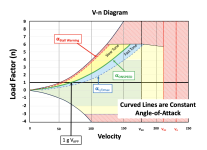
Bob and Mike bring up some great points. In the flight envelope, we can fly any angle of attack at any airspeed and any attitude. If you superimpose AOA on the envelope, it looks like this:

Screenshot 2024-07-07 at 11.03.38 AM.png
The AOA on the envelope we are all familiar with is critical AOA, which is the "aerodynamic limit" on the left side. Any AOA we plot on a V-n diagram is going to be curved, whereas n (g-load) and airspeed are straight lines. Notice that at 1 g, an on speed condition is Vapp. But we can be on speed at any airspeed and any attitude:


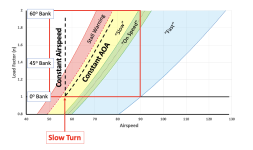
If you look between 1 and 2 g's in the area around Vapp/on speed, you'll see that the entire traffic pattern can be expressed as an angle of attack. If we blow up just that portion of the diagram it looks like this:

Screenshot 2024-07-07 at 11.06.21 AM.png
Here you can see that if you are little slow turning base to final and insist on holding airspeed, the airplane rapidly hits the aerodynamic limit. And Mike's observation about properly coordinating the turn is spot on. It's amazing how fast things can go from "normal" to "not normal" when you approach the limit:


Astute observers will notice I over-g the flaps slightly during recovery. No excuse.

What's cool about alpha, is that it's a great "curved math in public" cue. I'm not smart enough to adjust my indicated stall speed by the square root of my g load realtime (I can barely do that with a calculator at 1 g and zero knots), but I can watch an indexer or listen to a tone and push or pull the stick. AOA doesn't relieve me of responsibility for managing my flight path or coordinating flight controls.

Fly safe,

Vac
 
Last edited:
View attachment 66087
There is still a possibility that two suicidal bugs in route formation could take 'em both out...

Aerodynamics (thus AOA performance) occur when the tubes are in the same flow field :). There is an art to sensor placement when the objective is accurate performance and good transient response. I had to fly a vibration test last week with the system disconnected. As a proud tone cripple (hate to fly without it) it was horrific to actually have to look at the airspeed indicator...survived. Barely.
We have a brand new hardware design ready to go. Unfortunately, the CPU in our previous hardware succumbed to COVID. The new hardware is based on an ESP32 engine using RTOS (real-time operating system). The bad news is we have to re-write software to accommodate the new configuration. Lenny designed a clever manifold that replaces all of the previous brass plumbing. Performance should improve slightly with the increase in compute and RTOS, but we won't know until we test it. And we won't run out of suitable grounds.

View attachment 66088

Terry and I had the pleasure of presenting the project at the 53d European Society of Experimental Test Pilots Symposium last week where we managed to punch above our weight class and were awarded best paper out of 22 projects presented. We preceded "F-35 - Ultra Beast Mode" on the schedule by displaying the mighty RV-4 in full "Ultra Tone Mode":


I just re-cut this video and added a full energy display for some academic work to support Oshkosh, so you can see airspeed and g during maneuvering at a (relatively) constant on speed condition. Pretty caveman simple, you takeoff on speed, you approach on speed and you (mostly) "max perform" maneuver on speed. The Royal Navy hit it out of the park when they developed an aural AOA cue back in the Stone Age.

Fly safe,

Vac
How does a system like this compare to a GRT avionics or Garmin AOA system with appropriate probes? I'm not necessarily trying to ask if one is better then the other but rather does Onspeed offer better accuracy ? or more information ?
 
How does a system like this compare to a GRT avionics or Garmin AOA system with appropriate probes? I'm not necessarily trying to ask if one is better then the other but rather does Onspeed offer better accuracy ? or more information ?
OnSpeed offers both, better accuracy and also more information. For example OnSpeed gives you yaw info via your headphones. Just like you "step on the ball" to correct an out of trim condition you see in the panel slip/skid indicator, OnSpeed will give your AOA tones in stereo and will get louder in the ear you must "step on".
 
Calibration system is genius.
You get a graph to show how good the data is.

You can have as many flaps positions as you need.
Some systems don't even take flap position as an input

Vac has 100s if not a 1000 of hours verifying the system's performance.
We have know idea how much flight testing when into other systems.
This one is very well documented.
He is testing aerobatic maneuvers too. Onspeed works here too.

Btw, I was watching Scott on Flywire ( YouTube).
He was saying he loved flying military AOA.
He did not think current pressure based AOAs are not very good.
Well Onspeed has the flight test data.
 
How does a system like this compare to a GRT avionics or Garmin AOA system with appropriate probes? I'm not necessarily trying to ask if one is better then the other but rather does Onspeed offer better accuracy ? or more information ?
I'm not familiar with the design specifications for GRT or Garmin AOA systems or flight test results of those systems.

We designed the ONSPEED system to a set of performance specifications that include an accuracy of 1/2 degree or less across the speed band of the airplane (Vmax to Vmin) at 2 G's or less and 1 degree or less up to 6 G's at a g-onset rate of 2 g's per second. Performance during maneuvering is called "transient response," and we did our best to maximize performance during both normal flight, turbulent conditions and aggressive maneuvering encountered during aerobatics (or dog fighting). Calibration is automatic and repeatable, and will result in the same indications for the same condition in different airplanes. The heart of the system is the tone that provides progressive feedback from L/Dmax through stall. The tone is optimized to allow head's up maneuvering and if you have a stereo intercom, it moves left and right in the sound field with the slip/skid ball to provide yaw feedback. Additionally, we offer a visual display with multiple pages. The primary page is called the "energy display" and includes a military AOA indexer with trend information and integrated fractional lift display, IAS, G, flap position and a slip skid ball; the second page is just the AOA/fractional lift display; the third page is a deceleration display with integrated IVVI (this is used to help with calibration and for flight test purposes); the forth page is a historic G display (this is used for flight test purposes, e.g., wind-up turn) and the fifth page is an attitude display. The system has a secondary function as a data recorder and records data at 50Hz. It integrates EFIS data and all data is accessible via wifi post-flight. On our instrumented test airplanes, it also integrates wireless air data boom and GNSS/INS data. Data is in a .csv format and can be analyzed in Excel or MATLAB. In addition to AOA and data, the system also provides overload warning for symmetric and asymmetric maneuvering. We also provide high speed warning. The system is designed to let you hear each edge of the flight envelope. You interface with the system using a smart phone to calibrate, change settings or manage data. Daily operations are just a matter of adjusting the volume control :cool:

Pressure based angle of attack is an inherently noisy signal and requires some creative filtering, digital to analog conversion and pilot selectable settings to provide a responsive, but flyable cue. High speed processors and accurate pressure sensors with less than 1% error are required to pull that off. It's impossible to fly a specific angle with precision, so all military systems and ours use a band for the onspeed cue. In our case, about +1 or -1 degree, with results in an airspeed band of +/-2 kts at one g (in other words, an ONSPEED condition is small 4-5 knot speed band).

One of the pressures we use to compute coefficient of pressure is dynamic pressure, so any parameter that is dependent on dynamic pressure can be measured with the system. The system provides key AOA performance parameters including L/Dmax, on speed and stall warning. Additional parameters expressed in fractional lift include maneuvering speed and Carson's speed. The concept is explained in this article:

https://www.flyingmag.com/voices-of-flying/ultimate-issue-aoa-gets-revisited-again/

The system is sufficiently accurate and reliable that I'm able to fly without an airspeed reference for test and demonstration purposes in any Day/VFR conditions.

Arguably, the most important function of the system is stall warning. These are two maximum beta (sideslip) tests. High side slip angles place significant demand on a pressure based AOA system using conventional probes. The second test is an interesting oscillatory condition that produces a series of repeatable stall conditions at 2 1/2 second intervals. The key takeaway is that stall is detected prior to a loss of stability:


Sounds complicated, but it's caveman simple to use: turn up the volume and go. You takeoff on speed, you (mostly) max perform maneuver on speed and you approach on speed.

Fly safe,

Vac
 
Last edited:
Curious if there are any plans to simplify the boards to use one MCU instead of two. I think just an ESP32 would be more than adequate to perform all the functions necessary.
 
Curious if there are any plans to simplify the boards to use one MCU instead of two. I think just an ESP32 would be more than adequate to perform all the functions necessary.
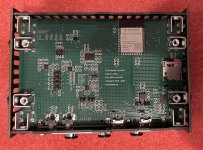
Bob, you're spot on. Here's the new (upper) board:

V4 Box 3.jpeg

One of the challenges is going to be generating the tone. The "musicality" (if that's a word) is important. We spent a lot of time working on that with our current system. Some of the time, the tone is pleasant (on speed or fast), and it's omni present below L/Dmax, so we'll need to make sure it's right with this configuration. On the upside, the new engine runs RTOS.

Cheers,

Vac
 
Last edited:
Bob, you're spot on. Here's the new (upper) board:

View attachment 66293

One of the challenges is going to be generating the tone. The "musicality" (if that's a word) is important. We spent a lot of time working on that with our current system. Some of the time, the tone is pleasant (on speed or fast), and it's omni present below L/Dmax, so we'll need to make sure it's right with this configuration. On the upside, the new engine runs RTOS.

Cheers,

Vac
Plus lots of surface mount resistors and capacitors so no need to install the old style ones manually.
 
Bob, you're spot on. Here's the new (upper) board:

View attachment 66293

One of the challenges is going to be generating the tone. The "musicality" (if that's a word) is important. We spent a lot of time working on that with our current system. Some of the time, the tone is pleasant (on speed or fast), and it's omni present below L/Dmax, so we'll need to make sure it's right with this configuration. On the upside, the new engine runs RTOS.

Cheers,

Vac
Awesome! Nice work!

Assuming you're using Kicad. When do you anticipate making the new board and schematic files available?

I've used a DFRobotDFPlayerMini with an ESP32 for playing sounds:
Could store the tones as individual mp3 files which "beep" at different rates and play them repeatedly.
 
I was educated on AOA by Jerry VanGrunsven and have used it for about 20 years now.
It is not only safer but makes my landings far more consistent.
I put the AFS system in my RV 9A and flew it for 900 hrs, about half of it X-C.
I now have it in my 10 and use it as primary for my approaches.
In varying conditions I have noticed that airspeed can vary by 7 Kts for the same AOA.
Using it allows me to use a slower approach speed and consistent flair.
Jim Frisbie
 
So to install the onspeed syatem in my rv6 is it just as simple as buying the components and assembling then adding a new pitot aoa probe and done ?
 
Hopefully a new pilot is not required. I wouldn't install a second pitot (if that's what you meant). Hoping it will work with an existing Garmin pitot as I "think" it uses the same data.

I believe the image in this thread with the two pitots was for testing AOA against regular stall warnings etc. "believe" is key word.
 
Bob, you're spot on. Here's the new (upper) board:

View attachment 66293

One of the challenges is going to be generating the tone. The "musicality" (if that's a word) is important. We spent a lot of time working on that with our current system. Some of the time, the tone is pleasant (on speed or fast), and it's omni present below L/Dmax, so we'll need to make sure it's right with this configuration. On the upside, the new engine runs RTOS.

Cheers,

Vac
Looks like you need an enclosure designed for that PCB... ;)
 
Vac has gone into plenty of detail so I‘ll try not to repeat too much of what’s already been said. I‘ve been flying with a FlyONSPEED container installed in my plane for about 3 years now. It’s fantastic for providing an auditory cue for what to do with my hands based on what I need the airplane to do. In aerobatics, pull to the On Speed tone. Mess up your entry speed but need to keep the nose tracking? Unload to the On Speed tone. In the final turn? Same thing. Need to bleed excess energy or pull out of a dive? Pull to the edge of stall tone or within 1g of your airframe limit, whichever occurs first. Need to clear a mountain? Hold On Speed. Need to know what Vy is at any altitude and weight? Pull to the L/Dmax tone.

In the past we made some WAGs for how to adjust IAS for PA, weight, CG, bank angle, etc. Flying an alpha allows us to achieve those parameters without any questionable pilot math. Perhaps more importantly, it does so without requiring us to look inside, making that cross check even easier, particularly when you’re maneuvering in relation to another airplane.
 
Last edited:
I had some hood time with my instructor today.
I am working on instrument rating.

We have chosen 90 knots for as good training speed for IFR.
That's right at the start of slow tone.
It nice monitor my Onspeed AOA as proxy for airspeed.

I am paying a lot more attention in my scan visually to attitude , heading and altitude. The tone pulls my attention back to airspeed as needed.

Example:
My instructor says lets climb from 6000 ft to 7000 ft.
I pull back on stick and start to climb. If don't add sufficient power the tone shift will let me know I getting slow far faster than my scan. I add power tone goes back to the AOA I need to climb. I then glance at the EFIS tape visually to check my airspeed is back to normal 90 knots.
I am actually using my hearing help me fly IFR.
 
I had some hood time with my instructor today.
I am working on instrument rating.

We have chosen 90 knots for as good training speed for IFR.
That's right at the start of slow tone.
It nice monitor my Onspeed AOA as proxy for airspeed.

I am paying a lot more attention in my scan visually to attitude , heading and altitude. The tone pulls my attention back to airspeed as needed.

Example:
My instructor says lets climb from 6000 ft to 7000 ft.
I pull back on stick and start to climb. If don't add sufficient power the tone shift will let me know I getting slow far faster than my scan. I add power tone goes back to the AOA I need to climb. I then glance at the EFIS tape visually to check my airspeed is back to normal 90 knots.
I am actually using my hearing help me fly IFR.
While that is all fine, what happens when the tones are NOT there? It is a rhetorical question, no need to answer. You do need to think about it, though, as your instrument rating gives you the ability to fly IMC in many different aircraft. Statistically speaking, a majority of those will NOT have the tones you have become accustomed to.
 
So to install the onspeed syatem in my rv6 is it just as simple as buying the components and assembling then adding a new pitot aoa probe and done ?
YES. The problem is that you can't buy the parts until the new version comes out because in a previous comment Vac explains what happened to one of the current parts.
 
I had some hood time with my instructor today.
I am working on instrument rating.

We have chosen 90 knots for as good training speed for IFR.
That's right at the start of slow tone.
It nice monitor my Onspeed AOA as proxy for airspeed.

I am paying a lot more attention in my scan visually to attitude , heading and altitude. The tone pulls my attention back to airspeed as needed.

Example:
My instructor says lets climb from 6000 ft to 7000 ft.
I pull back on stick and start to climb. If don't add sufficient power the tone shift will let me know I getting slow far faster than my scan. I add power tone goes back to the AOA I need to climb. I then glance at the EFIS tape visually to check my airspeed is back to normal 90 knots.
I am actually using my hearing help me fly IFR.
I agree with Bob. Learn the correct way to scan all instruments during instrument training. You might say "all I need is AOA" and I'd agree in VFR flight but now you're putting all eggs in one basket when you go into IMC.
 
I agree with Bob. Learn the correct way to scan all instruments during instrument training. You might say "all I need is AOA" and I'd agree in VFR flight but now you're putting all eggs in one basket when you go into IMC.
I will also tell you that you WILL become accustomed to tones like that, or the 50, 40, 30 aural count downs. It doesn’t matter how “good” you think you are, it will happen. When it does, beware; the outcome will be, shall we say, less then optimal…
 
Long thread about the perils of relying on airspeed and how AoA is superior (yes!)

But not one mention of "stalling stick position."

I don't think I'll ever understand why stalls in GA airplanes have been taught by reference to airspeed, rather than by reference to stick position.

In our simple airplanes, within the normal flight envelope, there's a very direct relationship between AoA and stick position, and a "stalling stick position" corresponding to the critical AoA. Effectively: The stick position is an analog AoA indicator.

It doesn't matter how fast or slow you're going, what your pitch attitude or bank angle is, how heavy you are, how much trim-force there is on the stick, where your c-of-g is, or what your power setting is; If your stick is aft of the stalling position you'll stall, and if it's forward of the stalling position you won't.

If stall training is performed by reference to airspeed, everything gets very complicated when the student asks about why the stall speed changes based on how much fuel you have on board, or why you can coast over the top of a loop at 25 knots without stalling even though the stall speed is 43 knots.

If a pilot is imbued with awareness of the stalling stick position and a spidey-sense tingle when they're approaching it, they'll never have a stall/spin accident.

(the designers of the Ercoupe knew this; they made an un-stallable airplane simply by setting the control stops so that you couldn't move the yoke aft of the stalling stick position)

- mark
 
Elbow memory is important, and Mark is spot on :)


And I'm also in violent agreement with Bob--"manual reversion" is always a possibility; so we need to be ready for it. As a confirmed "tone cripple," I have to be able to fly without it. And the simple fact is most airplanes don't have any AOA system. His example of the altitude count down in heavies is a brilliant example--if I become dependent on feedback from the radar altimeter to adjust the pitch for landing, I'm asking for a hard landing (or worse) the day it doesn't work.

And truth in advertising, as clever a "head's up" solution an AOA tone is, when we become task saturated, off-loading hearing is one of the first steps as we channelize attention. How many folks have landed with the gear horn blaring? But, short of automatic flight controls, the combination of tone and visual warning is still the best we can do, until we add a dog to the cockpit that knows when to bite the pilot.

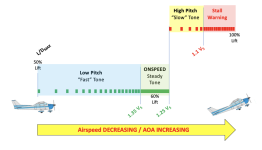
Some ergonomic thought has been applied to the tone pattern to help mitigate (but not eliminate) the possibility of "tune out." This diagram shows the basic pattern:

Screenshot 2024-07-11 at 12.43.49 PM.png
The first principle is that the tone provides progressive cues throughout the lower 1/3 of the "speed band" of the airplane, it's not a single warning parameter. The second principle is that there is a binary "good/bad" frequency and a perceived and actual volume increase as AOA increases. And, as a last ditch, pulse rate gets really annoying and loud when you get to FAR 23 stall warning.

We do know two things, transient response is sufficient that the pilot isn't able to "beat" the system with a high gain control input--there will be progressive stall warning before the airplane stalls. That is demonstrated in the video in Post 33 and in the video below of a high G accelerated stall. Whether or not that warning is perceived is another matter. We also know that the basic pattern proved itself in what is arguably one of the more demanding aviation scenarios: air combat. I only point this out because I've heard some folks argue that AOA isn't sufficiently accurate or is too noisy to be useful in demanding conditions. I'll leave it to my Navy and Marine brothers and sisters to vouch for for the fact that landing on a boat isn't exactly a non-demanding environment either. "Meatball, line-up, alpha" translates directly to "power for glide path, roll for ground track and pitch for AOA--" a nice succinct way to think about consistently landing an airplane where you want to, on parameters when the runway isn't moving away from you and pitching up and down at the same time :cool:


Fly safe,

Vac
 
I have the onspeed AoA device installed in my RV-8...but due to Lycoming backlog I have yet to fly it. However, I knew for certain that my -8 would have an AoA system of some flavor. As it works out the onspeed device is the best fit for me.

In Navy fighters and we absolutely used AoA, specifically for a 1-circle, lift limit dogfight and more well know landing on the aircraft carrier. The nice thing about AoA for fighters is that your gross weight (fuel and ordnance) can vary greatly from the beginning to the end of your sortie. Nearly 50% of the aircrafts weight can be burned or expended, but regardless of weight, AoA is always accurate.

I was originally skeptical that AoA was not needed in light civil GA plane, mainly because your gross weight should only change at max a few hundred pounds. Essentially, your reference airspeed 'should' be the same each day.

Where I think the AoA systems stand out is in the impossible turn, loss of power scenario immediately after takeoff. I am a flight Instructor in the USAF reserves for a Pilatus PC-12, which has AoA. While I am not giving advice or recommending the impossible turn, we in the PC-12 have a vetted procedure for executing the 'impossible turn.' Step 1: of our Critical Action Procedure is "AoA Centered." We set flaps to their first notch (15*), roll into a 45* AOB turn and fly on-speed AoA. There are a series of pre-flight calculations to determine our min-safe altitude for turnback. Executed correctly, following AoA, gives us repeatable and safe turnback. When banked to 45* AOB with various amount of G, it is nearly impossible to track a Vref. However, AoA is consistent and fairly predictable with practice.

Additionally, AoA will save your life in a HAPL (High Altitude Power Loss). As an instructor, I teach these as well. The procedure involves turning to the nearest piece of concrete, trimming pitch to onspeed AoA and then working the problem. Once we get into the mechanics of the engine out landing pattern, we continue to fly onspeed AoA. Mind you, that when you change your flap setting, critical AoA for the airfoil changes and the system needs to be programed for each flap setting. Using AoA for the failed engine scenario gives you an opportunity to fly the aircraft all the way into the crash, which I think was expressed by Bob Hoover.

The team onspeed device is even one step better because your eyes are free and you can track AoA purely by hearing. For the reasons of giving myself the best chance with an engine failed scenario, I will always have AoA in my personal planes.
 
Back
Top