Van's Air Force

The definitive Van's Aircraft support community! Buying, building or flying an RV? Join our exclusive family of mentors and enthusiasts!

Garmin G3X Touch

. A switching power supply with some device behind it is instead a constant-power load. If you change the input voltage, then the duty cycle of the switcher will change and therefore the current draw will change - but in the opposite direction, in order to maintain the same output voltage.
.
So, if the voltage feeding the switching PS drops, that means the current it is drawing will increase in order to preserve the target output, correct? I assume that if this goes too far, the current drawn will exceed the capacity of traces or components that were not designed to handle that much current and potentially damage things. Is that what we used to call a brown out? What happens when the voltage drops enough that it cannot preserve the target output voltage?

Again, trying to learn not make an argument.
 
For many years, it's been advisable to turn the Avionics Switch ON after the engine is running, and also turn the Avionics switch OFF before shutting down. Inductive devises, such as starters and alternators, can potentially induce transients into your electrical system. If you don't believe this, then meet me at the ramp with an oscilloscope. Even though avionics have become more tolerant, spikes and ground bounces can still get through and damage delicate electronic components.
Also my point. I see this as a fairly real risk and simply not worth accepting just so you don’t missthat precious 10 seconds of oil pressure indication. I would love to be proven wrong by a story of someone whose oil pressure never came up on startup. In my experience, engines can run for several minutes without oil pressure before seizing. Have heard of tests where they ran at full power for up to 20 minutes without oil pressure.
 
So, if the voltage feeding the switching PS drops, that means the current it is drawing will increase in order to preserve the target output, correct? I assume that if this goes too far, the current drawn will exceed the capacity of traces or components that were not designed to handle that much current and potentially damage things. Is that what we used to call a brown out? What happens when the voltage drops enough that it cannot preserve the target output voltage?

Again, trying to learn not make an argument.
In theory, yes, that can absolutely happen; in practice, most DC/DC converters have an undervoltage lockout feature that will prevent them from operating at all below a certain input voltage.

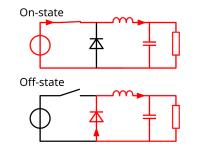
The most common converter topology is called a buck converter, and here's the basic outline:
Buck_operating.svg.png

The switch in the diagram is actually a MOSFET, driven by a complicated control circuit that senses the input and output voltages. Depending on how sophisticated it is, the control circuit might sense current, temperature, etc. as well. The ratio between input and output voltages is determined by the duty cycle of the switch, or what percentage of time it's on.

A buck converter can only lower voltage, not raise it. Suppose we have a 14-volt-to-5-volt converter supplying a 5V 1A load; the controller will run the switch at a 36% duty cycle and it'll draw about 360mA at 14V (or a little more because of inefficiency). If the input falls to 10V, the control circuit will increase the duty cycle of the switch to 50% and the input current will increase to around 500mA. Once the input reaches 5V, though, the duty cycle needs to be 100%. At and below that point, the output voltage just follows the input voltage, and the input current follows the output current - what happens there depends on the type of load (whether it's purely resistive, constant-current, more DC/DC converters, or a combination). But more likely, the control circuit has an undervoltage lockout feature. If it detects that the input voltage is below some threshold, it'll keep the switch off in order to shut the whole thing down.

For what it's worth, Dynon has a section in the SkyView manual entitled "SkyView System Can Be On During Engine Start":
All Dynon units in a SkyView system incorporate robust power protection that allows them to be powered on during engine start for full engine monitoring. SkyView displays require a minimum of 10V, and during engine start, it’s common for the electrical system to temporarily drop below 10V. If an SV-BAT-320 Backup Battery is not installed, SkyView may shut off / reboot. If you wish to monitor your engine prior to engine start, an SV-BAT-320 should be installed so that the SkyView display can switch to the SV-BAT-320 when its power inputs are not receiving at least 10V. The SkyView display will switch from SV-BAT-320 to aircraft power when its power inputs receive voltage above 10V.
The way I read that is:
  • The power inputs are protected against the kind of overvoltage that can occur during engine spikes
  • There's a 10V lockout threshold, so if the input is below 10V, the devices won't try to draw excessive current; instead, they simply won't run at all
  • Having a backup battery to run the displays during engine start is a matter of convenience (avoiding annoying reboots), not safety (no risk of damage)
I looked through the Garmin G3X install manuals and couldn't find as clear a statement, but all the references to engine start that I did find also made it sound like it was a convenience issue and not a safety issue. Also, the RV-12 POH from Van's says to leave the avionics switch on during engine start, and the flight training supplement says "The electrical system design incorporates a separate avionics master switch so that, in the event of a generator failure non-essential electrical equipment can be taken off-line" - no reference to engine start there either. Personally, I leave all my avionics on. I don't think it's wrong to turn them off for engine start but I don't think it's necessary either.

 
In theory, yes, that can absolutely happen; in practice, most DC/DC converters have an undervoltage lockout feature that will prevent them from operating at all below a certain input voltage.

The most common converter topology is called a buck converter, and here's the basic outline:
View attachment 106989

The switch in the diagram is actually a MOSFET, driven by a complicated control circuit that senses the input and output voltages. Depending on how sophisticated it is, the control circuit might sense current, temperature, etc. as well. The ratio between input and output voltages is determined by the duty cycle of the switch, or what percentage of time it's on.

A buck converter can only lower voltage, not raise it. Suppose we have a 14-volt-to-5-volt converter supplying a 5V 1A load; the controller will run the switch at a 36% duty cycle and it'll draw about 360mA at 14V (or a little more because of inefficiency). If the input falls to 10V, the control circuit will increase the duty cycle of the switch to 50% and the input current will increase to around 500mA. Once the input reaches 5V, though, the duty cycle needs to be 100%. At and below that point, the output voltage just follows the input voltage, and the input current follows the output current - what happens there depends on the type of load (whether it's purely resistive, constant-current, more DC/DC converters, or a combination). But more likely, the control circuit has an undervoltage lockout feature. If it detects that the input voltage is below some threshold, it'll keep the switch off in order to shut the whole thing down.

For what it's worth, Dynon has a section in the SkyView manual entitled "SkyView System Can Be On During Engine Start":

The way I read that is:
  • The power inputs are protected against the kind of overvoltage that can occur during engine spikes
  • There's a 10V lockout threshold, so if the input is below 10V, the devices won't try to draw excessive current; instead, they simply won't run at all
  • Having a backup battery to run the displays during engine start is a matter of convenience (avoiding annoying reboots), not safety (no risk of damage)
I looked through the Garmin G3X install manuals and couldn't find as clear a statement, but all the references to engine start that I did find also made it sound like it was a convenience issue and not a safety issue. Also, the RV-12 POH from Van's says to leave the avionics switch on during engine start, and the flight training supplement says "The electrical system design incorporates a separate avionics master switch so that, in the event of a generator failure non-essential electrical equipment can be taken off-line" - no reference to engine start there either. Personally, I leave all my avionics on. I don't think it's wrong to turn them off for engine start but I don't think it's necessary either.

Thanks for the detailed explanation. Very helpful.
 
So, if the voltage feeding the switching PS drops, that means the current it is drawing will increase in order to preserve the target output, correct? I assume that if this goes too far, the current drawn will exceed the capacity of traces or components that were not designed to handle that much current and potentially damage things. Is that what we used to call a brown out? What happens when the voltage drops enough that it cannot preserve the target output voltage?

Again, trying to learn not make an argument.
^^ This ^^
 
Look at that - Ohm’s Law in action!! 🤣
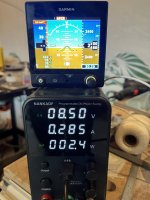
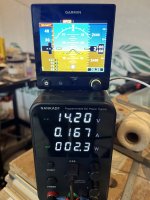
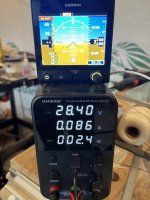
If it were Ohm's law, as input voltage increases (resistive or linear input), Ohm's law would say "current would increase". However, the G5 example shows exactly the opposite because the G5 incorporates a switching power supply, which makes it more efficient. With "old school" voltage regulators (non switching, resistive or linear type), as voltage goes up, current would go up and power consumption would also go up linearly (Ohm's law). With a switching power supply (like the G5 incorporates), as input voltage goes up, current actually goes down, while input power remains roughly constant, using only the power it needs (i.e. Power Consumption = Input Current x Input Voltage, which remains constant as input voltage changes). (y):cool:(y)
 
If it were Ohm's law, as input voltage increases (resistive or linear input), Ohm's law would say "current would increase". However, the G5 example shows exactly the opposite because the G5 incorporates a switching power supply, making it more efficient. With "old school" voltage regulators (non switching, resistive or linear type), as voltage goes up, current would go up and power consumption would also go up linearly (Ohm's law). With a switching power supply (like the G5 incorporates), as input voltage goes up, current actually goes down, while input power remains roughly constant, using only the power it needs (i.e. Power Consumption = Input Current x Input Voltage, which remains constant as input voltage changes). (y):cool:(y)
With a pure resistive load, current would increase with voltage. With a linear regulator, current would remain constant and the regulator would dissipate current * (Vin - Vout) as heat.

But I'm assuming that from the 🤣, @Ironflight was joking and knows that the photos show a constant-power load. Communication by text is hard 🙃
 
With a linear regulator, current would remain constant and the regulator would dissipate current * (Vin - Vout) as heat.
Correct -- however, power consumption goes up because current remains constant as input voltage goes up, making a linear regulator much less efficient than a switching buck-regulator power supply -- right? ;)

But I'm assuming that from the 🤣, @Ironflight was joking and knows that the photos show a constant-power load. Communication by text is hard 🙃
As you must probably already know -- engineers have a notoriously poor sense of humor. :oops:
 
Last edited:
I think at least for now I'm going to install an oil pressure switch that is normally closed at zero pressure and opens when there is pressure. I'll wire that to an idiot light on the panel. This way I can start the engine with the avionics master switch off. Do you think 20 psi is a good set point for the switch to open? Higher? Lower? Thanks.
 
With a pure resistive load, current would increase with voltage. With a linear regulator, current would remain constant and the regulator would dissipate current * (Vin - Vout) as heat.

But I'm assuming that from the 🤣, @Ironflight was joking and knows that the photos show a constant-power load. Communication by text is hard 🙃
Is the lm317 an example of that?
 
Is the lm317 an example of that?
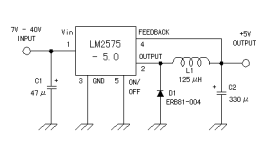
Yes -- LM317 is a 3-terminal adjustable linear regulator.
And, LM2575 can be used as a 5-terminal adjustable switching regulator along with an inductor and capacitor.
1768194887608.png
 
Last edited:
I have a TCW Technologies Intelligent Power Stabilizer (IPS) on one of the power inputs to my G3X and its associated engine sensors. They come in three different flavors, depending on the load, and they'll keep your engine monitor alive down to nearly 5VDC.
 
I think at least for now I'm going to install an oil pressure switch that is normally closed at zero pressure and opens when there is pressure. I'll wire that to an idiot light on the panel. This way I can start the engine with the avionics master switch off. Do you think 20 psi is a good set point for the switch to open? Higher? Lower? Thanks.
The pressure switch that Vans sell for this purpose is 15 psi. I've got one installed to complement the Dynon EFIS and it works well. The bonus is that the idiot light also acts a reminder to turn off the master.
20 psi would be OK also because min oil pressure for Lycoming at idle is 25 psi.
 
The pressure switch that Vans sell for this purpose is 15 psi. I've got one installed to complement the Dynon EFIS and it works well. The bonus is that the idiot light also acts a reminder to turn off the master.
20 psi would be OK also because min oil pressure for Lycoming at idle is 25 psi.
Thanks - I looked at the pressure switch Vans offers. Is it a normally closed switch? I can't tell.
 
Thanks - I looked at the pressure switch Vans offers. Is it a normally closed switch? I can't tell.
The Vans switch has terminals for both normally closed and normally open (so it could also be used for example to run an hour meter that counts when there is oil pressure)
 
Also my point. I see this as a fairly real risk and simply not worth accepting just so you don’t missthat precious 10 seconds of oil pressure indication. I would love to be proven wrong by a story of someone whose oil pressure never came up on startup. In my experience, engines can run for several minutes without oil pressure before seizing. Have heard of tests where they ran at full power for up to 20 minutes without oil pressure.
According to my G3X log, 3 minutes was enough to properly destroy the bearings, the crank and the case. Only good news is the metal didn't circulate through the rest of the engine. It does not take long to make those bearings really really hot.

Post maintain runup, and someone forgot to add back the oil - was a hard call to receive.

Derek
 
According to my G3X log, 3 minutes was enough to properly destroy the bearings, the crank and the case. Only good news is the metal didn't circulate through the rest of the engine. It does not take long to make those bearings really really hot.

Post maintain runup, and someone forgot to add back the oil - was a hard call to receive.

Derek
Ouch. Never really thought about the case of someone running the engine without oil.
 
Because of the human factor stuff can happen and has happened more than once. Good technique is to start an oil change by making “NO OIL” labels. I use 2” masking tape, make big letters with a sharpie and stick them on the prop blades and over the ignition switches. They stay on until oil is back in the engine. No exceptions.

Don Broussard A&P/IA (not a spring chicken)
RV9 Rebuild in Progress
57 Pacer.
 
Because of the human factor stuff can happen and has happened more than once. Good technique is to start an oil change by making “NO OIL” labels. I use 2” masking tape, make big letters with a sharpie and stick them on the prop blades and over the ignition switches. They stay on until oil is back in the engine. No exceptions.

Don Broussard A&P/IA (not a spring chicken)
RV9 Rebuild in Progress
57 Pacer.
I love that idea!!!
 
Back
Top