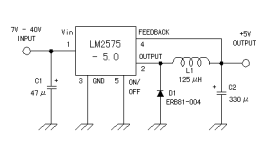
In theory, yes, that can absolutely happen; in practice, most DC/DC converters have an undervoltage lockout feature that will prevent them from operating at all below a certain input voltage.
The most common converter topology is called a
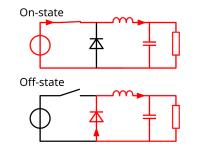
buck converter, and here's the basic outline:
View attachment 106989
The switch in the diagram is actually a MOSFET, driven by a complicated control circuit that senses the input and output voltages. Depending on how sophisticated it is, the control circuit might sense current, temperature, etc. as well. The ratio between input and output voltages is determined by the duty cycle of the switch, or what percentage of time it's on.
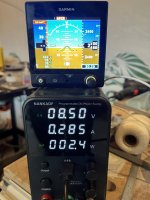
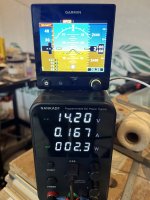
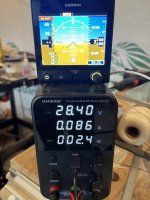
A buck converter can only lower voltage, not raise it. Suppose we have a 14-volt-to-5-volt converter supplying a 5V 1A load; the controller will run the switch at a 36% duty cycle and it'll draw about 360mA at 14V (or a little more because of inefficiency). If the input falls to 10V, the control circuit will increase the duty cycle of the switch to 50% and the input current will increase to around 500mA. Once the input reaches 5V, though, the duty cycle needs to be 100%. At and below that point, the output voltage just follows the input voltage, and the input current follows the output current - what happens there depends on the type of load (whether it's purely resistive, constant-current, more DC/DC converters, or a combination). But more likely, the control circuit has an undervoltage lockout feature. If it detects that the input voltage is below some threshold, it'll keep the switch
off in order to shut the whole thing down.
For what it's worth, Dynon has a section in the SkyView manual entitled "SkyView System Can Be On During Engine Start":
The way I read that is:
- The power inputs are protected against the kind of overvoltage that can occur during engine spikes
- There's a 10V lockout threshold, so if the input is below 10V, the devices won't try to draw excessive current; instead, they simply won't run at all
- Having a backup battery to run the displays during engine start is a matter of convenience (avoiding annoying reboots), not safety (no risk of damage)
I looked through the Garmin G3X install manuals and couldn't find as clear a statement, but all the references to engine start that I did find also made it sound like it was a convenience issue and not a safety issue. Also, the RV-12 POH from Van's says to leave the avionics switch on during engine start, and the flight training supplement says "The electrical system design incorporates a separate avionics master switch so that, in the event of a generator failure non-essential electrical equipment can be taken off-line" - no reference to engine start there either. Personally, I leave all my avionics on. I don't think it's
wrong to turn them off for engine start but I don't think it's necessary either.