Van's Air Force

The definitive Van's Aircraft support community! Buying, building or flying an RV? Join our exclusive family of mentors and enthusiasts!

Fuel Injector Restrictor Tuning Help

GyroF-16

Well Known Member
Patron
I’m trying to address a pretty wide GAMI spread in my F1 Rocket’s IO-540 with an Airflow Performance FI system.
With .028 restrictors in all cylinders, my average EGT peak fuel flows from 10 runs at 10-11,000 MSL, 20.5 MAP and 2100 and 2200 rpm are:

#5 13.15
#2 12.29
#6 12.17
#3 11.85
#1 11.54
#4 11.46

I have a recommendation to change #5 to a .029 (increase of .001) and #3, #1, and #4 to .027 (decrease of .001).

Given the size of my gaps in peak EGT fuel flows, I’m struggling to figure out how that will close them.

I calculate the following “gaps” in fuel flow between cylinder EGT peaks:

#5 13.15
—————————Gap A = .86
#2 12.29
—————————Gap B = .12
#6 12.17
—————————Gap C = .32
#3 11.85
—————————Gap D = .31
#1 11.54
—————————Gap E = .08
#4 11.46


If a .001 change would close “Gap C” of .32, then I struggle to see how the same incremental increase of .001 to #5 would close even half of “Gap A”.

I’ve seen suggestions in other threads such as
https://vansairforce.net/threads/fuel-nozzle-restrictor-size-advice-please.193832/
that IO-540s are better tuned around.025” restrictors. With that in mind, I’m open to replacing some/all of my restrictors with .025”. But I’d like to make an educated estimate when changing them, so as to at least make an incremental improvement in my current average spread of 1.69.

I’m completely willing to do an iterative process, but would also really like to make a meaningful improvement in the first iteration. And I can’t see how the initial recommendation of changing #3, 1 & 4 by the same amount will have any impact at all on “Gap D” between 3 and 1. Nor how the change of #5 to .029 would close even half of the biggest “Gap A”, which makes up about half of my total spread.

Here’s my bottom line: does anyone have a good experience-based “Rule of Thumb” as to how much the fuel flow to a given cylinder changes with a certain incremental change of the restrictor? Hypothetically, something like “For a change of .001, the measured fuel flow at peak EGT changes by 0.3 lbs per hour”.

Any experience in tuning 540s, especially with Airflow Performance FI systems is welcome!
 
Step #1, send this data to Don Rivera at AFP. He will get you going.

Carl
Step 1 already accomplished. That’s where the recommendation to change 5, and 3, 1 & 4 by .001 came from.
But, despite two more iterations of emails, no answer on how that will close the gaps that I’m seeing- especially the big one between 5 and the rest. And certainly not the gap between 3 and 1.
I fear that I might have offended him by asking the “how will this close all three gaps?” question. I just want to understand the methodology.
 
Last edited:
Step 1 already accomplished. That’s where the recommendation to change 5, and 3, 1 & 4 by .001 came from.
But, despite two more iterations of emails, no answer on how that will close the gaps that I’m seeing- especially the big one between 5 and the rest. And certainly not the gap between 3 and 1.
I fear that I might have offended him by asking the “how will this close all three gaps?” question. I just want to understand the methodology.
Too many variables to provide a confident answer to your “change one cylinder what happens” question.

It typically takes me three iterations to get the GAMI spread down to 0.1gph or less on Lycoming engines.

My recommendations:
- Never go with a larger injector unless you have no choice. There is still plenty of fuel flow with smaller restrictors.
- I’d start with going with a 0.026” restrictor in #3, #1 and #4.
- Also change #6 and #2 to 0.027”
- Leave #5 at 0.028”

Do the data runs. Do the data runs at WOT and the same RPM (e.g. 2500) to help repeatability. One set for me is three runs or so between 6K’ and 10K’. Land and review the data. Remember if you change flow to one cylinder it changes flow to the others as well. Based on the data do your next restrictor tweak. Keep good records. Here an EMS spreadsheet is gold. Clear the EMS data before each run to make the down load manageable. I did data at 1 second intervals (SkyView EMS). I found it helpful to edit the EMS data so the information of interest fit on one page width. With some practice you can scan the edited spreadsheet in a few minutes, making sure you have solid results for fuel flow when each cylinder EGT peaked. Use the new GAMI spread (which cylinders peak first, peak last, etc.) to determine your next injector tweak.

On my first IO-540 I had a plenum and started out with a GAMI spread of 1.5 gph. Don tells me that a plenum impacts the balance. I had to change out four of the six restrictors but got it down to 0.0 to 0.1gph. I did end up with a 0.0005 change in one restrictor (as in 0.0265”) to get that last little GAMI spread out.

Don sells restrictors in these “half” sizes as well.

Let us know your progress.
Carl
 
Thanks, Carl. Given the gap between #1 and #3, (the same size as the 6-3 gap), would it make sense to make #1 and 4 .025?
Other than that, what you’re suggesting is very close to what I was contemplating. Just glad to hear that I’m not totally out to lunch in my thinking. I truly appreciate the benefit of your experience.
 
Thanks, Carl. Given the gap between #1 and #3, (the same size as the 6-3 gap), would it make sense to make #1 and 4 .025?
Other than that, what you’re suggesting is very close to what I was contemplating. Just glad to hear that I’m not totally out to lunch in my thinking. I truly appreciate the benefit of your experience.
Would not hurt, but may not help either.

I suggest you pick what you want for the first iteration with full knowledge that you will change something for the following iterations.

Carl
 
First things first, are your intake gaskets the standard black ones? If so you possibly have intake leaks, get rid of the and use the pink Superior Air Parts gaskets.

second, do you have a Airflow performance upper deck system? If not call Don at AFP and order one. This makes the world of difference every single time. Trust me on this.

Last of all, Dons suggestions will be right. The GAP THEORY you have is sort of correct, but what you are not realising is that for every change you make to one injector it affects all the others at the same time. In simple terms change one 0.028 to a 0.027 (which is a big change 0.0275 might be better) and you are restricting fuel to that cylinder and all the other 5 get more fuel. So do not assume things stay constant when you make a change. I do this a lot for people down here and with my GAMI/APS background I have become better at the "black art" of injector tuning.

Get an upper deck installed and go from there.
 
First things first, are your intake gaskets the standard black ones? If so you possibly have intake leaks, get rid of the and use the pink Superior Air Parts gaskets.

second, do you have a Airflow performance upper deck system? If not call Don at AFP and order one. This makes the world of difference every single time. Trust me on this.

Last of all, Dons suggestions will be right. The GAP THEORY you have is sort of correct, but what you are not realising is that for every change you make to one injector it affects all the others at the same time. In simple terms change one 0.028 to a 0.027 (which is a big change 0.0275 might be better) and you are restricting fuel to that cylinder and all the other 5 get more fuel. So do not assume things stay constant when you make a change. I do this a lot for people down here and with my GAMI/APS background I have become better at the "black art" of injector tuning.

Get an upper deck installed and go from there.
Thank you for the input!

First of all, I appreciate the perspective on “.028 to .027 is a big change”. I have NO experience with this, and am trying to get a sense of what will drive a change. Bear in mind - I’m dealing with nearly a 2.0 total spread, and a nearly 1.0 “gap” from the first cylinder to peak (#5) and all the rest. So my impression is that this requires a fairly big correction.

I did not build this airplane, I bought it about 5 months ago, and am on a steep learning curve.

Second - you’re talking over my head on the intake gaskets and upper deck system.
I’m familiar with where the air intake is, but are these the gaskets between the intake and the engine itself?
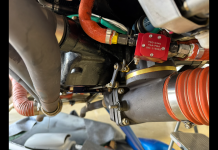
In the attached image, it appears there are orange gaskets on the top and bottom of the gold-colored disk. Is that what you’re talking about?

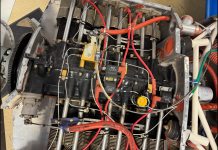
And tell me more about this “upper deck system”. I don’t see anything with that name on the Airflow Performance website. I’ve also attached an image of the top of my engine, showing the “spider” of flow divider and fuel lines. Can you tell from that what I have?

Again, I appreciate your help and suggestions - you’re just going to need to explain a little more. I have an undergraduate degree in Aeronautical Engineering, but all of the propulsion content was low-bypass turbofans, so I’m having to learn this piston engine stuff on my own.
 

Attachments

  • IMG_0029.png
    IMG_0029.png
    6.9 MB · Views: 66
  • IMG_0032.png
    IMG_0032.png
    7.5 MB · Views: 65
Thank you for the input!

First of all, I appreciate the perspective on “.028 to .027 is a big change”. I have NO experience with this, and am trying to get a sense of what will drive a change. Bear in mind - I’m dealing with nearly a 2.0 total spread, and a nearly 1.0 “gap” from the first cylinder to peak (#5) and all the rest. So my impression is that this requires a fairly big correction.

I did not build this airplane, I bought it about 5 months ago, and am on a steep learning curve.

Second - you’re talking over my head on the intake gaskets and upper deck system.
I’m familiar with where the air intake is, but are these the gaskets between the intake and the engine itself?
In the attached image, it appears there are orange gaskets on the top and bottom of the gold-colored disk. Is that what you’re talking about?

And tell me more about this “upper deck system”. I don’t see anything with that name on the Airflow Performance website. I’ve also attached an image of the top of my engine, showing the “spider” of flow divider and fuel lines. Can you tell from that what I have?

Again, I appreciate your help and suggestions - you’re just going to need to explain a little more. I have an undergraduate degree in Aeronautical Engineering, but all of the propulsion content was low-bypass turbofans, so I’m having to learn this piston engine stuff on my own.
It is a long hard thing to type out, I will send you my contact details and I can explain
 
What RV10Oz says…

I spent ages getting g my 9:1 540 dialed in even with AFPs excellent help. And I know what I’m doing as I’ve done it on 3 previous RVs.
Went from nominally 028 to 025 and iterated from there. It truly is whack a mole so you need to iterate a lot. I wouldn’t dream of telling you where to start based on whatever your spreads are now. There’s little point in guessing at this stage. Shrink them all down and start iterating from there. You’ll end up with excess restrictors.
I’m actually surprised that there isn’t an active swap marketplace here for them. I’ve got at least half a dozen off nominal restrictors floating about. When you get close I may be able to swap some for you! Will be slow tho as I’m in Australia.
I also eventually put turbo nozzles (upper deck system) in as well and now enjoy excellent LOP operation.
It is a bit of a tedious process but it’s most definitely worth it.

Turbo rails and nozzles: (upper deck system). DB can probably expand but..
Originally designed for turbocharged engines that obviously pressurize the intake to greater than ambient- so you can’t run a standard injector which vents to atmospheric to atomize the fuel. By adding this to a normally aspirated 6 cyl it helps by ensuring that all the injectors enjoy the same ambient pressure at the nozzle vent.
For some reason the bigger engines seem to have more varied under cowl upper deck pressures. Prob due to a combination of length, cowl shape, inlet shape, plenum etc etc. that variation manifests in uneven fuel distribution. This helps.
IMG_0622.jpegPicture 2.jpegIMG_4303.jpeg
 
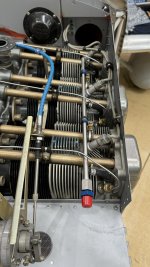
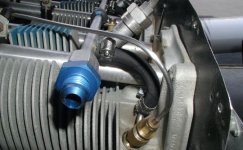
I’m working with GAMI right now on a set of injectors for the IO540 on my Rocket. My #2 cylinder was the first to peak and has a 0.9 gph spread vs. the last to peak. They sent a 90 degree fitting to go over the #2 injector to block pressurized air that is probably causing that particular injector to peak early. I just received the 90* fitting in yesterday’s mail so I haven’t had a chance to try it out.

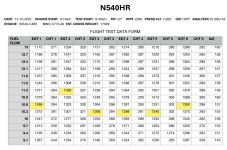
Note: my IAS in the table below is not accurate as I have not rectified my static port issue as of this writing. The actual speed is not relevant in this case. All we really care about for this test is the change in speed resulting from changes to the fuel flow.

IMG_1262.jpeg
 
Thanks
What RV10Oz says…

I spent ages getting g my 9:1 540 dialed in even with AFPs excellent help. And I know what I’m doing as I’ve done it on 3 previous RVs.
Went from nominally 028 to 025 and iterated from there. It truly is whack a mole so you need to iterate a lot. I wouldn’t dream of telling you where to start based on whatever your spreads are now. There’s little point in guessing at this stage. Shrink them all down and start iterating from there. You’ll end up with excess restrictors.
I’m actually surprised that there isn’t an active swap marketplace here for them. I’ve got at least half a dozen off nominal restrictors floating about. When you get close I may be able to swap some for you! Will be slow tho as I’m in Australia.
I also eventually put turbo nozzles (upper deck system) in as well and now enjoy excellent LOP operation.
It is a bit of a tedious process but it’s most definitely worth it.

Turbo rails and nozzles: (upper deck system). DB can probably expand but..
Originally designed for turbocharged engines that obviously pressurize the intake to greater than ambient- so you can’t run a standard injector which vents to atmospheric to atomize the fuel. By adding this to a normally aspirated 6 cyl it helps by ensuring that all the injectors enjoy the same ambient pressure at the nozzle vent.
For some reason the bigger engines seem to have more varied under cowl upper deck pressures. Prob due to a combination of length, cowl shape, inlet shape, plenum etc etc. that variation manifests in uneven fuel distribution. This helps.
View attachment 108592View attachment 108593View attachment 108594
Thanks for the description and photos. I do not have that setup.
You mentioned “resetting” to a .025 restrictor baseline for tuning. Don mentioned that if I choose to tune around a 10 gph range, to start with all .025s. Is that where you are? That is, in the 10 gph range in LOP cruise?
Most times, I wind up at close to 11 gph, but I’m still calibrating my new fuel flow transducer, and the last 50 gallons used indicate that it showing 10-15% higher than actual fuel usage, so I’m likely right in that 10 gph range.
 
I’m working with GAMI right now on a set of injectors for the IO540 on my Rocket. My #2 cylinder was the first to peak and has a 0.9 gph spread vs. the last to peak. They sent a 90 degree fitting to go over the #2 injector to block pressurized air that is probably causing that particular injector to peak early. I just received the 90* fitting in yesterday’s mail so I haven’t had a chance to try it out.

Note: my IAS in the table below is not accurate as I have not rectified my static port issue as of this writing. The actual speed is not relevant in this case. All we really care about for this test is the change in speed resulting from changes to the fuel flow.

View attachment 108677
Thanks for the input, RWoodard.
I’d be delighted to be starting where you are, with half the GAMI spread.
GAMI injectors must be a different shape, as I can’t imagine how a 90° fitting would even be possible with my setup.
Also, do you think #2 is pressurized because it’s the front cylinder? My first to peak is in the back (#5).
 
that IO-540s are better tuned around.025” restrictors. With that in mind, I’m open to replacing some/all of my restrictors with .025”. But I’d like to make an educated estimate when changing them, so as to at least make an incremental improvement in my current average spread of 1.69.
When I did my 540, Don or kyle at AFP recommended 6 unique .025 based restrictors that were typical for 540's (3 sets of sizes - 2 each). This set got me pretty close. Think I only had to change 1 or 2 after testing to get me to .1 or so spread. Dropping to .025 also helps with smoother running when hot.
 
Thanks for the input, RWoodard.
I’d be delighted to be starting where you are, with half the GAMI spread.
GAMI injectors must be a different shape, as I can’t imagine how a 90° fitting would even be possible with my setup.
Also, do you think #2 is pressurized because it’s the front cylinder? My first to peak is in the back (#5).
Descriptions like first or last to peak doesn't help unless you also tell us if you are leaning from rich toward lean, or lean toward rich.

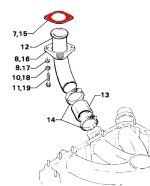
David offered an important suggestion...the cylinder peaking at a far larger fuel flow as compared to the others (#5) may indeed have an intake gasket leak. It is particularly true if you're doing the test at a throttled altitude. As supplied by our friends in Williamsport, the intake gaskets are miserable cardboard garbage, and generally need to be changed from time to time. Note; SDS sells a nice kit to convert the gasket joint to an o-ring seal.

While you're there, take a good look at clamp tightness (14) and the condition of the connector hose (13)

ScreenHunter_3132 Jan. 31 12.57.jpg

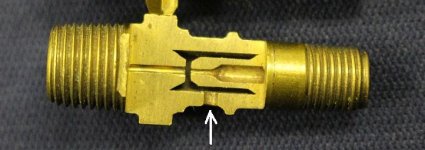
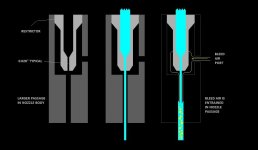
Richard spoke of a nozzle vent...the bleed air port below. Every stock nozzle has one.

Nozzle 800w.jpg

Constant Flow Nozzle Operation.jpg

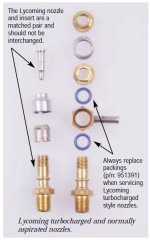
Obviously here in the EAB world we don't observe the "matched pair" note below.

Std and Turbo Nozzles.jpg
 
Descriptions like first or last to peak doesn't help unless you also tell us if you are leaning from rich toward lean, or lean toward rich.

David offered an important suggestion...the cylinder peaking at a far larger fuel flow as compared to the others (#5) may indeed have an intake gasket leak. It is particularly true if you're doing the test at a throttled altitude. As supplied by our friends in Williamsport, the intake gaskets are miserable cardboard garbage, and generally need to be changed from time to time. Note; SDS sells a nice kit to convert the gasket joint to an o-ring seal.

While you're there, take a good look at clamp tightness (14) and the condition of the connector hose (13)

View attachment 108687

Richard spoke of a nozzle vent...the bleed air port below. Every stock nozzle has one.

View attachment 108689

View attachment 108688

Obviously here in the EAB world we don't observe the "matched pair" note below.

View attachment 108690
Thanks, Dan.
Yes, the “first to peak” in my descriptions was when moving rich to lean. I’d forgotten that it’s useful to also check it lean-to-rich.

And now you’re speaking “fighter pilot” - you’re giving me pictures (with pretty colors!).

Looking at the diagrams - now I can visualize the intake gaskets. My airplane/engine is 22 yrs old and 600 hrs tach time. I can imagine that gaskets could be a bit aged.

I’m fairly familiar with the nozzles, having removed them and cleaned ultrasonically along with the restrictors, in hopes that my GAMI spread was due to fouled injection nozzles. I saw someone mention (can’t remember of in this thread or one of the many I searched through) “clocking” injector nozzles. Does this involve where that nozzle vent sits relative to the longitudinal axis, or relative airflow at that location?
When I reinstalled them, I just made sure they were snug, not oriented a particular way. Now- the GAMI spread didn’t get any worse, but that doesn’t mean that I didn't introduce another factor to compensate for…

I definitely see the utility in checking the intake gaskets for leaks before diving too deeply into swapping restrictors.
 
Last edited:
Descriptions like first or last to peak doesn't help unless you also tell us if you are leaning from rich toward lean, or lean toward rich.

David offered an important suggestion...the cylinder peaking at a far larger fuel flow as compared to the others (#5) may indeed have an intake gasket leak. It is particularly true if you're doing the test at a throttled altitude. As supplied by our friends in Williamsport, the intake gaskets are miserable cardboard garbage, and generally need to be changed from time to time. Note; SDS sells a nice kit to convert the gasket joint to an o-ring seal.

While you're there, take a good look at clamp tightness (14) and the condition of the connector hose (13)

View attachment 108687

Richard spoke of a nozzle vent...the bleed air port below. Every stock nozzle has one.

View attachment 108689

View attachment 108688

Obviously here in the EAB world we don't observe the "matched pair" note below.

View attachment 108690
I’m considering the upper deck system to help even out my distribution for my IO-540 running the FM-200. I haven’t been able to get near 0.2 gph difference and can’t run much past peak egt. Do the turbo nozzles use the same restrictors?

Thanks!
 
Thanks

Thanks for the description and photos. I do not have that setup.
You mentioned “resetting” to a .025 restrictor baseline for tuning. Don mentioned that if I choose to tune around a 10 gph range, to start with all .025s. Is that where you are? That is, in the 10 gph range in LOP cruise?
Most times, I wind up at close to 11 gph, but I’m still calibrating my new fuel flow transducer, and the last 50 gallons used indicate that it showing 10-15% higher than actual fuel usage, so I’m likely right in that 10 gph range.

Yes that’s about where I am depending on altitude. Between 10-11Gph.

I definitely see the utility in checking the intake gaskets for leaks before diving too deeply into swapping restrictors.

The paper gaskets definitely start leaking over time so I’d satisfy myself that they weren’t leaking before you even start the balancing process. Best way I’d say to do this is to pull the throttle to idle (at a safe altitude!) and watch the EGTs.
I replaced plenty of them on my RV7 over 1000h.
When I built the 10 I had the intakes modified with the SDS o-ring intake flanges to eliminate this problem for good.

I’m considering the upper deck system to help even out my distribution for my IO-540 running the FM-200. I haven’t been able to get near 0.2 gph difference and can’t run much past peak egt. Do the turbo nozzles use the same restrictors?

Thanks!

Yes
 
Gyro,
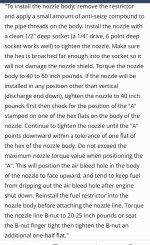
Here is some nozzle clocking info directly from Don:
 

Attachments

  • IMG_3746.jpeg
    IMG_3746.jpeg
    464 KB · Views: 48
Looking at the diagrams - now I can visualize the intake gaskets. My airplane/engine is 22 yrs old and 600 hrs tach time. I can imagine that gaskets could be a bit aged.

Oh yeah.

I saw someone mention (can’t remember of in this thread or one of the many I searched through) “clocking” injector nozzles. Does this involve where that nozzle vent sits relative to the longitudinal axis, or relative airflow at that location?
When I reinstalled them, I just made sure they were snug, not oriented a particular way. Now- the GAMI spread didn’t get any worse, but that doesn’t mean that I didn't introduce another factor to compensate for…

"A" down, which puts the bleed hole up. Yeah, it's dumb, because if the "A" is on the bottom you can't see it!

First time I take out the nozzles (which is rarely), I make punch marks on the hex flat opposite the "A" flat..one dot for cyl #1, two dots for cyl #2, etc. That way they always go back in the same holes, and I always know when the bleed hole faces up.

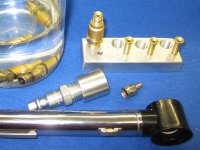
An organizer helps too.

Cleaning Tools.jpg
 

Attachments

  • IMG_1503.jpg
    IMG_1503.jpg
    2.5 MB · Views: 18
Oh yeah.


"A" down, which puts the bleed hole up. Yeah, it's dumb, because if the "A" is on the bottom you can't see it!

First time I take out the nozzles (which is rarely), I make punch marks on the hex flat opposite the "A" flat..one dot for cyl #1, two dots for cyl #2, etc. That way they always go back in the same holes, and I always know when the bleed hole faces up.

An organizer helps too.

View attachment 108722
Well, THAT would’ve been handy to know about a month ago.
Fortunately I’ll be in there again in about 10 days to swap the restrictors (I’m thinking to probably .025 all around to start), so I think I’ll do as you described.
Thanks again!
 
Last edited:
Good point. For clarification, I was leaning from rich to lean in my test.

Descriptions like first or last to peak doesn't help unless you also tell us if you are leaning from rich toward lean, or lean toward rich.
 
Descriptions like first or last to peak doesn't help unless you also tell us if you are leaning from rich toward lean, or lean toward rich.

David offered an important suggestion...the cylinder peaking at a far larger fuel flow as compared to the others (#5) may indeed have an intake gasket leak. It is particularly true if you're doing the test at a throttled altitude. As supplied by our friends in Williamsport, the intake gaskets are miserable cardboard garbage, and generally need to be changed from time to time. Note; SDS sells a nice kit to convert the gasket joint to an o-ring seal.

While you're there, take a good look at clamp tightness (14) and the condition of the connector hose (13)

View attachment 108687

Richard spoke of a nozzle vent...the bleed air port below. Every stock nozzle has one.

View attachment 108689

View attachment 108688

Obviously here in the EAB world we don't observe the "matched pair" note below.

View attachment 108690
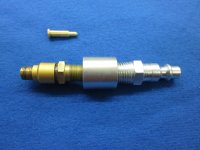
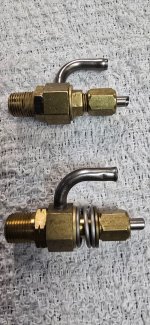
They make those turbo nozzles in two models. With and without the springs. I preferer to ones without the springs. Easier to mount.
 

Attachments

  • 20260201_184715.jpg
    20260201_184715.jpg
    1.5 MB · Views: 35
I’m curious as to how much one “increment” in restrictor changes your cylinder peak.

IO-540, vertical induction running AFP FM-200, .025 restrictors as a baseline (1&2 = .025, 3&4 = .0245, 5&6 = .0255). Lightspeed Plasma #3 on uppers, Standard Mag on lowers. AFP upper deck system installed.

As an example,
8500’ (9100 DA) 22.8”, 2270 RPM Peaks: [email protected], [email protected], [email protected], [email protected], [email protected], [email protected]

Changing #4 to .240 so (1&2 = .025, 3 = .0245, 4 = .0240, 5&6 = .0255)
9500’ (~8500DA) 21”, 2400 RPM Peaks: [email protected], [email protected], [email protected], [email protected]!!, [email protected], [email protected]
Yes, I should have run at the same power settings :(. But #4 moved a full gallon per hour in moving from .0245 to .0240).

Curious as to how much of a different .005 made for others. As it stands, I’m going to change #4 back to .0245 because the distribution wasn’t bad. Just surprised how much difference one increment made!

Interestingly, as hoped, the installation of the AFP upper deck system allows me to operate a few more 10ths of a gallon leaner before engine roughness...

Thanks!
 
Your 1 gph delta on 1 cyl with a .0005 restrictor change seems like a lot. The quality control of the restrictor might be suspect. Do you have a second .240 you can swap with to see if your 1 gph on #4 is repeatable?
I had a 1.0 gph spread when I started.
After a couple of runs and swaps I had a .6 gph spread. My last change was .0005 bigger on one cylinder. It then peaked .6 gph later, but all the other cylinders peaked .2-.4 gph sooner thus lowering my spread to .4 gph.
I left things there because it looked like the .0005 change was course enough that another .0005 change somewhere else wouldn’t close the spread but, rather, move the same spread around to different cylinders.
FWIW: I have a Bendix servo and spider on my 540. My restrictors range from .0245 - .0260.
 
Your 1 gph delta on 1 cyl with a .0005 restrictor change seems like a lot. The quality control of the restrictor might be suspect. Do you have a second .240 you can swap with to see if your 1 gph on #4 is repeatable?
I had a 1.0 gph spread when I started.
After a couple of runs and swaps I had a .6 gph spread. My last change was .0005 bigger on one cylinder. It then peaked .6 gph later, but all the other cylinders peaked .2-.4 gph sooner thus lowering my spread to .4 gph.
I left things there because it looked like the .0005 change was course enough that another .0005 change somewhere else wouldn’t close the spread but, rather, move the same spread around to different cylinders.
FWIW: I have a Bendix servo and spider on my 540. My restrictors range from .0245 - .0260.
That’s a good question. I did have one .025 that behaved differently than another. Anybody have a spare .0240? I’m loathe to spend another $35 to see if I got a suspect one!
 
That’s a good question. I did have one .025 that behaved differently than another. Anybody have a spare .0240? I’m loathe to spend another $35 to see if I got a suspect one!
I’d swap the body first - might be something a little “off” with the air bleed orifice instead of the insert…
 
I’m curious as to how much one “increment” in restrictor changes your cylinder peak.

IO-540, vertical induction running AFP FM-200, .025 restrictors as a baseline (1&2 = .025, 3&4 = .0245, 5&6 = .0255). Lightspeed Plasma #3 on uppers, Standard Mag on lowers. AFP upper deck system installed.

As an example,
8500’ (9100 DA) 22.8”, 2270 RPM Peaks: [email protected], [email protected], [email protected], [email protected], [email protected], [email protected]

Changing #4 to .240 so (1&2 = .025, 3 = .0245, 4 = .0240, 5&6 = .0255)
9500’ (~8500DA) 21”, 2400 RPM Peaks: [email protected], [email protected], [email protected], [email protected]!!, [email protected], [email protected]
Yes, I should have run at the same power settings :(. But #4 moved a full gallon per hour in moving from .0245 to .0240).

Curious as to how much of a different .005 made for others. As it stands, I’m going to change #4 back to .0245 because the distribution wasn’t bad. Just surprised how much difference one increment made!

Interestingly, as hoped, the installation of the AFP upper deck system allows me to operate a few more 10ths of a gallon leaner before engine roughness...

Thanks!
Yes, I’m curious too. That’s exactly what I’ve been wishing could be qualified as a rule of thumb.
Unfortunately, other factors required the engine to be removed for inspection- so I’m probably at least another month from flying again.
While the engine is off, I sent the fuel controller and flow divider to Airflow Performance for overhaul (a 12 and 8 year (respectively) interval is recommended, and mine had been in service for 22 years). I changed all the restrictors to .025 (except .026 on #5, which had been peaking at much higher fuel flows) in the same maintenance session where the unrelated problem was discovered, but I haven’t run the engine, much less flow and GAMI tested since the swap. I suspect that with the flow divider overhaul, I’m likely starting from scratch for GAMI runs, but this time I’ll have smaller restrictors that ar optimized for fuel flows around 10 gph.
 
Back
Top