



I’m trying to address a pretty wide GAMI spread in my F1 Rocket’s IO-540 with an Airflow Performance FI system.
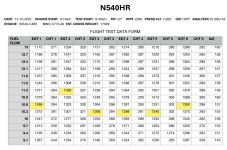
With .028 restrictors in all cylinders, my average EGT peak fuel flows from 10 runs at 10-11,000 MSL, 20.5 MAP and 2100 and 2200 rpm are:
#5 13.15
#2 12.29
#6 12.17
#3 11.85
#1 11.54
#4 11.46
I have a recommendation to change #5 to a .029 (increase of .001) and #3, #1, and #4 to .027 (decrease of .001).
Given the size of my gaps in peak EGT fuel flows, I’m struggling to figure out how that will close them.
I calculate the following “gaps” in fuel flow between cylinder EGT peaks:
#5 13.15
—————————Gap A = .86
#2 12.29
—————————Gap B = .12
#6 12.17
—————————Gap C = .32
#3 11.85
—————————Gap D = .31
#1 11.54
—————————Gap E = .08
#4 11.46
If a .001 change would close “Gap C” of .32, then I struggle to see how the same incremental increase of .001 to #5 would close even half of “Gap A”.
I’ve seen suggestions in other threads such as
https://vansairforce.net/threads/fuel-nozzle-restrictor-size-advice-please.193832/
that IO-540s are better tuned around.025” restrictors. With that in mind, I’m open to replacing some/all of my restrictors with .025”. But I’d like to make an educated estimate when changing them, so as to at least make an incremental improvement in my current average spread of 1.69.
I’m completely willing to do an iterative process, but would also really like to make a meaningful improvement in the first iteration. And I can’t see how the initial recommendation of changing #3, 1 & 4 by the same amount will have any impact at all on “Gap D” between 3 and 1. Nor how the change of #5 to .029 would close even half of the biggest “Gap A”, which makes up about half of my total spread.
Here’s my bottom line: does anyone have a good experience-based “Rule of Thumb” as to how much the fuel flow to a given cylinder changes with a certain incremental change of the restrictor? Hypothetically, something like “For a change of .001, the measured fuel flow at peak EGT changes by 0.3 lbs per hour”.
Any experience in tuning 540s, especially with Airflow Performance FI systems is welcome!
With .028 restrictors in all cylinders, my average EGT peak fuel flows from 10 runs at 10-11,000 MSL, 20.5 MAP and 2100 and 2200 rpm are:
#5 13.15
#2 12.29
#6 12.17
#3 11.85
#1 11.54
#4 11.46
I have a recommendation to change #5 to a .029 (increase of .001) and #3, #1, and #4 to .027 (decrease of .001).
Given the size of my gaps in peak EGT fuel flows, I’m struggling to figure out how that will close them.
I calculate the following “gaps” in fuel flow between cylinder EGT peaks:
#5 13.15
—————————Gap A = .86
#2 12.29
—————————Gap B = .12
#6 12.17
—————————Gap C = .32
#3 11.85
—————————Gap D = .31
#1 11.54
—————————Gap E = .08
#4 11.46
If a .001 change would close “Gap C” of .32, then I struggle to see how the same incremental increase of .001 to #5 would close even half of “Gap A”.
I’ve seen suggestions in other threads such as
https://vansairforce.net/threads/fuel-nozzle-restrictor-size-advice-please.193832/
that IO-540s are better tuned around.025” restrictors. With that in mind, I’m open to replacing some/all of my restrictors with .025”. But I’d like to make an educated estimate when changing them, so as to at least make an incremental improvement in my current average spread of 1.69.
I’m completely willing to do an iterative process, but would also really like to make a meaningful improvement in the first iteration. And I can’t see how the initial recommendation of changing #3, 1 & 4 by the same amount will have any impact at all on “Gap D” between 3 and 1. Nor how the change of #5 to .029 would close even half of the biggest “Gap A”, which makes up about half of my total spread.
Here’s my bottom line: does anyone have a good experience-based “Rule of Thumb” as to how much the fuel flow to a given cylinder changes with a certain incremental change of the restrictor? Hypothetically, something like “For a change of .001, the measured fuel flow at peak EGT changes by 0.3 lbs per hour”.
Any experience in tuning 540s, especially with Airflow Performance FI systems is welcome!







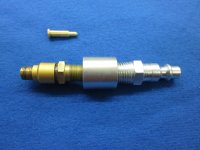
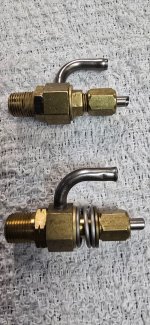
 . But #4 moved a full gallon per hour in moving from .0245 to .0240).
