Van's Air Force

The definitive Van's Aircraft support community! Buying, building or flying an RV? Join our exclusive family of mentors and enthusiasts!

Fuel Flow Issue after bad gas

Drippy

Well Known Member
I noticed my fuel flow dropped off significantly after getting bad gas.

Engine - IO540 C4B5
Scenario - epic cross country:-) but got fuel laced with water and rust at a stop in NM. I didn't notice right off but next day when I sumped the tanks I took out one full and 3 or 4 partially full (8") sumps of brownish water.

Trouble shooting:
Prior to bad gas takeoff GPH >25, after max I saw was 18 - resulting in high EGTs on 5&6.
I cleaned the two strainers I added to my design - under the seats one per tank and the filter in the tunnel and found nothing in any of the screens.
Cleaned and checked fuel flow at each injector and equal across all six.
In the hangar Fuel flow after servo ( line to flow divider) 3.8 gph, on gage and based on bucket/time test these seems about right. Fuel flow before servo >48 gph (gage and bucket/time).
Disassembled servo screen and found debris, rust and crud on servo screen - cleaned it with mineral spirits and compressed air. Not 100% sure how clean it really is - looks clean but????
Retested and no improvement to fuel flow after servo

Suggestions?

Thanks
 
Usually the fuel servo will only send enough fuel to mix correctly with the amount of air it senses, so this could be ok, since I guess it's not sensing any air. Did you try to run the engine?
 
Usually the fuel servo will only send enough fuel to mix correctly with the amount of air it senses, so this could be ok, since I guess it's not sensing any air. Did you try to run the engine?
I didn't today - hangar work - but when I did I was getting 18GPH vs what I was getting prior to the "bad Gas" >25GPH.
 
Can’t help with your troubleshooting but can you Tell us about how you got the contaminated gas?
 
Can’t help with your troubleshooting but can you Tell us about how you got the contaminated gas?
Landed at Carlsbad NM - it was the day after a "wind event". I am not sure what was in the fuel but when I sumped it the next day - I got one full and multiple partial sump glasses of a brown water mixture. Unfortunately I flew with it and didn't sump immediately after filling - not that I am sure it would have settled at that point anyway.
 
Where is your fuel flow sender mounted?

Did you flush all the fuel lines? An easy way to do that is to disconnect the line from the fuel manager, add an extension to that line to include a cheap inline clear filter, pump the tank dry using the boost pump, collecting in five gallon jugs. Use the now filtered fuel in the jugs to fill up the tanks - but use a filter funnel for this. Repeat for the other side. Once done remove the ship filters, clean and inspect and then reinstall.

This filter funnel does well for this job.


Carl
 
Where is your fuel flow sender mounted?

Did you flush all the fuel lines? An easy way to do that is to disconnect the line from the fuel manager, add an extension to that line to include a cheap inline clear filter, pump the tank dry using the boost pump, collecting in five gallon jugs. Use the now filtered fuel in the jugs to fill up the tanks - but use a filter funnel for this. Repeat for the other side. Once done remove the ship filters, clean and inspect and then reinstall.

This filter funnel does well for this job.


Carl
+1

If you got crud in strainer, you may also have crud in red cube. Was the strainer full? If it was, it will bypass (that is what the spring is for) and send crud into the servo, which would require a trip to Don for tear down.
 
Landed at Carlsbad NM - it was the day after a "wind event". I am not sure what was in the fuel but when I sumped it the next day - I got one full and multiple partial sump glasses of a brown water mixture. Unfortunately I flew with it and didn't sump immediately after filling - not that I am sure it would have settled at that point anyway.
Did you call and report the problem to the FBO? You may save others from experiencing the same problem.
 
If you got crud in strainer, you may also have crud in red cube. Was the strainer full? If it was, it will bypass (that is what the spring is for) and send crud into the servo, which would require a trip to Don for tear down.

What Larry said, assuming you have a Bendix or AvStar. I've done at least one AOG rescue after a Bendix screen bypassed.

The red cube outlet is larger than the inlet. The inlet diameter is about 9/64", roughly half the ID of a -6 hose. Debris can stop up the inlet, but generally it would require rather large trash to do it. We've seen that in an accident involving silicone sealant, but rust that large seems unlikely downstream of strainers.

In any case, if you want to remove the red cube and flush it, you wont hurt it flushing both ways with clean fuel. I would not use compressed air, as it would spin the little plastic rotor too fast.

Flow.jpg


Trouble shooting:
Prior to bad gas takeoff GPH >25, after max I saw was 18 - resulting in high EGTs on 5&6.

High EGT on just two cylinders suggests contamination of the flow divider, given you've already cleaned the nozzles.

In the hangar Fuel flow after servo ( line to flow divider) 3.8 gph, on gage and based on bucket/time test these seems about right. Fuel flow before servo >48 gph (gage and bucket/time).
Disassembled servo screen and found debris, rust and crud on servo screen - cleaned it with mineral spirits and compressed air. Not 100% sure how clean it really is - looks clean but????
Retested and no improvement to fuel flow after servo

Suggestions?

No flow change is normal.

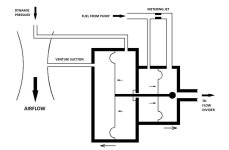
A Bendix-type servo links a metering ball valve with a fuel diaphragm and an air diaphragm. The fuel diaphragm compensates for fuel pressure variation and can (hopefully) be ignored here. The air diaphragm, however, works by piping dynamic pressure to one side (from a pitot inlet in the throat), and vacuum (from a venturi in the throat) to the other side. The ball valve isn't going to open without airflow through the throat.

Regulator Drawing 1000w.jpg

You can provide some airflow and probably get a flow change, which may or may not flush debris. Set up the fuel flow test as before, piping the servo outlet to a bottle or bucket. Turn the prop so two cylinders are on TDC, which guarantees one will be on valve overlap, i.e. providing an airflow path. Turn on the pump, set full throttle and full rich, then shoot a blow nozzle at the inlet from perhaps a foot away.

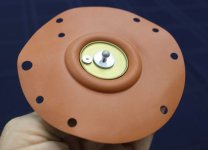
Fuel diaphragm and ball valve:

Fuel Diaphragm.jpg
 
Back
Top