Van's Air Force

The definitive Van's Aircraft support community! Buying, building or flying an RV? Join our exclusive family of mentors and enthusiasts!

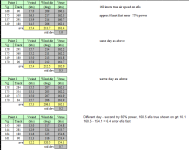
Four leg gps speed test - 6 knots difference help

johnpaul44

Well Known Member
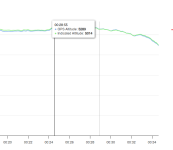
So i have flow the 4 leg GPS speed test several times now at different altitudes and power settings and it appears my GRT 10.1 is reporting TAS about 6 knots or so faster then what the gps box average is giving me. I leak tested the pitot static system and found no leaks, im thinking it might be the static ports?

I also have about a 200 feet error (grt 10.1 is 200 feet low) compared to gps altitude consistently, not sure if this is related?

 

Attachments

  • 20251022_174752.jpg
    20251022_174752.jpg
    680.3 KB · Views: 194
  • 20251022_174758.jpg
    20251022_174758.jpg
    601.1 KB · Views: 198
  • Screenshot 2025-10-23 092602.png
    Screenshot 2025-10-23 092602.png
    46.5 KB · Views: 192
  • Screenshot 2025-10-23 092821.png
    Screenshot 2025-10-23 092821.png
    16.8 KB · Views: 182
Try placing a piece of vinyl to smooth the airflow over your static ports (Make sure to put a hole in it!) . 50 cent test to confirm if your static ports are creating a small low pressure burble.
 
I had this issue on my 6 and it was the static ports. In my case reporting low. You can put fences in front of or behind the rivet - one locations moves the error one way and vice versa. The GRT also has a TAS offset function and can modify reported TAS. However, that doesn't addres the altitude issue. Several old posts about various ways to change airflow around the static ports to address this.

Be carefull as you modify the ports, as indicated stall speed will change. In my case, the static error was not there below 90 MPH, but significant at 185. The fences addressed most of the high speed reporting (remainder addressed with offset), but then my low speed readings were high. My stall speed went up several MPH. You need to re verify all V speeds and then adjust your docs.

Unsure why this happens to only some 6's.
 
any chance my painted static ports could be effecting the readings? i noticed in other discussions that people recommend them to not have paint.
 
any chance my painted static ports could be effecting the readings? i noticed in other discussions that people recommend them to not have paint.
Possible and likely probable. Mine were not painted and still had a significant error, so that certainly isn't a universal cause.
 
Are you using the recommended BLF rivet as per plans? Using those certified types that look like a silver dollar will not be accurate.
 
Are you using the recommended BLF rivet as per plans? Using those certified types that look like a silver dollar will not be accurate.
i attached photos in the original post above, I'm not the builder so I'm unsure what ports are being used. I did order the Stein air static ports but have not fitted them yet because they look identical to what i already have
 
i attached photos in the original post above, I'm not the builder so I'm unsure what ports are being used. I did order the Stein air static ports but have not fitted them yet because they look identical to what i already have
Sorry, missed that. Those are the correct ports. The stein ones should be an identical shape. The paint on the rivet is pretty light, with no build up around the edges and therefore doubt that the paint is the source of the error. Though easy to scrape it off and see what happens. Just don't disturb anything at the edge of the rivet where it transitions to the fuse paint. You want that a nice smooth transition from paint to rivet edge.
 
If you have an airspeed error the usual reason is a static error, not a pitot error. That static error will also produce an altitude error - but GPS altitude may not be that accurate so you may not have an altitude error.

Go back to the data you collected on your airspeed runs. The key here is constant airspeed and constant heading. Airspeed within 2 kt for a couple of minutes will give you a period of 10s where the airspeed is stable. Altitude should be steady, within 10 or 20 ft. The atmosphere has to be still - any convective activity will skew your results. It is best to fly at least 7 speeds, say every 10kt from 70 or 80kt to 150kt.

Fly squares on roughly cardinal headings, that will give several datasets. If one leg is off the others can be used. Fly for a minute or two on each heading and pick an 8 to 10 second period of steady flight as the data point to use. Let the aircraft settle down, don't move the throttle, make sure the altitude doesn't vary. It needs concentration.

Yes, it can take a while but no point in modifying your airplane to fix a problem that doesn't exist.
 
If you have an airspeed error the usual reason is a static error, not a pitot error. That static error will also produce an altitude error - but GPS altitude may not be that accurate so you may not have an altitude error.

Go back to the data you collected on your airspeed runs. The key here is constant airspeed and constant heading. Airspeed within 2 kt for a couple of minutes will give you a period of 10s where the airspeed is stable. Altitude should be steady, within 10 or 20 ft. The atmosphere has to be still - any convective activity will skew your results. It is best to fly at least 7 speeds, say every 10kt from 70 or 80kt to 150kt.

Fly squares on roughly cardinal headings, that will give several datasets. If one leg is off the others can be used. Fly for a minute or two on each heading and pick an 8 to 10 second period of steady flight as the data point to use. Let the aircraft settle down, don't move the throttle, make sure the altitude doesn't vary. It needs concentration.

Yes, it can take a while but no point in modifying your airplane to fix a problem that doesn't exist.


+1 and Constant Track (A/P TRK mode), not HDG.
 
A few comments.
1. I agree with last post, static port should not be painted.
2. I assume your altimeter reads correctly on the ground.
2. GPS and pressure altitude can be different. But at low altitude they should agree well. Make a low pass at a few hundred feet agl with moderate speed down a runway (with current altimeter setting) and compare.
If the indicated altitude is low, that means the static pressure is higher than it should be. Get rid of the paint, compare the static port rivet to Vans specifications including location. IMHO a lot of after market ports look great but don’t work as well as Van’s hollow rivet.
 
Lots of replies here about the static ports, but what about the temperature? This is an important piece of TAS calculations. In the speed/ altitude ranges we're dealing with roughly 15C of temperature error would result in a 6 kt difference in TAS.

Where is your OAT probe, and what is it indicating during these tests? Compare this data to the known OAT (from temps aloft reports, surface temps corrected for altitude, etc.)
 
A few comments.
1. I agree with last post, static port should not be painted.
2. I assume your altimeter reads correctly on the ground.
2. GPS and pressure altitude can be different. But at low altitude they should agree well. Make a low pass at a few hundred feet agl with moderate speed down a runway (with current altimeter setting) and compare.
If the indicated altitude is low, that means the static pressure is higher than it should be. Get rid of the paint, compare the static port rivet to Vans specifications including location. IMHO a lot of after market ports look great but don’t work as well as Van’s hollow rivet.
to your point about gps and pressure altitude, at low altitude they read equal and it seems the error is affected by altitude not airspeed , by 5,000 feet indicated the error is around 200 ft. Maybe this is normal? however the error sems to always favor gps being higher no matter the weather.
 
Lots of replies here about the static ports, but what about the temperature? This is an important piece of TAS calculations. In the speed/ altitude ranges we're dealing with roughly 15C of temperature error would result in a 6 kt difference in TAS.

Where is your OAT probe, and what is it indicating during these tests? Compare this data to the known OAT (from temps aloft reports, surface temps corrected for altitude, etc.)
thats a good point , at a pressure altitude of 4,900ft my OAT reads as 68 degrees. The EFIS calculates my density altitude at this point as 6,700ft.Not sure how far off 68 OAT is from standard atmosphere at that altitude.

The OAT probe was originally in the fresh air duct and very inaccurate. I moved it to under the wing in the root fairing near leading edge. On the ground the OAT probe agrees with all other temp sensors on the aircraft before engine start
 
thats a good point , at a pressure altitude of 4,900ft my OAT reads as 68 degrees. The EFIS calculates my density altitude at this point as 6,700ft.Not sure how far off 68 OAT is from standard atmosphere at that altitude.

The OAT probe was originally in the fresh air duct and very inaccurate. I moved it to under the wing in the root fairing near leading edge. On the ground the OAT probe agrees with all other temp sensors on the aircraft before engine start
I suspect engine heat is impinging on the temp sensor in that location.
 
to your point about gps and pressure altitude, at low altitude they read equal and it seems the error is affected by altitude not airspeed , by 5,000 feet indicated the error is around 200 ft. Maybe this is normal? however the error sems to always favor gps being higher no matter the weather.
Since FL is nearly always hotter than standard the indicated barometric altitude should be higher, not lower, than GPS altitude.
EDIT: I got this backward! Lower altitude on the barometer is consistent with warmer than standard temps.
 
Last edited:
Since FL is nearly always hotter than standard the indicated barometric altitude should be higher, not lower, than GPS altitude. Back to basics: what did the altimeter calibration look like at 5,000’ on your last pitot-static test?
I also agree with the earlier post: under the wing near the root is a poor location for a temperature probe - it can sense the exhaust heat. And if the temperature is off then the IAS to TAS calculation will be off.
i only fly VFR so no pitot static test, only a 24 month transponder check which just recently passed with no issues.

I'm wondering if i should just go pick up flight following and with the current baro set in the EFIS ask ATC what my indicated altitude is showing
 
I suspect engine heat is impinging on the temp sensor in that location.
i had hoped not to have to move it again, but where do people place them ? further out on the wing near inspection plate or wing tips?

looking over my EFIS data again the reported OAT was 68 degrees, i cant imagine I would have a 15C error here but i think its worth a shot to further relocate it outboard
 
i had hoped not to have to move it again, but where do people place them ? further out on the wing near inspection plate or wing tips?

looking over my EFIS data again the reported OAT was 68 degrees, i cant imagine I would have a 15C error here but i think its worth a shot to further relocate it outboard
I've seen them in / near wing inspection plates. I've also seen them under the HSTAB (sticking out from fuselage, shaded by the HSTAB. I've seen and put mine inside the HSTAB intersection fairing. That thing is pretty leaky in most cases, provides shade, should be sufficiently away from the exhaust, etc.
 
I'm wondering if i should just go pick up flight following and with the current baro set in the EFIS ask ATC what my indicated altitude is showing
That’s most likely pointless. Although your transponder sends out pressure altitude and your efis shows you indicated altitude the data cones from the same source.
 
I struggled with a similar problem on my RV-8 for years. Indicated speeds were 7% high throughout the range.
I had a pitot/static probe, changed to a separate attic source, moved the static source, tried different static source. Nothing changed.
I initially had a "six pack" of instruments but the issue continued when I installed a G-3X.
Nothing else to try so I finally changed to Garmins pitot prob. Problem solved. I still don't understand how a pitot tube could produce more air pressure to the instrument but it did.
 
I struggled with a similar problem on my RV-8 for years. Indicated speeds were 7% high throughout the range.
I had a pitot/static probe, changed to a separate attic source, moved the static source, tried different static source. Nothing changed.
I initially had a "six pack" of instruments but the issue continued when I installed a G-3X.
Nothing else to try so I finally changed to Garmins pitot prob. Problem solved. I still don't understand how a pitot tube could produce more air pressure to the instrument but it did.
interesting, i have no idea what probe i have but i know its not homemade because it was originally a heated probe
 
Static problem is easier to test.

Thought- a passing IFR pitot static check is a good baseline for leaks- but that is not flying.

Flying down the runway at cruise at a low altitude you can judge and record the altimeter. That's the old fashioned, TLAR method. Compare to field msl.

In my 6, at cruise, if I open the alternate static valve, the autopilot in altitude hold, both eyeball vents closed, dips the plane 30 feet. It is a standalone autopilot, plumbed to pitot and static.
Matches the EFIS x 2. GRT SX-200, zero offsets, whizzes through IFR pitot static, just had one.

TAT will likely error, to the high side., if mislocated. Makes air seem less dense than the pitot is actually smacking- should lie to the high side, right?

Nail the static, bet that's more of the 6 knots than any TAT high error.
 
Last edited:
i had hoped not to have to move it again, but where do people place them ? further out on the wing near inspection plate or wing tips?

looking over my EFIS data again the reported OAT was 68 degrees, i cant imagine I would have a 15C error here but i think its worth a shot to further relocate it outboard
You can do the math, but a few degrees of inaccurate indicated temp will NOT cause a 6 knot airspeed error. That location may not be optimal, but not likely to be that far off in my opinion. This shows you how little impact moderate temp variances make:

example 6000' & 150 kt - TAS @ 60*F = 168 / TAS @ 70*F = 169 Without rounding, this is probably under a knot.

At 150 kt, not a lot of exhaust is going to make it to the wing root, relative to free stream. The exhaust gasses would have to turn almost 70 degrees and travel a foot or two at that angle, fighting the free stream, to get to the center of the wing root cover. As long as the indicated temps aloft seem reasonable compared to forecast, you are not likely to be far enough off to be causing your problem. I am sure there is hot air leaking out of the corner of the cowl edge that will hit that wing root, but the impact should be limited. Nowhere near as bad as the probe in the naca vent that is in direct alignment with the long horiz cowl seam bleeding hot air.
 
Last edited:
…….I still don't understand how a pitot tube could produce more air pressure to the instrument but it did.
There’s a reason most ‘L’ shaped probes get the inlet well below and maybe a bit in front of the wing. Probes used for precision testing are often way in front of the wing. Both cases, they want clean undisturbed air. Piper-style blade combo pitot-static probes have less wing clearance and are often mounted further back under the wing. I’m amazed they work at all.
So, OP: what does your pitot look like, where is it mounted?
 
Flying down the runway at cruise at a low altitude you can judge and record the altimeter. That's the old fashioned, TLAR method. Compare to field msl.
.
Recommend you do this test to keep your sanity. Set field elev before take off and the speed run should be 10 or 20’ higher. If this test shows an altitude error, you know your issue is in the static system. If not, it is not the static system and likely in the Pitot system or an oat issue or an instrument issue.
 
Last edited:
Recommend you do this test to keep your sanity. Set field elev before take off and the speed run should be 10 or 20’ higher. If this test shows an altitude error, you know your issue is in the static system. If not, it is not the static system and likely in the Pitot system or an oat issue or an instrument issue.
so here's what my indicated and gps altitude read all the way up and down, i did not change the baro meter setting for the whole flight as it was a local flight only directly above the airport.

Indicated 50ft , gps 46ft (on ground)
Indicated 490ft, gps 495ft
indicated 1035ft, gps 1070ft
Indicated 1932ft, gps 2006ft
Indicated 2938ft, gps 3044ft
Indicated 3853ft, gps 4007ft
Indicated 4977ft, gps 5188ft

and back down

Indicated 3835ft, gps 3998ft
Indicated 2933ft, gps 3055ft
Indicated 1944ft, gps 2015ft
Indicated 1022ft, gps 1071ft
Indicated 463ft, gps 489ft
Indicated 41ft, gps 48ft (on ground)
 
so here's what my indicated and gps altitude read all the way up and down, i did not change the baro meter setting for the whole flight as it was a local flight only directly above the airport.

Indicated 50ft , gps 46ft (on ground)
Indicated 490ft, gps 495ft
indicated 1035ft, gps 1070ft
Indicated 1932ft, gps 2006ft
Indicated 2938ft, gps 3044ft
Indicated 3853ft, gps 4007ft
Indicated 4977ft, gps 5188ft

and back down

Indicated 3835ft, gps 3998ft
Indicated 2933ft, gps 3055ft
Indicated 1944ft, gps 2015ft
Indicated 1022ft, gps 1071ft
Indicated 463ft, gps 489ft
Indicated 41ft, gps 48ft (on ground)
Sadly this doesn’t help much. Unless you have access to real time wx balloon data, you can’t know the barometric pressure aloft and therefore can’t compare indicated altitude to gps altitude. While we call it an altitude indicator, it is really just a pressure indicator that we try to translate to altitude by making assumptions about pressure changes as we go up. The assumptions are wrong the vast majority of the time.

That is why moose pilots suggestion was so good. Speed is what causes static errors with the wrong port. You know the barometric pressure on the ground, so compare altitude on the ground at stand still vs 140 kts on the ground (20’ above it) will tell you if speed is fouling the static readings.

Set altimeter and observe altitude. Take off and come back around for a high speed pass at 20’ above the runway. Observe altitude during the pass and subtract 20’, then compare to initial altitude. If the numbers are the same, your static ports are not the source of the error. If they are way off, they are your problem.
 
Last edited:
Okay, those numbers are consistent with higher than standard temperatures. I think your static port is okay.
Now to airspeed.
I’d start with the efis calculation of TAS. Do you have IAS, outside temp, pressure altitude data? Use that (or post what you have) and calculate TAS by hand. I’m wondering if the efis is expecting Centigrade but getting Farenheit, or something like that.
 
A little higher than 20' please, don't want ground effect skewing the data;) or any needless P.K. ground tests.

Use a recorder, NOT real time eyeballs to record test height.

If not a very flat airport, pick a msl check high point on the field.
 
A little higher than 20' please, don't want ground effect skewing the data;) or any needless P.K. ground tests.
good advice. Was just throwing out an example number and wasn't thinking about what a safe altitude.:eek: Assumed the OP would pick a number that he was comfortable with.

 
The OAT probe was originally in the fresh air duct and very inaccurate. I moved it to under the wing in the root fairing near leading edge. On the ground the OAT probe agrees with all other temp sensors on the aircraft before engine start
I had my OAT probe in the wing root for a long time and found that some how engine heat got in there. I could change the OAT with the EGT. It has to be ,located externally out of the prop tip diameter. This conclusion is based on testing with TC's at 6 different locations. I finally used a wing inspection plate location.

I checked my speed accuracy and plotted it vs airspeed before and after paint. My paint made essentially no difference, way less than a knot, the delta vs airspeed varied, but none of that seemed to be outside normal test variability.

Before stripping paint, you might test clean the hole with a small drill bit as it looks like some buffing compound in there. Just hold it in your hand gently no real drilling.
 
Last edited:
You can do the math, but a few degrees of inaccurate indicated temp will NOT cause a 6 knot airspeed error. That location may not be optimal, but not likely to be that far off in my opinion. This shows you how little impact moderate temp variances make:

example 6000' & 150 kt - TAS @ 60*F = 168 / TAS @ 70*F = 169 Without rounding, this is probably under a knot.

At 150 kt, not a lot of exhaust is going to make it to the wing root, relative to free stream. The exhaust gasses would have to turn almost 70 degrees and travel a foot or two at that angle, fighting the free stream, to get to the center of the wing root cover. As long as the indicated temps aloft seem reasonable compared to forecast, you are not likely to be far enough off to be causing your problem. I am sure there is hot air leaking out of the corner of the cowl edge that will hit that wing root, but the impact should be limited. Nowhere near as bad as the probe in the naca vent that is in direct alignment with the long horiz cowl seam bleeding hot air.
I would agree with the OAT accuracy not being the problem with airspeed, but all the logic in how the exhaust can or can not get in the wing root is not reality. I did discover significant OAT change with the wing root location when going from low EGT to high EGT in cold weather. It was validated against the wing inspection plate location (among other locations also tested) via thermocouples. Did you know plain ole blue masking tape stays on quite well?
 
I would agree with the OAT accuracy not being the problem with airspeed, but all the logic in how the exhaust can or can not get in the wing root is not reality. I did discover significant OAT change with the wing root location when going from low EGT to high EGT in cold weather. It was validated against the wing inspection plate location (among other locations also tested) via thermocouples. Did you know plain ole blue masking tape stays on quite well?
Interesting observation. Thanks for sharing that. Never would have thought exhaust could move to that area.
 
After thinking about this, I’d suggest the next step is to check the pitot pressure calibration.
1. Look up ‘water manometer’. This is easy to construct with vinyl tubing (choose a diameter that makes a snug fit over your pitot tube.) you want the ‘U’ in the tubing at least 20” deep.
2. Tape over the pitot drain hole. Tape the tubing to insure a leak free fit.
3 add water, until there is a 13.7” difference in the water level, open end higher than pitot end. You can lightly blow on the open end to get the 13.7” if needed.
This is best done with 2 people; one to set the 13.7” difference in water level, the other to look at the efis.
If the water wants to flow up and into the pitot, you have a leak. Fix it.
When the difference in water height is 13.7”, the efis should read close to 145 knots, assuming you’re close to sea level. If it reads 150 knots, you found the problem; the internal pressure sensor needs re-calibration.

Your local instrument shop can run this test for you, using a lot more sophisticated instruments. Probably charge $300 or so.
 
After thinking about this, I’d suggest the next step is to check the pitot pressure calibration.
1. Look up ‘water manometer’. This is easy to construct with vinyl tubing (choose a diameter that makes a snug fit over your pitot tube.) you want the ‘U’ in the tubing at least 20” deep.
2. Tape over the pitot drain hole. Tape the tubing to insure a leak free fit.
3 add water, until there is a 13.7” difference in the water level, open end higher than pitot end. You can lightly blow on the open end to get the 13.7” if needed.
done with 2 people; one to set the 13.7” difference in water level, the other to look at the efis.
If the water wants to flow up and into the pitot, you have a leak. Fix it.
When the difference in water height is 13.7”, the efis should read close to 145 knots, assuming you’re close to sea level. If it reads 150 knots, you found the problem; the internal pressure sensor needs re-calibration.

Your local instrument shop can run this test for you, using a lot more sophisticated instruments. Probably charge $300 or so.
Op has a grt with an adhrs. Those are all electronic and don’t believe they can be calibrated by a local instrument shop, like a traditional diaphragm gauge, though it maybe possible that grt could replace a failed sensor. Electronic ahrs have a pretty good reputation of never drifting. This is at least that is what i have heard from the guys doing ifr certs.
 
Op has a grt with an adhrs. Those are all electronic and don’t believe they can be calibrated by a local instrument shop, like a traditional diaphragm gauge, though it maybe possible that grt could replace a failed sensor. Electronic ahrs have a pretty good reputation of never drifting. This is at least that is what i have heard from the guys doing ifr certs.
I agree. But a rule for trouble shooting is ‘look at easy stuff first, even if unlikely.’ And this is a pretty easy check.
What I really think is that the static pressure is lower than ambient by about 1” of water (0.1 “Hg). Maybe due to the paint, maybe due to location. This is being masked by the 68F OAT, which I suspect is high due to exhaust or engine cooling air. If the correct OAT turns out to be 59F then everything fits. Maybe the easiest test is to mask off the static port, use paint remover to take all the paint off the port, remove the tape, repeat the 4 leg gps test and see if speeds (gps corrected for wind and TAS calculated by efis) match better.
 
Last edited:
There’s a reason most ‘L’ shaped probes get the inlet well below and maybe a bit in front of the wing. Probes used for precision testing are often way in front of the wing. Both cases, they want clean undisturbed air. Piper-style blade combo pitot-static probes have less wing clearance and are often mounted further back under the wing. I’m amazed they work at all.
So, OP: what does your pitot look like, where is it mounted?

Yes, positioning is important. What is/was odd is that my original pitot/static tube was large (don't remember where I bought it) and was lower and the pitot opening were lower and further down from the wing than the standard at the time, AN tube pitot. I always thought it would get cleaner air but...?
 
I agree. But a rule for trouble shooting is ‘look at easy stuff first, even if unlikely.’ And this is a pretty easy check.
What I really think is that the static pressure is lower than ambient by about 1” of water (0.1 “Hg). Maybe due to the paint, maybe due to location. This is being masked by the 68F OAT, which I suspect is high due to exhaust or engine cooling air. If the correct OAT turns out to be 59F then everything fits. Maybe the easiest test is to mask off the static port, use paint remover to take all the paint off the port, remove the tape, repeat the 4 leg gps test and see if speeds (gps corrected for wind and TAS calculated by efis) match better.
Agreed across the board. However, I don't have a lot of confidence in the 6 port loacation, as I do on the other models. On my 6A, I am in the designed location, with the BLF rivet and no paint on it. I was off 6-8 knots at cruise and only a knot or 2 off at 90 mph, so definately a free stream static issue. I was able to bring it back in line with little fences in front of the rivet to disturb the airflow; A trick I learned here from other 6 owners with the same issue. I have seen posts from several other 6 users with similar issues, though not large numbers. My 10 is all stock and dead on. So, while I generally believe the RV port locations are very rerliable, I do not believe this is a solid on the 6. No idea why that is.

I think very few people do proper testing and the vast majority of owners woulds never even know if they had a 6 knot indication error. That kind of skews the data when we say the stock location is very accurate.
 
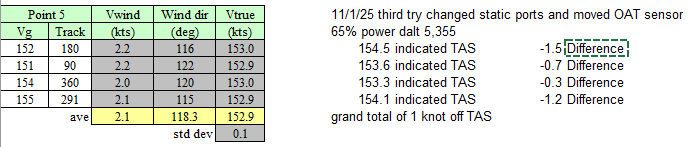
Thanks for all the help everyone, i finally had time for a test flight tonight and looks like the issue is fixed. I removed my stock rivet static ports that were painted and replaced them with Stein air ports, i also moved the OAT sensor out to the wing inspection panel.

The 4 leg GPS speed test results are a calculated TAS of 152.9 and TAS indicated of 153.9, or one knot off. Good enough for me!

Additionally my indicated altitude vs GPS alt is now only off by 100feet at 5,000 feet, and lower altitudes its only off by 10 to 20 feet
 

Attachments

  • 20251031_174700.jpg
    20251031_174700.jpg
    695.8 KB · Views: 23
  • Screenshot 2025-11-01 222550.png
    Screenshot 2025-11-01 222550.png
    17.6 KB · Views: 22
Thanks for all the help everyone, i finally had time for a test flight tonight and looks like the issue is fixed. I removed my stock rivet static ports that were painted and replaced them with Stein air ports, i also moved the OAT sensor out to the wing inspection panel.

The 4 leg GPS speed test results are a calculated TAS of 152.9 and TAS indicated of 153.9, or one knot off. Good enough for me!

Additionally my indicated altitude vs GPS alt is now only off by 100feet at 5,000 feet, and lower altitudes its only off by 10 to 20 feet
Any difference in OAT? Remember barometric and gps altitudes are two different things. They might not be ‘off’ at all if it’s warmer than standard.
 
Any difference in OAT? Remember barometric and gps altitudes are two different things. They might not be ‘off’ at all if it’s warmer than standard.
im not sure on the change but it seems about 10F lower then before. Recent flight 4,700 indicated OAT was 55. I think this might be closer to standard atoms lapse rate
 
im not sure on the change but it seems about 10F lower then before. Recent flight 4,700 indicated OAT was 55. I think this might be closer to standard atoms lapse rate
Well, about 13 C vs 5 C for standard lapse rate. (5K feet). If you apply the temperature correction to indicated altitude (to get a closer approximation to true (or gps) altitude I think you’ll see very good agreement.
I agree, problem solved.
 
Agreed across the board. However, I don't have a lot of confidence in the 6 port loacation, as I do on the other models. On my 6A, I am in the designed location, with the BLF rivet and no paint on it. I was off 6-8 knots at cruise and only a knot or 2 off at 90 mph, so definately a free stream static issue. I was able to bring it back in line with little fences in front of the rivet to disturb the airflow; A trick I learned here from other 6 owners with the same issue. I have seen posts from several other 6 users with similar issues, though not large numbers. My 10 is all stock and dead on. So, while I generally believe the RV port locations are very rerliable, I do not believe this is a solid on the 6. No idea why that is.

I think very few people do proper testing and the vast majority of owners woulds never even know if they had a 6 knot indication error. That kind of skews the data when we say the stock location is very accurate.
This brought back a memory ... when installing my static ports on the 6, I realized that the 7 had moved them... and put mine where the 7's were. I figured they must have figured something out. At least this is what I think I found & did 12-14 years ago (?) I am using the rivet, and my CAS came out good.

EDIT: yes, I mean the IAS is close to what it should be.
 
Last edited:
This brought back a memory ... when installing my static ports on the 6, I realized that the 7 had moved them... and put mine where the 7's were. I figured they must have figured something out. At least this is what I think I found & did 12-14 years ago (?) I am using the rivet, and my CAS came out good.
Thanks for sharing. I wonder if others have done the same. I may give that a try, as i would really like to have real ias numbers at low speeds.
 
Thanks for sharing. I wonder if others have done the same. I may give that a try, as i would really like to have real ias numbers at low speeds.
I presume you mean IAS close to CAS. Strictly speaking IAS is what it is. IAS well off from CAS at low speeds is usually due to the non-zero angle of the pitot tube with the relative wind (nose high attitude at low speeds). The ‘fix’ is to mount the pitot in a gimbal mount with vanes, like feathers on an arrow, to keep the pitot straight into the relative wind.
 
I presume you mean IAS close to CAS. Strictly speaking IAS is what it is. IAS well off from CAS at low speeds is usually due to the non-zero angle of the pitot tube with the relative wind (nose high attitude at low speeds). The ‘fix’ is to mount the pitot in a gimbal mount with vanes, like feathers on an arrow, to keep the pitot straight into the relative wind.
With the original rivet setup, the low speed ias indications matched well to 4 point gps tests and also vans specified stall speeds. However, my cruise numbers were about 8 mph high or possibly low, i just can’t remember from 10 years ago. After putting on the fences in front of my rivet, the high speed numbers came back in line, but the low speed numbers went up relative to 4 point tests.

I have the relatively standard pitot stalk installed just behind the spar like most other rvs and a relatively standard dynon pitot. Many other rvs have similar setups with accurate speed indications and they seem to report accurate cruise speeds and stall speeds similar to vans. For these reasons, i always assumed this was a static issue. At low velocity free stream, ige get accurate static, but at high velocity, the static deviates from ambient pressure. I always thought this was a common problem and why the designers work so hard to find a spot that is neutral.
 
Back
Top