Van's Air Force

The definitive Van's Aircraft support community! Buying, building or flying an RV? Join our exclusive family of mentors and enthusiasts!

Flywheel drive lugs and propeller fit issue

Craw

Active Member
Hello,
I am trying to install my new whirlwind 330 series 2 blade constant speed propeller onto my factory new Lycoming YIO-360-A1B6.

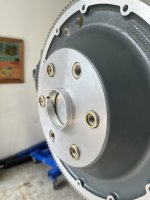
The Whirlwind instructions clearly state that the drive lugs must protrude the flywheel surface by between 0.18” to 0.20”.

The drive lugs provided with my engine only protrudes ~0.14” so just shy of the baseline requirement. I have noticed that the two drive lugs meant to be flush are recessed by ~0.04 which happens to be the dimension that I am missing to meet the requirement.

The flywheel is is fitted with the O aligned with the O on the crankshaft. I can’t find anything causing interference with its fit..? Should I order new lugs or a new flywheel? What could be causing this issue?

Thanks for your feedback,
 

Attachments
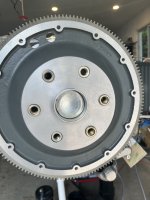
  • IMG_1942.jpeg
    IMG_1942.jpeg
    1.8 MB · Views: 64
  • IMG_1941.jpeg
    IMG_1941.jpeg
    1.7 MB · Views: 62
Last edited:
Hello,
I am trying to install my new whirlwind 330 series 2 blade constant speed propeller onto my factory new Lycoming YIO-360-A1B6.

The Whirlwind instructions clearly state that the drive lugs must protrude the flywheel surface by between 0.18” to 0.20”.

The drive lugs provided with my engine only protrudes ~0.14” so just shy of the baseline requirement. I have noticed that the two drive lugs meant to be flush are recessed by ~0.04 which happens to be the dimension that I am missing to meet the requirement.

The flywheel is is fitted with the O aligned with the O on the crankshaft. I can’t find anything causing interference with its fit..? Should I order new lugs or a new flywheel? What could be causing this issue?

Thanks for your feedback,
It's been a while but when I installed my WW300 also noticed a similar issue. I pulled the flywheel to insure there was nothing obstructing a flush fit and took 1-inch 1/2-20 bolts and with an oversized washer and inserted in the 2 drive lugs that sat recessed and tightened each one up maybe 15 ft lbs. They pushed the flywheel down enough to get very close to 0.18 proud on the 4 lugs. Same thing will occur when you mount your prop.

BTW don't forget to pull the center cap off before mounting the prop.
 
look at the back of the crank flange. Are the lugs pulled all the way that their seats are flush with the flange?

Also need to insure that the flywheel is fully pressed onto the flange. hard to do without bolts.
 
Thanks all and yes I have removed the crank plug, confirmed that second plug is NOT pierced and of course the engine came with the oil return line for the governor already installed.

Even with the Flywheel bolted on with washers and torqued to 15ft-lbs the flywheel will forward face is not flush with two drive lugs. The drive lugs remain recessed by approximately 0.04 inches from the forward face of the flywheel. The lugs are pulled up snug against the rear face of the crankshaft flange and the flywheel is correctly place on the index lug and is not binding anywhere.

I have also confirmed that my crankshaft flange is 0.44'' thick in line with a type/config 2 setup per Lycoming SI1098Q and the the lugs are correctly indexed and have the correct numbers on them per the SI.

I have contacted both Vans Aircraft, Lycoming and Whirlwind for advice on how to proceed. Whirlwind pointed me to SI1098Q and have been helpful but I believe the issue lies with the Flywheel and am waiting for Vans (thorugh whom I purchased the engine) or Lycoming to provide the next steps or corrective actions to address the issue.

Cheers
 
Last edited:
Hello, I have the same issue. What is the resolution? Whirlwind 300-3B-77 3 blade on a IO-540-D4A5. RV-10.
 
Hello, I have the same issue. What is the resolution? Whirlwind 300-3B-77 3 blade on a IO-540-D4A5. RV-10.
Imho, there is no reason that the lug be flush with the flywheel. .040” short is no big deal. The forces on the flywheel are relatively light and there is still plenty of contact on that lug, not to mention the other 5.
 
I am less worrried about the flush and more concerned about the .180-.200 recommended protrusion only being .140.

They call it out for a reason. I sent a tech question to WW.
 
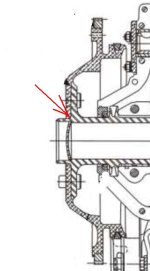
Check the filet radius on the crank nose, as compared to the relief cut on the aft side of the flywheel bore.

ScreenHunter_3127 Jan. 20 08.17.jpg
 
In April 2024 I saw the same thing during the installation of my WW 300-72. It's impossible to get the minimum lug engagement called out in the WW manual.

Mine also came with AN5-4 (head drill for safety wire) bolts already installed finger tight in the back side of the prop hub for mounting the spinner backplate. The manual calls out AN5-4A (non-drilled) bolts and specifies that they're supposed to be secured with loc-tite 262.

I contacted Whirlwind and was told that both of those were mistakes in their manual, that the lower actual lug engagement was fine, that the preferred method of installing the backplate was to safety wire the bolt heads and not to use loc-site 262, and they would correct both those callouts at the next revision.

They revise that manual 6 months later (sept. 2024) and carried both of those issues over into the new revision.
 
Check the filet radius on the crank nose, as compared to the relief cut on the aft side of the flywheel bore.

View attachment 107733
Hello Dan, thank you for the suggestion. It appears this is not the problem. First is that the flywheel does not "rock", back and forth. I would expect the rocking if it was interfering at the inside radius you point out. Second, my drive lugs protrude on the front face of that crankshaft a total of .395. The mating surface of the flywheel is .255 thick. .395-.255 = .140, protrusion on the flywheel, again proving the flywheel is flush mounted on the crank- a good sign.

Either my crank flange is too thick, my flywheel mating surface is too thick or I can find the .140 protrusion to be acceptable.

SI1098Q states that the Flange thickness on an IO_540-D4A5 engine should be .44. Mine is .442 all good there.

Maybe the flywheel flange is too thick?
Is .140 vs .180-.200 protrusion enough.
Or as mentioned by Desert Rat", the manual is not correct.
 
I found the same discrepancy with the lug lengths and spinner back plate bolts. My dimensions match everyone here. And drilled head screws with instructions to use loctite. Received last week.
 
Is .140 vs .180-.200 protrusion enough.
IMO, yes. I don't understand why WW even cares about this, as those short lugs don't interface with the prop hub. As long as the threads are the correct length, they shouldn't care. The longer lugs don't extend the threads into the extended portion. This is really a lyc question, as the short lugs engage only the Lyc ring gear support.
 
IMO, yes. I don't understand why WW even cares about this, as those short lugs don't interface with the prop hub. As long as the threads are the correct length, they shouldn't care. The longer lugs don't extend the threads into the extended portion. This is really a lyc question, as the short lugs engage only the Lyc ring gear support.
Pure speculation using my Mechanical engineering degree (not used in 30 years). I think the protrusion into the prop hub and into the flange is to make those lugs bear the brunt of shear issues as opposed to the bolt. Just my 2 cents.
 
Pure speculation using my Mechanical engineering degree (not used in 30 years). I think the protrusion into the prop hub and into the flange is to make those lugs bear the brunt of shear issues as opposed to the bolt. Just my 2 cents.
True for the 4 long lugs and agree with you. They bear load from prop and ring gear. The two short lugs only carry loads from the ring gear and not the prop. Hence a lyc issue, not a ww issue. Not even sure the long ones carry any load. above mt pay grade. some here have speculated the tensile force of the bolts and contact friction do all the load carrying. Though suspect in that case the lugs become the backup.
 
Last edited:
I just called Whirlwind Technical support. Very nice to talk to. They responded with the following.
The Drive Lug protrusion just needs 1 full thread on the 1/2-20 bolt. 20 threads per inch - 1 thread is .050 inches. Most of us have .140 so closer to 3 threads. All OK.
 
Last edited:
Back
Top