Van's Air Force

The definitive Van's Aircraft support community! Buying, building or flying an RV? Join our exclusive family of mentors and enthusiasts!

Flying the approach at 185 kt in an RV-9A

Ed_Wischmeyer

Well Known Member
Patron
Well, okay, that was the groundspeed on base with a nice tailwind, but when ATC asked for maximum forward speed to get us in ahead of two regional jets, the RV-9A was up to the task. And we were VFR, so we could be aggressive in our speed management.

The fun started maybe 15 miles from the Initial Approach Fix, IIRC, 1200 feet above the crossing altitude, and well off the final approach course. 24" of manifold pressure and a slight descent quickly had us at 155-160 KIAS, top of the green and tickling the yellow. I let the autopilot do the flying, and I concentrated on the power management, airspeed, and descent. The turbulence was "light," meaning we still got beat up some, especially at those speeds, and there was one feisty gust that hit us from the side.

ATC wanted maximum forward speed to a five mile final, i.e., the final approach fix. That's where I started a gradual slowdown from 155 KIAS, almost as if nursing a turbocharged big Continental instead of a bulletproof O-320. Everything was well under control, and two miles out, we were at 100 KIAS. Flap speed came soon, and we were at minimums at the desired 80 KIAS -- fast enough to allow the autopilot to easily TOGA if we needed to, but slow enough that full flaps were available and would easily get us onto any instrument runway. If this had been actual IFR, I could have been less aggressive in keeping the speed up.

Right over the runway, there were considerable gusts and, to use the Navy phrase, I was killing snakes (moving the stick vigorously), keeping the plane exactly over the centerline and compensating for the gusts till a very gentle touchdown on the mains. However, I forgot that I'd asked for a long landing, but there was plenty of time to get to the turnoff most of the way down the runway.

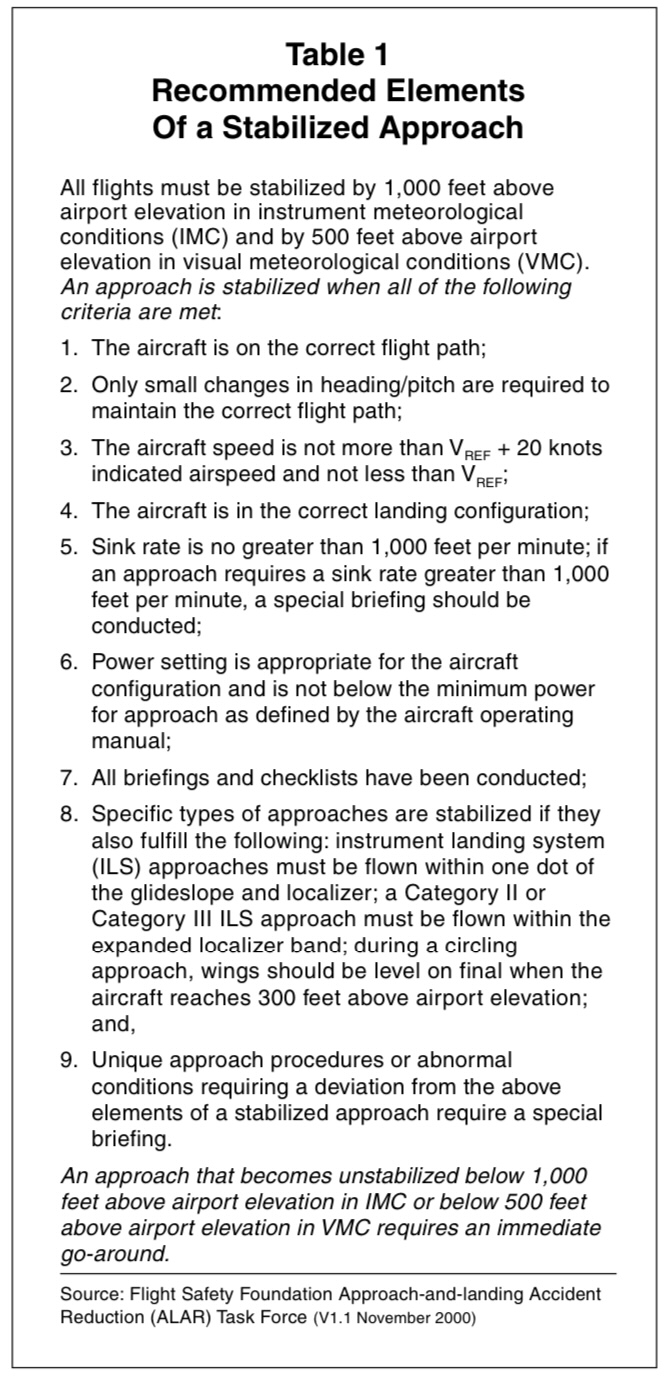
So everything was well under control on the approach. Even if this didn't meet the airline definition of "stable approach," it met those same objectives. Along those lines, Rod Machado has a fun read about CFIs who try to teach their students to fly light planes as if they were jets.

My young CFI had never seen some of what we used to fly, so earlier in the flight I showed her a Lazy 8 with 60° banks. I'd not done a Lazy 8 for forty plus years, and never in the RV. It was smooth and easy, maybe 1.5 G, but my wind compensation was absent. Still, she enjoyed seeing something more than a Lethargic 8 as currently taught.

As for my recovery from two surgeries last year and a heart attack, and only ten hours (dual) during that time, several questions are answered. Yes, I can still fly reasonably well and yes, I still enjoy it. The one remaining question is how much endurance I'll have in the cockpit, if six hour trips are still doable or if my body only wants to fly one hour per day, despite all the rehab. Meanwhile, I'm still waiting for the Special Issuance Third Class medical...

It's too soon to advertise the RV-9A for sale.
 
I have a different way to look at “stable approach.” It is reminiscent of the old expression “fast is slow, slow is smooth, smooth is fast.” And it is just as simple, ‘don’t be a jerk and jolt it.’ We need to remind ourselves the physics definition of jerk or jolt. That’s it, if you’re smooth, you’re stable. And remember, dive bombing requires stability in order to hit targets… ‘dive’ has a particular definition too. A definition that proves ‘dive and drive’ to be a misnomer.
 
For what it’s worth, my airline’s stabilized approach policy is at 1000’. On speed, configured, on glide path, and spooled. Until then, most everyone is flying a constantly-slowing approach. We kinda whine when the RNAV-RNP approaches require no faster than 210KIAS for the turns. Nothing wrong with what you did IMHO. Another tool in your bag. Use it when it’s appropriate.
 
For what it’s worth, my airline’s stabilized approach policy is at 1000’. On speed, configured, on glide path, and spooled. Until then, most everyone is flying a constantly-slowing approach. We kinda whine when the RNAV-RNP approaches require no faster than 210KIAS for the turns. Nothing wrong with what you did IMHO. Another tool in your bag. Use it when it’s appropriate.

They may soon move away from that:


For what it’s worth, my airline’s stabilized approach policy is at 1000’. On speed, configured, on glide path, and spooled. Until then, most everyone is flying a constantly-slowing approach. We kinda whine when the RNAV-RNP approaches require no faster than 210KIAS for the turns. Nothing wrong with what you did IMHO. Another tool in your bag. Use it when it’s appropriate.
I looked at stable approaches 20+ years ago while at Boeing: https://asasi.org/wp-content/uploads/2021/05/Wischmeyer_Unstable-Approach_ISASI04.pdf. And, IIRC, about three years or so ago, the Flight Safety Foundation did a study with similar conclusions. And here's a more recent paper that includes GA: https://airfactsjournal.com/2022/12/unstable-final-approaches-history-fiction-and-fact/

Enjoy!!
 
Well, okay, that was the groundspeed on base with a nice tailwind, but when ATC asked for maximum forward speed to get us in ahead of two regional jets, the RV-9A was up to the task. And we were VFR, so we could be aggressive in our speed management.

The fun started maybe 15 miles from the Initial Approach Fix, IIRC, 1200 feet above the crossing altitude, and well off the final approach course. 24" of manifold pressure and a slight descent quickly had us at 155-160 KIAS, top of the green and tickling the yellow. I let the autopilot do the flying, and I concentrated on the power management, airspeed, and descent. The turbulence was "light," meaning we still got beat up some, especially at those speeds, and there was one feisty gust that hit us from the side.

ATC wanted maximum forward speed to a five mile final, i.e., the final approach fix. That's where I started a gradual slowdown from 155 KIAS, almost as if nursing a turbocharged big Continental instead of a bulletproof O-320. Everything was well under control, and two miles out, we were at 100 KIAS. Flap speed came soon, and we were at minimums at the desired 80 KIAS -- fast enough to allow the autopilot to easily TOGA if we needed to, but slow enough that full flaps were available and would easily get us onto any instrument runway. If this had been actual IFR, I could have been less aggressive in keeping the speed up.

Right over the runway, there were considerable gusts and, to use the Navy phrase, I was killing snakes (moving the stick vigorously), keeping the plane exactly over the centerline and compensating for the gusts till a very gentle touchdown on the mains. However, I forgot that I'd asked for a long landing, but there was plenty of time to get to the turnoff most of the way down the runway.

So everything was well under control on the approach. Even if this didn't meet the airline definition of "stable approach," it met those same objectives. Along those lines, Rod Machado has a fun read about CFIs who try to teach their students to fly light planes as if they were jets.

My young CFI had never seen some of what we used to fly, so earlier in the flight I showed her a Lazy 8 with 60° banks. I'd not done a Lazy 8 for forty plus years, and never in the RV. It was smooth and easy, maybe 1.5 G, but my wind compensation was absent. Still, she enjoyed seeing something more than a Lethargic 8 as currently taught.

As for my recovery from two surgeries last year and a heart attack, and only ten hours (dual) during that time, several questions are answered. Yes, I can still fly reasonably well and yes, I still enjoy it. The one remaining question is how much endurance I'll have in the cockpit, if six hour trips are still doable or if my body only wants to fly one hour per day, despite all the rehab. Meanwhile, I'm still waiting for the Special Issuance Third Class medical...

It's too soon to advertise the RV-9A for sale.
Ed,
Fly until you can't.
Be safe, have fun until it isn't.
Daddyman58
 
Flying approaches in a RV-9V at 155 kts IAS is a really neat thing. I've had to do it a couple of times and was amazed at how smooth the event was - until I was about a mile from the runway... Then I had to rely on the wonderful braking power of the constant-speed prop to get slowed down to landing speed. But, those approaches were into airports with 6K+ runway. So I could let it roll out if I had had to.
Now, I'm facing the great eternity with Pancreatic Cancer, and am going to have to sell the plane, and rip my heart out...
I understand the path Ed is / has taken, very well.
 

Having seen some other pieces, I had to go back in and add a stinger to this one:

————————————————
Consider this piece advocating stabilized approaches:

https://www.iata.org/contentassets/...6015/unstable-approaches-2016-2nd-edition.pdf

“Inevitably safety management resources are finite and must be targeted in ways that offer the greatest opportunities for prevention. During the data period 2011-2015 considered within the following chapters approximately 65% of all recorded accidents occurred in the approach and landing phases of flight, and unstabilized approaches were identified as a factor in 14% of those approach and landing accidents.”

Wow! Fourteen percent! That seems a far cry from percentages previously reported. Almost as if there is lots of noise ready to lead one astray to false conclusions. Fourteen percent. Almost like this is not the area to address to reduce approach and landing accidents.

“Many contributory factors can be identified in each accident but approach-and-landing accidents are frequently preceded by a poorly executed and consequently unstabilized approach, together with a subsequent failure to initiate a go-around.”

How do you draw this conclusion when 86% of landing accidents came from approaches deemed stable?

“In the terminology of Threat & Error management (TEM) an unstabilized approach is a serious Undesired Aircraft State that can have a catastrophic outcome or ‘End State’ if not correctly managed by the pilots.”

What are we doing here? We’re labeling something bad, declaring it so despite it not actually having substance making it so, then finding anyone doing such to be bad. This is attribution, it is social construct; it is not evidence and discovery. Where is the falsifiable hypothesis?

We’ve seen this ‘buzzword bingo’ before, TEM is crap. https://medium.com/@jamesmcclaranallen/turds-eating-manure-tem-c6337af9574c

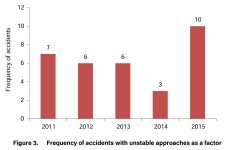
“On average, there were about six (6) accidents per year. Figure 3 below illustrates the frequency of events with an unstable approach as a factor over each of the five years of the period:

Again, how many landings do you suppose there are in a year?

Oh, wait, they try to discount this,

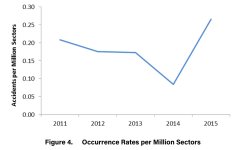
“Absolute numbers of accidents are not necessarily a good indication of safety performance and are of limited comparative value unless they are normalized by the number of sectors flown per year to create an accident rate. Figure 4 shows the occurrence rates per million sectors flown per year.

I don’t know what a “sector” is, but I see you’re looking at one per every four or five million sectors. That is a tiny number. You really think you can parse noise out of that? That you can draw conclusions? And, at this, one per every four to five million is total events… ‘unstabilized’ only applies to fourteen percent of these? Tiny just got excessively puny.

Consider James Albright again, “a balked landing is more complicated and riskier than a missed approach. What do you have to worry about? The second you dip below the published Decision Altitude (DA) or beyond the published Missed Approach Point (MAP), lots: 1. obstacle clearance, 2. ground effect, 3. engine spool up time, 4. execution… Once you've gone below your Decision Altitude (DA) you are landing. If for some reason you can't land, you have ‘balked’ the landing. There are many ways this can happen.” “Going missed approach before the DA assures you of obstacle clearance, provided you follow the procedure. Once you've gone beyond the DA, you might be okay. But maybe not... The Juneau International Alaska (PAJN) LDA X Rwy 8 does just that: ‘CAUTION: Any go-around after passing MAP will not provide standard obstruction clearance.’” “The approach plate tells you the missed approach climb gradient is steep. The procedure may hint at a problem with steeper than normal required climb gradients. The Juneau International Alaska (PAJN) RNAV(GPS) V Rwy 8 does that: ‘Missed approach requires minimum climb of 363 feet per NM to 3200.’” “The airport is normally one way in, another way out.” “in the balked landing situation is that we could find ourselves just barely climbing while in-ground-effect, and once we do climb out-of-ground-effect, we may not have enough thrust available to maintain airspeed.” potentially compounded by “even modern engines can sometimes take the full 8 seconds to accelerate from low speeds. The lag will be made worse if the aircraft is slow. In the balked landing accident of Air Canada 646, for example, it took the engine 7.5 seconds to go from idle to a normal go around thrust because the aircraft was 6 knots below VREF. Normal spool up time should have been 3 seconds.”- https://code7700.com/balked_landing.htm

Yet his point here seems to me to suggest an alternative course of action, “Even if you spot the runway you might discover an aircraft problem that prevents you from landing or a runway problem that makes landing impossible. Consider also the impact of an unstabilized approach, wake turbulence, or a wind shear. A balked landing could be called for.”

A destabilized approach might call for a balked landing yet a balked landing could be more dangerous? Being a pilot means being an optimizer, or in this case, a minimizer. You should seek the less risky choice as you believe both options carry risk. In this instance, there is no third way. Horns of a Dilemma, your rook and queen are forked… (or perhaps it is merely your rook and bishop).

Maybe electing to go around because of becoming unstabilized below some wicket might not be circumstantially a good thing to do. Maybe striving to adapt and flex and move toward restoring better parameters might be more survivable perhaps even to the extent of becoming a non-event. High density altitude with rugged sharply rising terrain, hmm… now add being a twin with an engine failure to the mix…

It amazes me how much the word ‘deviation’ resembles the words ‘adaptation’ and ‘flex.’ In our Crew Resource Management we learn two of these are good. Yet somehow we are admonished about “anti-authority” while being told noncompliance constitutes such. Lack of compliance equates deviation yet circumstance demands adaptation.
 

Attachments

  • IMG_5304.jpeg
    IMG_5304.jpeg
    74.2 KB · Views: 5
  • IMG_5306.jpeg
    IMG_5306.jpeg
    61.2 KB · Views: 5
Last edited:
Back
Top