Van's Air Force

The definitive Van's Aircraft support community! Buying, building or flying an RV? Join our exclusive family of mentors and enthusiasts!

FlyEFII System32 factory tour and system review

I tried the O2 sensor in my early setup and tuning and despite multiple sensors and controllers could never get anything even remotely close to consistent readings. My running hypothesis is that the multiple slip joints on the Rocket exhaust was simply letting too much outside O2 in and polluting the readings. Does your 10 have a ”tight“ gas path from cylinder to sensor?
Yes, I have the custom aircraft exhaust; three into one collector. The O2 sensor is located in the #6 stack so there are no leaks, just exhaust gas.
 
Yes, I have the custom aircraft exhaust; three into one collector. The O2 sensor is located in the #6 stack so there are no leaks, just exhaust gas.
OK, so word to the wise out there - it does not take much of a leak to corrupt the O2 sensor. I think “properly installed” does not include slip joints in the path ahead of the sensor. I should have known that.
 
OK, so word to the wise out there - it does not take much of a leak to corrupt the O2 sensor. I think “properly installed” does not include slip joints in the path ahead of the sensor. I should have known that.
My O2 sensor is located ~ 6 inches downstream of #4 exhaust well in front of any slip joints. My first several sensors never made it to the next oil change (I change oil at 25 hrs. and filter at 50) At ~ 150 hrs. installed a timer and delayed turning on the PLX system for 2 mins after engine start. That seemed to help. Several O2 sensors made it to the next oil change, and several made it to 2nd oil change. After this really didn't need the O2 sensor to understand where I was running rich or lean so stopped changing the sensor. I doubt our current O2 sensors will last long enough to make changing it at conditional SOP as long as we are using 100LL. If anyone has a magic bullet would love to hear it.
 
My O2 sensor is located ~ 6 inches downstream of #4 exhaust well in front of any slip joints. My first several sensors never made it to the next oil change (I change oil at 25 hrs. and filter at 50) At ~ 150 hrs. installed a timer and delayed turning on the PLX system for 2 mins after engine start. That seemed to help. Several O2 sensors made it to the next oil change, and several made it to 2nd oil change. After this really didn't need the O2 sensor to understand where I was running rich or lean so stopped changing the sensor. I doubt our current O2 sensors will last long enough to make changing it at conditional SOP as long as we are using 100LL. If anyone has a magic bullet would love to hear it.
Exactly. That's why I asked how a previous poster was getting 100 - 200 hours on a sensor.

I haven't seen an answer.
 
All of that said, the engines ran fine, without issue on the 155L pump. It wasn't until we were looking at the data, that we found the loss of pressure, and we weren't specifically looking for it. Had we NOT been studying the actual data, we likely would never had known. There are more details to the story but they aren't really relevant to the discussion. I just summarized what we saw, and how it was resolved.
Good to know. You have my curiosity. I'm sensing fuel pressure at the regulator (Borla), which is the end of the injector loop and reflects "rail" pressure and has been pretty steady. Full loop flow testing provided 36 GPH at 50 PSI, which is a head scratcher for me when compared to your data. One thing to note is that I used AN8 suction piping and my Andair fuel valve is 1/2 on the supply with 3/8 on the return and uses a single Andair pre-filter, which is 62 µm on the pump rack. However, I'll be sure to trend pressure.
 
Good to know. You have my curiosity. I'm sensing fuel pressure at the regulator (Borla), which is the end of the injector loop and reflects "rail" pressure and has been pretty steady. Full loop flow testing provided 36 GPH at 50 PSI, which is a head scratcher for me when compared to your data. One thing to note is that I used AN8 suction piping and my Andair fuel valve is 1/2 on the supply with 3/8 on the return and uses a single Andair pre-filter, which is 62 µm on the pump rack. However, I'll be sure to trend pressure.
Are you measuring that static or actual during full power engine runs?

No doubt the 1/2” supply makes a difference.

Please post if you find a pressure drop in your data.
 
Can you detail "properly installed and setup" for the O2 sensor?
1. Installed >12" from the exhaust outlet. At least 18" from the exhaust port. Mine is at the 3:1 collector on the left exhaust.
2. installed > 10º up from level, but not more than 15º off vertical. Mine is about 45º up.
3. Wired properly per the diagram. Ensure the heating element is operational.
4. Operate in Resistor Calibration mode.
5. Use Decalin if possible, or other TCP additives. I haven't done any detailed testing to validate the impact of using this on an O2 sensor, but I've been running decalin for years on my experimental engines and it definitely reduces lead fouling of plugs and is touted by Decalin to reduce fouling of O2 sensors... seems to work.
 
Last edited:
Are you measuring that static or actual during full power engine runs?

No doubt the 1/2” supply makes a difference.

Please post if you find a pressure drop in your data.
Absolutely, suction piping size makes a huge difference. With head loss being a squared function of flow, I agree that higher loads will definitely drop the net positive suction head for the pump, which is exactly why I did 1/2" suction lines.

I've done all of my fuel flow testing on my newest -10 on the ground. I'll keep you posted. BTW, if for some reason my pumps can't maintain 45 PSI at full power, I have no problem spending a couple hundred bucks to swap those out, but 25% loss of pump D/P is considerable.
 
Last edited:
Absolutely, suction piping size makes a huge difference. With head loss being a squared function of flow, I agree that higher loads will definitely drop the net positive suction head for the pump, which is exactly why I did 1/2" suction lines.

I've done all of my fuel flow testing on my newest -10 on the ground. I'll keep you posted.
Yes, all of ours was in the ground but the data showing the pressure loss was during flight. Let us know.
 
Yes, all of ours was in the ground but the data showing the pressure loss was during flight. Let us know.
I'm really curious what changed with your aircraft on the ground vs in the air. Does your fuel system have serial fuel flow? Such as fuel from one bank of cylinders then flows to the other? I ask because my SDS system supplies to a fuel block which then returns to the tank; the injectors are all fed from that block. If the injectors in sum at full load don't exceed the available fuel load, then you should still have excess pump capacity available at regulated pressure - this is a system design, not an altitude dependent variable and can be calculated from the injector specs. Only if there is a restriction in your system that changes at altitude (i.e. your regulator) would there be a difference between ground and altitude performance.

These rotary pumps operate best closest to the fuel source, hence why nearly all cars have them installed in the fuel tanks. While heat can be a factor, this generally only impacts devices mounted forward of the firewall, which leaves the biggest headloss factor being the suction side of the pump. Increasing the size of the pump power definitely helps provide a greater differential pressure, but it masks the real issue, which I suspect is suction side restriction for the higher power engine.

3/8" lines are fine for the 260 hp target engine of the -10, but I highly recommend anyone intending higher powered engines for their aircraft, any airframe, focus on larger suction lines and making those lines as short and with fewest bends as possible. Ideally with the pumps as near the fuel tank as possible with a goal of short and high volume suction lines, and then longer higher pressure supply lines.
 
Last edited:
I always assumed that band clamp was just for the fire sleeve.
Hey Michael,

re: System 32 EFII Injectors

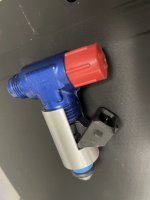
The clamp I was referring to is the one that clamps the alloy body to the blue T fitting.
It may work ok but it is an unusual thing to see in my world.

This is one of the injectors that was removed and the band clamp removed for clarity.

741487930.jpeg
 
You can actually setup the wiring to fire all top or all bottom plugs.
Ah yes sorry I meant that currently coil pack #1 operates all top while coil pack #2 operates all bottom plugs (as shown in the installation manual)

I talked to Robert about it and you can switch the leads up to mimic a Lycoming. I'm going to swap mine out at the next condition inspection:

Coil pack #1: Bottom left bank, upper right bank
Coil pack #2: Bottom right bank, upper left bank
 
Ah yes sorry I meant that currently coil pack #1 operates all top while coil pack #2 operates all bottom plugs (as shown in the installation manual)

I talked to Robert about it and you can switch the leads up to mimic a Lycoming. I'm going to swap mine out at the next condition inspection:

Coil pack #1: Bottom left bank, upper right bank
Coil pack #2: Bottom right bank, upper left bank
Ok, I'd like to understand. Would you kindly say why change to the bottom left/upper right + bottom right/upper left vs your current setup?
Better ignition/combustion if one coil goes bad ??
Thanks
 
Ok, I'd like to understand. Would you kindly say why change to the bottom left/upper right + bottom right/upper left vs your current setup?
Better ignition/combustion if one coil goes bad ??
Thanks
Just speculating but I think the RPM drop IGN 1 to IGN2 would be more consistent instead of firing 4 top plugs vs 4 bottom plugs. If you start seeing a difference time to look further.
 
Ok, I'd like to understand. Would you kindly say why change to the bottom left/upper right + bottom right/upper left vs your current setup?
Better ignition/combustion if one coil goes bad ??
Thanks
Going way back here. The Lyc manual I had showed the alternating top/bottom lead connection for each mag. The tribal knowledge passed to me at the time =

if you lost a mag AND had a fouled plug(s) connected to the remaining good mag, you’re only going to make partial power at best. Since bottom plugs have a higher likelihood of fouling, having them all on a single mag increases the chances of things going from bad to worse.

Obviously, the higher spark energy from coils vs mags adds some plug fouling margin here but “cross connecting” the leads as stated is easy and can only help If the aforementioned occurs.

It still makes sense to me But I’d be interested to hear from anyone who received different tribal knowledge.
 
Ok, I'd like to understand. Would you kindly say why change to the bottom left/upper right + bottom right/upper left vs your current setup?
Better ignition/combustion if one coil goes bad ??
Thanks

Exactly. When the top plugs are off, I see a 70-80 rpm loss. When the bottom plugs are off I only see a 30-40rpm loss. Now that might be gravity, might be because my fuel injectors are on top not bottom, etc. Don't know why. Doesn't matter.

All things being equal, two top and two bottom plugs, regardless of which orientation should make the same power and I don't want to have to pray that the coil pack I might lose is the bottom one.

Plus having a symmetric run up test standard just feels more right to me as an engineer.
 
Interesting discussion concerning the “magneto style” plug wire orientation. I was told that the top/bottom mix used on magnetos was due to switching polarity of the ignition during operation and the resulting plug wear…. When I switched to Pmags years ago I dispatched with that scheme and do the “all top/all bottom” configuration. Several airplanes with Pmags and now SDS on the Rocket and I have never noticed a difference in the EOR “mag check”. Of course, we now know that the EOR check is essentially worthless anyway - the up and away LOP stress test is a much more valuable test to perform. And even that one I see no discernible difference between top or bottom.
 
Interesting answers about the top/bottom plugs options.
Mine are all top and all bottom.
I'll check on the next runup, but I believe I have about the same loss on either coil, (~70) at least not enough difference to get my attention.
I only have 100 hours of airtime.
 
"Only" 100 hours on my System32 and it runs flawlessly. Starts like a modern car, in hot or cold weather either cold, warm or hot engine.
Obviously no vapour lock as ~50 GPH runs in the fuel lines at all times. If there are bubbles after the pressure regulator, who cares if the in-tank return line is far enough from the pickup line.

One mistake I did during installation/setup was with the MAX RPM setting. It cuts the ignition just prior to reaching that number then re-lights 40ish RPM lower.
I put mine at 2700 and at first take-off, I had a studder (rev limiter). Reducing the prop speed a bit eliminated the studder.
After reviewing the EFIS data, it clearly showed a 2680 to 2640 to 2680 etc (very quick) RPM variation.
I set it to 2750 and never had the studder again. Low pitch stops and then prop governor now limits my RPM.

Yes, with 2 batteries and 2 alternators, just in case... Could do it with, say, one alternator and 2 batteries.

Only 1 fuel pump at a time (#1/Auto) as the BMS will instantly switch to #2 if pressure drops below a set value.
The engine doesn't even miss a quarter beat, it's unnoticeable if switched from one to another. Tested it at idle, 1800 and 2700 RPM.
I would never consider this setup without the BMS. Mandatory piece of equipment in my view. Correctly connected of course.

As for the ECU's, I have a select 1 or 2 switch for "primary fuel" + a grounding "test" switch for each. I always run on #1.
On run-up, I kill one then the other, similar to a magneto test.
When one or the other is off, I get the expexted RPM drop, but outside of that the engine runs normally.
So if one would fail, there's no re-start needed, just a slight drop in RPM (70ish for me)

Fuel mapping is straightforward and simple to do, just follow the instructions.
Tweaking each injector afterwards a non-issue.
With the fuel trim knob, and help from the EFIS, it's easy to run LOP when at cruise power.
Otherwise, leave it at 0% on take-off, climb and just before landing. It takes care of density altitude, no guessing around/mixture adjusting. Set it and (almost) forget it.

It's a different system from traditional aviation setups, I find it simpler to operate and more efficient (fuel/spark) in operation.

It's not simpler to install, The ECU's, BMS and Controller take up some real-estate, wiring/cables routing needs consideration as for the fuel rail/lines.
It can be a challenge for some. Good planning, preperation and understanding the system is a must.

Someone not knowing, wishing to fly it should get a good breiffing on architecture, ops and emergency procedures.

Would I do it again on another build ? 100% yes.

I am just getting ready for my phase 1— would you be willing to share your preflight and runup using system 32 EFII? RV 14
Thank you—
 
I'm still taking the pilot course, that is, a beginner... I bought 1 RV-10 here in Brazil and I'm updating it, I'm thinking about updating the fuel line (with return) and the pumps of the chosen system. As I will be a beginner, I will probably fly with different pilots at first, could this make an electronic injection system unfeasible? I didn't want to update my entire plane now, and in about 2-3 years have to modify it again to use the electronic injection system.
 
I'm still taking the pilot course, that is, a beginner... I bought 1 RV-10 here in Brazil and I'm updating it, I'm thinking about updating the fuel line (with return) and the pumps of the chosen system. As I will be a beginner, I will probably fly with different pilots at first, could this make an electronic injection system unfeasible? I didn't want to update my entire plane now, and in about 2-3 years have to modify it again to use the electronic injection system.
A short answer to a seemingly simple question = No.

Adding EFI or EI to an aircraft requires a whole system(s) approach/mentality. Adding either in their entirety makes the aircraft electrically dependent. Redundancy/Dual-Redundancy for related electrical system feeds is needed. The fuel system requires new considerations. Any detailed answer would require a lot more detail of the existing systems, electrical architecture, etc. I'd start my self education for researching the vendor sites: Flyefii, SDS EFi, others. If still interested, then come back with some more detailed questions. My opinion.
 
A short answer to a seemingly simple question = No.

Adding EFI or EI to an aircraft requires a whole system(s) approach/mentality. Adding either in their entirety makes the aircraft electrically dependent. Redundancy/Dual-Redundancy for related electrical system feeds is needed. The fuel system requires new considerations. Any detailed answer would require a lot more detail of the existing systems, electrical architecture, etc. I'd start my self education for researching the vendor sites: Flyefii, SDS EFi, others. If still interested, then come back with some more detailed questions. My opinion.
I read the SDS files, my engine is being overhauled, I'm in doubt about whether to buy a fuel pump on the Vans website or go straight to the complete electronic injection products... I'm extending the fuel tank, so that would be it. the time..
 
I tried the O2 sensor in my early setup and tuning and despite multiple sensors and controllers could never get anything even remotely close to consistent readings. My running hypothesis is that the multiple slip joints on the Rocket exhaust was simply letting too much outside O2 in and polluting the readings. Does your 10 have a ”tight“ gas path from cylinder to sensor?
O2 sensor with leaded fuel. Interesting. Tell me more? Does EFIii use O2 sensor? I ask because I thought the half life of an O2 sensor in aircraft with 100LL was short.
 
O2 sensor with leaded fuel. Interesting. Tell me more? Does EFIii use O2 sensor? I ask because I thought the half life of an O2 sensor in aircraft with 100LL was short.

Leaded fuel is not instant death for O2 sensors, but it’s certainly a limited life device in the best circumstances. With care and a little luck, some pilots are getting hundreds of hours of life, some much, much less. Used as a tuning aid, the limited life is not a show stopper. Once tuned, remove the sensor and fly on.
 
I have an O2 sensor for my EFII install. The sensor lifetime is inconsistent, at best. I have had some that lasted 10 hours, the one I have now is going on 75. As stated, once tuning is accomplished, it is just another piece of data that is available, and it the EFII system doesn't rely on it to operate normally.
 
I hesitated to write this PIREP but wanted to try and document my recent experience with an EFI installation and first flight. Some background on my experience is I’ve had over 600 hrs. of virtually trouble-free running over 5 years with my current EFI system on a RV-14A with an IO-390. I loved the system and repeated the design on an IO-540 RV-10. I knew it was best to get in the air as soon as one was comfortable with the mapping and after ~ 1 hr. made the first take-off. Initial performance was OK and after 100 ft in the air the EGT’s started to rise to uncomfortable levels. (Over 1450 F) At this point I was committed and started to dial in more fuel. The performance was weak at best and managed to limp around the field and landed. Made several ground runs and everything seemed ok, so I thought. The second attempt is almost the same thing but worse. (EGT’s slightly over 1,500 F) Landed and checked the mapping. This time showed clearly mapped to lean, remapped and added more fuel at higher MP’s. Problem solved? No, took off and would not develop over 2,400 RPM, shut it down and was able to stop before the 3,149 ft runway end.

Decided to call it a day and review SD cards. What I found was both MP transducers were reading the same at run-up but when applying take-off power my ECU that I was using was reading 4 to 5 inches MP lower than ECU2. This created a very lean condition when the engine needed ~ 30 GPH and was only getting 20 GPH. Retuning made it excessively rich and accounted for not developing full power. Of course, my MAP I was looking at on take-off was the G3X MAP sensor which was reading ~ 30 in Hg.

Bottom line after using this system for over 5 years did not realize how important 2 accurate MAP sensors were which is clearly shame on me. Now as part of my run-up I compare the 2 MAP sensors and on departure review ECU1 and ECU2 MAP readings to determine they are consistent. It appears both suppliers use the same MAP transducer for normally aspirated engines.

Replaced MAP 1 and now everything is working fine.
 
Great data, thanks for sharing.

It is so important that we share the good, bad and the ugly.

Thank you again 👍
 
Back
Top