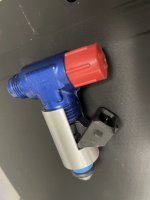
"Only" 100 hours on my System32 and it runs flawlessly. Starts like a modern car, in hot or cold weather either cold, warm or hot engine.
Obviously no vapour lock as ~50 GPH runs in the fuel lines at all times. If there are bubbles after the pressure regulator, who cares if the in-tank return line is far enough from the pickup line.
One mistake I did during installation/setup was with the MAX RPM setting. It cuts the ignition just prior to reaching that number then re-lights 40ish RPM lower.
I put mine at 2700 and at first take-off, I had a studder (rev limiter). Reducing the prop speed a bit eliminated the studder.
After reviewing the EFIS data, it clearly showed a 2680 to 2640 to 2680 etc (very quick) RPM variation.
I set it to 2750 and never had the studder again. Low pitch stops and then prop governor now limits my RPM.
Yes, with 2 batteries and 2 alternators, just in case... Could do it with, say, one alternator and 2 batteries.
Only 1 fuel pump at a time (#1/Auto) as the BMS will instantly switch to #2 if pressure drops below a set value.
The engine doesn't even miss a quarter beat, it's unnoticeable if switched from one to another. Tested it at idle, 1800 and 2700 RPM.
I would never consider this setup without the BMS. Mandatory piece of equipment in my view. Correctly connected of course.
As for the ECU's, I have a select 1 or 2 switch for "primary fuel" + a grounding "test" switch for each. I always run on #1.
On run-up, I kill one then the other, similar to a magneto test.
When one or the other is off, I get the expexted RPM drop, but outside of that the engine runs normally.
So if one would fail, there's no re-start needed, just a slight drop in RPM (70ish for me)
Fuel mapping is straightforward and simple to do, just follow the instructions.
Tweaking each injector afterwards a non-issue.
With the fuel trim knob, and help from the EFIS, it's easy to run LOP when at cruise power.
Otherwise, leave it at 0% on take-off, climb and just before landing. It takes care of density altitude, no guessing around/mixture adjusting. Set it and (almost) forget it.
It's a different system from traditional aviation setups, I find it simpler to operate and more efficient (fuel/spark) in operation.
It's not simpler to install, The ECU's, BMS and Controller take up some real-estate, wiring/cables routing needs consideration as for the fuel rail/lines.
It can be a challenge for some. Good planning, preperation and understanding the system is a must.
Someone not knowing, wishing to fly it should get a good breiffing on architecture, ops and emergency procedures.
Would I do it again on another build ? 100% yes.