Van's Air Force

The definitive Van's Aircraft support community! Buying, building or flying an RV? Join our exclusive family of mentors and enthusiasts!

(EarthX) BMS fail-op/fial-safe modes

Freemasm

Well Known Member
Patron
“I had the right to remain silent, but I didn’t have the ability.”
- a great American philosopher (and story of my life)

All of the previous arguments for/against Li-x-y batteries have been beaten to death around here a plethora of times. The latest one here.

Some repeated observations/facts:
  • Observation - The camps are thoroughly entrenched even though there is confusion regarding the newer chemistries.
  • Indisputable - A BMS introduces failure modes. More stuff = more complexity -> more that can go wrong.
  • Indisputable - The Li-x-y based energy densities beat the sh!t out of the legacy chemistry. *
  • Indisputable (in most minds) - The newest LiFe chemistry is completely manageable from a thermal runaway aspect. **
  • So much more
Many have a reluctance because of the BMS. I'm one of those. I understand the stated intended actions of the BMS. That's not really the debate anymore, IMO.

Edit = Can anyone explain how the fail-safe and fail-op modes of the EarthX BMS rather than stating redunancy? What happens when the associated code freezes, the processor crashes, BMS internal electrical fault, BMS internal component failure, etc. ? I would like to understand the related "switching" vs statement of redundancy.


Sounds a bit like @bjdecker bait (camp LiFe). This is neither bait nor debate. It is technical question. It is fully evident which hill many of you wish to die on so no need to restate your positions/objections/etc.
The future chemistry tech won't be lead based. If the need for a BMS goes away, many like myself will be all over it like a 40 degree day.

Happy 4th.
Cheers boys

* Pick one up at the vendor booth if you haven't. It feels like a show demo
** Someone argued FAA certification as a validation. Sorry but that's the same agency that certified a Li-Co
(Corrected, Thx MBurch) pack for commercial airliner use a while . (don't remember the details as it was too long ago but seem to remember tragedy narrowly averted.)
.
 
Last edited:
It depends which EarthX batteries you are referring to as the hundred series (e.g. ETX900) have dual redundant BMSs. Take a look at the faqs on the EarthX website, especially the one about single point failures.
 
Here’s the thing about failure modes - they are usually trade cases.

The BMS protects the battery from bad events…the worst bad for. LiFePo being smoke release. You don’t want that! A good BMS will shut off the battery to protect it - and as a result, protect you from all the things that people say are “bad” about various Lithitum batteriues.

But….if the BMS shuts of the battery, that leaves you in the are with no battery! Yup - that’s the trade case. But aircraft have flown for YEARS with no electrical systems at all - they can be designed that way. If you are designing yours so that it MUST have a working battery to keep you in the air, then perhaps the weight/volume benefits of the LiFePo batteries are not for you. That’s a trade.

I am pretty sure that the FAA hasn’t approved a Lithium battery for aircraft use that doesn’t have a BMS - because they want to protect against a battery runaway (they might occasionally watch YouTube as well….). It’s up to the aircraft designer to make sure that the airplane can survive without the battery.

I liek the Lithium batteries - but I won’t have one without an onboard BMS…. But that’s just me - everyone is free to make their own trades. Just remeber that your passengers (if properly informed about the risk trades) might have different thoughts.
 
“I had the right to remain silent, but I didn’t have the ability.”
- a great American philosopher (and story of my life)

All of the previous arguments for/against Li-x-y batteries have been beaten to death around here a plethora of times. The latest one here.

Some repeated observations/facts:
  • Observation - The camps are thoroughly entrenched even though there is confusion regarding the newer chemistries.
  • Indisputable - A BMS introduces failure modes. More stuff = more complexity -> more that can go wrong.
  • Indisputable - The Li-x-y based energy densities beat the sh!t out of the legacy chemistry. *
  • Indisputable (in most minds) - The newest LiFe chemistry is completely manageable from a thermal runaway aspect. **
  • So much more
Many have a reluctance because of the BMS. I'm one of those. I understand the stated intended actions of the BMS. That's not really the debate anymore, IMO.

Edit = Can anyone explain how the fail-safe and fail-op modes of the EarthX BMS rather than stating redunancy? What happens when the associated code freezes, the processor crashes, BMS internal electrical fault, BMS internal component failure, etc. ? I would like to understand the related "switching" vs statement of redundancy.


Sounds a bit like @bjdecker bait (camp LiFe). This is neither bait nor debate. It is technical question. It is fully evident which hill many of you wish to die on so no need to restate your positions/objections/etc.
The future chemistry tech won't be lead based. If the need for a BMS goes away, many like myself will be all over it like a 40 degree day.

Happy 4th.
Cheers boys

* Pick one up at the vendor booth if you haven't. It feels like a show demo
** Someone argued FAA certification as a validation. Sorry but that's the same agency that certified a Li-Co
(Corrected, Thx MBurch) pack for commercial airliner use a while . (don't remember the details as it was too long ago but seem to remember tragedy narrowly averted.)
.
I have no idea about the structure / architecture of the BMS deployed by EarthX.

I would hope that it *isn't* microprocessor/microcontroller based - thereby avoiding the inevitable coding mistakes and corner conditions inherent with said architecture. Hopefully it's just a collection of FETs, LM385s, other discrete parts, resistors, caps.
 
Sorry, I know this is not answering the OP question, but...

I have always been a bit surprised by the amount of concern over the BMS causing an electrical outage. Unless you have an electrical dependent ignition/fuel system, the plane is not going to fall out of the sky. I realize that IFR ops will have its challenges in such a scenario, but if you are going to fly in IMC, shouldn't you have some redundancy, like backup battery? If you are electrically dependent, then I think two batteries is a min.
 
Last edited:
I have no idea about the structure / architecture of the BMS deployed by EarthX.

I would hope that it *isn't* microprocessor/microcontroller based - thereby avoiding the inevitable coding mistakes and corner conditions inherent with said architecture. Hopefully it's just a collection of FETs, LM385s, other discrete parts, resistors, caps.

From the website, hence one of the reasons for uncovering this rabbit hole.

. Inside every one of the ETX-Series batteries is a microprocessor Battery Management System (BMS) that monitors the charge level of each cell and balances the charge when needed, protecting the cells from overcharge or over-discharge.

Here’s the thing about failure modes - they are usually trade cases.

The BMS protects the battery from bad events…the worst bad for. LiFePo being smoke release. You don’t want that! A good BMS will shut off the battery to protect it - and as a result, protect you from all the things that people say are “bad” about various Lithitum batteriues.

But….if the BMS shuts of the battery, that leaves you in the are with no battery! Yup - that’s the trade case. But aircraft have flown for YEARS with no electrical systems at all - they can be designed that way. If you are designing yours so that it MUST have a working battery to keep you in the air, then perhaps the weight/volume benefits of the LiFePo batteries are not for you. That’s a trade.

I am pretty sure that the FAA hasn’t approved a Lithium battery for aircraft use that doesn’t have a BMS - because they want to protect against a battery runaway (they might occasionally watch YouTube as well….). It’s up to the aircraft designer to make sure that the airplane can survive without the battery.

I liek the Lithium batteries - but I won’t have one without an onboard BMS…. But that’s just me - everyone is free to make their own trades. Just remeber that your passengers (if properly informed about the risk trades) might have different thoughts.
Wasn't an argument for getting rid of the BMS. Future chemistries might due to their inherent which would be a big plus. I'm comfortable with the safety of any potential runaway from the relative less extreme nature of such and requirements for placement and/or venting. What happens to the battery function if the BMS sh!ts the bed?
 
From the website, hence one of the reasons for uncovering this rabbit hole.

. Inside every one of the ETX-Series batteries is a microprocessor Battery Management System (BMS) that monitors the charge level of each cell and balances the charge when needed, protecting the cells from overcharge or over-discharge.
...Well, that's interesting...(brings back bad fond memories)

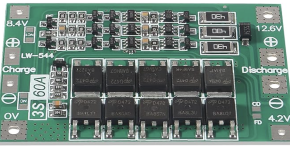
I was hoping it was something a bit more..simple, and robust (attached.)

Screenshot 2026-07-02 at 3.08.20 PM.png

Note - I have an extra ETX680 and 1200 at the hangar; I suppose it's time for an autopsy on one of them -- what could possibly go wrong??

Screenshot 2026-07-02 at 3.12.12 PM.png

Wish me luck :)
 
May I suggest calling and talking to the source. Better yet, take a tour if your in the neighborhood.
Keenan
(970) 674-8884
955 Merchant CT
Windsor, CO
 
It’s up to the aircraft designer to make sure that the airplane can survive without the battery.
If something is made foolproof - they'll just make a better fool.

A guy I know had two alternators and one EarthX in his airplane. As part of his runup checks he would disable his main alternator to make sure the backup came online. Somehow or another he mananged to depart with both of them offline. He proceeded to run the battery out doing practice IFR approaches and returned to the airport NORDO. He blamed his hot and long landing and ground loop on the failure of the battery and his flaps being inop. I went out the next day and did 7 no flap landings.

I've brought this up in other threads: If you use an EarthX battery (or lead acid), you need a positive notification of alternator failure so you can shed loads and land before it runs out. The B&C external regulators that many of us use have a flashing light for this purpose. The problem is that it is supposed to go off at about 13v. The EarthX will happily maintain 13.1 or better until very nearly depleted and about to disconnect. I proved this lack of notification by pulling my field breaker in flight. The alarms that I had set on my EFIS for LV at about 13.6 or .7 ( I need to check the setting) and low amps at 5A both went off with audible and visual indications. The B&C flashing light did not.

I know - I'm just trying to make it more foolproof and there's always a better fool. I hope it's not me.

Ed
 
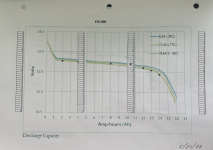
Attached is my amp-voltage discharge curve for my ETX-900 that I've been performing annually the last 7 years. I measure this voltage at the battery using a calibrated multi-meter. Recently I saw this is a requirement Earth-X states in their certified batteries. I also have 3 locations on each bus where the voltage is checked and fed into my electrical system. (EIS, bus and EFII interface) At the end of the test I turn on the EFIS and check what these are at. Also, I check when the Earth X warning light is activated which Earth X documents as 12.8-13.0 volts which is ~70% discharged. With an energy dependent engine, I feel this annually check is needed. Obviously having the proper alarming on the voltages and amperage the alternator is outputting. I've seen more than one builder with an excellent avionics package not do this or done incorrectly. If properly installed and maintained these batteries are marvelous. I have a primary and essential bus so 2 batteries and 2 alternators.

Screenshot 2026-07-03 085449.png
 
Back
Top