

Van's Air Force
You are using an out of date browser. It may not display this or other websites correctly.
You should upgrade or use an alternative browser.
You should upgrade or use an alternative browser.
Does anyone have experience with cowl flaps for a RV7A for high cylinder temps ?
- Thread starter Flybob
- Start date


Back to the original question . . . .
Yes, I have two EZ-Cool cowl flaps on my -7, and they are worth 10-15 degree reduction in climb.
I think -7's run hot in climb even with a stock Lycoming. The cowl flaps do help.
Thanks for that
50 replies before someone offered a number. Looking at DanH’s charts is 10-15 degrees wondering if it’s worth the effort?

I don't know what is considered "large bore" in terms of dimensional threshold...
I think Taylor's "The Internal Combustion Engine..." stated more than 4"
Dual AS Cowl Flaps on the bottom of the cowl of my -7 with IO-360. I do notice an small increase in speed and a slight change in pitch when I close them in cruise. They work quite well upon departure from a hot airport. Bonus is leaving them open when doing a fuel stop to help with FI hot start. I did have one of the actuators fail but they were quite fair supplying a replacement. No issues with the product in 3 years after that. Happy customer.

RV10inOz
Well Known Member
Prove it. And try not to confuse things with anecdotes about TCM turbos.
Here's reality. IO360A1A at WOT/2700, on a Lycoming dyno. Detonation test, so CHT at maximum. Best power is around 81 lbs/hr, or 13.5 gph, or 0.46 BSFC, and it's still well short of detonation.
View attachment 98727
Dan, I really like a lot of what you do, but your "bullying antics" do not work with me. I do not need to prove anything to you......YOU DID IT all yourself.
You are a smart cookie, you love digging into information, and for that I am grateful. You saved me all the work. Your red line is peak power mixture, and yes that is BSFC=0.46 or there about for all the TCM / LYC NA engines. But you know, FULL RICH is where that graph stops on the RHS. Why would they have a full rich position if it was not necessary? So let's see what that shows, 180HP and 104.5lbs/hr. Just divide that up and I'll be darned if the BSFC is not exactly what I quoted above. Seems Lycoming like it six feet up a cows......... also.
Sure you can force feed cold air over the engine and keep it cool, or cool enough, but the design has a full rich for a reason and it is all about keeping ICP where it should be. If you don't believe me, go argue that with George Braly. I have spent a bit of time in the dyno there, and you can not un-see and unlearn some things.
One last thing, detonation margin is one aspect, but longevity based on CHT and ICP is another. Probably why many if not most engine shops do not reuse Chieftain cylinders. They run cool enough but the ICP's are often much higher over time. Same with some others but you did ask me not to go near turbo things, so that is as far as we need to go there.
All the best,

Are you in the "lower is better" camp, or is there a specific reference number you use for "good" CHTs in an angle valve engine?
This is asking too much. Discussions of when and how various metals lose strength due to heat, etc., usually crop up during an episode of the Great CHT Debate, but… they don’t actually answer any important question.
I’m in the camp of “Lycoming knows what its cylinders are made of, and how they’re built, and has tested them, and has set the temperature limits accordingly.”


bryanhorgan
Member
I have a RV7A with an 0-360 A2A. After switching to Pmags (timed at 20 degrees) I struggled with ground temperatures. I have maybe 12 minutes on the ground before my CHTs hit 380. That puts me around 420 degrees at 1000' AGL on takeoff, which is the max I want to be hitting (I know what Lycoming says about temps!). After investigating all the aforementioned things (timing, fuel, baffles, etc.), I installed 2 Anti Splat Cowl Flaps on the underside of my cowling. This helped to slow the temperature rise (maybe 3-4 more minutes) but did not eliminate it. I'm still investigating other options. Hope that's helpful.
Which ones are you using and thanks for the post...I use them on my 8A and I can keep temps below 400 on the hottest southern summer days all the way up to 17,000 with no step climb.
Which ones are you using ? Thanks for the replyI have a pair of them on my IO360 -7 and they work well.
Which ones are you using, thanks for the reply.... BobDual cowl flaps on my -7. They’re a get out of jail free card when I’m departing hot, heavy and high. They cost 3-5kts if you need them in cruise.

I use two of these:Which ones are you using and thanks for the post...

EZ Cool Cowl Flap - AntiSplatAero
EZ Cool Flap – The Ultimate Cowl Flap Solution Anti-Splat-Aero is proud to introduce the EZ Cool Flap, a revolutionary electric cowl flap system designed to help RV owners and builders better manage high CHTs during climb-out. Why Choose the EZ Cool Flap? ✔ Optimized Cooling – Reduces high CHTs...
 antisplataero.com

Ez cowl flaps wired to a single switch.Which ones are you using, thanks for the reply.... Bob
I use two of these, fairly early purchase from AntiSplat. I used 4 nutplates on each to put them in so I could easily remove them. Never did. I wired them to a single switch and covered the wire on the inside surface of the cowl with aluminum tape and ran up to a pair of 1/4" spade terminals near the oil door. This last summer I would leave them open after shut down along with the open oil door to hopefully shed heat more quickly from under the cowl. I did have a motor fail on me in less than a year and they were fair with me on a replacement. No complaints.Ez cowl flaps wired to a single switch.
Is there a product similar to the EZ Cowl flaps but with cables instead of electrical actuators?

Antisplat sells an oil plenum door very close to the same dimensions. It has a Bowden cable type control.Is there a product similar to the EZ Cowl flaps but with cables instead of electrical actuators?
It's a lot of fiberglass work, but I cut cowl flaps into the bottom of the cowl and set piano hinges. I ran cables up ahead of the panel and setup an actuator to run them. If you've already painted, it probably would be better to do ez cowl flaps. Easier for sure.Is there a product similar to the EZ Cowl flaps but with cables instead of electrical actuators?
Ed

andoman
Well Known Member
I recall a thread that addressed that question. There was quite a bit of info in it including how to heat resist the stock actuator.
Due to info gleaned in that thread I wrapped my actuator with fiberfrax and a couple layers of aluminum tape. I believe many have had excellent longevity using that method.
Due to info gleaned in that thread I wrapped my actuator with fiberfrax and a couple layers of aluminum tape. I believe many have had excellent longevity using that method.
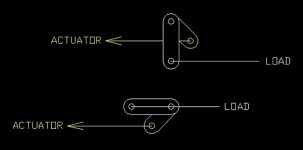
As an aside, I see the Anti Splat doors use an off the shelf actuator that doesn’t appear particularly robust for under cowl use. Has anyone found a more robust actuator?
I originally designed this door linkage around the little Firgelli actuator, but it developed some internal slack pretty quickly. It was replaced with an ordinary Ray Allen trim servo, wrapped in a layer of 970 and aluminum tape. In both cases the actuator is protected from radiant heat, so it only has to deal with convective heating, and when closed, there is no static load on the plastic internals.
Note wrapping an object in 970 and reflective tape doesn't change its ultimate temperature if the object has no heat rejection path. It simply slows the rate of temperature rise.
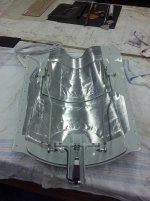
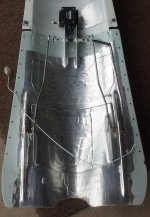

I had high Oiltemperature in the beginning. CHTs were not excessive, but in the upper region during break-in.
CHTs lowered a bit after break-in but oil stayed high. Too high for my likings.
After some other trials i came to the conclusion to improve the outflow of the lower cowl.
I decided against moveable cowlflaps because they would be another system that could fail and the linkeage (electrical or mechhanic) wouldn‘t make things any easier.
I hereby would like to say that i admire the work some others have done to implement cowlflaps. Second to none for me is the work of art by DanH.
However, i thought about louvers but didn’t like the ones from Van‘s.
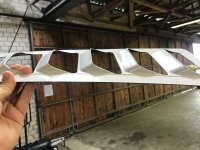
After some research I found the solution at a DTM tuning shop/manufacturer.
(DTM = deutsche Tourenwagen Meisterschaft, our Nascar equivalent-ish)
Those louvers are all carbonfibre and were designed to extract the hot air from the front brakes from above. They are supposed to be mounted in the hood on top of the disk brakes.
My thoughts had been that they were designed for the same purpose (extract hot air) at the same speedrange.
As they are used on racecars, i assume that some aerodynamic engineering went into them.
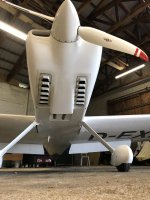
Installing them was more work than expected, but the result is flawless.
Oiltemp came down as well as the CHTs.
Fullpower climbs at max gross in Summer and no numbers exceed their yellow ranges.
They did not cause a single knot of speed loss!!
(By now they are painted white)
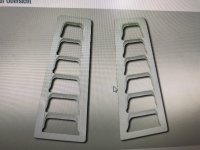
CHTs lowered a bit after break-in but oil stayed high. Too high for my likings.
After some other trials i came to the conclusion to improve the outflow of the lower cowl.
I decided against moveable cowlflaps because they would be another system that could fail and the linkeage (electrical or mechhanic) wouldn‘t make things any easier.
I hereby would like to say that i admire the work some others have done to implement cowlflaps. Second to none for me is the work of art by DanH.
However, i thought about louvers but didn’t like the ones from Van‘s.
After some research I found the solution at a DTM tuning shop/manufacturer.
(DTM = deutsche Tourenwagen Meisterschaft, our Nascar equivalent-ish)
Those louvers are all carbonfibre and were designed to extract the hot air from the front brakes from above. They are supposed to be mounted in the hood on top of the disk brakes.
My thoughts had been that they were designed for the same purpose (extract hot air) at the same speedrange.
As they are used on racecars, i assume that some aerodynamic engineering went into them.
Installing them was more work than expected, but the result is flawless.
Oiltemp came down as well as the CHTs.
Fullpower climbs at max gross in Summer and no numbers exceed their yellow ranges.
They did not cause a single knot of speed loss!!
(By now they are painted white)
