
I recently finished a RV7A and have finished the phase one flight testing. Being a lifetime car racer I hot rodded the engine with Ly Con 10:1 compression pistons, ported and polished cylinders, and a Superior cold air box. We dynod the finished engine at Ly Con and saw 230 peak hp. With that said, on take off I am seeing cylinder head temps exceeding 400 on takeoff in about two minutes. If I reduce the manifold pressure and the angle of attack, the temps go right down to the 380 range and in cruise they go down to the 375 range. I have heard that if I install cowl flaps that this could significantly reduce my cylinder head temps. Does anyone have experience with this???

Van's Air Force
You are using an out of date browser. It may not display this or other websites correctly.
You should upgrade or use an alternative browser.
You should upgrade or use an alternative browser.
Does anyone have experience with cowl flaps for a RV7A for high cylinder temps ?
- Thread starter Flybob
- Start date


andoman
Well Known Member
I installed 4 on the sides of my Rocket cowl. And a second oil cooler. Needed to keep it cool at slow speed higher AOA flight. It was acceptable in cruise and climb if I kept the speeds up.
To answer your question: They work as advertised. I recommend them only after working through all the other typical cooling troubleshooting. Quite a number of threads to check out.
But if you are ready to go to cowl flaps now, install 2 ASA EZ Cool units and you’ll solve your high CHT’s.
To answer your question: They work as advertised. I recommend them only after working through all the other typical cooling troubleshooting. Quite a number of threads to check out.
But if you are ready to go to cowl flaps now, install 2 ASA EZ Cool units and you’ll solve your high CHT’s.

I use them on my 8A and I can keep temps below 400 on the hottest southern summer days all the way up to 17,000 with no step climb.

Are we to assume you've already eliminated all the usual suspects and the cowl flaps are your only remaining straw to grasp?
Alluding to what andoman said, there are many other potential causes, most of which are covered with a search in this forum. Ignition timing, fuel flow and air flow are the broad topics. Have you had a tech counselor or other experienced build take a look at your baffles and baffle seals? Is the fuel flow appropriate for the HP you're pumping out (and that's a lot of HP for an RV-7)? What type of ignition, timing, advance, etc.? At what IAS are you climbing? So many questions to ask...
Alluding to what andoman said, there are many other potential causes, most of which are covered with a search in this forum. Ignition timing, fuel flow and air flow are the broad topics. Have you had a tech counselor or other experienced build take a look at your baffles and baffle seals? Is the fuel flow appropriate for the HP you're pumping out (and that's a lot of HP for an RV-7)? What type of ignition, timing, advance, etc.? At what IAS are you climbing? So many questions to ask...

Not tested in flight, yet. I made my louvers ground adjustable. I figured I could find a happy place for most ops and save the weight.
They are just a fiberglass slotted gate matching the Vans louver profile. Easy to adjust on the ground from closed to fully open either side.
They are just a fiberglass slotted gate matching the Vans louver profile. Easy to adjust on the ground from closed to fully open either side.
BoydBirchler
Well Known Member
If you are pushing that much HP, you might check your timing and make sure it is timed at 20 degrees instead of the usual 25. The difference in power at 20 is almost unnoticeable ( maybe 1 1/2 % loss at the most)
I've got a similar engine in my 6. On hot days I can get my CHTs over 400. I usually control that with prop to 2400 and pull mixture to well LOP. I did install cowl flaps and they will for sure cool things off. I don't use them much.I recently finished a RV7A and have finished the phase one flight testing. Being a lifetime car racer I hot rodded the engine with Ly Con 10:1 compression pistons, ported and polished cylinders, and a Superior cold air box. We dynod the finished engine at Ly Con and saw 230 peak hp. With that said, on take off I am seeing cylinder head temps exceeding 400 on takeoff in about two minutes. If I reduce the manifold pressure and the angle of attack, the temps go right down to the 380 range and in cruise they go down to the 375 range. I have heard that if I install cowl flaps that this could significantly reduce my cylinder head temps. Does anyone have experience with this???
You haven't mentioned ignition type and timing. A little advance goes a long way to heating up the engine. Seal everything you can find with high temp RTV and make sure your baffle seals well at the cowl before you start adding exit area. A bright light under the engine and looking from the top will sometimes surprise you with how much leakage there is.
Love to see your dyno sheet. What does it show at 2700 RPM? Lycon sometimes runs them faster than that to get a high HP reading.
Ed
Anyone who believes Lycon dyno numbers probably believes in Santa, Easter Bunny, Tooth Fairy and the Loch Ness MonsterI've got a similar engine in my 6. On hot days I can get my CHTs over 400. I usually control that with prop to 2400 and pull mixture to well LOP. I did install cowl flaps and they will for sure cool things off. I don't use them much.
You haven't mentioned ignition type and timing. A little advance goes a long way to heating up the engine. Seal everything you can find with high temp RTV and make sure your baffle seals well at the cowl before you start adding exit area. A bright light under the engine and looking from the top will sometimes surprise you with how much leakage there is.
Love to see your dyno sheet. What does it show at 2700 RPM? Lycon sometimes runs them faster than that to get a high HP reading.
Ed
Norman CYYJ
Well Known Member
Hey, leave Sanata out of this one.Anyone who believes Lycon dyno numbers probably believes in Santa, Easter Bunny, Tooth Fairy and the Loch Ness Monster
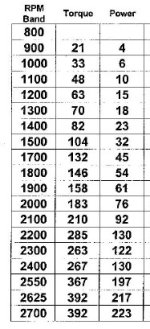
Yeah…2700rpm at 392ftlbs is 201.5HPThis a snip from a dyno chart supplied to a Lycon customer. There's no evidence of correction factors, but do you notice something odd?
View attachment 98585
TQxRPM/5252

Oh that? Just a lil' flat spot in the power band, no problem!This a snip from a dyno chart supplied to a Lycon customer. There's no evidence of correction factors, but do you notice something odd?

RV10inOz
Well Known Member
I recently finished a RV7A and have finished the phase one flight testing. Being a lifetime car racer I hot rodded the engine with Ly Con 10:1 compression pistons, ported and polished cylinders, and a Superior cold air box. We dynod the finished engine at Ly Con and saw 230 peak hp. With that said, on take off I am seeing cylinder head temps exceeding 400 on takeoff in about two minutes. If I reduce the manifold pressure and the angle of attack, the temps go right down to the 380 range and in cruise they go down to the 375 range. I have heard that if I install cowl flaps that this could significantly reduce my cylinder head temps. Does anyone have experience with this???
First things first, as mentioned already, spark timing is the big deal here, along with adequate fuel flow at full rich.
You must be using a maximum 20 degrees if using magneto's. If you have any electronic mags, this MUST be reduced to 17 or 18 degrees.
Fuel flow, well if you truly believe 230HP you would want up around 22GPH or a tad more. I have done some rough calculations and I suspect you are likely to be 215 BHP maximum, I would be interested in Dan's speculative calculation based on his experience. On 215HP you need to be at 21GPH, and no less than 20.5 based on sea level and standard day atmospherics.
Get those things fixed first before you start doing anything else. Otherwise you will just be chasing your tail. Also remove those little baffle dams in front of C1&2.
RV10inOz
Well Known Member
Well that would be perfect for 180 or so HP.Hmmm.... I have the same engine. I don't have a dyno ticket because I bought if from LyCon as a kit and assembled it myself. That said, I have never seen much more than 17.5 gph on takeoff. Don at AFP didn't blink an eye at that number.
Ed
To Dan's point earlier, you can't always believe all these "Claims".
Just a rough guess but I would think if you had an RSA-5 and 10:1 pistons you should be in the 19-19.5 range. At sea level.
The torque jump from 267 to 367 at 2500 is almost laughable.This a snip from a dyno chart supplied to a Lycon customer. There's no evidence of correction factors, but do you notice something odd?
View attachment 98585

No authoritative source thinks “exceeding 400” is a problem for Lycoming CHTs on takeoff.With that said, on take off I am seeing cylinder head temps exceeding 400 on takeoff in about two minutes.
What actual temps are you seeing?
But Mike Busch says...No authoritative source thinks “exceeding 400” is a problem for Lycoming CHTs on takeoff.

He’s perfectly fine with takeoff (even cruise!!) temps “over 400!” I’m on a mission!!But Mike Busch says...

I applaud your efforts here. Seems many have taken the loose guideline that under 400 is safe and desireable to mean that anything over 400 is unsafe.He’s perfectly fine with takeoff (even cruise!!) temps “over 400!” I’m on a mission!!
Everyone needs a hobby!I applaud your efforts here. Seems many have taken the loose guideline that under 400 is safe and desireable to mean that anything over 400 is unsafe.
It’s really odd how so many people have gotten it into their heads that 400 (or even 380!) is some kind of limit.
Busch says 400-420 in cruise flight can be thought of as a “yellow arc,” and that seems both sensible and still quite conservative to me.

This a snip from a dyno chart supplied to a Lycon customer. There's no evidence of correction factors, but do you notice something odd?
View attachment 98585
"California Horsepower", There's a well known gravimetric anomaly in Visalia -- instead of 32fps^2 it's more like 33fps^2. Plus a healthy amount of male bovine excrement.
The torque jump from 267 to 367 at 2500 is almost laughable.
Maybe they switched it over to diesel mode for those last few hundred RPMs...

This a snip from a dyno chart supplied to a Lycon customer. There's no evidence of correction factors, but do you notice something odd?
View attachment 98585

Based on this data/chart, I think someone fat-fingered/mis-typed the Torque value at 2200RPM -- should have been 258ft.lb. (maybe). Also, as others have stated the Power values are "fudged" or there is a marketing adjustment in there. Calculated HP follows the formula HP = Torque*RPM/5252.
Probably, but the glaring issue is the torque at 2500. Torque peak on these engines should be in the neighborhood of 2500 and torque tends to rise rapidly in the lower rpm's and then flatten out on either side of peak before it falls off slowely. a 40% increase in torque between 2400 and 2550 just doesn't compute. I could maybe believe the 2550 torque number if there was porting, so maybe something going on with the dyno on the torque readings at lower rpms. Someything is off though. The shape of the torque line throws the whole thing into question in my mind.View attachment 98616
Based on this data/chart, I think someone fat-fingered/mis-typed the Torque value at 2200RPM -- should have been 258ft.lb. (maybe). Also, as others have stated the Power values are "fudged" or there is a marketing adjustment in there. Calculated HP follows the formula HP = Torque*RPM/5252.
Last edited:

Yeah…2700rpm at 392ftlbs is 201.5HP
TQxRPM/5252
Exactly
The reasonable explanation is dyno software programmed to correct gross output for Standard Day conditions. The common correction factors are temperature, barometric pressure, and humidity. Given a hot day, low pressure, and lots of humidity, the corrected HP will be higher than indicated by the measured torque.
We live in the info age. I pulled up the reported conditions for Visalia at the date and time noted on the dyno sheet, then hand-calculated using what I believe are SAE J607 correction factors, which can be described as old-school. The baseline values are familiar to aero guys; 29.92, 60F, and dry air. The reported conditions were 29.68, 72F, and 38%, so the HP calculated from torque and RPM is multiplied by 1.0081, 1.0115, and 1.0264 respectively...
(2700*392)/5252 = 201.5
201.5*1.0081*1.0115*1.0264 = 210.9 corrected HP
...which doesn't match the reported 223. So why? Different standard of course, of which there are at least eight. An operator can pick any of them, plus there are a bunch of subtle accounting, operating, and calibration details.
I'd rather not speculate. Even if the HP numbers are, well...presented favorably, Lycon is a respected shop. Here the takeaway is get raw RPM, torque, and atmosphere. Do your own HP calculation using the correction factors from a standard of your choice. It doesn't eliminate torque and RPM calibration errors (every dyno is a little different), but at least your numbers will be comparable for all the engines examined.
Note a wildcard. Lycon uses a propeller test stand. The correction factors are based on ambient pressure, but pressure behind the prop is higher. That's prohibited by most standards.
I apologize for only posting the RPM, torque, and HP columns, as you couldn't see the manifold pressure and fuel flows during those bumps in the graphs. Someone was rowing the levers, so please, ignore that part. My intent was to illustrate the HP calculation.
Fuel flow, well if you truly believe 230HP you would want up around 22GPH or a tad more. I have done some rough calculations and I suspect you are likely to be 215 BHP maximum, I would be interested in Dan's speculative calculation based on his experience. On 215HP you need to be at 21GPH, and no less than 20.5 based on sea level and standard day atmospherics.
Shucks David, we've talked about that before. You like things rich as six feet up a cow's butt. I like mixture closer to best power, and use the cooling system to cool.
Living in Texas, I thought I had heard every home spun colloquial expression there was. But that's a new one on me. I guess it's true what they say, you really do learn something new every day.You like things rich as six feet up a cow's butt. I like mixture closer to best power, and use the cooling system to cool.

From Lycoming : 320/360 parallel valveHe’s perfectly fine with takeoff (even cruise!!) temps “over 400!” I’m on a mission!!
High performance cruise(continuous) 435 degrees. Economy cruise 400 degrees.
Ultimate solution: remove CHT instrument
2500 hours plus in aerobatic airplanes with no CHT instrument installed.
CHT is primarily a concern for engine break in. Until rings re seated do not exceed 400 degrees CHT
For long distance overwater flights tape a piece of paper over the engine instruments except for MP, r/m and fuel flow. When Betty Skelton flew her Pitts across the water in the 50's that is what she did.
Ultimate solution: remove CHT instrument
RV10inOz
Well Known Member
Shucks David, we've talked about that before. You like things rich as six feet up a cow's butt. I like mixture closer to best power, and use the cooling system to cool.
Yes, I learned from the best. George Braly, and he is from a small town in Oklahoma, so you can probably run a few more Bovine jokes there quite easily

The maximum fuel rate of around BSFC = 0.58 is a number that was dating back to when Lycoming and TCM were first building these things. Detonation margin was factored with worst case scenarios for oil and air cooling etc. So you may have a point but that is what they were designed around. There comes a limit where you can cool enough short of water cooling. Most builders will struggle with a standard build and an attempt to replicate the time and effort you would go to.
And just for a point of reference, the TNIO550 TCM engine has a fuel flow of BSFC=0.694 at full power (35GPH) as certified. Now we know of course, if you run that same engine up to 33" and feed it a BSFC=0.39-0.395 it will also generate full rated power and run cooler. But that is not in the certification window. So talk about six feet
OK, back to regular programming.
The maximum fuel rate of around BSFC = 0.58 is a number that was dating back to when Lycoming and TCM were first building these things. Detonation margin was factored with worst case scenarios for oil and air cooling etc. So you may have a point but that is what they were designed around.
Prove it. And try not to confuse things with anecdotes about TCM turbos.
My 390 operating manual says 105 lbs hr minimum fuel flow, or 0.5 BSFC. That's conservative guidance, as manuals tend to be, and it's an 8.9 CR engine.
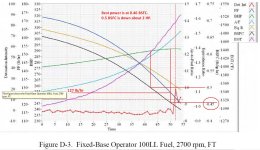
Here's reality. IO360A1A at WOT/2700, on a Lycoming dyno. Detonation test, so CHT at maximum. Best power is around 81 lbs/hr, or 13.5 gph, or 0.46 BSFC, and it's still well short of detonation.
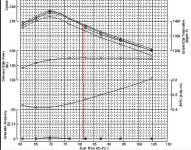
IO-540 K, the standard for detonation testing, FAA dyno at Hughes. Again WOT, 2700 RPM, and CHT at 475F. Best power is again 0.46 BSFC, just short of detonation. Assuming an operator was idiot enough to actual fly it at 475 CHT, backing off to 0.5 BSFC would buy the needed detonation margin. Your 0.58 BSFC would be down about 10 HP
There comes a limit where you can cool enough short of water cooling. Most builders will struggle with a standard build and an attempt to replicate the time and effort you would go to.
Our OP spent hard money for extra power. Your solution to his cooling problem is a power reduction, while spewing even more money out the exhaust.
Let's teach folks how to cool all the power they bought.
pitts12driver
Member
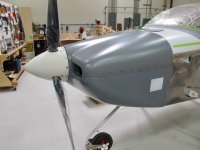 I installed electric cowl flaps as a precautionary measure during the build (the white squares). They work great, and despite a very careful baffling job, have proved to be useful.
View attachment 98739I installed electric cowl flaps as a precautionary measure during the build (the white squares). They work great, and despite a very careful baffling job, have proved to be useful.
The Anti-Splat style is draggy in cruise, but the OP tells us his cruise CHT is fine, so we could expect them to be closed in that regime. That leaves the lower airspeed case, predominately climb, where drag is of less importance and buying more HP has a real return...climb rate is proportional to excess power.
The interesting thing here is the location. Does anyone know if the side of the cowling (as pictured above) offers lower freestream pressure, as compared the usual belly installation?
andoman
Well Known Member
No hard data in my case, but on my HRII I suspect not. The HRII has a notable narrowing at the sides of the firewall. A “coke bottle” effect exists.
I opted for the sides due to ease of installation and greater distance from the exhaust system as compared to the traditional lower cowl exit location.
I hope Allen chimes in. When discussing my needs he suggested 2 on the top, aft of the cowl. I believe he said that experience in Brazil with the -10 has shown that to be an excellent location.
I opted for the sides due to ease of installation and greater distance from the exhaust system as compared to the traditional lower cowl exit location.
I hope Allen chimes in. When discussing my needs he suggested 2 on the top, aft of the cowl. I believe he said that experience in Brazil with the -10 has shown that to be an excellent location.

I’m starting to sound like an old man!
Back in the day, you wouldn’t even consider adding anything as precautionary. That added weight and complexity that may not be necessary.
Today, we add weight, add HP, and add heat, now we need to add more to deal with what we added.
Vans original designs were all about performance within a conservative umbrella. The cowling and cooling opportunity hasn’t changed even though builders needs, or wants have.
Just my observation.
If you choose to build simple, light, and conservatively, as Van intended, my guess is you won’t have unmanageable cooling problems in almost any environment. But, we want what we want and are willing to pay for it, in more ways than one.
Some, like Dan, have gone through extensive research and testing to overcome the original designs limitations. There’s a price for that too, but that’s the beauty of experimentals.
Back in the day, you wouldn’t even consider adding anything as precautionary. That added weight and complexity that may not be necessary.
Today, we add weight, add HP, and add heat, now we need to add more to deal with what we added.
Vans original designs were all about performance within a conservative umbrella. The cowling and cooling opportunity hasn’t changed even though builders needs, or wants have.
Just my observation.
If you choose to build simple, light, and conservatively, as Van intended, my guess is you won’t have unmanageable cooling problems in almost any environment. But, we want what we want and are willing to pay for it, in more ways than one.
Some, like Dan, have gone through extensive research and testing to overcome the original designs limitations. There’s a price for that too, but that’s the beauty of experimentals.
I have the same setup with a Sam James cowl on my RV6. As you know, HP = Heat. Forgive me if my comments have already been covered.I recently finished a RV7A and have finished the phase one flight testing. Being a lifetime car racer I hot rodded the engine with Ly Con 10:1 compression pistons, ported and polished cylinders, and a Superior cold air box. We dynod the finished engine at Ly Con and saw 230 peak hp. With that said, on take off I am seeing cylinder head temps exceeding 400 on takeoff in about two minutes. If I reduce the manifold pressure and the angle of attack, the temps go right down to the 380 range and in cruise they go down to the 375 range. I have heard that if I install cowl flaps that this could significantly reduce my cylinder head temps. Does anyone have experience with this???
First of all, the CHT's you are mentioning are not excessive. Lycoming wants to see the cruise EGT's closer to 400°F than 350°F. This is because you are scavenging more lead, and if the cylinders are warmer, the tolerances are tighter, and you get micro-horsepower improvement. Your max CHT is between 460°F to 500°F, based on the model. In Lycoming's "Tips for Extending TBO," they recommend climb CHT "as cool as 400° F," with max cruise CHT of 420°F.
Second, at what airspeed are you climbing? You need to climb with at least 120 KIAS to generate the needed cooling flow.
Third, you want the cowling tuned for cruise with the CHT's in the upper 300's and the oil above 180°F. If you are getting that, but still unhappy with climb temperatures, you can add holes to the cowling but you are sacrificing cruise performance because you have created more cooling drag with more air going through the cowl. I see too many adding louvers and holes in the cowl, not realizing they are sacrificing cruise performance.
My solution was to add an Antisplat EZ Cool Cowl Flap that I electronically open when needed for climb, and close for cruise. I temporarily open a hole in the cowl, but then close it to get back my well tuned cruise cowl.
$$
First of all, the CHT's you are mentioning are not excessive.
Agree, but...
Lycoming wants to see the cruise EGT's closer to 400°F than 350°F. This is because you are scavenging more lead, and if the cylinders are warmer, the tolerances are tighter, and you get micro-horsepower improvement. Your max CHT is between 460°F to 500°F, based on the model. In Lycoming's "Tips for Extending TBO," they recommend climb CHT "as cool as 400° F," with max cruise CHT of 420°F. $$
....let's note "Tips for Extending TBO" was written nearly 50 years ago, specifically to address the use of a Piper Chieftain by commuter airlines. The referenced temperatures are for the TIO-540-J2BD, which has an entirely different cylinder head.
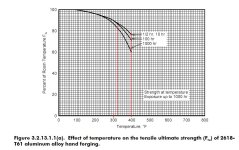
For sure, the strength of aluminum alloys falls rapidly in the region between 300F and 400F. At the same time, the valve seat pockets are growing. I'm not sure which alloy Lycoming is using for cylinder heads these days, but here's an Al-Cu alloy example. I'm just sayin'...
Are you in the "lower is better" camp, or is there a specific reference number you use for "good" CHTs in an angle valve engine?For sure, the strength of aluminum alloys falls rapidly in the region between 300F and 400F. At the same time, the valve seat pockets are growing. I'm not sure which alloy Lycoming is using for cylinder heads these days, but here's an Al-Cu alloy example. I'm just sayin'...
I would challenge this. Have never seen lycoming recommend 400 over 350; only 400 as a recommended Max temp for economy cruise. While i agree that 400 is safe, you can’t take that to mean that 400 is better than 350.I have the same setup with a Sam James cowl on my RV6. As you know, HP = Heat. Forgive me if my comments have already been covered.
First of all, the CHT's you are mentioning are not excessive. Lycoming wants to see the cruise EGT's closer to 400°F than 350°F. This is because you are scavenging more lead, and if the cylinders are warmer, the tolerances are tighter, and you get micro-horsepower improvement. Your max CHT is between 460°F to 500°F, based on the model. In Lycoming's "Tips for Extending TBO," they recommend climb CHT "as cool as 400° F," with max cruise CHT of 420°F.
Second, at what airspeed are you climbing? You need to climb with at least 120 KIAS to generate the needed cooling flow.
Third, you want the cowling tuned for cruise with the CHT's in the upper 300's and the oil above 180°F. If you are getting that, but still unhappy with climb temperatures, you can add holes to the cowling but you are sacrificing cruise performance because you have created more cooling drag with more air going through the cowl. I see too many adding louvers and holes in the cowl, not realizing they are sacrificing cruise performance.
My solution was to add an Antisplat EZ Cool Cowl Flap that I electronically open when needed for climb, and close for cruise. I temporarily open a hole in the cowl, but then close it to get back my well tuned cruise cowl.
$$
From all of my research, effective lead scavenging (i.e. lead becomes gaseous - no deposits) takes place above 800-1000* gas temps; basically anything above 1000* egts. At moderate power, you are getting egts well above 1200 regardless of chts. Lead deposits form at adle or near idle rpms, where the combustion gas temps do not get above the critical temp for converting lead to lead bromide, the gaseous version.
I almost never run 400 in my 6. 3/4 of the time they are 350ish and the other 25% between 290 - 330. I have almost NO lead deposits ever. Just a tiny ball or two in the spark plugs to remove at ci. Reducing available lead, by optimizing idle mixture helps as well. I do not lean on the ground.
Last edited:
Can’t speak for dan, but i am definitely in the lower is better camp, for MANY reasons, one of which dan outlined above.Are you in the "lower is better" camp, or is there a specific reference number you use for "good" CHTs in an angle valve engine?
Last edited:
Lower is better for longevity...re the strength data above, and for cool exhaust valve seats. However, it's all about reasoned compromise. I too want speed, so I'm running far less exit area, and that pushes CHT upward.Are you in the "lower is better" camp, or is there a specific reference number you use for "good" CHTs in an angle valve engine?
Never been over 380 max under any condition. High power cruise ballparks around 350, normal cruise around 325. I am enjoying the advantage of an angle valve (more fin area); a parallel valve would need to flow more mass to get similar CHT.
Examples...here's a high power cruise shot. Looks like I wanted to land at Gulf Shores before dark, so I turned up the wick to counter a headwind, and stayed low. EGT average is 115 ROP, with CHT in the 350 ballpark. Fuel flow is awful, but re previous discussion, run the numbers. (12.4*6)/(210*0.70) = 0.5 BSFC.
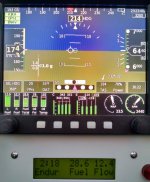
More typical cruise CHT. Higher altitude, EGT at peak. BSFC is 0.42. This taken on the way home from OSH in 2023.
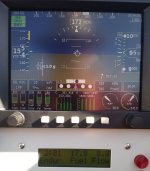
This one taken at top of climb, pushing over, gaining speed, shooting for 10.5, no power adjustment yet. Result of continuous climb, WOT/2600 at 125 indicated from near sea level, leaning all the way using the reference EGT method.
CHT's in the 350 ballpark. BSFC = 0.51
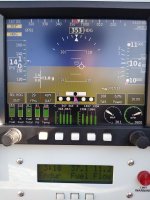
Last edited:
I realize your purpose for posting this was not to make me jealous of your airplane's speed, but I am. My best guess (after flying TAS calibration boxes and significant testing) as to my 8A's cruise speed at 9500' indicated (and only a hair higher DA) is 160ktas, 141kias at 2500 rpm, max MP, and 100° ROP. Probably about as apples-to-apples as you can get, except I have a nosewheel and angle valve IO-360 with Bendix mags. And, of course, I haven't spent a lot of time trying to find extra knots through subtle tweaks to the airframe and cooling drag. I do think there may have been additional drag due to flying in a slip due to an error in roll adjustment in my GRT EFIS, but I find it hard to believe my worn cam lobes (plus the 10-15hp of your IO-390) would explain a 23 knot difference -or roughly -13kts from the factory demonstrator with my equivalent engine.More typical cruise CHT. Higher altitude, EGT at peak. BSFC is 0.42. This taken on the way home from OSH in 2023.

Back on topic: I've heard some opine that AV engines get cooler CHTs through the piston oil squirters more than through the fin area. I had never considered that and always thought it was fin area like you said. Does anyone install piston oil squirters in parallel valve engines (like OP's engine) for additional cooling benefits?
Last edited:
.... I find it hard to believe my worn cam lobes (plus the 10-15hp of your IO-390) would explain a 23 knot difference -or roughly -13kts from the factory demonstrator with my equivalent engine.
In comparison, a standard 8A has three significant drag sources...nose gear, big low velocity cowl exit, and the sliding canopy/turtledeck configuration. I don't know why it is slower than the factory airplane. How do they compare on weight?
Back on topic: I've heard some opine that AV engines get cooler CHTs through the piston oil squirters more than through the fin area. I had never considered that and always thought it was fin area like you said. Does anyone install piston oil squirters in parallel valve engines (like OP's engine) for additional cooling benefits?
Folks have put squirters in parallel valve engines. I don't know the effect on CHT, if any. Do note pistons run in the steel cylinders, while CHT measures cylinder head temperature in a region near the combustion chamber crown. It's a long way from the piston crown to the CHT well.
Not much specific data in my little library, but Taylor suggests the real purpose, in a large bore, is simply piston cooling. Given a small bore and relatively thick crown, heat transfer from the center to the top ring land is adequate. Harder to do with large bore sizes, so squirt the bottoms. It's structurally good for the pistons (the nosediving strength vs temperature thing), and it increases detonation margin.
The plane was supposedly about 1070 empty, but one of my better measurements at that altitude was with full fuel and a passenger. It will need a re-weigh. Once the overhauled engine is back on, and I eventually work up the motivation to get into fiberglass, the cowl exit is high on my list. The nosegear really gums up the exit area, unfortunately, and a 4-1 exhaust is simply not an option due to it.In comparison, a standard 8A has three significant drag sources...nose gear, big low velocity cowl exit, and the sliding canopy/turtledeck configuration. I don't know why it is slower than the factory airplane. How do they compare on weight?
Good point - no easy path of heat transfer to change temp in that area.Folks have put squirters in parallel valve engines. I don't know the effect on CHT, if any. Do note pistons run in the steel cylinders, while CHT measures cylinder head temperature in a region near the combustion chamber crown. It's a long way from the piston crown to the CHT well.
I don't know what is considered "large bore" in terms of dimensional threshold, but these pistons are absolutely massive compared to the automotive world. I consider 500cc cylinders to be "normal" and the Lycoming 360ci engines are 3x that.Not much specific data in my little library, but Taylor suggests the real purpose, in a large bore, is simply piston cooling. Given a small bore and relatively thick crown, heat transfer from the center to the top ring land is adequate. Harder to do with large bore sizes, so squirt the bottoms. It's structurally good for the pistons (the nosediving strength vs temperature thing), and it increases detonation margin.
I did a hone / re-ring on a PV 360. OTs were 220/230 by 1000 agl after T/O with 7 row cooler. upgrade to 9 row did little to help. On jug removal, found squirters and removed them. On the break in flights, did not notice any meaningfull increase in CHTs. My flights in this plane were somewhat limited, so didn't intimately knows the temps.Folks have put squirters in parallel valve engines. I don't know the effect on CHT, if any. Do note pistons run in the steel cylinders, while CHT measures cylinder head temperature in a region near the combustion chamber crown. It's a long way from the piston crown to the CHT well.
When he got the plane, baffling work was bad. prior to remediation, would reach 425* CHT shortly after T/O and that was with squirters, so don't believe they do much in reducing chts on pv 360's.
Last edited:
