Van's Air Force

The definitive Van's Aircraft support community! Buying, building or flying an RV? Join our exclusive family of mentors and enthusiasts!

Did I Just Experience a Stuck Exhaust Valve? Confirmed!

We dont have a dog in this hunt, but surely seems like its time for a new design engine.
I agree! I'm new to aircraft ownership (REALLY new considering mine isn't even completed yet). But, one thing that has really caught my attention since joining this forum is how "unreliable" these darned engines are. Now before you jump all over me, I don't mean these engine are failing left and right and I know there are some poor automotive engine designs out there especially in recent years as makers have chased CAFE fuel standards.

It's just the fact that every other piston engine I've owned for the last 50 years has been bulletproof. That includes owning a lot of high mileage junkers in my youth. No stuck or burnt valves. No pitting on the cams. No concerns about not starting the engine every two weeks or else! No dilemma about which oils to use or avoid. No strict guidelines on breaking in the engine to prevent glazing or else!

The sad part is the Lycoming engine as FAR more simple than non-aviation engines. It should be absolutely foolproof. I can understand using more oil because of looser tolerances due to the air cooled design. But, there should never be any other issues because there are FAR fewer parts and FAR less complexity than automotive engines.

I have a new 390 on order and to be honest, I'm a bit paranoid about getting a stuck valve - and glazing during break in - and cam pitting due to low use during the winter. An $80,000 engine with a high likelihood of stuck valves after a couple years???? That's just crazy and yet we have no alternative so we keep buying these prehistoric engines and do all kinds of crazy dances to limp to TBO.

If Honda made a big enough air cooled lawnmower engine for my airplane, I'd install it so fast it would make your head spin. Flame on!!!!
 
I doubt an oil pressure increase will flow enough additional oil to the rocket box to reduce valve stem and guide temperature. That said, I think Sky Dynamics had a mod to add external oil lines.

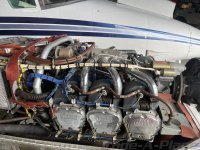
Lycoming directly addressed guide cooling on the TIO-541. It's an uncommon engine not seen much...top intake, bottom exhaust, with the cam and pushrods on the bottom. In the photo below, see the lines connected to fittings just to the left of the spark plugs? That's an oil supply from the front of the crankcase oil gallery. I'm pretty sure the fittings feed a groove on the OD of the exhaust valve guide. I don't know where the oil goes from there.

Note this system supplies cooling right where it is needed...the middle of the guide. The flip side? The groove had a tendency to fill up with (drum roll please) coked oil. To check the passage you blow air through the fittings. If clogged I think you need to remove the guide.

Nope, I've never worked on one, and you now know everything I know.

Side story; about 25 years ago two of my airport buddies decided they wanted a Duke, home of the TIO-541-E1C4. They offered me a 1/3 share in the airplane if I would just do all the repairs and maintenance. I turned them down, as it looked too much like a second career.

TIO-541.jpeg

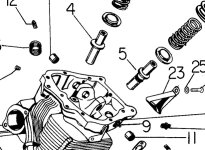
I tried to find a picture of the guide (79046, if you want to look), but the best I could do was the illustration in the parts catalog, #5:

79046 exhaust guide.jpg

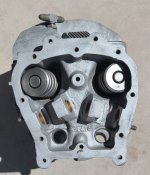
Here's the oil supply fitting on the top of a head:

ScreenHunter_3067 Dec. 18 09.14.jpg
 
agree that lyc could care less. Possibly not a total lack of concern but more about the liability consequences of making changes to design.
Do we think that Lycoming knows how many stuck valves are occurring on say the 390? Perhaps we should be reporting them to Lycoming.
 
The Cirrus SR20 uses the IO-390, a simple internet search shows they are having valve sticking issues also. I would guess that Cirrus is putting some heat on Lycoming to get this sorted out.
 
Tinfoil people will say they know exactly whats up, but can't address it for fear of admitting an issue. I think its likely they really don't know the exact causes though.
 
A simple search says it's not just a 390 problem.

BTW, the L2A in the above example is a parallel valve engine.

EDIT...just took a further spin in the net, search words being "sticking valves". You'll find what seems like every engine known to man.
 
Last edited:
A simple search says it's not just a 390 problem.

BTW, the L2A in the above example is a parallel valve engine.
+1

While the problem may or may not develop a bit sooner on the 390's, this is far from limited to that engine. The big mystery is the hit or miss nature of the problem. You can have 2 seemingly identical engines in two seemingly identical airframes and one develops the problem in 200 hours and the other goes to TBO without it. Leads one to conclude that somewhere in the engine, the tolerance range(s) is/are too wide. Or there is an installation or operational variable we are not understanding or cannot isolate; MB excluded of course.
 
Last edited:
I highly doubt that Lyc doesn't know the cause or how to fix it. You can't design and mfr engines for 80 years and be oblivious to the cause and effect here.
Well like I said, opinions vary. However I feel that if they had a clear cause identified, they would have made a new revision of the design to eliminate (greatly reduce?) the issue on new engines.
 
The choice of materials used in the valves & guides is interesting -- does anyone know the bearing material used in the guides?

Maybe the issue isn't the oil (or lack thereof) dribbling down the push rod tubes, but the alloy used in the guide bushings changing or not being appropriately specified and controlled over time and application. ("Hand me some bushings -- yeah, that bin over there...that'll work")

Just a thought.
 
It's just the fact that every other piston engine I've owned for the last 50 years has been bulletproof. That includes owning a lot of high mileage junkers in my youth. No stuck or burnt valves. No pitting on the cams. No concerns about not starting the engine every two weeks or else! No dilemma about which oils to use or avoid. No strict guidelines on breaking in the engine to prevent glazing or else!
There's an easy explanation for that, those engines didn't cost anywhere near the 100K we're heading to.

Trying not to head into conspiracy theories here, but why would Lyco change anything to this ancestral design? Relishing amidst very cosy warm cushions on the sofa provided by the quasi-monopoly, sipping champagne whilst laughing their (insert any suitable adjective, here's some space: .....................) off, watching orders pour in, and selling new cylinder assys and parts as demand rises. No expansion aspirations, so why change anything?
 
Last edited:
+1

While the problem may or may not develop a bit sooner on the 390's, this is far from limited to that engine. The big mystery is the hit or miss nature of the problem. You can have 2 seemingly identical engines in two seemingly identical airframes and one develops the problem in 200 hours and the other goes to TBO without it. Leads one to conclude that somewhere in the engine, the tolerance range(s) is/are too wide. Or there is an installation or operational variable we are not understanding or cannot isolate; MB excluded of course.
Well, that would point towards a QC problem... not sure if that is the key.
 
Come on guys, quit the bitching and tinfoil hat stuff. Think.

1. Everything has a physical cause. If you present a theory, explain it in physical detail, and propose an experiment to prove or disprove. Speculation without test or measurement is how "those forum people" got their reputation.

2. We've had recent posts from at least one serious player at Lycoming. Quite a few of us would like to see it continue. Sticking to technical fact would be a good start.
 
Well, that would point towards a QC problem... not sure if that is the key.
I didn’t say that. Most every critical part in contact with another has a tolerance range. Anything within that range is not a defect nor a qa issue. Some of those ranges are pretty wide and generous on a lyc. Very possible that extreme edges of tolerance can create differences that could be creating the wide variability seen with this problem. Then there is tolerance stacking.

Not saying this is the issue, just that it is something to consider.

There was a guy here a month ago talking about tappet to case bore clearance differences and how they changed oil flow coming out of the tube shroud. Some flowed generously and others barely anything. That oil flowed right on to the guide area (creating a cooling effect)and could possibly showcase how tolerance differences could be related to this issue. He made those observations on a running engine.
 
Last edited:
Bill Marvel investigated premature valve guide wear in parallel valve lycs many years ago. His conclusion was that the sodium filled valves were transmitting more heat to the guides than the limited oil flow to that area was able to carry away. He measured the amount of oil being delivered to the heads and found that the odd side had less than the even side and neither side was getting all that much. He further posited that the lifters were never designed to move oil through hollow pushrods to the top end. Lycoming evidently agreed with him, although not in public, when they added external oil pressure lines to the Malibu engines that were having the same problem. They also quietly upped the oil pressure on new engines delivered to Cessna and partially masked that by now tapping the pressure from the front of the engine. Tappet to bore clearance may well up flow to the rocker. The flat tappet Lycoming design limits the amount of time that the lifter body oil port is in registration (lined up with) the annulus in the bore. The Superior roller lifter setup has a wider annulus and is in registration full time which might increase oil available to be pumped to the valve train. The angle valve head is different and, as Dan said, might not benefit from more oil pressure, but it seems to me that both types would probably be better off with oil squirters of some sort right onto the guides.

Liquid cooled heads might work better too, but at additional weight, expense, and complexity.

Ed
 
@johnpaul44 thanks for linking the article. I'm certainly no chemist (and forgot all what we've been told in high school...) but the interactions cited make sense, and the article explains it all very nicely.

Somehow outlined are also the 2 types of deposits, namely lead or carbon, or a combination of the 2. I've seen both thru the years, but carbon is clearly predominant on engines with low hours on them, as lead probably wasn't given enough time to adhere to valve stems.

Said article also gives what is probably no final solution, but good advice for the operation of our engines, including frequent oil changes.
 
My mistake, I didn't realise that was MP. I still believe you're more likely to have had a fuel blockage than an exhaust valve stick at a steady phase of flight
I would think with fuel blockage unless is complete blocked, the EGT will go up not down. I suppose it is possible for the fuel to become blocked completely for a short period and clear up completely that quick.
 
So as I mentioned before it ended up being a stuck valve. Used the ball hone this afternoon and it cleaned up very easily. There were no deposits on the valve stem itself.
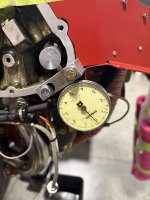
Did the wobble test after cleaning it up and got .018" which is within spec. Thanks for everybody's help and suggestions. Dropping the valve and reinstalling is pretty easy even on the angle valve. Tomorrow I will be doing the wobble test on cylinder #2.

(As an aside I have had several partly blocked injectors on 540's and they never seemed to clean themselves up. Also cylinder doesn't go cold)


IMG_4322.jpeg
 
Last edited:
I highly doubt that Lyc doesn't know the cause or how to fix it. You can't design and mfr engines for 80 years and be oblivious to the cause and effect here.
Maybe Larry, however I’m lead to believe the “bean counters” furloughed some of the old guys in the 90’s & some serious knowledge went with them.
Also, there was an event where intake (non squirt type) valve rockers were installed instead of squirter type (to the exhaust valve position) in the assembly line - what was the solution ? They dumbed own the assembly process & used squirt type rockers on ALL the intake/ exhaust valves, duh ?
Then there was the valve guide wear issue - what did Lyc do? Oh! we’ll just increase the chromium content = we STILL have the 388 SB for the guides & still have guide wear.
Also some turbo engines had external flexible oil lines to increase oil flow - what did that achieve ?
I used to think a manufacturer would know a lot about there own designs however it appears they may know less now than we think.
 
Maybe Larry, however I’m lead to believe the “bean counters” furloughed some of the old guys in the 90’s & some serious knowledge went with them.
Also, there was an event where intake (non squirt type) valve rockers were installed instead of squirter type (to the exhaust valve position) in the assembly line - what was the solution ? They dumbed own the assembly process & used squirt type rockers on ALL the intake/ exhaust valves, duh ?
Then there was the valve guide wear issue - what did Lyc do? Oh! we’ll just increase the chromium content = we STILL have the 388 SB for the guides & still have guide wear.
Also some turbo engines had external flexible oil lines to increase oil flow - what did that achieve ?
I used to think a manufacturer would know a lot about there own designs however it appears they may know less now than we think.
I guess we will never know. I am not a lawyer, but learned quite a bit about liability and negligence in product management. i can’t help but wonder if addressing the issue opens them up to increased risk in liability cases.

None of this is new or a mystery in engines. It is seen in other egines, but the rate of occurrence is very low and usually attributed to poor mx, specifically long oil drain intervals. The mfr has the expertise and tools to measure heat, airflow, materials analysis, etc. they knew they had a problem with valves getting too hot and breaking and knew how to fix it. And they did, though one could argue there were better ways to do so. I just can’t imagine a company of that size and caliber being unable to understand the cause and effect related to this issue. We are just builders here with no measurement tools or dynos and have addressed many different possibilities. Just imagine if we could stick temp sensors all over the heads and run them on a test stand for 1000 hours, as they can at the factory.

All that said, you could be right that lyc is a shell of their former selves with limited real expertise. But i struggle to see how that could be when they have to routinely defend and prove things to the faa for certification. What if you start getting cranks cracking in the field? The faa is going to demand some serious engineering analysis on the failure modes and root cause. There better be someone around that has expertise in that area.

Over time, this WILL be addressed and we will learn in hindsight who knew what. Sadly, in the interim we are left to our own devices.
 
Last edited:
Bill Marvel investigated premature valve guide wear in parallel valve lycs many years ago. His conclusion was that the sodium filled valves were transmitting more heat to the guides than the limited oil flow to that area was able to carry away.
How bout we change the type of oil, not the engine design?
I mean there are piston engine oils with higher temperature tolerance than the oils "certified" for use in aircraft engines.
 
How bout we change the type of oil, not the engine design?
I mean there are piston engine oils with higher temperature tolerance than the oils "certified" for use in aircraft engines.
A very detailed, scientific discussion about coking. Targetted to turbine engines, but details still applies to us. Far too detailed for me to get through, but covers the subject in great detail.

https://journal.gpps.global/Coking-...oils-at-elevated-temperatures,168292,0,2.html
 
From what I am hearing, if you run 100LL you have to keep the temperature up to allow the lead scavenging to work, and keep the temperature down so that the oil doesn't coke up. Obviously not possible. Mitigation is use unleaded fuel and then you can keep the temp down, oil won't coke, and you'll be fine.

I have a feeling with all the data that Savvy has, they should soon be able to find correlations with CHTs and valve sticking. I think they should start capturing other info like fuel type, oil type, filter, additives, and other data that can help with their ML analysis.
 
A very detailed, scientific discussion about coking. Targetted to turbine engines, but details still applies to us. Far too detailed for me to get through, but covers the subject in great detail.

https://journal.gpps.global/Coking-...oils-at-elevated-temperatures,168292,0,2.html
Very interesting reading. Thank you.
Their experiment shows that a synthetic turbine oil coks at 500 degrees Celsius (932F), at a very slow flow rate (10.4 mL/min). How does that compare to rate of oil flow trough the Lycoming's exhaust valve guide?
 
How bout we change the type of oil, not the engine design?
I mean there are piston engine oils with higher temperature tolerance than the oils "certified" for use in aircraft engines.
I was very involved with the work by Bill Marvel & his friend back in the mid 90’s, my engine was the ‘canary in the coal mine’ to prove/disprove some ideas with testing. As stated before - we/I measured the oil flow to the rocker box area & where that oil came from - the oil that lubricated/cooled the valve guides ran down the shroud tubes (dropped directly above the guides) & oil in the pushrods did not have any affect on the guides.
 
From what I am hearing, if you run 100LL you have to keep the temperature up to allow the lead scavenging to work, and keep the temperature down so that the oil doesn't coke up. Obviously not possible.

The competing theories are (1) a valve below some critical temperature condenses tetraethyl lead breakdown products on its surface, specifically the stem portion exposed to gas flow. In this theory, the loss of operating clearance is in the lower 1/2" or so of the guide, the buildup being mostly lead byproduct. The other theory says the buildup is mostly coked oil, and the loss of operating clearance is further up the guide. Some authors combine the two as possible in the same guide

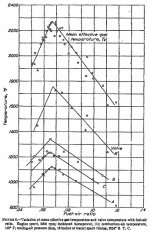
Kollin states it is necessary to keep CHT high to prevent lead buildup on the lower stem, because valve temperature follows CHT, not EGT. The assertion is not supported in any literature I've seen. As far back as 1945 the folks at the NACA determined the most significant factor in exhaust valve temperature was local mean gas temperature, the variable being fuel-air ratio. The plot below is three exhaust valve designs equipped with internal thermocouples, plotted against gas temperature. The plots sync, and note mixture change moves valve temperature far more than could be expected with any practical change in CHT.

ScreenHunter_3089 Dec. 24 20.12.jpg

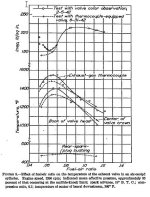
Earlier test, in 1942. Note EGT and valve temperatures are in sync, then look at the thermocouple plot for the spark plug bushing. Peak CHT is seen at an FA ratio richer than stoich, and (2) exhaust valve temperature does not follow this CHT plot.

Exhaust Valve Temp vs Mixture.jpg

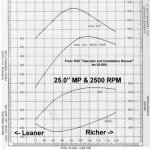
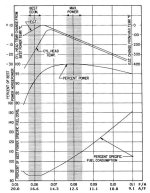
More recently, TCM IO550 and generic Lycoming plots. Note CHT peaks when mixture is rich of stoich, again different than valve temperature plots, which peak in sync with stoich mixture.

Cont IO-550.jpgLeaning Relationships.jpg

I did find a single condition under which valve temperature followed cylinder head temperature, independent of exhaust gas temperature. NACA 1209 looked at a water cooled Merlin head on a lab crankcase and found valve temperature and CHT were in sync with change in RPM. Given the majority of hours for our Lycomings are spent within a very narrow RPM range, I think it irrelevant.

ScreenHunter_3090 Dec. 25 06.25.jpg

From the same report...given a 150F coolant temperature change with a 120F CHT change, the exhaust gas gained 20F, and the exhaust valve gained 40F.

ScreenHunter_3091 Dec. 25 06.27.jpg

Assuming the lead deposition and oil coking theories are true, I'll suggest the desirable operating combination is a high EGT and a low CHT. High EGT would maintain high surface temperature at the portion of the valve exposed to gas flow, while a low CHT might hold guide temperature below the oil coking point, and provide a lower thermal resistance for cooling the valve head when the hot gas is not flowing.
 
Last edited:
I was very involved with the work by Bill Marvel & his friend back in the mid 90’s, my engine was the ‘canary in the coal mine’ to prove/disprove some ideas with testing. As stated before - we/I measured the oil flow to the rocker box area & where that oil came from - the oil that lubricated/cooled the valve guides ran down the shroud tubes (dropped directly above the guides) & oil in the pushrods did not have any affect on the guides.

Jake, was the work related to valve guide wear (i.e. exceeding the wobble limits), or valve sticking (no significant wobble), because the stem is tight in the guide?
 
From what I am hearing, if you run 100LL you have to keep the temperature up to allow the lead scavenging to work, and keep the temperature down so that the oil doesn't coke up. Obviously not possible. Mitigation is use unleaded fuel and then you can keep the temp down, oil won't coke, and you'll be fine.
i wonder if deposits on the valve guides are mainly from incomplete fuel combustion as opposed to oil breakdown. cold starts, idling below 1000 rpm and too rich, leaning habits in flight are valuables hard to measure but can generate huge amounts of carbon?
 
i wonder if deposits on the valve guides are mainly from incomplete fuel combustion as opposed to oil breakdown. cold starts, idling below 1000 rpm and too rich, leaning habits in flight are valuables hard to measure but can generate huge amounts of carbon?
You need to look no further than the inside of your exhaust pipe to see the type of deposits created by combustion exhaust. Wipes right off with you finger. Does not create rock hard deposits that are strong enough to clamp your valve stem in place.
 
You need to look no further than the inside of your exhaust pipe to see the type of deposits created by combustion exhaust. Wipes right off with you finger.
that may be soot not captured by the oil and exiting the engine before it had a chance to harden and bake in to the metal surfaces at high temperatures. lycoming seems to be pretty clear that oil contamination and operating procedures is what influences deposits in the valve guides, rather than the clean oil breaking up by itself and producing own carbon.

https://www.lycoming.com/sites/defa...ing - Early Warning Signs and Indications.pdf

I'm not yet convinced that there is a consipracy and that Lycoming knows what the "real" cause is and hides it from us. It would be a really big secret to keep from escaping to the public 🤷‍♂️
 
I am the original poster. My 390 has 290 hrs on it all flown by me. The aircraft is housed in a heated hangar. It is preheated with cylinder band and sump heat whenever hangar is below 50F. Engine is started, leaned just above stumbling, and idles at 1000 rpm. Taxis are short. Idle mixture is set according to Lycomings instructions. Mixture is enriched when I take the runway. I have flown 100% of the time LOP since original break in period. Hottest cylinder is usually 5-10 degrees LOP. Oil changes every 25 - 25 hours. Use Phillips 20W50 and Camguard. Fly at least once per week. Oil temps 190 -195F. CHT 300F - 390F. Valve stem had no deposits on it and guide had a bit. Not really hard deposits. I was surprised such little deposits could cause the valve to stick against the force of the spring. I go back to the 390's having a very high number of issues at least in RV-14's. I operated a lot of 540's and have many friends with 320's and 360's and never have had sticky valve issues. It seems like 1/3 of RV-14 guys I know have and especially on low hour engines. I don't believe there is a conspiracy. I believe the issue is poorly understood and 390's are more susceptible.
 
It is preheated with cylinder band and sump heat whenever hangar is below 50F. Engine is started, leaned just above stumbling, and idles at 1000 rpm. Taxis are short. Idle mixture is set according to Lycomings instructions. Mixture is enriched when I take the runway. I have flown 100% of the time LOP since original break in period. Hottest cylinder is usually 5-10 degrees LOP. Oil changes every 25 - 25 hours. Use Phillips 20W50 and Camguard. Fly at least once per week. Oil temps 190 -195F. CHT 300F - 390F. Valve stem had no deposits on it and guide had a bit. Not really hard deposits.
Glenn it's really a shame you got a stuck valve so quickly despite following Lycoming's proper care and feeding advice. if it happened to me I'd be on the phone a lot requesting their best engineers to take a closer look and provide some kind of plausable explanation and hopefully a fix. Problems like this are becoming very visible now and they can't simply brush off with a scripted response.
 
I am the original poster. My 390 has 290 hrs on it all flown by me. The aircraft is housed in a heated hangar. It is preheated with cylinder band and sump heat whenever hangar is below 50F. Engine is started, leaned just above stumbling, and idles at 1000 rpm. Taxis are short. Idle mixture is set according to Lycomings instructions. Mixture is enriched when I take the runway. I have flown 100% of the time LOP since original break in period. Hottest cylinder is usually 5-10 degrees LOP. Oil changes every 25 - 25 hours. Use Phillips 20W50 and Camguard. Fly at least once per week. Oil temps 190 -195F. CHT 300F - 390F. Valve stem had no deposits on it and guide had a bit. Not really hard deposits. I was surprised such little deposits could cause the valve to stick against the force of the spring. I go back to the 390's having a very high number of issues at least in RV-14's. I operated a lot of 540's and have many friends with 320's and 360's and never have had sticky valve issues. It seems like 1/3 of RV-14 guys I know have and especially on low hour engines. I don't believe there is a conspiracy. I believe the issue is poorly understood and 390's are more susceptible.
Other than preheating the engine, my practice and flying habits have been pretty much the same and I did have a stock valve (#2C) at around 260 hours. My CHTs are in the low 300 and the delta between the hottest and coolest cylinder is about 8F with #1 and #2 being the hottest.
 
Maybe just wishful thinking but my IO390 after 250 hrs. "black deposits" seen around and under the exhaust valves looked pretty bad. (never performed a wobble test) Was using Phillips 20W50 Victory oil after switching from Aeroshell 100W (at 150 hrs.) because the oil "looked better" after ~30 hrs. between oil changes. Began to wonder where the dark residue no longer present in the oil went. Switched to AeroShell 15-50 and the black deposits slowly went away. Has anyone on the forum experienced a stuck valve on their IO390 using predominantly Aeroshell 15-50? This can't be that difficult to obtain data that points us to a solution.
 
Glenn it's really a shame you got a stuck valve so quickly despite following Lycoming's proper care and feeding advice. if it happened to me I'd be on the phone a lot requesting their best engineers to take a closer look and provide some kind of plausable explanation and hopefully a fix. Problems like this are becoming very visible now and they can't simply brush off with a scripted response.
But they do and have been doing so for many years now. Or possibly blame the owner for dirty oil or running lean of peak or any item off their 10 commandments. You can call it a conspiracy or whatever you want. You can pretend they are just oblivious and don’t know what to do about it. What is happening behind the curtain is not public and generally irrelevant. They have posted instructions on how to check for it and address it. Thats it. No reasons disclosed. No details about what causes it and how to avoid it. No press release discussing their intended fix. Maybe they know the why, maybe they don’t, but It would seem pretty clear that they don’t view this as a design flaw that needs to be addressed by them. Same way that pmag doesn’t think it is a problem that you have to check for bearings going bad every year take steps to fix it when it does. Many companies don’t strive for perfection for various reasons.
 
But they do and have been doing so for many years now. Or possibly blame the owner for dirty oil or running lean of peak or any item off their 10 commandments. You can call it a conspiracy or whatever you want. You can pretend they are just oblivious and don’t know what to do about it. What is happening behind the curtain is not public and generally irrelevant. They have posted instructions on how to check for it and address it. Thats it. No reasons disclosed. No details about what causes it and how to avoid it. No press release discussing their intended fix. Maybe they know the why, maybe they don’t, but It would seem pretty clear that they don’t view this as a design flaw that needs to be addressed by them. Same way that pmag doesn’t think it is a problem that you have to check for bearings going bad every year take steps to fix it when it does. Many companies don’t strive for perfection for various reasons.
Larry…did you just allege that corporations might knowingly choose profit, over safety and quality?…Lions and tigers and bears…oh my.

that’s just plain silly…like any corporation might commit engineering conspiracy and fraud…to protect themselves from exhaustive class action liability, for refusing to disclose known issues with their customers…

No….you go be quiet now and pour in some red liquid into your gas and oil and everything will be fine…and stop telling people it might not be their fault…that fundamentally certain withheld engineering solutions can’t be discussed, because …well….because. So there.

Everyone knows this is caused by users not changing oil often enough…using the wrong oil and operating their engines not in accord with the way “they” say to.

Common knowledge…

I’m putting my blinders back on….tearing down yet another engine, in an effort to fix nagging issues that affect my health and well being, if I don’t just do it myself…

Buckle up buttercup.
 
Back
Top