
I have been concerned about water getting through the filler cap. Of course I replaced the cap gasket but wonder how you can detect water in mogas during the usual fuel drain sequence. On rare occasion I have seen a water bead on the inside of the tester tube. Gas sheets like wine in a glass, whereas water forms a bead the acts and runs differently. Is there a better way to test, and is there a safe, recommended way to remove contaminated water from the mogas?

Van's Air Force
You are using an out of date browser. It may not display this or other websites correctly.
You should upgrade or use an alternative browser.
You should upgrade or use an alternative browser.
Detecting Water in Mogas
- Thread starter n74846
- Start date


Does your mogas have ethanol? If so, then it will mix with the water, and generally burn ok, if you don't have too much. Otherwise, just let it settle and drain it from the sump.I have been concerned about water getting through the filler cap. Of course I replaced the cap gasket but wonder how you can detect water in mogas during the usual fuel drain sequence. On rare occasion I have seen a water bead on the inside of the tester tube. Gas sheets like wine in a glass, whereas water forms a bead the acts and runs differently. Is there a better way to test, and is there a safe, recommended way to remove contaminated water from the mogas?
Norman CYYJ
Well Known Member
Use water based food dye to test for ethanol in your fuel. The dye will disperse throughout the fuel if there is ethanol in the fuel. If not the dye will just go to the bottom as water does.Does your mogas have ethanol? If so, then it will mix with the water, and generally burn ok, if you don't have too much. Otherwise, just let it settle and drain it from the sump.

[email protected]
Active Member
Water in mogas is no different than water in Avgas - unless the mogas contains ethanol. The ethanol will absorb the water until saturated, then the remaining water will settle to the bottom of a sight glass just as with Avgas. First, never, ever, use mogas containing ethanol, even if your engine is approved for it. There are thousands of sellers of ethanol-free gasoline at pure-gas.org. To test for ethanol in fuel, see the offering here: https://autofuelstc.com/collections/fuel-testerI have been concerned about water getting through the filler cap. Of course I replaced the cap gasket but wonder how you can detect water in mogas during the usual fuel drain sequence. On rare occasion I have seen a water bead on the inside of the tester tube. Gas sheets like wine in a glass, whereas water forms a bead the acts and runs differently. Is there a better way to test, and is there a safe, recommended way to remove contaminated water from the mogas?

Ethanol isn't great and I agree with the recommendation to avoid it if possible, but I wouldn't say "never, ever". There are a lot of places where ethanol-free gas is very hard to find and the official word from Van's is that if it's down to a choice between 100LL avgas and unleaded E10, go with the unleaded E10.First, never, ever, use mogas containing ethanol, even if your engine is approved for it.
On the legacy 12 never run the fuel pump before sumping the gascolator. Doing so will move the water to the carb bowls if the carbs were dry. It may also return water to the tank that will need time to settle. The carbs will need to come off so you can dump out the carb bowls (Side note; an indication of water in the carb bowls is the engine running with the choke ON, but stalls when the choke is turned OFF)
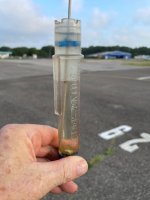
Take a minimum of four fuel samples. The gascolator is the lowest point in the fuel system, but the fuel needs to go up hill to get there. So you need to empty the gascolator to move the upstream water into the gascolator. With auto fuel, if you have water in the fuel the sample it will first appear cloudy and gradually separate. It may take 30 or more fuel tests to get all the water out. When you think you got it all, wait about half an hour for the fuel to settle and take another four samples to be sure. Repeat as needed.
I was amazed at the amount of water that can drain into the fuel system from that #40 vent hole in the fuel cap. This was about the15th sample, note the cloudy fuel above the water.
Take a minimum of four fuel samples. The gascolator is the lowest point in the fuel system, but the fuel needs to go up hill to get there. So you need to empty the gascolator to move the upstream water into the gascolator. With auto fuel, if you have water in the fuel the sample it will first appear cloudy and gradually separate. It may take 30 or more fuel tests to get all the water out. When you think you got it all, wait about half an hour for the fuel to settle and take another four samples to be sure. Repeat as needed.
I was amazed at the amount of water that can drain into the fuel system from that #40 vent hole in the fuel cap. This was about the15th sample, note the cloudy fuel above the water.
Attachments

BH1166
Well Known Member
I burn nothing but unleaded 93 octane, unless out and need fuel, then some 100ll. Im hangared , great seal on caps no leaks when on the ramp or flying in rain. I have sumped my tanks and found on occasion a drop or two over the last 8 years/900+ hours. You are doing exactly what I do. Sump after fueling, sump till no water in tester, use no alcohol laced gas as water mixes with it, this is my process.I have been concerned about water getting through the filler cap. Of course I replaced the cap gasket but wonder how you can detect water in mogas during the usual fuel drain sequence. On rare occasion I have seen a water bead on the inside of the tester tube. Gas sheets like wine in a glass, whereas water forms a bead the acts and runs differently. Is there a better way to test, and is there a safe, recommended way to remove contaminated water from the mogas?
I have never, ever used mogas without ethanol, it's just not available around here in CA.First, never, ever, use mogas containing ethanol,
To the original poster, I would first of all make sure your fuel caps don't leak.
In more than 10 years of flying mostly on mogas E10, I have never detected water in my fuel samples.
I know there may be some water in it but as others pointed out it would be absorbed by the ethanol.
On the legacy 12 never run the fuel pump before sumping the gascolator. Doing so will move the water to the carb bowls if the carbs were dry. It may also return water to the tank that will need time to settle.
How is this possible unless you have a lot of water over 4 ounces in the gascolator. The pickup is at the top of the gascolator not the bottom. .
Obviously no water in the tank is the best option but if there was a little from say condensation I would prefer a ethanol blend gasoline that can absorb the water rather than have it settle to the bottom and possibly choke the engine if it passes through all at once.

I usually add some ETHANOL SHIELD Fuel Stabilizer to my non-ethanol mogas to take care of any water and to inhibit potential phase separation if the plane is down for a month or two. While ethanol does absorb water, it also causes phase separation (water-ethanol from the gas).
Alcohol based auto fuel, like the 10% here in California will suspend water until the percentage is above about .5% before phase separation. At phase separation the alcohol / water mix will separate from the gasoline. Ethanol in gasoline does not cause phase separation it actually hinders it. If any water is added to gasoline (non-ethanol), it will fall to the bottom since it does not mix. Add some alcohol to that tank and the alcohol will mix with the water and the alcohol / water / gasoline mixture will burn in the engine.I usually add some ETHANOL SHIELD Fuel Stabilizer to my non-ethanol mogas to take care of any water and to inhibit potential phase separation if the plane is down for a month or two. While ethanol does absorb water, it also causes phase separation (water-ethanol from the gas).
BoydBirchler
Well Known Member
Rotax says from best to worst: No alcohol Mo gas, Mo gas with alcohol, 100LL. We ran many hundreds of hours on my wife's Rans S7 on Walmart 93 octane with 10% alcohol with no ill effects. Rotax advises oil change intervals with 100LL should be reduced to 35 hours; this is because lead pastes up in the prop reduction transmission and its clutches.
flightdoc101
Active Member
The FBO at my airport runs an RV12 for instruction, (now two), and uses 100ll exclusively. I can tell you that the flight instructors rarely add Decalin when refueling. I took my transition with them. The first RV12 got 2400 hours before having to swap out the engine.
Maybe we make too much of fuel type.
Maybe we make too much of fuel type.

