Van's Air Force

The definitive Van's Aircraft support community! Buying, building or flying an RV? Join our exclusive family of mentors and enthusiasts!

Cowl Fit issues

JDBoston

Well Known Member
At the risk of making a fool of myself (doesn't take much), I am running into a problem which hopefully is user error.

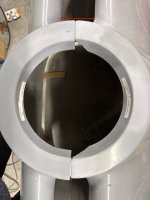
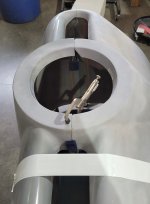
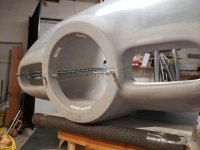
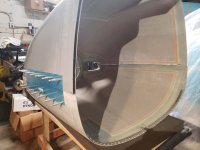
Has anyone else after cutting top and bottom front cowl to the scribe lines seen that they are not the same size in order to form a smooth fit?

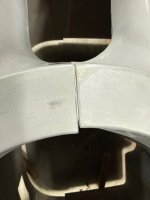
This is for the EXP119 engine, so the top cowl is the regular RV-14 and the bottom is the newer one. The bottom cowl is 1/4" smaller so there is no way for it to be fit properly or at least not that I can see without some surgery here. Any hints?

The red line I drew indicates that it is flush on that side, but I put small red marks where it doesn't line up and on the opposite side of that flush section it is 1/4" too small.

Thanks
IMG_3399.JPGIMG_3402.JPG
 
My 14 cowl halves probably mated up worse overall than my rv-8 cowls did from 30 years ago and looked similar to yours at first. Just tape off adjacent cowl areas you don’t epoxy/microballoon slurry to touch and using a thick slurry build up low areas to match opposite cowl half good areas and sand to match ‘perfectly’ when dry. Or if the area that’s bad needs to be sanded down instead of built up, put the slurry on the inside of the area to be sanded down so you have enough thickness to sand down to match the other cowl half and still have strength and rigidity after sanding down.

It’s annoying but I think just about everyone has to do this if they want a nice symmetrical pair of cowl halves when done.
 
Has anyone else after cutting top and bottom front cowl to the scribe lines
Never cut to the scribe lines. Always sneak up on them. Cut a bit, fit, repeat. It’s a lot easier to remove than build back up. Trust me🤦‍♂️
I had very similar situation on mine, albeit 210hp. Lots of good information on VAF from DanH on working with FRP.
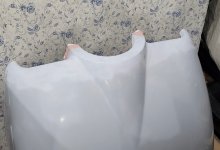
20250430_173549.jpeg20250618_115358.jpeg
 
This is a common issue on a lot of Vans cowlings. At one time, they had a company that was making the S-type cowlings and they were really nice. We got one of those and it went together really nicely. Of course, Vans went price shopping and selected a different vendor and then the quality of the cowls went south. I spoke to Vans about this "back in the day" and their reply was that they were trying to keep kit prices down. I get it, but on the fiberglass parts, most of us would probably pay 300-500 dollars more and save ourselves the months of fiberglass work that is involve due to warping and misalignment. I've done cowls from Harmon and of course Sam James and they were higher in quality. The SJ cowl took a little more work with the alum rings.
Most of the -4 and -6 cowls from Vans that I did, had a lot of the work around the inlets and the spinner area to get it all to align and look good. Lots of building up areas with glass and floc, then sanding and repeating until it all mates together. I had one, similar to yours, that had an offset in it on the spinner face. I had to build it up all the way around the face to make it align perfectly with the other mating cowling. Another cowl, the spinner lined up nicely but the cowl inlets on the outside were offset and it took a lot of rework to get it right and make them look symmetrical. It's just one dang job after another.....
 
Im not there yet but expect the same on my -14 cowl.
Similar experience on my -7 cowl build.
Always considered Vans fiberglass parts as 'guidelines' for where to start.
Rest is up to you on how far you want to take it.
 
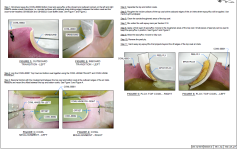
I have the same set up and mine was off as well. this starts to get a bit better once you get closer to the final fit. The Cowl Baffle section will walk through getting to your final fit (47-27)

1767457533320.png
 
There are many ways to skin this cat. The cowl is not a primary structure so you can dill alignment holes and use Cleco to keep the two halves in place. After the halves are aligned, then you can sand and trim as needed. The holes are refilled with epoxy/flox when done.

This is what I did when trimming my RV8 cowling. I used four alignment holes at the front.

20210516_182741.jpg

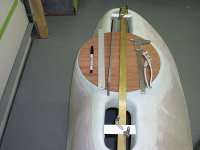
And to keep the two halves while trimming the ends to fit to the fuselage. The aluminum piece holds the cowl in place like a single piece. You can see the black alignment tape that shows how much to trim.
20210515_201121.jpg
 
The glass, as removed from the crate, is just a template.

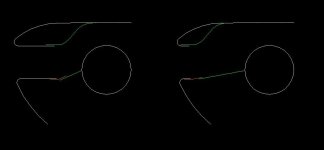
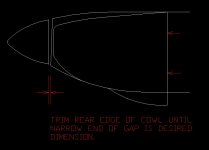
Forget the scribe lines. Work from fundamental dimensions. Trim and fit as necessary for a circle of the correct diameter with equal inlets. Flanges are wrong? Sometimes it's easier to just cut them off and add new flanges.

Cowl Initial Trim.jpg

The depth of the inlets is up to you, but generally deeper is not better. A shorter bottom is fine, because you later bridge the gap between cowl and inlet ramp with rubber sheet, and more gap means the lower cowl is easier to remove and install. Shortening the upper cowl moves the ramps forward, reducing the pinch between the forward cylinders and the ramp.

Inlet Flange Trim.JPG

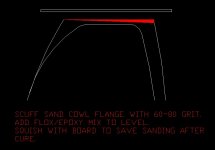
Sometimes the forward face isn't parallel to the spinner and backplate. After the cowl is entirely fitted and mounted, the flange face is easily corrected with some flox.

Spinner Gap.jpg
Spinner Gap Fill.jpg

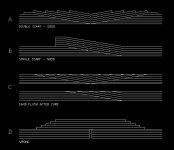
Scarf joints are your friends.

Scarf Joints.jpg
 
Thanks everyone. I guess I am getting thrown because of the RV-14 instructions where they have a specific process and even show an illustration of a perfect circle early on which then will dictate where everything else sits. I am going to need to modify quite a bit and I guess even though I understand that fiberglass is forgiving just endless sanding and rebuilding I was hoping the initial parts in the kit would be a bit more precise with me finishing the last 10% not having to do 30-40% especially on something like this where most people have similar dimensions given we are all using similar stock engines and exhaust (obviously not people who go more custom).

I will continue to look at this, I am not sure how important it is to get the spinner area right this early on in the fitting it seems to imply it is important.
 
I am going to need to modify quite a bit and I guess even though I understand that fiberglass is forgiving just endless sanding and rebuilding I was hoping the initial parts in the kit would be a bit more precise with me finishing the last 10% not having to do 30-40% especially on something like this where most people have similar dimensions given we are all using similar stock engines and exhaust (obviously not people who go more custom).
This is why we have the saying "90% done, 90% to go" ;)
 
Thanks everyone. I guess I am getting thrown because of the RV-14 instructions where they have a specific process....

The instructions will yield a perfectly flyable airplane, but it's important to realize the best builders treat them as a guide...like a map, not a turn-by-turn. Don't tie yourself to them. Instead use them to visualize a desired result, then think about your own path to an optimum.
 
Back
Top