Van's Air Force

The definitive Van's Aircraft support community! Buying, building or flying an RV? Join our exclusive family of mentors and enthusiasts!

Continuous Oil Pressure Fluctuation

BLittleton

Active Member
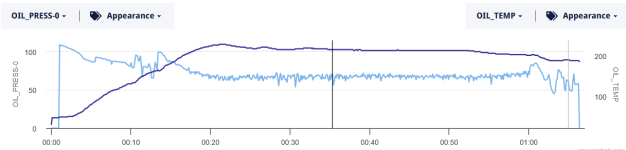
Howdy folks. I have an IO-360-A3B with a Dynon engine monitor. I'm getting a continuous oil pressure fluctuation of +- 10 PSI or so...always withing the green range. But I can watch the OP dance up and down the entire flight.

I'd like to know if this is perhaps normal? The engine monitor is so much more precise than an old gauge...perhaps this is just the way it always works for all engines but the fluctuation is too small for an analog needle gauge to see???

If it is a problem, my best guess is perhaps the oil pressure relief spring has the ball bouncing on the seat. If so, do I need a stronger spring, or a weaker one?
1740622490468.png
 
Howdy folks. I have an IO-360-A3B with a Dynon engine monitor. I'm getting a continuous oil pressure fluctuation of +- 10 PSI or so...always withing the green range. But I can watch the OP dance up and down the entire flight.

I'd like to know if this is perhaps normal? The engine monitor is so much more precise than an old gauge...perhaps this is just the way it always works for all engines but the fluctuation is too small for an analog needle gauge to see???

If it is a problem, my best guess is perhaps the oil pressure relief spring has the ball bouncing on the seat. If so, do I need a stronger spring, or a weaker one?

View attachment 81770
Got a snubber in the sense line?
 
Second on the snubber sense line. At the same time, I had a similar issue with fuel pressure bouncing all around. It turned out to be one of the wires almost ready to break off adding resistance. If there is loose wire or terminal the added resistance can result in a sporadic readings.
 
No that is not normal and no, you don’t need a snubber on an oil pressure sender line to get a stable reading. They are normally there, but there purpose is to slow oil loss in the event of a line or sender failure. You most likely have a wiring issue of some sort or it could be a bad sender. Electrical interference, like too close to a spark plug wire, is also a possibility.

For any given oil temp and rpm, oil pressure is very stable with almost no fluctuations beyond 1 psi. What you are seeing is an indication issue. You can get actual fluctuations like this, but is quite rare.
 
Thanks for the replies. There is a restrictor fitting on the engine side of the sense line. I'll check wire connections...it may be close to a plug wire...I'll have to check.

Thanks all for the ideas.
 
No that is not normal and no, you don’t need a snubber on an oil pressure sender line to get a stable reading. They are normally there, but there purpose is to slow oil loss in the event of a line or sender failure. You most likely have a wiring issue of some sort or it could be a bad sender. Electrical interference, like too close to a spark plug wire, is also a possibility.

For any given oil temp and rpm, oil pressure is very stable with almost no fluctuations beyond 1 psi. What you are seeing is an indication issue. You can get actual fluctuations like this, but is quite rare.
Going to disagree to an extent, Sir. PD pumps make pressure ripples; sometimes with a rather high amplitude. Most instrumentation won't capture it as the frequency is too high but you can see it properly instrumented (Engine RPM ratio'd to pump gear size X number of teeth). The leak link in the system is the instrument components (bourdon tubes, strain gages, diaphragms, etc.) Hard sense lines are next in line.

Since the fluid sense lines typically don't come into the cockpit anymore, the safety importance of a snubber is diminished these days. While I can't say how much dampening the oil system provides at the pick-up point, pressure ripple will still be there. If you want to save money/maximize sensor life, utilize a snubber.

We're talking a one time investment and a fraction of an ounce weight. Always utilize a fitting with the restriction versus without. Then there is the (secondary?) safety benefit of minimizing fluid loss as you've mentioned
 
We typically recommend having a restrictor fitting ( or a restricted insert) for oil pressure, fuel pressure and MAP. Not because of a teflon hose failing, but because the senders are so sensitive, they will sometime pick up the pressure pulses. In the OP's situation, I think it might be prudent to run a known good mechanical gauge and check that vs the Dynon and see if they match. If the mechanical gauge behaves properly, then suspect something in the sender system. BUT, if the mechanical gauge and the Dynon match with pressures fluxuating, then a more thorough inspection of the engine system is prudent!
Tom
 
Going to disagree to an extent, Sir. PD pumps make pressure ripples; sometimes with a rather high amplitude. Most instrumentation won't capture it as the frequency is too high but you can see it properly instrumented (Engine RPM ratio'd to pump gear size X number of teeth). The leak link in the system is the instrument components (bourdon tubes, strain gages, diaphragms, etc.) Hard sense lines are next in line.

Since the fluid sense lines typically don't come into the cockpit anymore, the safety importance of a snubber is diminished these days. While I can't say how much dampening the oil system provides at the pick-up point, pressure ripple will still be there. If you want to save money/maximize sensor life, utilize a snubber.

We're talking a one time investment and a fraction of an ounce weight. Always utilize a fitting with the restriction versus without. Then there is the (secondary?) safety benefit of minimizing fluid loss as you've mentioned
I am sure you are correct, but i have done lots of oil pressure checks on engines using mechanical gauges and they are all rock stable. I believe there is a lot of dampening from the pressure relief assembly. The spring absorbs some of the pulsing. At least this is with instruments the avg man can afford. Just like other things. Plug a VOM in my wall socket and get a very stable 121 volts. Plug in a $10k oscilloscope and I am sure you see something quite different. No sense talking about what the O scope shows to a man without one.

Also, I was not advocating skipping the restrictior, just mentioning that not having one doesn’t translate to an unstable reading.
 
Last edited:
Thanks again all for the responses.

Since the original post, I've swapped the sensor, checked ground continuity, installed a new restrictor fitting, and even moved the EMS input signal wire to a different pin all attempting to get rid of the noise. None of those efforts have had any effect at all.

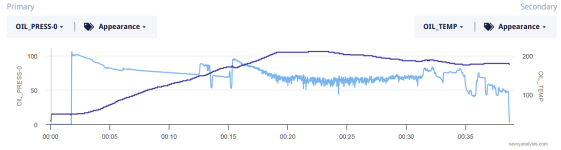
You can see from the last flight after all these tweaks, the OP is still noisy. It's interesting that the line is stable until leveling off about 20 mins into the flight where it becomes noisy during cruise, then sort of levels off again during landing phase. Don't know what that means.

After all these changes, I'm now assuming the sensor is true, and the OP really is fluctuating like this. Does anyone have any ideas what on/in the engine could cause it? Perhaps the prop governor somehow? Perhaps the OP ball and spring?

1742592000632.png
 
It isn't difficult to check the pressure relief ball, seat and spring for condition and debris. At least it would rule out another possibility.
 
I hate to say this, because I can imagine the flack. Oil pump sucking air?
Long time ago, a friend had a CJ-6 that exhibited really strange oil pressure symptoms. Oil flop tube had a small crack, allowing it to aspirate air when the oil got hot. Yeah, I know this is a vastly different engine.

Bill
 
Thanks again all for the responses.

Since the original post, I've swapped the sensor, checked ground continuity, installed a new restrictor fitting, and even moved the EMS input signal wire to a different pin all attempting to get rid of the noise. None of those efforts have had any effect at all.

You can see from the last flight after all these tweaks, the OP is still noisy. It's interesting that the line is stable until leveling off about 20 mins into the flight where it becomes noisy during cruise, then sort of levels off again during landing phase. Don't know what that means.

After all these changes, I'm now assuming the sensor is true, and the OP really is fluctuating like this. Does anyone have any ideas what on/in the engine could cause it? Perhaps the prop governor somehow? Perhaps the OP ball and spring?

View attachment 83411
Sorry, but the likelihood of your OP constantly fluctuating 20 psi is very low. Far more likely to be electrical and not mechanical. Heck, you have a 45 psi change in 3 seconds. These systems don’t just do that out of the blue and then magically go back to stable. This assumes you haven’t recently messed with parts inside the relief assembly.

Any chance you are turning on the auto pilot when you level off and turn it off in the landing phase? I would be looking for what is electrically changing at the time these swings appear.
 
Last edited:
I hate to say this, because I can imagine the flack. Oil pump sucking air?
Long time ago, a friend had a CJ-6 that exhibited really strange oil pressure symptoms. Oil flop tube had a small crack, allowing it to aspirate air when the oil got hot. Yeah, I know this is a vastly different engine.

Bill
Certainly air will make a mess of the OP, but it rarely makes sinusoidal waves. The ops chart looks way more like electrical interference to me.
 
It isn't difficult to check the pressure relief ball, seat and spring for condition and debris. At least it would rule out another possibility.
Thanks all for the inputs!

I put in a new ball and spring in the OP regulator about 20 hours ago. Ball seat looked clean and normal.

This last flight I didn't use the AP at all. The fuel press and manifold press are in the same wire bundle as the OP, so if something electrical were bleeding over, it seems it should happen to those sensors also, but they are rock solid.

In the middle of the cruise, I thought maybe the prob gov was fluctuating making the OP move, even though RPM was perfectly stable. So I lowered manifold press and moved prop to full forward in an attempt to take the prop gov out of the equation. After flying in that condition for a few minutes, I saw no change, same OP fluctuation.

I'm stumped as to what to try next.
 
The oil pressure sensor is a Gauge type sensor (psiG).
It senses the pressure in the oil line and compare it with surrounding air pressure.
The pressure difference between oil line and surrounding air pressure is presented as Gauge pressure.
The oil pressure sensor signal is ratiometric meaning the signal goes from 0,5 - 4,5 volt.
This signal is sensitive for magnetic fields from other cables.
Wire needs to be shielded and grounded at the engine monitor only.

Good luck
 
Here's something to think about - where is your oil pressure sensor? On the engine itself, or on the firewall with a line to the engine?

The reason I ask is this - I recently helped a friend with a flaky oil TEMP indication very similar to this. The oil temp indicator is on the back of the engine and is a single-wire device, relying on engine ground for the return path. He had a slightly less than perfect engine ground, and the alternator uses that same ground path - as the voltage on the system (and alternator output) changed, because of the slight resistance in the ground path the entire engine assembly would rise and fall very slightly in voltage above ground - taking the alternator and oil temp sensor along for the ride. The "floating ground" caused the temp indication to fluctuate quite a bit, same could be happening for your pressure indication if you have it located such that it relies on the engine grounding strap.
 
Is your oil pressure sensor a single wire unit or a double wire unit. If a single wire unit, how did you ground the case? In either case, I agree with the previous post to carefully review the sensor ground. Also, once you solve this, and you will, please post the conclusion. Thanks.
 
Have you put a direct reading gauge on it as suggested by Tom in post #7??
It’s the only way to know if you’re chasing an engine problem or indication problem!
 
Do you have a short tower oil pressure relief valve cap without the corresponding cage in the crankcase to keep the relief valve ball centered? Without the cage the ball can drift around on the seat and cause fluctuations. also try filling the line from the engine to the sender, if the sensor isn't mounted directly. The air will act as a shock absorber to absorb the fluctuations.
Good Luck,
Mahlon
 
The oil pressure sensor is a Gauge type sensor (psiG).
It senses the pressure in the oil line and compare it with surrounding air pressure.
The pressure difference between oil line and surrounding air pressure is presented as Gauge pressure.
The oil pressure sensor signal is ratiometric meaning the signal goes from 0,5 - 4,5 volt.
This signal is sensitive for magnetic fields from other cables.
Wire needs to be shielded and grounded at the engine monitor only.

Good luck
sensors can be diaphragm/resistor types (1 or 2 wires) or can be the transducer type (3 wires). We don't know what type he has. Also, I have sevaral transducer type sensors on my planes. None use shielded wire and are all steady and stable. lets not send the op on a wild goose chase.
 
Last edited:
Do you have a short tower oil pressure relief valve cap without the corresponding cage in the crankcase to keep the relief valve ball centered? Without the cage the ball can drift around on the seat and cause fluctuations. also try filling the line from the engine to the sender, if the sensor isn't mounted directly. The air will act as a shock absorber to absorb the fluctuations.
Good Luck,
Mahlon
I thought about that. I had that exact issue on my 540 core and you helped me figure it out. I did not get anything like the op is getting. it was generally somewhat stable, with minor fluctuations. however, it tended to read somewhat correctly at low rpm and as the rpm rose, OP would start dropping with some minor, slow moving changes. totally illogical behavior until I understood what the ball was doing without the cage.
 
Thanks all for the responses...great ideas.

The OP regulator is the "tall cap" variety that can have up to 9 washers. I've already replaced the ball and went from the softest to the mid-level spring a few hours ago. It did fine raising the pressure into the 70's but the fluctuation is still there. I've thought about going to the adjustable type regulator, but didn't really think it would have any effect.

The OP and FP sensors are both the kavlico type from dynon. They have 3 wires (power/ground/signal). They share a ground with the MP sensor back into the Dynon EMS. I've checked continuity on all power and grounds, all stable with continuity.

I've downloaded almost all my flight engine data into Savvy. While going through all the OP readings in its history, it seams to be most stable above the 70s. My plan this weekend is to jack up the OP with another couple washers and see if running in the 80s has any effect.
 
I'd try to fill up oil to the max and see if the problem replicates
Also, see what it does in a constant 2g turn. Took me months of screwing around with all the stuff mentioned in this thread before figuring out my cold air sump does not have a good "well" and I was sucking air. Pulling g smoothed it out as it forced oil to the pickup. Running a quart more than I was used to on the old plane resolved the issue.
 
FIXED!!

I thought I'd follow up on this thread I started about my OP fluctuation...It turned out to be the OP spring after all.

Several hours ago, I went up to the next heavier spring hoping to increase the OP, I didn't really help that much, and I think made the fluctuation worse. I decided to change from the oil pressure cap that used the washers to modulate pressure and move to the screw-adjustable one. That didn't help the fluctuation, but it is much easier now to change the OP.

I finally decided to go back to the "normal" 61804 spring, except got a new one (this would be the third spring). Now my OP is rock solid. It may fluctuate 1 psi or so which probably means the system is between rounding decimals. SOOO happy to finally have this fixed after months of messing with it.

On to the next thing!
 
Back
Top