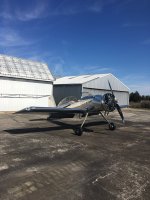
I am building a project with a Verner 9S (not an RV) so I think I can add some helpful observations here.
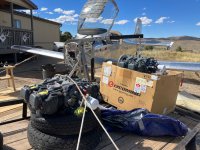
I ordered my Verner 9S last March. It arrived in September, as promised. This, despite the massive flooding that occurred at about that time in Central Europe. Apparently a number of the factory workers had damage to their homes, and an important bridge washed out on the highway, so one of the workers put my engine in a light truck and drove some distance on back roads to get it to a shipping hub.
It is beautifully made.
Some thoughts on the engine itself for you to consider:
• It is shipped with a rather crude motorcycle carburetor, which has no mixture control. There are a number of solutions to better carburetion. I am adapting a Marvel Schebler HA-6 side-draft carb from a Cessna 172RG. Several folks have used throttle-body injection -- I think Brett even offers one. Brian Kelly at RadialConversions (the builder of the RV8R) is developing an integral engine back plate that incorporates throttle-body injection and accepts an FM-150 servo. (this seems like a really good solution).
There have been a couple of port-injection systems adapted. Brian Kelly machined his cylinder heads to accept a Bendix fuel injector, and adapted an 8-port spider to supply the nine cylinders. This is flying and working great on Brian's RV8R, but he and Don Rivera insist this was a one-off and have no interest in helping anyone replicate it. There is a builder in Santa Cruz that bonded injector bosses to the composite induction tubes, and I *think* he is adapting an SDS injection with a crank position sensor installed in an adapter/prop extension. (I don't believe he has run that engine yet). Port injection is/would be a great solution because Verners suffer from very uneven mixture distribution attributed to 'gravity effects' - this is apparently common among radial engines.
• The engine has an integrated "alternator" that consists of a rotor/stator on the crank flange and crankcase, and a separate rectifier/regulator unit. It is rated at 16 amps. This is a pretty small power budget for anything other than a day-VFR simple airplane. There is no accessory mounting feature that would enable installation of a second, or different alternator. The 16-amp system would be further taxed by the need for continuous electric fuel pumps for a low-wing airplane - although Brian's RV8R seems to work OK, with a glass panel, electric fuel pumps, etc.
• As mentioned above, there is no accessory case that would enable installation of a magneto, alternator, crank-angle sensor, engine-driven fuel pump, etc.
• The engine is supplied with a dual electronic ignition, which by all accounts is very solid. But it does mean that you have an all-electric engine. (and no accommodation to install a second alternator).
• Getting adequate cylinder cooling in an enclosed cowl requires careful baffling. Brian Kelly has evolved his baffling arrangement over time in his RV8R, and has a good set-up now. He is tooling up to make carbon-fiber inter-cylinder baffles available to others.
• The Verner is a dry-sump engine relying on gravity drain of case and cylinder head oil into an oil tank mounted below the engine. Several builders have used a faired pod on the belly with both the oil cooler and oil tank. Brett does supply an oil tank, but it is very wide, which is difficult to incorporate into an aerodynamic pod. I am making a custom oil tank.
Many of these factors suggest that the engine is well-suited for its intended purpose - simple airplanes such as WW I replicas, biplanes, etc. that are primarily low-and-slow fun airplanes, but not necessarily a good choice for a fast, long-distance cross-country traveling airplane.
Some comments on the reliability of Verner radials:
The biggest vulnerability seems to be damaged valve trains due to sticky valves from running 100LL. The factory is adamant about using unleaded fuel. It may be that this is more of an issue for a radial because the lower cylinders run rather rich (gravity effects on mixture distribution).
There have been a few instances of builders chasing oil leaks at cylinder flanges, warped cylinder heads, things like that.
Originally the Verner factory recommended SAE 60 weight engine oil, and there were apparently some burst oil filters from starting cold. The metric automotive oil filter size does not incorporate a bypass valve, and there do not appear to be any available filters in that size that do. The factory now recommends SAE 20-50 oil. I plan to make an adapter to fit american-size oil filters, and I will select one with a bypass valve.
A few folks have commented on the asthetics of putting a radial on a side-by-side. It certainly has been done. The Spartan Executive comes to mind. With a well-done cowl, it could be a unique and striking airplane.
Any time you depart from plans, you buy yourself more tinkering. Fitting any alternative engine requires a huge chunk of roll-your-own development and fabrication. Fitting a radial to a design intended for a flat engine requires even more custom work. I completely re-lofted the fuselage formers for my Hatz biplane to blend well into a round engine. I'm finding the project very satisfying. If you take this on, do it because you enjoy building, especially roll-your-own development. Do it because it will allow you to build a unique, interesting airplane. DO NOT do it to save money on an engine!!!