
I didn’t go through this entire thread to see if it was mentioned, but, I finally set my low pitch stop and not only did I get a better glide rate, but, I can now reduce my rpm’s below 2300 without it getting rough. I’m not sure why this would effect low rpm’s, but it did make them smoother. I normally kept prop at 2400 or higher for smooth rides, not any more.

Van's Air Force
You are using an out of date browser. It may not display this or other websites correctly.
You should upgrade or use an alternative browser.
You should upgrade or use an alternative browser.
Check your CS prop “low pitch” stops
- Thread starter Taltruda
- Start date

This is so weird that I’d give Hartzell a call, see if they have any explanation.I didn’t go through this entire thread to see if it was mentioned, but, I finally set my low pitch stop and not only did I get a better glide rate, but, I can now reduce my rpm’s below 2300 without it getting rough. I’m not sure why this would effect low rpm’s, but it did make them smoother. I normally kept prop at 2400 or higher for smooth rides, not any more.

My preferred way to set the Low pitch stops is to first fly the plane and see if you can get 2700 rpm on climb out. if you can’t, go ahead and make a governor adjustment. It’s about 30RPM per revolution of the governor screw. Then after you can get 2700 in climb, cruise ect.. then I would pull the spinner and do the low pitch stops. You might have to pull the front bulkhead too if you can’t get a wrench on the 9/16 bolt. You can’t use a socket, as you really need to hold the nit while turning the alan wrench. I find almost every Hartzell on an RV seems to take 2 1/3 turn on the Alan key clockwise to produce 2650RPM.Hi Tom,
Would you mind sharing the task list sequence you did to make the adjustments? From the thread I understood what the activities are but I am trying to figure the order of the adjustments.
Thanks!
Shoot me a message with your phone number and I’ll call you and talk you through it. It’s super easy.

Thank you Tom! I appreciate the detailed step by step. My plan is to do the first flight close to November-december. I will definitely reach out to you if I have questionsMy preferred way to set the Low pitch stops is to first fly the plane and see if you can get 2700 rpm on climb out. if you can’t, go ahead and make a governor adjustment. It’s about 30RPM per revolution of the governor screw. Then after you can get 2700 in climb, cruise ect.. then I would pull the spinner and do the low pitch stops. You might have to pull the front bulkhead too if you can’t get a wrench on the 9/16 bolt. You can’t use a socket, as you really need to hold the nit while turning the alan wrench. I find almost every Hartzell on an RV seems to take 2 1/3 turn on the Alan key clockwise to produce 2650RPM.
Shoot me a message with your phone number and I’ll call you and talk you through it. It’s super easy.
 Thanks!
For some reason I can't send you a private message...All of you should let me know of other topics that could use a video or a column. Carol tells me I need to do more and that I take it for granted that others understand some of the operational stuff.
Vic
I think it would be valuable for a lot of guys if a person could do a "How To" for when going from Lycoming carb to fuel injection. Such as starting procedure differences and how to run them etc. I think it would eliminate a bunch of the hard starting complaints especially hot starts.
Thanks for all your hard work.
Mike

This has been a great thread for learning how this system works. I'll add my situation here, in case anyone else runs into something similar.
- I have an RV-8A with a Hartzell C/S blended airfoil propeller (Model HC-C2YR-1BFP/F7496-2) and a rear mounted MT governor (P-860-4)
- On takeoff, even if I'm very slow in adding throttle, the RPM surges high. It's made me very nervous, as the RPM has come close to, but not exceeded, the overspeed limits of both the engine and the propeller.
- In flight, I have to reduce the propeller lever to keep the RPM at the correct RPM (my engine/prop combo requires reducing to 2600 RPM after takeoff. The governor seems to be set quite high - around 2800 RPM.
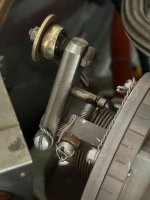
- Strangely, there doesn't seem to be any movement left in the governor adjustment screw - it's basically bottomed out. I suspect the problem may be alleviated once the low-pitch static stops are set correctly, and that this is a symptom of the last owner trying to correct the surging with the governor, but maybe not. If not, I'm going to back the screw out about halfway, and then reseat the governor arm onto a different spline, so that I have room to adjust it in both directions in the future. (see pic of governor).
Plan (would love any feedback you have if this is incorrect)
- While tied down, confirm the governor isn't controlling the RPM at full throttle by confirming that moving the prop lever doesn't IMMEDIATELY reduce prop rpm, per Vic's video. If it does, I'll back out the governor adjustment screw until it's NOT controlling RPM at full throttle.
- Set the static stops correctly by adjusting the Allen screw on the propeller, turning it clockwise (inward) until the static RPM is set to 2650 (my engine/propeller limit is 2700).
- Here's where I'm a little confused. I know the next step is to check the governor in flight. But given that I won't know where the governor is set - it may be too high - how do I determine the initial setting for the governor screw?
Thanks!
Matt
- I have an RV-8A with a Hartzell C/S blended airfoil propeller (Model HC-C2YR-1BFP/F7496-2) and a rear mounted MT governor (P-860-4)
- On takeoff, even if I'm very slow in adding throttle, the RPM surges high. It's made me very nervous, as the RPM has come close to, but not exceeded, the overspeed limits of both the engine and the propeller.
- In flight, I have to reduce the propeller lever to keep the RPM at the correct RPM (my engine/prop combo requires reducing to 2600 RPM after takeoff. The governor seems to be set quite high - around 2800 RPM.
- Strangely, there doesn't seem to be any movement left in the governor adjustment screw - it's basically bottomed out. I suspect the problem may be alleviated once the low-pitch static stops are set correctly, and that this is a symptom of the last owner trying to correct the surging with the governor, but maybe not. If not, I'm going to back the screw out about halfway, and then reseat the governor arm onto a different spline, so that I have room to adjust it in both directions in the future. (see pic of governor).
Plan (would love any feedback you have if this is incorrect)
- While tied down, confirm the governor isn't controlling the RPM at full throttle by confirming that moving the prop lever doesn't IMMEDIATELY reduce prop rpm, per Vic's video. If it does, I'll back out the governor adjustment screw until it's NOT controlling RPM at full throttle.
- Set the static stops correctly by adjusting the Allen screw on the propeller, turning it clockwise (inward) until the static RPM is set to 2650 (my engine/propeller limit is 2700).
- Here's where I'm a little confused. I know the next step is to check the governor in flight. But given that I won't know where the governor is set - it may be too high - how do I determine the initial setting for the governor screw?
Thanks!
Matt
Attachments
oaklandaviator
Well Known Member
Set the low pitch stop to 2630 or 2650 first, then go fly and pull your prop control to 2700 in flight. Land with it there and match the adjustment screw to the governor arm.
no, setting the pitch stop won’t help this problem. If your governor is at the end of its adjustment at 2800 rpm, then either there is a problem in the governor or more likely your gov was set up for a different gov drive ratio than the one used by your engine. There are two different ratios used across lyc engines..
- In flight, I have to reduce the propeller lever to keep the RPM at the correct RPM (my engine/prop combo requires reducing to 2600 RPM after takeoff. The governor seems to be set quite high - around 2800 RPM.
- Strangely, there doesn't seem to be any movement left in the governor adjustment screw - it's basically bottomed out. I suspect the problem may be alleviated once the low-pitch static stops are set correctly,
Matt
The pitch stop is for throttling rpm at very low airspeed. Once you get moving 5-10 mph, it starts increasing and the gov takes over.
Just to confirm - if I set the low pitch stop to 2650ish in a static setting, and go fly, won't that pitch limit the prop to about 2700 RPM in flight? So how do I pull the prop control back to 2700 if it's already there? Bring it back until it drops just a bit, then go forward?Set the low pitch stop to 2630 or 2650 first, then go fly and pull your prop control to 2700 in flight. Land with it there and match the adjustment screw to the governor arm.
No. The key here is to remember that with a fixed pitch prop, the angle of attack seen by the prop blades depends on a vector combination of the rotational speed and the forward speed. At 150 knots airspeed the prop blades see a much lower angle of attack, so the rpm wants to increase if you leave the power in. Remember flying a 172? At the start of the takeoff roll full power might only get you 2300 rpm, but if you level out after lift off and leave it at full throttle it will go past red line. So set the internal prop stop to give you 2650-2675 rpm when you’re not moving. Take off and if the rpm starts to go above 2700 pull the blue knob back until the governor kicks in and limits rpm to 2700. Leave the blue knob alone, land, and adjust the governor stop screw to be in contact with the stop.Just to confirm - if I set the low pitch stop to 2650ish in a static setting, and go fly, won't that pitch limit the prop to about 2700 RPM in flight? So how do I pull the prop control back to 2700 if it's already there? Bring it back until it drops just a bit, then go forward?
That’s a great explanation, thank you!No. The key here is to remember that with a fixed pitch prop, the angle of attack seen by the prop blades depends on a vector combination of the rotational speed and the forward speed. At 150 knots airspeed the prop blades see a much lower angle of attack, so the rpm wants to increase if you leave the power in. Remember flying a 172? At the start of the takeoff roll full power might only get you 2300 rpm, but if you level out after lift off and leave it at full throttle it will go past red line. So set the internal prop stop to give you 2650-2675 rpm when you’re not moving. Take off and if the rpm starts to go above 2700 pull the blue knob back until the governor kicks in and limits rpm to 2700. Leave the blue knob alone, land, and adjust the governor stop screw to be in contact with the stop.
Follow on question - some of the comments in this thread talk about a proper low pitch stop setting preventing an overspeed if the governor fails…but this seems to say otherwise…eg if I’m flying 150KIAS and it fails the prop will likely over speed as you describe. Is it just that it will accelerate at a rate slow enough that I’d be able to arrest with throttle?
I appreciate you taking the time, BTW, it’s super helpful. I learned to fly in T-34Cs, then spent a career in helicopters, so I don’t have the experiences with GA aircraft that many of you do.
Last edited:
oaklandaviator
Well Known Member
Correct. At high airspeed it will still overspeed with a governor failure but at least you have enough pitch in the prop to prevent a huge overspeed. Also, if your governor fails and the low pitch stops allow a dramatic overspeed, then you have little to no thrust, a tremendous amount of drag from the near flat blades, and very little ability to climb on a go-around.That’s a great explanation, thank you!
Follow on question - some of the comments in this thread talk about a proper low pitch stop setting preventing an overspeed if the governor fails…but this seems to say otherwise…eg if I’m flying 150KIAS and it fails the prop will likely over speed as you describe. Is it just that it will accelerate at a rate slow enough that I’d be able to arrest with throttle?
I appreciate you taking the time, BTW, it’s super helpful. I learned to fly in T-34Cs, then spent a career in helicopters, so I don’t have the experiences with GA aircraft that many of you do.
+1. Remember the governor will ‘fail’ if you lose all the engine oil, so, again, if the stop is mis-adjusted to too low a pitch your glide range will be decreased.Correct. At high airspeed it will still overspeed with a governor failure but at least you have enough pitch in the prop to prevent a huge overspeed. Also, if your governor fails and the low pitch stops allow a dramatic overspeed, then you have little to no thrust, a tremendous amount of drag from the near flat blades, and very little ability to climb on a go-around.

skylor
Well Known Member
no, setting the pitch stop won’t help this problem. If your governor is at the end of its adjustment at 2800 rpm, then either there is a problem in the governor or more likely your gov was set up for a different gov drive ratio than the one used by your engine. There are two different ratios used across lyc engines.
The pitch stop is for throttling rpm at very low airspeed. Once you get moving 5-10 mph, it starts increasing and the gov takes over.
This could be as simple as the governor control arm is somehow incorrectly clocked on the splined shaft that come out of the rear of the governor.
Skylor
That's what I thought it might be. Once I get the low pitch stops set, I'll check it and report back here.This could be as simple as the governor control arm is somehow incorrectly clocked on the splined shaft that come out of the rear of the governor.
Skylor
In most governors, removing the arm will unwined a spring and requires a special procedure to get it back in place. Others have that arm set wihile on the test/setup tool (the ones prop shops use) to tweak rpm targets. I would consider that a problem with the gov. Maybe some are different and allow clocking via arm removal, but most that I have seen you rotate the face of the gov assy to clock. Haven't seem one yet that does so via arm removal.This could be as simple as the governor control arm is somehow incorrectly clocked on the splined shaft that come out of the rear of the governor.
Skylor
Generally speaking, when full arm movement to the end of arm travel does not get you to target RPM, somethings is wrong with the config/setup.
Be sure to read the manual before removing that arm. It is likely to unwind the internals and may have to go back to the shop to be set up again.That's what I thought it might be. Once I get the low pitch stops set, I'll check it and report back here.
If you are getting a rpm surge on initial application of full throttle, you need to make a low pitch stop adjustment under the spinner. 2650 is a good target while full throttle, statically (holding the brakes). As for your governor out of adjustment range, the Governor manufacturer typically say don’t remove the arm to reclock.. and some governors have a way to loosen the screws and re clock the whole face, that may be the way to go.This has been a great thread for learning how this system works. I'll add my situation here, in case anyone else runs into something similar.
- I have an RV-8A with a Hartzell C/S blended airfoil propeller (Model HC-C2YR-1BFP/F7496-2) and a rear mounted MT governor (P-860-4)
- On takeoff, even if I'm very slow in adding throttle, the RPM surges high. It's made me very nervous, as the RPM has come close to, but not exceeded, the overspeed limits of both the engine and the propeller.
- In flight, I have to reduce the propeller lever to keep the RPM at the correct RPM (my engine/prop combo requires reducing to 2600 RPM after takeoff. The governor seems to be set quite high - around 2800 RPM.
- Strangely, there doesn't seem to be any movement left in the governor adjustment screw - it's basically bottomed out. I suspect the problem may be alleviated once the low-pitch static stops are set correctly, and that this is a symptom of the last owner trying to correct the surging with the governor, but maybe not. If not, I'm going to back the screw out about halfway, and then reseat the governor arm onto a different spline, so that I have room to adjust it in both directions in the future. (see pic of governor).
Plan (would love any feedback you have if this is incorrect)
- While tied down, confirm the governor isn't controlling the RPM at full throttle by confirming that moving the prop lever doesn't IMMEDIATELY reduce prop rpm, per Vic's video. If it does, I'll back out the governor adjustment screw until it's NOT controlling RPM at full throttle.
- Set the static stops correctly by adjusting the Allen screw on the propeller, turning it clockwise (inward) until the static RPM is set to 2650 (my engine/propeller limit is 2700).
- Here's where I'm a little confused. I know the next step is to check the governor in flight. But given that I won't know where the governor is set - it may be too high - how do I determine the initial setting for the governor screw?
Thanks!
Matt
I appreciate the warnings on removing the governor arm, everyone! Unfortunately, I don't have the manual for the governor and it's not available via the MT site. Does anyone happen to have a PDF of the manual they'd be willing to share?
After 170 posts on this subject and lots of repetitive and piecewise discussions of experiences and what to do: Reminder, go back to the very beginning of this thread for the link to Vic Syracuse's excellent video on the subject which makes it all super clear and actionable.
Thanks to everyone for all the help. I wanted to check in with the results.
- I adjusted the low-pitch static stops as described in Vic's video, and IAW the Hartzell manual. It took a full 3 1/2 turns to get to the right static RPM. I was able to set the static RPM to 2670. My target was 2650, but it was windy out (wind was generally off the nose), so I think the actual static RPM may be very slightly lower, and very close to nominal.
- For the issue I was having with the governor (adjustment screw was bottomed out), I ended up removing the jam nut, using threadlocker and a safety cable to hold the adjustment screw, and putting on a torque stripe. I'm contacting MT to see if I can get the maintenance manual for the governor; I'd like to set the arm so that the adjustment screw is about halfway in; that'll allow adjustments in either direction in the future, if needed. My dynamic RPM was limited to 2680, so I will tweak the governor setting a bit using the adjustment screw next time I have the cowl off.
- I'm attaching a file with all my notes and pictures, in case anyone finds them helpful.
Attachments
Your Governor screw will adjust the RPM 30 RPM per turn, so if you need to raise your maximum rpm setting, back it off 2/3 of a turn to gain 20 rpm. I would say for now, put the lock nut on the other side of the adjustment screw. It’ll perform the same function.Thanks to everyone for all the help. I wanted to check in with the results.
- I adjusted the low-pitch static stops as described in Vic's video, and IAW the Hartzell manual. It took a full 3 1/2 turns to get to the right static RPM. I was able to set the static RPM to 2670. My target was 2650, but it was windy out (wind was generally off the nose), so I think the actual static RPM may be very slightly lower, and very close to nominal.
- For the issue I was having with the governor (adjustment screw was bottomed out), I ended up removing the jam nut, using threadlocker and a safety cable to hold the adjustment screw, and putting on a torque stripe. I'm contacting MT to see if I can get the maintenance manual for the governor; I'd like to set the arm so that the adjustment screw is about halfway in; that'll allow adjustments in either direction in the future, if needed. My dynamic RPM was limited to 2680, so I will tweak the governor setting a bit using the adjustment screw next time I have the cowl off.
- I'm attaching a file with all my notes and pictures, in case anyone finds them helpful.
Thanks, Tom, I'll make that adjustment soon. Unfortunately, you can't put the jam nut on the other side - there isn't enough clearance from the spring for the nut to turn.Your Governor screw will adjust the RPM 30 RPM per turn, so if you need to raise your maximum rpm setting, back it off 2/3 of a turn to gain 20 rpm. I would say for now, put the lock nut on the other side of the adjustment screw. It’ll perform the same function.
skylor
Well Known Member
As for your governor out of adjustment range, the Governor manufacturer typically say don’t remove the arm to reclock.. and some governors have a way to loosen the screws and re clock the whole face, that may be the way to go.
On the MT governors, reclocking the whole governor face won’t fix the OP’s issue of running out of travel of the stop screw because the entire condol-arm mechanism including the stop screw rotates as a unit and the relative position between the arm and stop screw remain unchanged.
Skylor
I've not read thru the entire post here, however it sounds like you have an MT governor that was set up at either .895/narrow deck 540 or .947/wide deck 540 and you need the governor set to 2700 with a rear mount 4 cylinder .866 governor drive ratio. The easiest way to remedy, is to remove the governor and take to any prop shop with a test rig and have them re-index the arm on the shaft. Most likely it is off by a tooth or two of the spline and that will get you back in the middle of the range for adjustment on the screw. This is pretty common. At our shop it will take longer to get the governor written up than to perform the adjustment on the test rig. If you try and re-index yourself, you might get lost at to which spline you started at... Tricky "in the field".
May the force be with you
May the force be with you
