


Van's Air Force

The definitive Van's Aircraft support community! Buying, building or flying an RV? Join our exclusive family of mentors and enthusiasts!

Chasing fuel line leak.

docjjrmd

Well Known Member
Benefactor
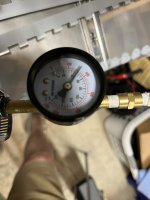
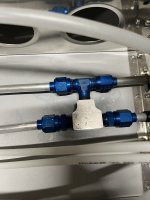
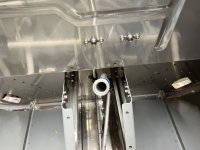
Well I am glad I listened to my big toe itch. For background I am building an RV-12iS and working on finishing up the fuselage. I decided to high pressure test the fuel lines before riveting the avionics bay floor. Pumped the lines (not the tank!) up to 40 psi. Oops, leaking. First leak found was on the bypass block and was fixed with another 1/2 flat turn on the nut. That took care of the majority of the leak but was still losing pressure very slowly. Stood on my head and used mirror to look at bulkhead fittings with leak detector. These are not the easiest to get to at the best of times. Right hand connector had small ring of bubbles. Studied it for a while realized only way to get to it was to drop the rudder pedals. That opened everything up vision and access wise. Cranked on the nut another 1/4 turn. Leak slower but small ring of bubbles persisted. At this point, only option I could see was to pull the connection apart, see what was happening. So as can be seen in photo below, found a small nick or crack on edge of flare at 3 o'clock and some dicey looking area at 6 o'clock. I presume that is cause of leak. Pulled the fitting off the firewall, looks ok. The plan going forward is to cut flare off, re-flare, and retest before going further. I will also replace bulkhead fitting with new simply because I have one at hand .

I certainly feel for those builders that have to track and repair this connection after avionics and controls are installed. Instructions cover leak testing of fuel tank but silent on fuel line system until fuel pumps installed with power plant kit. I'd suggest the addition of a high pressure test after fuel lines are fabricated and installed so access is easier and familiar. - JJR
 

Attachments

  • pressure test.jpg
    pressure test.jpg
    739.1 KB · Views: 99
  • air leak.jpg
    air leak.jpg
    1 MB · Views: 102
  • flare nick 3 oclock.jpg
    flare nick 3 oclock.jpg
    1.5 MB · Views: 104
These are good at sealing the flares with minor imperfections.
 
These are good at sealing the flares with minor imperfections.
I agree
They are good for correcting minor imperfections.
When we did the RV-12iS One Week Wonder build, we used them on all of the fuel line connections preemptively for some extra insurance against leaks, considering the dynamic build environment with lots of different people of varying levels of experience, doing the work.
 
Thanks for the link. I will consider using the Del seal. I primarily wanted other builders to be aware that what looks good might actually fail under high pressure and its saves a bunch of trouble and time if testing is done before the lines get buried under all the subsequent build clutter. This particular fitting holds fine to about 22 psi, anything higher and it leaks off in about 30 minutes. Makes me wonder if there is a minute crack involved that spreads under pressure. I will order some Del seals to have on hand and likely re-flare tube end and if still leaks, try a seal.
 
I agree
They are good for correcting minor imperfections.
When we did the RV-12iS One Week Wonder build, we used them on all of the fuel line connections preemptively for some extra insurance against leaks, considering the dynamic build environment with lots of different people of varying levels of experience, doing the work.
Clean the flare cone on your flareing tool. Th
 
Clean the cone on your flaring too. It gets little imbedded aluminum from soft tubing and creates little imperfections in the sealing surface. Also, not that thi stube is, but overflaring can thin the tube wall and create little cracks that when tightened cause leaks.
 
I agree
They are good for correcting minor imperfections.
When we did the RV-12iS One Week Wonder build, we used them on all of the fuel line connections preemptively for some extra insurance against leaks, considering the dynamic build environment with lots of different people of varying levels of experience, doing the work.
I did the same on all my flares as a preemptive strike also on the RV-10, and my RV-9A.
 
Clean the flare cone on your flareing tool. Th
???

I know your are the hose and line expert, but I have flared a few lines in my aviation career ;) so I do know how to get a good result... I couldn't count on that being the case with everyone that help on the One Week Wonder build though.

There is no real down side to using Del seals other than the cost (they aren't cheap). They are even acceptable on certificated aircraft.
 
I certainly feel for those builders that have to track and repair this connection after avionics and controls are installed. Instructions cover leak testing of fuel tank but silent on fuel line system until fuel pumps installed with power plant kit. I'd suggest the addition of a high pressure test after fuel lines are fabricated and installed so access is easier and familiar. - JJR
I second this advice and also feel there should be at least a note in the KAI recommending builders pressure test these lines before controls & avionics block access.
 
Well I am glad I listened to my big toe itch. For background I am building an RV-12iS and working on finishing up the fuselage. I decided to high pressure test the fuel lines before riveting the avionics bay floor. Pumped the lines (not the tank!) up to 40 psi. Oops, leaking. First leak found was on the bypass block and was fixed with another 1/2 flat turn on the nut. That took care of the majority of the leak but was still losing pressure very slowly. Stood on my head and used mirror to look at bulkhead fittings with leak detector. These are not the easiest to get to at the best of times. Right hand connector had small ring of bubbles. Studied it for a while realized only way to get to it was to drop the rudder pedals. That opened everything up vision and access wise. Cranked on the nut another 1/4 turn. Leak slower but small ring of bubbles persisted. At this point, only option I could see was to pull the connection apart, see what was happening. So as can be seen in photo below, found a small nick or crack on edge of flare at 3 o'clock and some dicey looking area at 6 o'clock. I presume that is cause of leak. Pulled the fitting off the firewall, looks ok. The plan going forward is to cut flare off, re-flare, and retest before going further. I will also replace bulkhead fitting with new simply because I have one at hand .

I certainly feel for those builders that have to track and repair this connection after avionics and controls are installed. Instructions cover leak testing of fuel tank but silent on fuel line system until fuel pumps installed with power plant kit. I'd suggest the addition of a high pressure test after fuel lines are fabricated and installed so access is easier and familiar. - JJR
Good For YOU!! I consider this test a requirement - - happy you posted for others to see the benefits. None of my friends having run this test . . didn't find some leak. Me included.
 
Good For YOU!! I consider this test a requirement - - happy you posted for others to see the benefits. None of my friends having run this test . . didn't find some leak. Me included.
Hey Scott---I wasnt refering to you, I was referring to the OP---there was some imbedded debris in the flare. I certainly know that you have flared many prefectly good tubes, and YES del seals are great insurance.
 
Hey Scott---I wasnt refering to you, I was referring to the OP---there was some imbedded debris in the flare. I certainly know that you have flared many prefectly good tubes, and YES del seals are great insurance.
I you click the reply button in someone’s post it quotes their post in yours.
If you just want to post in the thread you can use the text box at the very bottom of the last page and it will be just your post by itself.
😉
 
Back
Top
