Van's Air Force

The definitive Van's Aircraft support community! Buying, building or flying an RV? Join our exclusive family of mentors and enthusiasts!

Brake Bleed Mess Mitigation

Jav8or

Member
G’day all. I’ve found lots of great info on how to bleed brakes. However, haven’t found much by the way of starting the process.

In preparation for removing the master cylinder, do I simply removing the bleed fitting near the brake caliper to empty fluid from the effected side prior to removing the MC?
 
Slow down and tell us a few things first! Bleeding brakes doesn't require anything to "come off". What RV type are you working on? Why are you removing the master cylinder? I have always had success with mine and others by pushing the fluid from the caliper bleeder nipple up through and simply putting a drain fitting in the cap of the master to catch the overflow. I can do my RV-4 in about 10 minutes without a drop spilled. Plenty of good intel on here if you can clarify what you have going on first.
 
Bleeding the brakes does not necessarily involve much mess. Agree the bottom up method is usually the best.
A method to push the brake fluid up to the reservoir is required, such as a small oil can or something more sophisticated.
A piece of clear flexi pipe pushed into the fill hole of the reservoir and emptying into a cup or can is all that is need at the top.
Lots of good advice on here about the details.
If you really need to empty the system fit a hose to the bleed nipple and crack it open 1/2 or 1 turn and let the fluid flow out into a container, pumping the pedal may help.
 
Slow down and tell us a few things first! Bleeding brakes doesn't require anything to "come off". What RV type are you working on? Why are you removing the master cylinder? I have always had success with mine and others by pushing the fluid from the caliper bleeder nipple up through and simply putting a drain fitting in the cap of the master to catch the overflow. I can do my RV-4 in about 10 minutes without a drop spilled. Plenty of good intel on here if you can clarify what you have going on first.
Haha, sorry.

I have a small seep cooking from a nylon fitting from my Cleveland 10-30 master cylinder. The fitting is loose and my need to be tightened and dabbed wit some sealant.
 
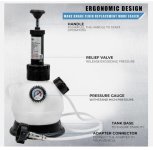
Sounds like you are doing more than just bleeding brakes. You apparently have a need to remove one of the master cylinders for maintenance. So yes, I would drain the MC by putting a catch basin, bowl or other item under the wheel brake caliper and open it or remove it outright. Since you want to drain the the system I would just unscrew the whole bleed assembly. After repairing/replacing the MC re-install it and swap the MCs vented pipe plug with a barbed fitting and affix vinyl tubing to that fitting and have enough tubing to exit the cockpit to a catch jar on the wing walk or hangar floor. Then reinstall the bleed fitting on the brake caliper and crack it open so you can fill new fluid up from the caliper to the MC. I feed using an inexpensive ($40) automotive pressure pot to all but eliminate any air bubbles in the process. It has a hand air pump to pressurize the system prior to use.
I added a brass ball valve to the pressure pot’s feed tube so I can regulate and shut off the flow. I start the feed at the bleeder at a slow steady rate and watch the exit tube from the cockpit until I see the outflow show up in it without any bubbles. So far with the pressure pot I rarely see any bubbles like you get with a legacy hand pump oiler. When I see the solid exit fluid I turn off the pressure pot valve and then tighten the caliper bleed fitting before removing the pressure pot feed tube. Then up top in the cockpit I place a few rags around and below the MC and then pull the exit line from the barbed fitting and either put my thumb on the end of the tube or allow it to drain into a jar or cup on the floor. Then I replace the barbed fitting with the OEM vented pipe plug. This method works well for me and keeps things as clean as I’ve ever been able to.IMG_0031.jpeg
 
Last edited:
I have posted this before, but there are always "new" builders/maintainers that need this info ... Other builders, as posted do something similar, I just "formalize" the process.

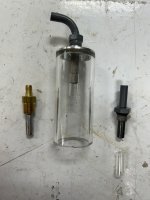
To prevent filling the brake fluid reservoir, either FW or MC mount, when bleeding the brakes from the bottom up, and then having to (somehow) remove some of the fluid in the reservoir to have "head space" for ops I make a little tool I call EZ-FILL which automatically retains the head space needed in the reservoir as part of the bleeding process. You can see the idea from the attached pic - screw the EZ-FILL fitting into the top of the reservoir, either 1/8-27 NPT, 1/4-18 NPT or the Matco O-ring type, and when the fluid reaches the bottom of the tube protruding into the body of the reservoir, excess fluid is dumped overboard via a 1/4" vinyl hose - thereby retain the space above for air. No messy drips ... No eye droppers to remove excess (or equivalent) are involved.

Also, when installed, if the tube goes into the reservoir farther than you would like, just cut off the offending length; if, it doesn't go far enough - slip the short piece of vinyl hose (included) over the tube to the desired height.

I make them and sell them as a service to the "community" - $10 (include shipping CONUS).

Another simple trick, when disassembling the system at the calipers is to plug the vent in the reservoir and then when the brake line is separated, quickly cap that end also. By sealing the outlet from the reservoir, you are creating a "vacuum" in the space below. The viscosity of the fluid is such that not much movement of it is possible - ergo, not much leaks out. I have done jobs where none leaked out, and the only thing I had to to at reassembly is to fill (by hand) the caliper body, remake the brake line connection, then reinstall the vent cap ...

HFS
 

Attachments

  • EZ-FILL Gen 2 & Matco.jpg
    EZ-FILL Gen 2 & Matco.jpg
    1.2 MB · Views: 152
Haha, sorry.

I have a small seep cooking from a nylon fitting from my Cleveland 10-30 master cylinder. The fitting is loose and my need to be tightened and dabbed wit some sealant.
The nylo stuff works good for years, some swear by it. I built my -4 with all nylon lines/fittings per plans and after 10 years of flying and fixing leaks, break failures and worry, I switched to all SS lines and AN fittings. You may not want to spend the money, but it may be in your favor at the point your at. Simple afternoon job and you'll never have to worry again. Not sure what "sealant dab" you plan to use, but teflon tape is your better answer with the nylon pipe thread side of the fitting. Also, the brass furl and compression fitting inside the pressure side line may not seal back up when you re-connect it. Others have shared the bleeding and draining process, I just use a cheapo pump oil can to push the fluid back in, but the tanks shown are really nice.
 
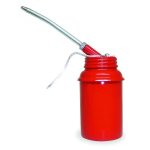
I use something like this simple pump available at any auto parts store for less than $10. Screw the tube out and insert a flexible line with a female quick connect zerk fitting from a grease gun, also available at any auto parts store.
A standard barb type pipe fitting on the reservoir and a piece of tubing to a catch can. No bubbles, no mess.
IMG_0205.jpeg
 
I have posted this before, but there are always "new" builders/maintainers that need this info ... Other builders, as posted do something similar, I just "formalize" the process.

To prevent filling the brake fluid reservoir, either FW or MC mount, when bleeding the brakes from the bottom up, and then having to (somehow) remove some of the fluid in the reservoir to have "head space" for ops I make a little tool I call EZ-FILL which automatically retains the head space needed in the reservoir as part of the bleeding process. You can see the idea from the attached pic - screw the EZ-FILL fitting into the top of the reservoir, either 1/8-27 NPT, 1/4-18 NPT or the Matco O-ring type, and when the fluid reaches the bottom of the tube protruding into the body of the reservoir, excess fluid is dumped overboard via a 1/4" vinyl hose - thereby retain the space above for air. No messy drips ... No eye droppers to remove excess (or equivalent) are involved.

. . . . .

HFS
Excellent David, I have been making various reservoir caps like this for all my brake needs for 30 yrs (like you!) The same principle works if the reservoir is pressurized or back bled. I use a 1/8" npt to 1/4" hose adapter (brass) and drill through to allow a 1/4" poly tube to be adjusted for the liquid level, then the tube can be attached to a catch jar in a place for solo bleeding. A nylon compression wedge is needed to seal easily to the poly tube. I hope that conveyed the configuration.

I use a 1 liter pressure sprayer from the hardware store for pressure, but found a need for pressure release incase of leaks and pressurized shut off while using. Both are a result of spills.
 
I use something like this simple pump available at any auto parts store for less than $10. Screw the tube out and insert a flexible line with a female quick connect zerk fitting from a grease gun, also available at any auto parts store.
A standard barb type pipe fitting on the reservoir and a piece of tubing to a catch can. No bubbles, no mess.
View attachment 89544
Wish you would have posted this earlier. I purchased an oiler from Amazon and during testing, it input so much air into the liquid. Thanks for this recommendation.
 
Whenever I open a brake hydraulic system, for any reason, I have a plug or cap handy to quickly stop air intrusion. Some systems have places that trap air making it difficult to bleed the air out
 
Wish you would have posted this earlier. I purchased an oiler from Amazon and during testing, it input so much air into the liquid. Thanks for this recommendation.
Any time I have used a hand operated oiler I have found it introduces bubbles at every hand cycle. Used one for years with mixed results. I have also tried the gravity bleeder ACS sells that looks like a medical IV bag. No dice. After using a local shop owner's pressure pot I bought the plastic one referenced in my prior post. Key points being the pressure release valve, the hand oump so no air compressor needed and the addition of a brass ball valve to control the process. An important point is to make sure whatever system you settle on make sure the materials, especially seals are not affected by brake fluid (whether MIL 5606 or DOT). ATS used to market one made from a garden sprayer with instructions to empty it and wash it out after each use because 5606 would dissolve the rubber seals. Nice fine print there ATS. The referenced one I procured even works well on those troublesome Piper models that have looped brake lines with trapped air.
 
Sounds like you are doing more than just bleeding brakes. You apparently have a need to remove one of the master cylinders for maintenance. So yes, I would drain the MC by putting a catch basin, bowl or other item under the wheel brake caliper and open it or remove it outright. Since you want to drain the the system I would just unscrew the whole bleed assembly. After repairing/replacing the MC re-install it and swap the MCs vented pipe plug with a barbed fitting and affix vinyl tubing to that fitting and have enough tubing to exit the cockpit to a catch jar on the wing walk or hangar floor. Then reinstall the bleed fitting on the brake caliper and crack it open so you can fill new fluid up from the caliper to the MC. I feed using an inexpensive ($40) automotive pressure pot to all but eliminate any air bubbles in the process. It has a hand air pump to pressurize the system prior to use.
I added a brass ball valve to the pressure pot’s feed tube so I can regulate and shut off the flow. I start the feed at the bleeder at a slow steady rate and watch the exit tube from the cockpit until I see the outflow show up in it without any bubbles. So far with the pressure pot I rarely see any bubbles like you get with a legacy hand pump oiler. When I see the solid exit fluid I turn off the pressure pot valve and then tighten the caliper bleed fitting before removing the pressure pot feed tube. Then up top in the cockpit I place a few rags around and below the MC and then pull the exit line from the barbed fitting and either put my thumb on the end of the tube or allow it to drain into a jar or cup on the floor. Then I replace the barbed fitting with the OEM vented pipe plug. This method works well for me and keeps things as clean as I’ve ever been able to.View attachment 89540
I have one too. Combined with David's EZ-Fill, it's a simple operation. I did modify mine with a fitting for the Beringer nipple and a ball valve. It can't introduce air unless you allow the fluid level to drop below the pickup.
 
You guys are making this way harder than it needs to be.

I just run a length of tube from the caliper bleeder to a supply of fluid on the floor. Remove the MC fill cap and screw in a nipple or insert a tapered probe with a length of hose attached. Open the bottom bleeder and draw a vacuum from the top. When bubbles stop coming out the top of the MC, close the caliper bleeder and you have a rock solid, air free brake circuit. Takes seconds, literally.
 
You guys are making this way harder than it needs to be.

I just run a length of tube from the caliper bleeder to a supply of fluid on the floor. Remove the MC fill cap and screw in a nipple or insert a tapered probe with a length of hose attached. Open the bottom bleeder and draw a vacuum from the top. When bubbles stop coming out the top of the MC, close the caliper bleeder and you have a rock solid, air free brake circuit. Takes seconds, literally.
What is your procedure for removing the air from this length of tubing?
Thanks.
 
You guys are making this way harder than it needs to be.

I just run a length of tube from the caliper bleeder to a supply of fluid on the floor. Remove the MC fill cap and screw in a nipple or insert a tapered probe with a length of hose attached. Open the bottom bleeder and draw a vacuum from the top. When bubbles stop coming out the top of the MC, close the caliper bleeder and you have a rock solid, air free brake circuit. Takes seconds, literally.
I’ll bite. I pressure bleed from the bottom and it is like a 30 minute workout of shaking and banging the pedals to get the trapped air out of the mc. Are you saying that vacuum from the top solves that challenge? If i just pressure bleed until bubbles stop coming out, it a is far from rock hard. There are still many bubbles stuck in the mc that only seem to release with shaking the assembly or pumping the pedal while bleeding. Anxious to learn a better method here!
 
…Are you saying that vacuum from the top solves that challenge?…

Yes, that has been my experience. I tried this method after I found the RV-8 brakes nearly impossible to bleed due to the upper loop of the lines. The vacuum method just draws the air right out.
 
What is your procedure for removing the air from this length of tubing?
Thanks.
Vacuum from the top. Yes, the air in the line initially draws through the whole system, but so what? Once you have a solid slug of fluid coming out of the bottle, keep drawing until the train of air has come out the top.
 
Yes, that has been my experience. I tried this method after I found the RV-8 brakes nearly impossible to bleed due to the upper loop of the lines. The vacuum method just draws the air right out.
Thanks, will definitely try your method.
 
Vacuum from the top. Yes, the air in the line initially draws through the whole system, but so what? Once you have a solid slug of fluid coming out of the bottle, keep drawing until the train of air has come out the top.
What do you use to draw the vacuum Mike?
 
What do you use to draw the vacuum Mike?

I usually use one of those Mi- T - vac units from the auto parts store, but I’ve also used a siphon chemical sprayer nozzle you connect to an air hose, a shop vac with my hand creating a sort of seal between the clear tube and the vac hose…. Heck, could probably even do it by mouth. The cool part about this technique is the bubbles, once above the MC piston, will never go back down. Said another way, no need to do it all at once and “rush” to close the bleeder screw at the caliper.
 
Low flow (i.e. pressure) when bleeding is problematic - if the flow of the bleed fluid moves more slowly that a rising bubble, then the bubble won't be cleared. The vacuum method solves this aspect, but can draw in air across a seal. Fortunately we have o-rings which will seal with pressure on either side of the ring. I just use (w/o orifice) 20 psi when bleeding and it forces the bubbles out. It is not fluid thrifty though - always a downside.
 
Low flow (i.e. pressure) when bleeding is problematic - if the flow of the bleed fluid moves more slowly that a rising bubble, then the bubble won't be cleared. The vacuum method solves this aspect, but can draw in air across a seal. Fortunately we have o-rings which will seal with pressure on either side of the ring. I just use (w/o orifice) 20 psi when bleeding and it forces the bubbles out. It is not fluid thrifty though - always a downside.
I just made a rig that uses my differential compression tester. I use 10 PSI on the right gauge and have never had an issue with bubbles not noving through the horizontal tubes. My issue is the bubbles getting trapped in the MC itself. I have NEVER had success just running fluid through it. Always had to shake or pump or do something to knock the bubbles loose. Maybe I am unlucky or missing a step, but wondering how others get this done without all the hassle.
 
Many ways to bleed brakes. My favorite is pressure pot, attached @caliper bleed fitting using ATS "brake bleeder coupler".. air has no chance trying to hide
 
Pressure bleeding from the bottom can often keep bubbles in lines that have a tall arch. Pressure bleeding the -8 was unsuccessful for me due to this. Creating negative pressure from the top was more effective getting these air bubbles out than pushing from the bottom.
 
Mmmmmm - I spent (probably way too much) time trying to get my automotive hand pump vacuum to extract the air bubbles in my brake lines. I'm sure some folks have had success doing this, but the only method I've found that gets all the air out is applying positive pressure from the from the caliper bleed fitting down low and capturing overflow brake fluid at the reservoir using one of the methods described above.

Especially in a 7 - the side by side double master cylinders and associated brake lines going between the two make bleeding at the MCs really tough. Maybe I'm missing something...
 
I'm curious what you did to pull the vacuum on the tubing above the oil reservoir?

The reservoir usually has a 1/8 NPT plug for servicing. I screw a barbed nipple into the servicing port and slip tube over that. Makes a nice tight seal and the vacuum source connects to that. Get enough flow going through the system under vacuum and the bubbles will flush out, even going downhill.
 
The reservoir usually has a 1/8 NPT plug for servicing. I screw a barbed nipple into the servicing port and slip tube over that. Makes a nice tight seal and the vacuum source connects to that. Get enough flow going through the system under vacuum and the bubbles will flush out, even going downhill.
Yes... what is the vacuum source?
 
The reservoir usually has a 1/8 NPT plug for servicing. I screw a barbed nipple into the servicing port and slip tube over that. Makes a nice tight seal and the vacuum source connects to that. Get enough flow going through the system under vacuum and the bubbles will flush out, even going downhill.
Mighty Vac brake bleeding kit.

Not exactly sure why more people don’t use it; it works great, very little mess, and zero bubbles when finished. Five years now and brakes are solid.
 
Siphon sprayer was the easiest to control, but the shop vac was surprisingly effective (and "self cleaning").
 
How much head space are we leaving in the reservoir? I have a firewall mounted reservoir on a RV-14a.
 
How much head space are we leaving in the reservoir? I have a firewall mounted reservoir on a RV-14a.
I use totally filled, then use a plastic zip tie to “dip” all the way to the bottom to displace just a bit.. if you wanted to displace more, just use the head of the zip tie instead of the tail. When it comes time to replace the pads and you want to push the piston back in the caliper, I remove the fill cap first incase any fluid needs to overflow.
 
Low flow (i.e. pressure) when bleeding is problematic - if the flow of the bleed fluid moves more slowly that a rising bubble, then the bubble won't be cleared. The vacuum method solves this aspect, but can draw in air across a seal. Fortunately we have o-rings which will seal with pressure on either side of the ring. I just use (w/o orifice) 20 psi when bleeding and it forces the bubbles out. It is not fluid thrifty though - always a downside.
But great for flushing the system.
 
Back
Top