Van's Air Force

The definitive Van's Aircraft support community! Buying, building or flying an RV? Join our exclusive family of mentors and enthusiasts!

BlackboxPi - Free DIY Cockpit Audio Recorder for Disaster Recovery

jquayle

Active Member
Patron
From Tinkering to Passion Project

I've been working on a cockpit audio recorder for my RV-7 - mostly for my own use to review flights. Record not only ATC, but also intercom audio. Useful when you have to second guess if something really happened the way you thought you heard it. Also fun to share snippets with friends or review for training purpopes. Something that didn't require remembering to turn it on. Something I didn't need to recharge. Not my phone, not a portable audio recorder. Something you can set and forget and it would just work. I had in my mind that maybe this would turn into a product I would build and market for other pilots.

Then the Needles crash happened. Two recently certified young pilots rented a plane from a fligth school at my home base of KVGT to time build and flew out to Needles at night. The plane went down near the airport and both perished. A friend of mine is a student at that school and took the loss very hard. Lots of questions about what happened on the flight. What was discussed before the accident. Questions there will never be answers to.

That crash made me rethink everything. Post-flight playback is convenient. But disaster recovery? That could actually help families get answers and maybe prevent future accidents. Could I redesign what I already have into something that would have been able to provide those answers? Not just an audio recorder, but a true 'blackbox' for GA that could have worked even in a situation like this where the plane was completely consumed by a post crash fire. Building something to survive a fire didn't seem feasible, but what about streaming the audio in flight rather than after the plane lands as was my current design. This actually required a complete ground up rethink and rebuild.


What I Built:

I pivoted completely and built BlackboxPi - a Raspberry Pi-based system focused entirely on one thing: making sure CVR audio survives even if the aircraft doesn't.


How it works:


- Continuously records cockpit audio in 60-second segments
- Uploads each segment to the cloud as it's recorded
- Even if the aircraft is destroyed (fire, water, impact, or never found), the audio is already safely in the cloud
- Redundant recordings with audio on the SD card and cloud.


The Setup:

- Raspberry Pi Zero 2W ($15)
- USB audio adapter ($7)
- NFlight audio cable to your audio panel ($40)
- SanDisk MAX Endurance microSD Card - 32GB ($12)
- USB adpater cable ($3)
- Any case for the Pi Zero 2 ($5-18) or can 3d print for free
- Your iPhone hotspot for connectivity
- Your Dropbox account (free tier is fine)
- Total cost: ~$80 for DIY build


Installation:

- Audio cabled plugs into panel jack. Has a passthrough for headset
- USB from ship power to the BlackboxPi.
- 5-minute setup via iOS app (configure WiFi, set Tail number, link Dropbox)
- Mount or stash out of the way.
- Done. Zero user interaction required after this.


Why I'm Sharing This

After that crash, I realized this doesn't really exist for GA. The purpose of a 'Blackbox' isn't that would have changed the outcome of an accident, but to help answer questions about what was happening before the accident and to hopefully help investigators prevent future accidents.

The core safety concept - disaster-proof audio recording - should be available for GA and not just airlines.


What I'm Looking For:

I'm at the point where I need feedback from the community:

1. Is this even useful? Am I solving a real problem or just building something I think is cool?
2. Would you actually build/use this? Or is it too much hassle for something you hope you'll never need?
3. What am I missing? What would make this more useful? What concerns do you have?


Current Status:

- I've donated units to the flight school where this happened for their 3 plane fleet and they are beta testing the hardware and iOS app
- I've been flying with this in my RV-7 (N560MW) for several months. Core recording functionality is rock solid.
- Handles abrupt power-off (no SD card corruption)
- Auto-reconnects to iPhone hotspot (this was a huge challenge)

- It just works


I have finally finished an iOS app for setup and monitoring. This now makes the setup and configuration dead simple.
Now it's ready for additional testers beyond my local airport.


If You Want to Build One:

I'll put together detailed build instructions with:
- Parts list with links
- SD card image (pre-configured, just flash and boot)
- iOS app (TestFlight beta)
- Installation guide with photos
- Help if you have any issues


Questions Welcome
Happy to answer any questions, help with builds, or take feedback on how to make this better.


Blue skies,


Jeff
RV-7 (N560MW)
 
From Tinkering to Passion Project

I've been working on a cockpit audio recorder for my RV-7 - mostly for my own use to review flights. Record not only ATC, but also intercom audio. Useful when you have to second guess if something really happened the way you thought you heard it. Also fun to share snippets with friends or review for training purpopes. Something that didn't require remembering to turn it on. Something I didn't need to recharge. Not my phone, not a portable audio recorder. Something you can set and forget and it would just work. I had in my mind that maybe this would turn into a product I would build and market for other pilots.

Then the Needles crash happened. Two recently certified young pilots rented a plane from a fligth school at my home base of KVGT to time build and flew out to Needles at night. The plane went down near the airport and both perished. A friend of mine is a student at that school and took the loss very hard. Lots of questions about what happened on the flight. What was discussed before the accident. Questions there will never be answers to.

That crash made me rethink everything. Post-flight playback is convenient. But disaster recovery? That could actually help families get answers and maybe prevent future accidents. Could I redesign what I already have into something that would have been able to provide those answers? Not just an audio recorder, but a true 'blackbox' for GA that could have worked even in a situation like this where the plane was completely consumed by a post crash fire. Building something to survive a fire didn't seem feasible, but what about streaming the audio in flight rather than after the plane lands as was my current design. This actually required a complete ground up rethink and rebuild.


What I Built:

I pivoted completely and built BlackboxPi - a Raspberry Pi-based system focused entirely on one thing: making sure CVR audio survives even if the aircraft doesn't.


How it works:


- Continuously records cockpit audio in 60-second segments
- Uploads each segment to the cloud as it's recorded
- Even if the aircraft is destroyed (fire, water, impact, or never found), the audio is already safely in the cloud
- Redundant recordings with audio on the SD card and cloud.


The Setup:

- Raspberry Pi Zero 2W ($15)
- USB audio adapter ($7)
- NFlight audio cable to your audio panel ($40)
- SanDisk MAX Endurance microSD Card - 32GB ($12)
- USB adpater cable ($3)
- Any case for the Pi Zero 2 ($5-18) or can 3d print for free
- Your iPhone hotspot for connectivity
- Your Dropbox account (free tier is fine)
- Total cost: ~$80 for DIY build


Installation:

- Audio cabled plugs into panel jack. Has a passthrough for headset
- USB from ship power to the BlackboxPi.
- 5-minute setup via iOS app (configure WiFi, set Tail number, link Dropbox)
- Mount or stash out of the way.
- Done. Zero user interaction required after this.


Why I'm Sharing This

After that crash, I realized this doesn't really exist for GA. The purpose of a 'Blackbox' isn't that would have changed the outcome of an accident, but to help answer questions about what was happening before the accident and to hopefully help investigators prevent future accidents.

The core safety concept - disaster-proof audio recording - should be available for GA and not just airlines.


What I'm Looking For:

I'm at the point where I need feedback from the community:

1. Is this even useful? Am I solving a real problem or just building something I think is cool?
2. Would you actually build/use this? Or is it too much hassle for something you hope you'll never need?
3. What am I missing? What would make this more useful? What concerns do you have?


Current Status:

- I've donated units to the flight school where this happened for their 3 plane fleet and they are beta testing the hardware and iOS app
- I've been flying with this in my RV-7 (N560MW) for several months. Core recording functionality is rock solid.
- Handles abrupt power-off (no SD card corruption)
- Auto-reconnects to iPhone hotspot (this was a huge challenge)

- It just works


I have finally finished an iOS app for setup and monitoring. This now makes the setup and configuration dead simple.
Now it's ready for additional testers beyond my local airport.


If You Want to Build One:

I'll put together detailed build instructions with:
- Parts list with links
- SD card image (pre-configured, just flash and boot)
- iOS app (TestFlight beta)
- Installation guide with photos
- Help if you have any issues


Questions Welcome
Happy to answer any questions, help with builds, or take feedback on how to make this better.


Blue skies,


Jeff
RV-7 (N560MW)
Jeff

I think this a great idea and would like to try it. I fly with my brother and don’t talk to ATC much. I’ve had a couple of times were I would have liked to hear some of our conversations. I’m using a Raspberry Pi Zero now on my network so have a 1st grade knowledge on it operation.
 
I know a bit about this topic.
Many times the last 60 seconds is the critical part, so keeping that safe is pretty important. However, with our small aircraft, the necessary protection is not the same as the heavies. Eurocae ED-112A (112B was just released, but not in any mandates yet) is the flight recorder MOPS for the larger aircraft. ED-155 (155A is coming) addresses recorders for smaller aircraft like turbine helos, turboprop singles, AAM, UAV, etc. The French BEA recently did a study for recovery of non-protected memory devices in small aircraft, mostly helos, to see what the survival rate is. Things like phones, handheld GPS', GoPros, and the like. Any fire exposure was pretty much fatal to the devices, but fire was not a factor in many of the incidents so they were able to recover data in about 80% of the incidents. So, if you take some measures to ruggedize the memory, you will have a fighting chance.
Adding an ambient audio microphone is also recommended (required on mandated CVR installs) to capture forensic noises that might not be in the headset audio. Our aircraft are very loud, (my RV at high power was about 120dB SPL at the panel), but useful information can still be obtained, especially if the engine has gone quiet! A small bit of standby power is also good. CVRs are now fitted with ten minute backup power supplies (since the SwissAir accident) and these power the cockpit ambient microphone, so even if the whole plane is dark, there will still be audio recorded.

BTW, streaming of flight data is a hot topic, but full of unknowns. The thing with the FDR and CVR is that they have to work when everything else isn't. So, piping data out of the airplane can work fine when things are normal, but what about when the plane is upside down? Most of the satcom links are using steered antennas that can only handle "normal" bank and pitch angles and rates. Remember what I said about that last 60 seconds? For our mostly overland flights, cell coverage is possible, but again, cell tower antennas are not designed to look up, so the link reliability may not be great.

The G3X has a data log that is updated every second on the SD card. Also piped out an RS-232 port on the display. I made a ruggedized datalogger for the 232 pipe, but that is just flight data. A simple FDR.

Have fun with your project! And, if you're ever interested in working on the real stuff, let me know!
 
I know a bit about this topic.
Many times the last 60 seconds is the critical part, so keeping that safe is pretty important. However, with our small aircraft, the necessary protection is not the same as the heavies. Eurocae ED-112A (112B was just released, but not in any mandates yet) is the flight recorder MOPS for the larger aircraft. ED-155 (155A is coming) addresses recorders for smaller aircraft like turbine helos, turboprop singles, AAM, UAV, etc. The French BEA recently did a study for recovery of non-protected memory devices in small aircraft, mostly helos, to see what the survival rate is. Things like phones, handheld GPS', GoPros, and the like. Any fire exposure was pretty much fatal to the devices, but fire was not a factor in many of the incidents so they were able to recover data in about 80% of the incidents. So, if you take some measures to ruggedize the memory, you will have a fighting chance.
Adding an ambient audio microphone is also recommended (required on mandated CVR installs) to capture forensic noises that might not be in the headset audio. Our aircraft are very loud, (my RV at high power was about 120dB SPL at the panel), but useful information can still be obtained, especially if the engine has gone quiet! A small bit of standby power is also good. CVRs are now fitted with ten minute backup power supplies (since the SwissAir accident) and these power the cockpit ambient microphone, so even if the whole plane is dark, there will still be audio recorded.

BTW, streaming of flight data is a hot topic, but full of unknowns. The thing with the FDR and CVR is that they have to work when everything else isn't. So, piping data out of the airplane can work fine when things are normal, but what about when the plane is upside down? Most of the satcom links are using steered antennas that can only handle "normal" bank and pitch angles and rates. Remember what I said about that last 60 seconds? For our mostly overland flights, cell coverage is possible, but again, cell tower antennas are not designed to look up, so the link reliability may not be great.

The G3X has a data log that is updated every second on the SD card. Also piped out an RS-232 port on the display. I made a ruggedized datalogger for the 232 pipe, but that is just flight data. A simple FDR.

Have fun with your project! And, if you're ever interested in working on the real stuff, let me know!
I've seen the product and its really impressive. I'll be a beta tester very soon once my airplane is back flying next week But from what I've seen, its ideal for the GA market. Its extremely small, lightweight, and doesn't really interfere with anything. It about the size of a large pack of gum. The OP and I have had MANY discussions over coffee and margaritas and the data being piped out - as you said - is one of the biggest challenges. Its not a perfect solution for every possible situation. But I think he's thought this through really well. And for the GA guys, I think it has great uses beyond just the last 60 sec in the event of a loss of aircraft for the NTSB to go back and try to find out what happened.
 
1. This is an ongoing issue with military aircraft as well. There's no common standard among the services for crash survivability or what parameters (FDR) or if voice (CVR) is captured. Often times we're rebuilding the chain of events from disparate sources of data, relying on raw radar (ADS-B uncommon) or onboard mission systems not designed for crash survivability and often don't record the most interesting data or do it fast enough. I have to believe that the NTSB has a standing recommendation for this type of system in GA but an absence of regulation requiring it has prevented one from being commercially developed. So yes, I think something like this is valuable to the community.

2. I look at this similar to insurance. You don't carry life insurance on yourself for you're benefit and you don't put this in your aircraft for you. You put it in the aircraft for everyone else's benefit, whether that be closure for loved ones or to be a cautionary tale for others.

3. Recording aircraft state data and control positions is really valuable for mishap investigation. State data would be easier nowadays if you could find a way to tap into modern avionics architectures and siphon off the data. Control positions are probably the hardest part since those almost never instrumented. An engaged Auto pilot might be able to tell you servo positions to help ascertain stick position?
 
I know a bit about this topic.
Many times the last 60 seconds is the critical part, so keeping that safe is pretty important. However, with our small aircraft, the necessary protection is not the same as the heavies. Eurocae ED-112A (112B was just released, but not in any mandates yet) is the flight recorder MOPS for the larger aircraft. ED-155 (155A is coming) addresses recorders for smaller aircraft like turbine helos, turboprop singles, AAM, UAV, etc. The French BEA recently did a study for recovery of non-protected memory devices in small aircraft, mostly helos, to see what the survival rate is. Things like phones, handheld GPS', GoPros, and the like. Any fire exposure was pretty much fatal to the devices, but fire was not a factor in many of the incidents so they were able to recover data in about 80% of the incidents. So, if you take some measures to ruggedize the memory, you will have a fighting chance.
Adding an ambient audio microphone is also recommended (required on mandated CVR installs) to capture forensic noises that might not be in the headset audio. Our aircraft are very loud, (my RV at high power was about 120dB SPL at the panel), but useful information can still be obtained, especially if the engine has gone quiet! A small bit of standby power is also good. CVRs are now fitted with ten minute backup power supplies (since the SwissAir accident) and these power the cockpit ambient microphone, so even if the whole plane is dark, there will still be audio recorded.

BTW, streaming of flight data is a hot topic, but full of unknowns. The thing with the FDR and CVR is that they have to work when everything else isn't. So, piping data out of the airplane can work fine when things are normal, but what about when the plane is upside down? Most of the satcom links are using steered antennas that can only handle "normal" bank and pitch angles and rates. Remember what I said about that last 60 seconds? For our mostly overland flights, cell coverage is possible, but again, cell tower antennas are not designed to look up, so the link reliability may not be great.

The G3X has a data log that is updated every second on the SD card. Also piped out an RS-232 port on the display. I made a ruggedized datalogger for the 232 pipe, but that is just flight data. A simple FDR.

Have fun with your project! And, if you're ever interested in working on the real stuff, let me know!
Mike,

digitally recorded audio has to have the file 'closed' or the whole clip becomes corrupt. That's why I break it into 1 min segments and upload them like that so at most you should loose 59.9 seconds in a worst case scenario. I do understand that these might be critical seconds, but currently this is the limitation of the system. I had to strike a balance somewhere. The system lets you reduce that to 30 seconds, but I haven't properly field tested that to confirm if it would be stable. I can continue to work on improving this to try to get the maximum audio lost time even lower.

This is not a true CVR trying to meet all the mandates. I'm trying to get as much functionality out of it for as little cost and hassle as possible. I can build one of these from scratch in under 10 minutes including imaging the SD card. I think the average person doing it for the first time could be done start to finish in less than an hour easily. The unit I built for myself before designing the BlackboxPi has a full UPS, but that doubles the cost and increases the complexity by probably a factor of 10. Plus there are no commercially available cases that would fit and the only options are 3D printed cased. I'm trying to keep the barrier to entry as low as possible (cost, effort and time)

From my understanding the number of GA aircraft that are completely consumed by fire or otherwise completely destroyed are in the single digits. SD card are incredibly reliable. Installing this in the back seats of a 4+ seater airplane would probably make it even more likely to survive a bad crash.

I'm very interested about your FDR for the G3X. My research led me down a dead end trying to see if I could get the data out in flight. Obviously that would be a huge advantage as well in a case where the plane was completely destroyed and the built in SD card was unretrievable or no installed. I'm going to DM you about that.

I was looking into pulling GPS data from the iPhone and logging and uploading that info along with the audio. That would work regardless of the plane you were in but I wanted to get the product out now and I can add those features through updates without having to remake the BlackboxPi.

Thank you for your input.


Jeff
 
On my last flight around the patch I was impressed at the ability of my iPhone to track the wife in her car (and relative to my position in the plane loitering overhead) at about 3000' AGL, but in general I find cell reception in the plane gets very sketchy to none at more than a couple thousand feet up. Probably not towers rejecting phones hitting multiple towers at once as seemed to be standard practice in the analog cell days, but as someone said above, the antennas are highly directive straight out and down from the tower height. I was expecting to see that the OP was using StarLink for connectivity, which of course is not nearly so prevalent as cellular devices in the GA cockpit.
 
Not clear to me that this would be of that much value in real accidents (but I could be wrong -- again). When people get stressed, speech and hearing get suppressed...

For routine access, bluetooth or a small cable would work.

As for survivability, the tail of the airplane is frequently recoverable and, I think, not always consumed by fire. I do like your idea of recording 60 second files so that audio files are not corrupted. If you do want fire survivability, IIRC, commercial FDR/CVR surround the electronics with baking soda. Yup, baking soda.
 
We are talking RV’s. Just have the pilot record four messages in his own voice and a little keypad to select an option.
1) those cloud bases are a lot lower than predicted
2) I’m out of gas!
3) I have gas but shouldn’t have used the hardware store parts in the fuel system
4) hold my beer and watch this.
 
On my last flight around the patch I was impressed at the ability of my iPhone to track the wife in her car (and relative to my position in the plane loitering overhead) at about 3000' AGL, but in general I find cell reception in the plane gets very sketchy to none at more than a couple thousand feet up. Probably not towers rejecting phones hitting multiple towers at once as seemed to be standard practice in the analog cell days, but as someone said above, the antennas are highly directive straight out and down from the tower height. I was expecting to see that the OP was using StarLink for connectivity, which of course is not nearly so prevalent as cellular devices in the GA cockpit.
Nope - Just the iPhone as a hotspot. There's a lot of logic behind the scenes that manages both the connection to the iPhone and from the phone to the internet. If upload speeds drop, it pauses the uploads vs trying over and over when coverage is bad. It then checks every 2 min to see if it can ping the internet and runs a quick speed test to validate a good connection before resuming uploads. If cell coverage is lost in flight, one restored the files all upload in batch back to real time.

Even in the 10-12k range I normally have good luck with getting reception. I was originally thinking about people having a hotspot or even Starlink but almost every pilot I know has an iPhone and no one I know has a Mi-Fi or Starlink in their plane. If someone builds one of these and has Starlink in their plane, I’d be happy to work with them and build in functionality for that. Currently it is iPhone specific.
 
Last edited:
Mike,

digitally recorded audio has to have the file 'closed' or the whole clip becomes corrupt. That's why I break it into 1 min segments and upload them like that so at most you should loose 59.9 seconds in a worst case scenario. I do understand that these might be critical seconds, but currently this is the limitation of the system. I had to strike a balance somewhere. The system lets you reduce that to 30 seconds, but I haven't properly field tested that to confirm if it would be stable. I can continue to work on improving this to try to get the maximum audio lost time even lower.
Right, that is why "real" CVRs don't use certain audio formats and use some other tricks. The MOPS prohibits loss of more than one second of audio due to data corruption. (also, psycho-acoustic compression formats (mp3, AAC, etc) and silence editing are not allowed in order to provide forensic information and time correlation)
 
As for survivability, the tail of the airplane is frequently recoverable and, I think, not always consumed by fire. I do like your idea of recording 60 second files so that audio files are not corrupted. If you do want fire survivability, IIRC, commercial FDR/CVR surround the electronics with baking soda. Yup, baking soda.
LOL, baking soda? Yeah, no....

It's a bit macabre, but one helo manufacturer mounts a (not TSO compliant) data recorder memory under the pilot seat, because....well....it's usually occupied, and 150 pounds of water provides a certain....well, you connect the dots.....
 
My real question is how are you getting cell coverage in the air. This used to work occasionally, but as of a couple of years ok, i get no service as soon as i am a few hundred feet off the ground. Assuming it is an apple thing with them kissing a$$ with the fcc.
 
@jquayle i love the idea. a while ago i designed a recorder for ham radio contesting which also interfaces in real time with the dropbox and there is a site that allows to search recordings and quickly pull them up for review (they are 45 second mp3 compressed files to conserve bandwidth) i can definitely appreciate your work. great job!
 
My real question is how are you getting cell coverage in the air. This used to work occasionally, but as of a couple of years ok, i get no service as soon as i am a few hundred feet off the ground. Assuming it is an apple thing with them kissing a$$ with the fcc.
A high percentage of the USA and Canada has no cell coverage. In Canada the cell towers are not aimed as low and cell coverage is better than flying in the US also it is quite legal to use cell phones while in the air in Canada and NAV Canada publishes the tower phone numbers that can be used if you have a comm failure.
 
Could a Meshtastic device work for this application?

No experience with Meshtastic other than reading about it on VAF and asking Grok, “Could a Meshtastic transmitter be used as a rudimentary “black box” in a small experimental airplane?”
 
A high percentage of the USA and Canada has no cell coverage. In Canada the cell towers are not aimed as low and cell coverage is better than flying in the US also it is quite legal to use cell phones while in the air in Canada and NAV Canada publishes the tower phone numbers that can be used if you have a comm failure.
thanks!
 
Nice project - I've seen a few similar that include a camera, and are mainly focused on road vehicles. Might consider using BWF and then having a background compression running on the chunks if you have any left over CPU. Please keep us posted. So much can be done with these little SOCs like the Pi or the STM32 or the ESP32.
 
My real question is how are you getting cell coverage in the air. This used to work occasionally, but as of a couple of years ok, i get no service as soon as i am a few hundred feet off the ground. Assuming it is an apple thing with them kissing a$$ with the fcc.
Given the difference in experiences, my guess is that it might depend on who you have as a carrier and the area you are flying over. The online backup is for the absolute worst case scenario. For most crashes the SD card would likely still survive and audio would be retrievable there. As has already been mentioned, positioning the unit further aft in the plane would increase the chance of it surviving if the plane was partially burned.
 
Nice project - I've seen a few similar that include a camera, and are mainly focused on road vehicles. Might consider using BWF and then having a background compression running on the chunks if you have any left over CPU. Please keep us posted. So much can be done with these little SOCs like the Pi or the STM32 or the ESP32.
I wasn't familiar with Broadcast Wave Format. After looking into it, this looks like the right path forward. I'm going to look into switching to BWF. Good news is that the system is setup where updates to the Pi can be made via the iOS app, so even existing units could upgrade to this without having to re-image the SD card.

Really appreciate the insight! This is exactly the kind of community feedback I was hoping for. 👍

Thank you,


Jeff Quayle
 
Looks neat! I'll have to try it out. Also wondering how the cell coverage is.

My company makes a portable state estimator and data logger for GA - mostly for post-flight aerobatic analysis, but also student pilot training, and de-briefing your own performance and proficiency. I won't link it here, since we aren't setup as a VAF vendor / advertiser yet (I know, I know, I keep meaning to). We have been quietly working on integrating the Appareo RDM-300 to stream data to for potential use in post-crash analysis - the RDM-300 is designed to survive a crash / fire, but the price also reflects that.

We've had some flight schools express interest in streaming data in real-time to keep an eye on students or for use in post-crash analysis, but I haven't figured out a good approach yet. Cell tower antennas are pointed to service people on the ground, so I've noticed that we tend to loose cell signal once we're at pattern altitude and above, if not sooner. Iridium is an option, but expensive. Be interesting to hear how your experience is.

Anyway, please feel free to reach out - in addition to logging to an SD card, our system broadcasts data over wifi, so it might be a fun integration to time correlate the voice input from BlackBoxPi with the state data.
 
The G3X has a data log that is updated every second on the SD card. Also piped out an RS-232 port on the display. I made a ruggedized datalogger for the 232 pipe, but that is just flight data. A simple FDR.
So are you saying that the same data from the G3X that gets written to the SD card is also going down this RS-232 pipe? Is that data encrypted by Garmin or is it easy to get the data to look at?
 
Some of the new auto dash cams would provide a good foundation for a light aircraft black box. A few offer aux audio inputs, multiple external cameras and 4K video.
A small fireproof box could house the critical main portion of the device with the SD card storage.
 
Seems as if one thing that would take some thought is some way to let the accident investigators learn the the plane has this equipment and how to extract the data and, just as importantly, how the data is formatted (if it's not obvious). Since most GA airplanes don't have anything like this, and most EA accidents probably don't get the full in-depth investigation that an airliner would, it would be too easy for them to not bother with the curious and unusual box.

Dave
RV-3B project
 
So are you saying that the same data from the G3X that gets written to the SD card is also going down this RS-232 pipe? Is that data encrypted by Garmin or is it easy to get the data to look at?
Read the installation manual, it describes the open format that can be set to come out of the g3x serial ports
 
Seems as if one thing that would take some thought is some way to let the accident investigators learn the the plane has this equipment and how to extract the data and, just as importantly, how the data is formatted (if it's not obvious). Since most GA airplanes don't have anything like this, and most EA accidents probably don't get the full in-depth investigation that an airliner would, it would be too easy for them to not bother with the curious and unusual box.

Dave
RV-3B project
It is not just a matter of making a fireproof container but it also has to prevent the the heat from destroying the contents of the container.
 
Seems as if one thing that would take some thought is some way to let the accident investigators learn the the plane has this equipment and how to extract the data and, just as importantly, how the data is formatted (if it's not obvious). Since most GA airplanes don't have anything like this, and most EA accidents probably don't get the full in-depth investigation that an airliner would, it would be too easy for them to not bother with the curious and unusual box.

Dave
RV-3B project
I made an html file you can open locally that will generate a logbook entry along with a QR code to take them straight to the files. Alaina with the audio files is a full technical document explaining what the BlackboxPi is, how everything is recorded and stored and instructions on how to retrieve them off the SD card if it’s available. I figure any investigation into a fatal accident is going to involve going through the logs book.

Open to other and better ideas


Jeff Quayle
 
the antennas are highly directive straight out and down from the tower height.
From my days working at a federal TLA (three-letter agency), I can tell you that cell tower antennas are supposed to be pointed down, for several reasons: keeps the cell tower footprint smaller, which aids in frequency reuse; directs transmitted energy towards users presumed to be mostly on the ground; and in some cases, promotes frequency sharing with satellite communication systems.
 
Nope - Just the iPhone as a hotspot. There's a lot of logic behind the scenes that manages both the connection to the iPhone and from the phone to the internet. If upload speeds drop, it pauses the uploads vs trying over and over when coverage is bad. It then checks every 2 min to see if it can ping the internet and runs a quick speed test to validate a good connection before resuming uploads. If cell coverage is lost in flight, one restored the files all upload in batch back to real time.

Even in the 10-12k range I normally have good luck with getting reception. I was originally thinking about people having a hotspot or even Starlink but almost every pilot I know has an iPhone and no one I know has a Mi-Fi or Starlink in their plane. If someone builds one of these and has Starlink in their plane, I’d be happy to work with them and build in functionality for that. Currently it is iPhone specific.
What cell carrier are you using, and in what part of the country? This is pretty much unheard of for me. Occasionally the wife will get a message through to the kids, our more rarely an in-flight pic, above 2,500 or so, but it's not the rule.
 
My car has a "Dash cam", or as I call it a "Crash Cam". As soon as you start the car, it starts recording 4K video and high quality audio. The device works incredibly well and the high quality video makes reading another car's license plate from the videos possible from quite a distance. The SD card holds many hours of video. Cost $100.
On my new Sonex Highwing I am going to mount one on the overhead behind the pilots and adjust it to record the audio from the intercom and com radio and the video to capture the EFIS screen and out the windshield looking forward.
If a crash , or potential violation occurs, the data may help figure out what happened, unless the camera and it's SD card burns up from the crash.
Or you could mount it in a fireproof enclosure if you thought necessary.
It could also be used to help prove your story if needed.
$100 and a 12 volt power feed. A switch on the panel would allow you to disable the camera for privacy if wanted.
Easy Peasy and $100.
 
Does anyone have a PIREP on Lightspeed's free app that will record all intercom activity, including radio and in-cabin conversations?

https://www.lightspeedaviation.com/flightlink-app/

I have not tried it yet.
I spoke to a pilot today that had this. He said the thing about it is that you have to open the app and start recording never ends up doing it. That was part of what I was experiencing with using a dedicated recorder or a spare iPhone and recording to voice memos. Never worked out as well as I planned for every flight and I wanted something I never had to think about. It just worked.
 
My car has a "Dash cam", or as I call it a "Crash Cam". As soon as you start the car, it starts recording 4K video and high quality audio. The device works incredibly well and the high quality video makes reading another car's license plate from the videos possible from quite a distance. The SD card holds many hours of video. Cost $100.
On my new Sonex Highwing I am going to mount one on the overhead behind the pilots and adjust it to record the audio from the intercom and com radio and the video to capture the EFIS screen and out the windshield looking forward.
If a crash , or potential violation occurs, the data may help figure out what happened, unless the camera and it's SD card burns up from the crash.
Or you could mount it in a fireproof enclosure if you thought necessary.
It could also be used to help prove your story if needed.
$100 and a 12 volt power feed. A switch on the panel would allow you to disable the camera for privacy if wanted.
Easy Peasy and $100.
This was one of my first thoughts as well. Although I think dashcams recording video (usually out the front and also of the driver) are better suited when you often have someone suddenly pulling right out in front of you and proving that you weren't looking at your phone when it happened. I was unable to find a unit that would let you plug in external audio. (Not saying there isn't one out there somewhere, every unit I saw only recorded ambient audio which in a plane would be basically nothing).
 
What cell carrier are you using, and in what part of the country? This is pretty much unheard of for me. Occasionally the wife will get a message through to the kids, our more rarely an in-flight pic, above 2,500 or so, but it's not the rule.
Bill,

I live in Las Vegas and regularly get cell coverage up to 10k' or above here in Nevada, California and recently did a trip up to the top of Washington with coverage most of the way. I have AT&T on an iPhone 15pro. (though I don't think the phone makes a big difference)

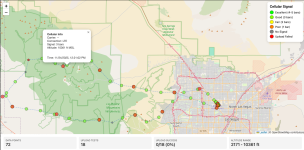
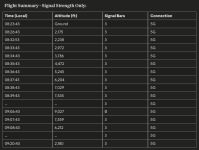
Wrote an app to check cell reception and upload performance after hearing that others were unable to get coverage above pattern altitude. I need to rework the app a bit. All the uploads failed because I had an expired dropbox token. I'm going to rewrite it to use the SpeedTest.net CLI API and can make this available to any other pilots that would like to check coverage in their area. I'm going to test again tomorrow with the revisions, but this flight does show good cellular coverage up to 10361 feet.
 

Attachments

  • Screenshot 2025-11-24 at 7.24.45 PM.png
    Screenshot 2025-11-24 at 7.24.45 PM.png
    568.9 KB · Views: 14
Bill,

I live in Las Vegas and regularly get cell coverage up to 10k' or above here in Nevada, California and recently did a trip up to the top of Washington with coverage most of the way. I have AT&T on an iPhone 15pro. (though I don't think the phone makes a big difference)

Wrote an app to check cell reception and upload performance after hearing that others were unable to get coverage above pattern altitude. I need to rework the app a bit. All the uploads failed because I had an expired dropbox token. I'm going to rewrite it to use the SpeedTest.net CLI API and can make this available to any other pilots that would like to check coverage in their area. I'm going to test again tomorrow with the revisions, but this flight does show good cellular coverage up to 10361 feet.
It will be interesting to see the results of this distributed survey of reception aloft. I suspect it will vary greatly by geography and be disappointing in the eastern seaboard but we'll eventually see for sure. I'm hoping that better cell coverage aloft will become the new normal though.
 
Does anyone have a PIREP on Lightspeed's free app that will record all intercom activity, including radio and in-cabin conversations?

https://www.lightspeedaviation.com/flightlink-app/

I have not tried it yet.
This is one I can answer… pretty simple. It doesn’t work! I recently bought a brand new Delta Zulu directly from Lightspeed.

I’ve spent more than an hour on the phone with a very nice support person at Lightspeed. We sent screen capture videos back and forth. I tried 3 different iOS devices. I uninstalled and reinstalled. I tried it in a second airplane. I flipped dip switches on the headset and nothing we did would get the app to work. A couple of days ago, I checked the App Store to see if they’ve released an updated app to fix the issue and see that it’s been an ongoing problem for years. Pretty ticked off that their tech acted as if t was the first he heard of it and that it must just be me (and my 3 different iOS devices and two different airplanes). I’m pretty sure this is a textbook example of gaslighting.

The headset is great, but don’t plan on using the recording function.
 
This was one of my first thoughts as well. Although I think dashcams recording video (usually out the front and also of the driver) are better suited when you often have someone suddenly pulling right out in front of you and proving that you weren't looking at your phone when it happened. I was unable to find a unit that would let you plug in external audio. (Not saying there isn't one out there somewhere, every unit I saw only recorded ambient audio which in a plane would be basically nothing).
Your right. There is a big advantage in a system that will always record and does not require any pilot action to initiate. That's how the big boys fly.
 
Interesting discussion, mostly highlighting to me how little I know of the language of modern “tech”. I used to build my own computers - now I just hope that the new laptop I have has everything pre-loaded…..

The thing I’d return to however, is the top concept of a CVR in a single-pilot airplane. I have, in my flying career, had a number of emergencies that required my full attention to survive. The last thing I was going to do was narrate what was going on as I returned what was left of the aircraft to the earth. Maybe it’s just me (and folks trained the same way), but I am too busy “working the problem” to tell the story of what I am doing at the same time. So I am not sure what you’re going to get out of this in most cases.

Now data recording? Absolutely! I have numerous friends at various avionics and kit companies that spend non-trivial amounts of their time helping accident investigators pull data from SD cards and EFIS memories, then analyzing the flight data to come up with good recordings of what the airplane actually experienced. That has, quite honestly, revolutionized the accident investigation process when it comes to light GA mishaps. And it is amazing just how robust those little chips of silicon really are - the whole packaging can be melted away, and we still have a recording of what was being gathered by the system.

This is not to say “don’t both with a CVR” - we never know where tinkering like this will lead, and in some cases, you might well get useful data. But…. Make sure to put resources where they can do the most good. Not all of us talk to ourselves out loud - but a video recording of what was actually going on in (and out of) the cockpit would tell a LOT in some cases!
 
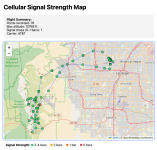
Flew for an hour this morning testing cellular strength again in my local area. 76 data points recorded and only 1 didn't have coverage. This was on the outskirts of town here in Las Vegas. I realize coverage might be drastically different in other parts of the country. Here's a screenshot and the interactive html file if anyone would like to have a closer look at the data. I'm now wondering how much the carrier and perhaps even the phone make a difference. I spoke to another pilot about this that also has AT&T in my area but with a 3 year older phone and he said he very seldom sees the kind of reception I do.

If anyone would like to test this, I can make available and send you the iOS app I used to record this info. You just open the app and hit start recording. I can help analyze the data if needed as it involves a bit of coding to review, but I'm happy to do it and send back the interactive html file like I have here.

link to the map file:
 

Attachments

  • Screenshot 2025-11-25 at 11.05.36 AM.png
    Screenshot 2025-11-25 at 11.05.36 AM.png
    489.3 KB · Views: 7
  • Screenshot 2025-11-25 at 11.01.49 AM.png
    Screenshot 2025-11-25 at 11.01.49 AM.png
    52.1 KB · Views: 7
So typically cellular systems use down tilt antennas that favor the ground vs air. Also some systems has sw lockouts enabled so that a single cellphone can't lockup multiple cellular antennas. Some of this has evolved over the years, but there will be an altitude where coverage will greatly diminish. I suspect this will happen more in flat land than mountainous altho, mountains have their own other set of challenges, cellular is by its nature and frequency extreme line of site coverage.

I don't think I'd trust cellular to be *good coverage* ubiquitously
 
So typically cellular systems use down tilt antennas that favor the ground vs air. Also some systems has sw lockouts enabled so that a single cellphone can't lockup multiple cellular antennas. Some of this has evolved over the years, but there will be an altitude where coverage will greatly diminish. I suspect this will happen more in flat land than mountainous altho, mountains have their own other set of challenges, cellular is by its nature and frequency extreme line of site coverage.

I don't think I'd trust cellular to be *good coverage* ubiquitously

Alan,

Understood. The cellular cloud realtime upload is just an attempt at another layer of redundancy. Even if it never worked there is a very high likely hood that the audio from the SD card would be retrievable.
 
I have to say that I'm admiring, and hereby do salute your endeavour @jquayle, well thought out 👍🏻

In the last few years I kept looking around for a system close to the one you designed, the primary aim is having an audio recording of a flight.
This is until 3 years ago when I had an eye opener when in anticipation of a little Tour I had planned I acquired my first 360 cam with an audio adapter...
Today I'm using a 360 cam which is located between the seatbacks on my SBS steed, on a "magic" stick. Since the view to the rear is obscured, I'm only using the 180° forward lens. This coupled with the audio (and power) adapter records all headphone (radio + intercom) audio, and of course video. The cam (an Insta X4) has USB power, and is used in the same way as a dashcam is: nothing has to be done 🙂 The cam starts recording as soon as power is applied, and the "loop recording" function has been selected for the SD card. Yes, the major downside can, depending on one's aspirations, be the lack of air/ground link...

Again, well done, and thanks for enriching the community 👍🏻
 
Last edited:
I have to say that I'm admiring, and hereby do salute your endeavour @jquayle, well thought out 👍🏻

In the last few years I kept looking around for a system close to the one you designed, the primary aim is having an audio recording of a flight.
This is until 3 years ago when I had an eye opener when in anticipation of a little Tour I had planned I acquired my first 360 cam with an audio adapter...
Today I'm using a 360 cam which is located between the seatbacks on my SBS steed, on a "magic" stick. Since the view to the rear is obscured, I'm only using the 180° forward lens. This coupled with the audio (and power) adapter records all headphone (radio + intercom) audio, and of course video. The cam (an Insta X4) has USB power, and is used in the same way as a dashcam is: nothing has to be done 🙂 The cam starts recording as soon as power is applied, and the "loop recording" function has been selected for the SD card. Yes, the major downside can, depending on one's aspirations, being the lack of air/ground link...

Again, well done, and thanks for enriching the community 👍🏻
Helping a friend setup that exact same thing in his plane. Insta360 X5 with the audio adapter and a power linked to a switch in the plane. Insta 360 is set to begin recording when power is applied so he can toggle it on/off at will and get full intercom and ATC audio.

It's a very slick setup and the footage is amazing. You do have to maintain the SD cards but taking the recharging of batteries and remote activation via a cell phone out of the mix are huge. He argued with me that he didn't see the need to hardwire because it worked for him fine with his phone. Until that first Epic 4 ship formation flight where the phone refused to connect to the camera in flight 😅 [true story]

The Insta 360/wired in audio/wired in power is really the best dash cam type option for aviation. I really do love this though and plan to add it to my own plane but I'm still going to have this installed and always recording with no chance of running out of space. (auto-deletes audio)


JQ
 
Interesting discussion, mostly highlighting to me how little I know of the language of modern “tech”. I used to build my own computers - now I just hope that the new laptop I have has everything pre-loaded…..

The thing I’d return to however, is the top concept of a CVR in a single-pilot airplane. I have, in my flying career, had a number of emergencies that required my full attention to survive. The last thing I was going to do was narrate what was going on as I returned what was left of the aircraft to the earth. Maybe it’s just me (and folks trained the same way), but I am too busy “working the problem” to tell the story of what I am doing at the same time. So I am not sure what you’re going to get out of this in most cases.

Now data recording? Absolutely! I have numerous friends at various avionics and kit companies that spend non-trivial amounts of their time helping accident investigators pull data from SD cards and EFIS memories, then analyzing the flight data to come up with good recordings of what the airplane actually experienced. That has, quite honestly, revolutionized the accident investigation process when it comes to light GA mishaps. And it is amazing just how robust those little chips of silicon really are - the whole packaging can be melted away, and we still have a recording of what was being gathered by the system.

This is not to say “don’t both with a CVR” - we never know where tinkering like this will lead, and in some cases, you might well get useful data. But…. Make sure to put resources where they can do the most good. Not all of us talk to ourselves out loud - but a video recording of what was actually going on in (and out of) the cockpit would tell a LOT in some cases!
I tend to agree with you Paul, when I have been emergency situations some of the time you hardy have time to chat with the tower when you are busy just flying the plane.
 
I reached out to DR to make sure this would be okay to present before mentioning it here. He just got back to me today with the ok, so I'd like to post an update on the project.

Several people in this thread brought up that cockpit audio can be just as valuable for training and post-flight review as it is for accident reconstruction, so I wanted to share a second component I’ve been building alongside the free BlackboxPi recorder.

I’ve added the ability for BlackboxPi to automatically stitch together all recorded segments from the previous flight and send the merged file to an iOS app for offline playback and review. This already works today and makes past flight recordings accessible without pulling SD cards or managing files. Right now it supports:

- Automatic download of your flight audio from the Pi
- Playback on a timeline
- Scrubbing/rewinding/fast-forwarding
- Sharing clips (or entire flights) directly from the app

Those features are live today.

I’m also investigating additional capabilities that may or may not be useful depending on what pilots want, such as:

- Waveform visualization
- Transcription
- Ability to search for words/phrases
- Automatic skipping of silence or dead air

If those would add value, I can continue developing them — but the core flight-review functionality is already stable.


I really want to get additional feedback from the community here. I’d like to offer the full flight-review option to the first 10 people who want to beta test it and give feedback. I'm still releasing the BlackboxPi with CVR like functionality free. This is just an optional add-on for those who want easier access to their flight audio.


I’d love your thoughts on whether this direction provides enough value to be worth continuing. If anyone here would like to be part of the early test group, just let me know.


JQ
 
Nice project - I've seen a few similar that include a camera, and are mainly focused on road vehicles. Might consider using BWF and then having a background compression running on the chunks if you have any left over CPU. Please keep us posted. So much can be done with these little SOCs like the Pi or the STM32 or the ESP32.

Mickey,

Thank you again for the suggestion. I've converted the recording internally to uncompressed BWF as you suggested. BWF files are then compressed to .ogg for cloud backup to keep bandwidth and upload times at a minimum but BWF files remain on the SD card should they be needed by investigators.


JQ
 
Last edited:
The Insta 360/wired in audio/wired in power is really the best dash cam type option for aviation. I really do love this though and plan to add it to my own plane but I'm still going to have this installed and always recording with no chance of running out of space. (auto-deletes audio)
Keep in mind that in an acident situation, that loop recording will continue until the battery dies, and if you are incapacitated it will quickly end up being a long video of a very small portion of the crash site.
 
that loop recording will continue until the battery dies,
Very good point. If you know you are going down, turning off the master will be a good idea, and should cut the power to the camera, leaving only the battery. On my cameras, the battery dies before it runs out of SD card space, but that might not be true for everyone's camera.
 
Back
Top