Van's Air Force

The definitive Van's Aircraft support community! Buying, building or flying an RV? Join our exclusive family of mentors and enthusiasts!

Axle Nut Installation Tool

rockitdoc

Well Known Member
Patron
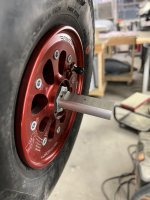
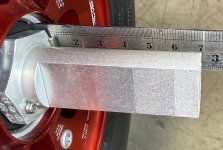
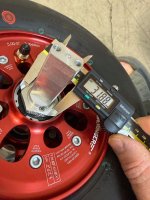
If you have tried to find a deep enough socket to tighten the axle nut on one of our planes, forget it; nobody makes one, until now. Plans for the 'RV Axle Nut Installation Tool' will soon be available. If my kit goes sideways, maybe I can hire out as a 'master' tool and die maker!

Axle Nut.jpg

Axle Nut Wrench.jpg
 
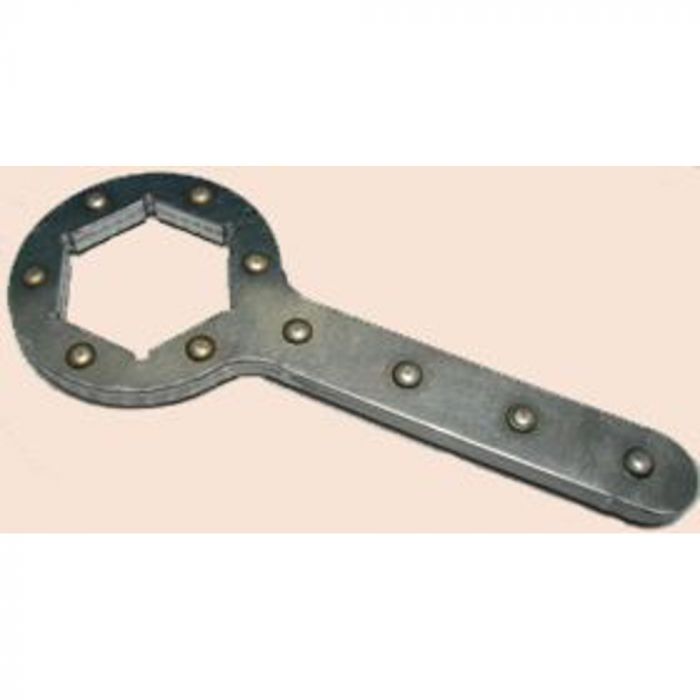
This is what I use. Its good on several of the homebuilder axles.

https://store.vansaircraft.com/vans-axle-wrench-kit-for-1-1-2-aluminum-nuts-tool-axle-wrench.html

tool_axle_wrench.jpg
 
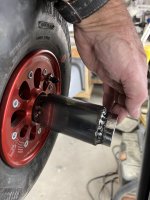
Socket

Here is what I used.

Sunex 240XD 1/2" Drive 1-1/4" Extra Deep Impact Socket

$22.99 on Amazon
 
Maybe I missing something, from the Beringer manual:

Torque axle nut to contact by hands, do not force. (WARNING)
 
Maybe I missing something, from the Beringer manual:

Torque axle nut to contact by hands, do not force. (WARNING)

That's what I was thinking. Don't know what is inside a berringer wheel, but I would NEVER tighten an axle nut with tapered roller bearings with anything but my fingers. I wouldn't thing that even a sealed bearing would be tightened, beyond snug, around the inner race in most circumstances with a removable wheel, but admittadly have limited experience with that outside of automotive, which are torqued, but a very different design.

Larry
 
Last edited:
That's what I was thinking. Don't know what is inside a berringer wheel, but I would NEVER tighten an axle nut with tapered roller bearings with anything but my fingers. Even a sealed bearing wouldn't be torqued in most circumstances.

Larry
The Beringer does use roller bearings, but I don't recall them having a center spacer to avoid side loading them like the nose wheel does.
 
I just spoke to Beringer tech. The axle nut is indeed supposed to be torqued to 220 in-lbs. The bearings are captured inside the hub by snap rings, so they don't know the nut is torqued. The torque is specified simply as a safety measure to assure there is enough 'snugness' to get the cotter pin inserted through the spindle and to provide a standard torque spec for all builders. Finger tight is fine as long as the cotter pin can be inserted.

Too bad, because I was hoping to recoup some of my build costs by selling ANUS (axle nut universal socket) wrenches. :D

Axle Nut Wrench.jpg
 
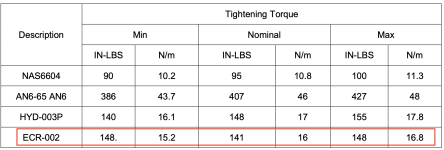
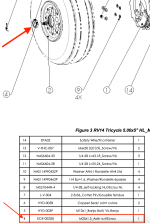
Resurrecting this thread because I'm seeing conflicting information on the proper torque specs for the Beringer axle nuts. It appears the original guidance was hand tight only. Then it went to 220in/lbs which was later confirmed by Beringer technical support. My "Beringer Installation and Maintenance Manual" (Ref document: BRG-MM-002.14(B)) says 141in/lbs (see below).

So has Beringer really changed their specs from hand tight to 220 to 141 in-lbs???? Seems very odd since as far as I can tell, the parts haven't changed.

Screenshot 2025-06-13 at 1.34.40 PM.png

Screenshot 2025-06-13 at 1.36.33 PM.png
 
I believe most users assumed since their is a cotter pin that hand tight and if the pin inserts good to go or at least that’s what I have been doing on the 14 for 5 years. The nut seems a little puny to torque that high? If you talk with Beringer can you post their response.

Also if they tell you the 407 in lbs is correct for the AN6, seems high?
 
Knipex #10 pliers wrench works nice if the nut needs a slight push beyond hand tight to line up with the cotter pin hole.
 
The nut seems a little puny to torque that high? If you talk with Beringer can you post their response.
I agree. The nut is very narrow. I sent an email to Beringer and I'll report back what their latest position is. Maybe we'll get a new official fourth torque value! We've had 0, 141 and 220. Maybe 70 or 180in-lbs?
 
I agree. The nut is very narrow. I sent an email to Beringer and I'll report back what their latest position is. Maybe we'll get a new official fourth torque value! We've had 0, 141 and 220. Maybe 70 or 180in-lbs?
Update from Beringer, apparently the RV-10 and RV-14 mains are slightly different. The 10 main axle nut should remain finger tight and insert cotter pin. The 14 main axle nut should be torqued. Now to what torque since it has on one page (4/29) 140ish and another page (11/29) 220 in lbs. France engineering will review and update the document. Taking a guess at the outcome reviewing (5/7) M-00-005 Maintenance Working Card it will be 25 Nm or 221 in-lbs.

They will also confirm the torque specs of the AN4 and AN6 nuts which seem high. Now need to find a deep socket to measure mine since I've been hand tightening for 6 years on the 14. :eek:
 
Last edited:
Thanks for the update. I never heard back from Beringer. I ended using the 141in-lbs but will re-do it at 220in-lbs if Beringer settles on that number.
 
Update from Beringer, apparently the RV-10 and RV-14 mains are slightly different. The 10 main axle nut should remain finger tight and insert cotter pin. The 14 main axle nut should be torqued. Now to what torque since it has on one page (4/29) 140ish and another page (11/29) 220 in lbs. France engineering will review and update the document. Taking a guess at the outcome reviewing (5/7) M-00-005 Maintenance Working Card it will be 25 Nm or 221 in-lbs.

They will also confirm the torque specs of the AN4 and AN6 nuts which seem high. Now need to find a deep socket to measure mine since I've been hand tightening for 6 years on the 14. :eek:

I have always torqued to 220 and it is only a fraction of a turn after lightly tightening it. All the documents that I have had and watched a video from Beringer said 220 which is the same for the caliper bolts.
 
I have always torqued to 220 and it is only a fraction of a turn after lightly tightening it. All the documents that I have had and watched a video from Beringer said 220 which is the same for the caliper bolts.
Did you find a 25 mm deep-deep socket, or did you go with 1 in. (25.4 mm) ?
 
Did you find a 25 mm deep-deep socket, or did you go with 1 in. (25.4 mm) ?
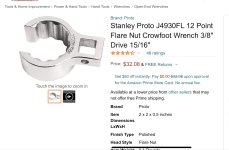
I bought this crowfoot from Amazon and it was not expensive but it looks like they don't have the exact one anymore. This works perfectly. I am not at that hanger to check but pretty positive that is not 1" as I have another one that is 1" and use it for the oil filter.


I bought this crowfoot from Amazon and it was not expensive but it looks like they don't have the exact one anymore. This works perfectly. I am not at that hanger to check but pretty positive that is not 1" as I have another one that is 1" and use it for the oil filter.


I checked my record and last time I paid $31 for this crowfoot. We can see how prices have changed since, this is part of the reason flying is not as affordable anymore.
 
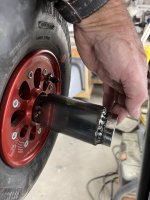
After finally torquing my Berringer wheels to the "new" correct published spec this is what I used:

Stanley Proto J7340HT 1/2" Drive Thin Wall Deep Impact Socket, 1-1/4", 6 Point​

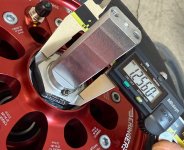
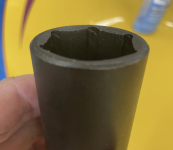
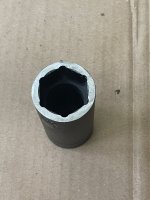
This for "OK" but the recess face did not allow a very tight grip, so I ground the edge down.

Screenshot 2025-06-27 152628.png

From this to:

IMG_7375.jpg

This allows a very tight fit and torque from a previous finger tight install and cotter pin insert. Note, this is for the RV-14 main wheels and not the RV-10 main wheel Beringer installation.
 
Back
Top