


Van's Air Force
You are using an out of date browser. It may not display this or other websites correctly.
You should upgrade or use an alternative browser.
You should upgrade or use an alternative browser.
Axle Cotter Pin Hole Location
- Thread starter mfleming
- Start date

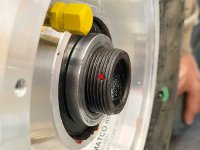
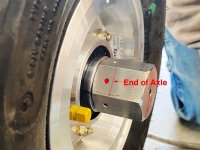
That looks fine. Only rotational force on cotter pin hole. Wall thickness of axle is 3/16 not counting threads.
Thanks...
On another note....that axle must be hard...bits dulled fast


Thanks...
On another note....that axle must be hard...bits dulled fast
Axle is hard... use cobalt drill bit with cutting fluid at low RPM. Some people use a small Dremel stone to grind a depression in the threads to help the drill bit start on target.

I've been meaning to ask - is this method common across small aircraft? Just seems very hokey, particularly when things get a little loose - do you drill another hole? Or are there very thin shims available?
You have multiple holes in the nut, and chose one that’s on the looser side.

You have multiple holes in the nut, and chose one that’s on the looser side.
I just ordered some thin shims from mcmaster-carr - hopefully that will be a good solution - I want the wheels to rotate freely but not have any play.
I just ordered some thin shims from mcmaster-carr - hopefully that will be a good solution - I want the wheels to rotate freely but not have any play.
Actually these Matco wheels are set differently than traditional wheels. Tighten the axle nut until the seal stops spinning, then insert the cotter pin. If one backs the nut out to align the hole and the seal spins, the wheel is too loose.

Face The Nut - On A Lathe
If you feel the need to get very precise, you can "face" the nut on an engine lathe, or vertical mill if you prefer.
Since you know the TPI is 16 - you know that each revolution = .063" advancement. With six "flats" on the nut, you also know that the advancement of each one = .0105".
So, as an example, if you estimate you need about a half a flat advancement for a proper fit, you need to face off .0105/2" = .0052". Any machinest, home schooled or otherwise should be able to do this with out problem.
I do this on all my "fit ups" to insure I get the fit I want instead of what the suppliers give me. Also, if needed, the depth of the nut itself can be cut down quite a bit, if doing so helps with the wheel pant install.
If you like the idea of using shims to "adjust" the fit for future wear, I would suggest the following:
Extremely thin shims (a few "thou") have the tendency to ball up in a wad when they are installed or are too fragile to remain intact during their service life. So, undercut the axle nut to allow a thicker shim to be installed initially, to give the desired fit. Then as conditions warrant, change the shim size (but still thick enough) as needed. From the Aviation Division of McMaster-Carr, for 1 1/4" diameter axles, their shim thickness from .031" on down are less than or equal to .005" - should be close enough.
YMMV - and probably will.
HFS
If you feel the need to get very precise, you can "face" the nut on an engine lathe, or vertical mill if you prefer.
Since you know the TPI is 16 - you know that each revolution = .063" advancement. With six "flats" on the nut, you also know that the advancement of each one = .0105".
So, as an example, if you estimate you need about a half a flat advancement for a proper fit, you need to face off .0105/2" = .0052". Any machinest, home schooled or otherwise should be able to do this with out problem.
I do this on all my "fit ups" to insure I get the fit I want instead of what the suppliers give me. Also, if needed, the depth of the nut itself can be cut down quite a bit, if doing so helps with the wheel pant install.
If you like the idea of using shims to "adjust" the fit for future wear, I would suggest the following:
Extremely thin shims (a few "thou") have the tendency to ball up in a wad when they are installed or are too fragile to remain intact during their service life. So, undercut the axle nut to allow a thicker shim to be installed initially, to give the desired fit. Then as conditions warrant, change the shim size (but still thick enough) as needed. From the Aviation Division of McMaster-Carr, for 1 1/4" diameter axles, their shim thickness from .031" on down are less than or equal to .005" - should be close enough.
YMMV - and probably will.
HFS
Attachments
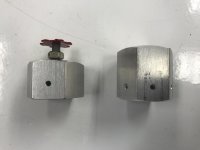

Good info. I can see adjustment as described by shaving a bit on nut face to get to fit tight, but loose, initially.If you feel the need to get very precise, you can "face" the nut on an engine lathe, or vertical mill if you prefer.
Since you know the TPI is 16 - you know that each revolution = .063" advancement. With six "flats" on the nut, you also know that the advancement of each one = .0105".
So, as an example, if you estimate you need about a half a flat advancement for a proper fit, you need to face off .0105/2" = .0052". Any machinest, home schooled or otherwise should be able to do this with out problem.
I do this on all my "fit ups" to insure I get the fit I want instead of what the suppliers give me. Also, if needed, the depth of the nut itself can be cut down quite a bit, if doing so helps with the wheel pant install.
If you like the idea of using shims to "adjust" the fit for future wear, I would suggest the following:
Extremely thin shims (a few "thou") have the tendency to ball up in a wad when they are installed or are too fragile to remain intact during their service life. So, undercut the axle nut to allow a thicker shim to be installed initially, to give the desired fit. Then as conditions warrant, change the shim size (but still thick enough) as needed. From the Aviation Division of McMaster-Carr, for 1 1/4" diameter axles, their shim thickness from .031" on down are less than or equal to .005" - should be close enough.
YMMV - and probably will.
HFS
I Don’t know where the wear would come from as only relative motion should be in the bearing. I have over 1000 hours on my RV and axel nut fit up to bearing is as it was when I first drilled the whole 18 years ago.
You have multiple holes in the nut, and chose one that’s on the looser side.
The nut does not work that way... Only the original hole on the nut that was used to drill the axle will line up.
FWIW - Using The Next Available Hole
The math for using the next available axle nut hole is as follows:
Each "flat" advancement moves the nut .0105" inboard. The absolute best hole diameter you could get using a #30 drill is .128" - the new nut that I have does in fact, mic @ .128".
Advancing the nut one flat changes the shape of the hole from circular to oblong - .128" transverse to the axle & .118 along the axle alignment. A standard 1/8" nominal diameter cotter pin for this purpose mics @ .109" x .120" - so, it will fit with a single advancement. Any more than that requires some "adjustment".
If the initial fit was good enough (no "slop"), you would pin it there. If an advancement is desired, it's going to be less than the .0105" noted above; and, therefore, the hole in the axle alignment direction will be greater than .118, making for an even more comfortable fit.
YMMV - but I bet not by much.
HFS
The math for using the next available axle nut hole is as follows:
Each "flat" advancement moves the nut .0105" inboard. The absolute best hole diameter you could get using a #30 drill is .128" - the new nut that I have does in fact, mic @ .128".
Advancing the nut one flat changes the shape of the hole from circular to oblong - .128" transverse to the axle & .118 along the axle alignment. A standard 1/8" nominal diameter cotter pin for this purpose mics @ .109" x .120" - so, it will fit with a single advancement. Any more than that requires some "adjustment".
If the initial fit was good enough (no "slop"), you would pin it there. If an advancement is desired, it's going to be less than the .0105" noted above; and, therefore, the hole in the axle alignment direction will be greater than .118, making for an even more comfortable fit.
YMMV - but I bet not by much.
HFS
Last edited:

Also note that if you move the hole inboard, it is infinitely harder to get a cotter pin in there since the wheel flange prevents a straight shot.
My A&P instructor shared a tip on getting the cotter pins to bend around into position. Make a bend in the cotter pin with the longer leg on the outside of the bend. This way when you insert the pin, the longer leg keeps pressing up against the shorter leg and you can guide the pin in easier to the hole. Otherwise the cotter pin legs will spread apart and you'll never get it through the hole.
My A&P instructor shared a tip on getting the cotter pins to bend around into position. Make a bend in the cotter pin with the longer leg on the outside of the bend. This way when you insert the pin, the longer leg keeps pressing up against the shorter leg and you can guide the pin in easier to the hole. Otherwise the cotter pin legs will spread apart and you'll never get it through the hole.
I treat my axle & nut alignment a bit differently. I want to have (or have available) finer adjustability of the bearing preload so instead of 60 degree, I drill the axle with a second hole to allow 30 degree increments. This comes notably relevant when it comes the day if I ever have to replace my bearings.
I also slot the cotter pin holes in the nuts to make them easier to install.
Sorry for the 'manual' graphics
I also slot the cotter pin holes in the nuts to make them easier to install.
Sorry for the 'manual' graphics
Attachments

I treat my axle & nut alignment a bit differently. I want to have (or have available) finer adjustability of the bearing preload so instead of 60 degree, I drill the axle with a second hole to allow 30 degree increments. This comes notably relevant when it comes the day if I ever have to replace my bearings.
I also slot the cotter pin holes in the nuts to make them easier to install.
Sorry for the 'manual' graphics
Good idea. Make the slot longitudinally instead of axially (is that a word?) will allow you to slide the pin in a little easier for a tighter fit. Nothing wrong with drilling a second hole in another hole in the nut if your fit is too loose. You have two shots at this with our 6 sided nuts as long as the new holes you drill are not too close to another one previously drilled hole.
Last edited:
I was just re-reading this old post from when I was originally installing my wheels.
Now I'm putting two new tires on and am dealing with the fact that the holes are so hard to line up with the nut and the right tension. This is stupid, they should be a slotted nuts like most other aircraft axels nuts...why did Matco do this???
Now I'm putting two new tires on and am dealing with the fact that the holes are so hard to line up with the nut and the right tension. This is stupid, they should be a slotted nuts like most other aircraft axels nuts...why did Matco do this???
I think Van's designed it like this so that the nut could be used to support the wheel pant via the bolt in the middle for the bracket.I was just re-reading this old post from when I was originally installing my wheels.
Now I'm putting two new tires on and am dealing with the fact that the holes are so hard to line up with the nut and the right tension. This is stupid, they should be a slotted nuts like most other aircraft axels nuts...why did Matco do this???
I get that the nut needs to support the wheel pants.I think Van's designed it like this so that the nut could be used to support the wheel pant via the bolt in the middle for the bracket.
If I had a mill, I’d try slotting the existing holes in the stock nuts
A round needle file could be used to elongate the existing holes along the axis and that should make it easier to get the pin in.I get that the nut needs to support the wheel pants.
If I had a mill, I’d try slotting the existing holes in the stock nuts
Edit: thinking about this some more - a standard castellated nut will fit the axle and is even mentioned in the construction manual somewhere (if not using wheel pants). Then a plug could be machined to fit inside the axle so as to support the wheel pant bracket.
Another aircraft that I fly has solid axles and the wheel pant simply bolts into a threaded hole in the end of the axle.
Last edited:
