
During an EAA Webinar back in January 2023, Rian Johnson said they will use LP4-3 blind rivets (raised head). The CS4-4 countersunk blind rivets are considered too weak, and during the Q&A session, they said they have much less fatigue life and they are “not even close”. They also said solid rivets would be an option, but they walked back from their previous consideration of using annealed solid aluminum rivets. I'd like to know more about how the countersunk pull rivets fall short in fatigue because other kit aircraft (Sling) use those.

Van's Air Force
You are using an out of date browser. It may not display this or other websites correctly.
You should upgrade or use an alternative browser.
You should upgrade or use an alternative browser.
Anyone planning on bucking rivets for the RV-15?
- Thread starter Gandor
- Start date

According to Zenith, there is a difference (at least with the domed pulled Avex rivets they used back in the day) - the pulled ones are NOT as strong. Their aircraft kits are apparently designed with that strength difference in mind (read: more rivets, basically).
I suspect quality control (or perhaps “accommodation of lower skill sets”) is another advantage with pulled rivets. Easier to do a serviceable job with pulled rivets.
Pulled rivets for skins tend to be 1/8 which are a bit stronger than 3/32 flush solid rivets Van is using.
I am using countersunk pop rivets ( Cherry BC style ) on my current project for all skins while using sold rivets for internal parts .If you don't want all of the universal head pop rivets, I suppose you could dimple and use countersunk 1/8" pop rivets, yeah? Granted, I have zero idea if they are as strong as the universal heads. For me, if I went with the RV15, I'd be gleefully pulling pop rivets and laughing to myself how quickly it all goes together!
Regardless of the time difference, the biggest advantage of pulled rivets, in my opinion, is that they enormously reduce the need for a trained helper to buck.I'm not planning to build a -15 but pull vs. bucked rivets seems one of those things that won't make a big time difference in the end. Perhaps a week or two overall, and that's if you build slow like me? Deburring, wiring, priming/paint prep, fiberglass (), p-clamps, and all the other fiddly bits seem to eat up more of the time. But then, way back when I'd started on a Sonex (before switching to an RV) I was planning to dimple and buck for drag reduction (which never hurts) and appearance.
Now if someone made self-locating auto-retrieving tools that I could just summon back to my hand by voice after setting them down 10 seconds ago and losing them, that would be a worthwhile investment
What's your estimate (rough guess) on how much extra $ that's gonna cost for the whole project?I am using countersunk pop rivets ( Cherry BC style ) on my current project for all skins while using sold rivets for internal parts .
Around $1000 for various dimpling tools and dies.What's your estimate (rough guess) on how much extra $ that's gonna cost for the whole project?


The biggest investment is the additional time required for dimpling ribs and skins.

Having maintained the Airtourer series of aircraft (the "concrete sparrow" as we called them) which were put together with pop-rivets, I have no doubt that if I get to build a RV-15 it would be with solid rivets. Besides pop rivets being a lot heavier perhaps the worst thing about them is they seem to work loose very quickly, especially in high movement areas, and they're a real pain to drill off. Most of the time they spin in place and just end up making the hole in the skin bigger. I'm not saying that solids don't work loose, just that pops will loosen faster.
Look at the aircraft that operate on floats and off unimproved surfaces and see how many smoking rivets you can find in high-stress areas. Then consider that the RV-15 is being touted as perfect for floats and strips. Put a plane assembled with pop-rivets on floats or operate it off unimproved strips and I feel certain you will end up wishing you'd used solid rivets.
Look at the aircraft that operate on floats and off unimproved surfaces and see how many smoking rivets you can find in high-stress areas. Then consider that the RV-15 is being touted as perfect for floats and strips. Put a plane assembled with pop-rivets on floats or operate it off unimproved strips and I feel certain you will end up wishing you'd used solid rivets.

Since we are on the topic of pushed vs pull rivets. . . . What are the sizes of the solid rivets in the RV15? Will a pneumatic tool to set 5 and above rivets be needed? In fact, is it possible a "primer war" arena will result over the best (powered) pull rivet tools? Some look pretty awkward.

Since we are on the topic of pushed vs pull rivets. . . . What are the sizes of the solid rivets in the RV15? Will a pneumatic tool to set 5 and above rivets be needed? In fact, is it possible a "primer war" arena will result over the best (powered) pull rivet tools? Some look pretty awkward.
I think we should expect pretty standard modern day Van's kit construction with no surprises on the hardware.
The blind rivets that in places where other RVs have solid rivets, are LP4-3. It is a 1/8 aluminum rivet with a steel mandrel that requires no special puller. You can go buy one at the hardware store that will work, but a pneumatic or battery puller will make things easier. There will probably be rivets in a handful of places that have tight spacing and are easier to pull with a wedge tool, a close clearance or otherwise modified manual puller. I had a swivel head Stanley puller that I ground the nose to get better clearance in a few tight spots.
There is no reason to think the solid rivets will be larger than 1/8 and will be easily handled by the standard squeezer options. Where there are #5 and above, they will be set by the factory.


N10KE
Well Known Member
Sure like to under how that will be possible - especially if there is no build sequence published (thinking wing skins for example) using solid rivets. And if the fuel tanks are all quick build, Van’s will have used pulled dome head rivets already, won’t they ?Having maintained the Airtourer series of aircraft (the "concrete sparrow" as we called them) which were put together with pop-rivets, I have no doubt that if I get to build a RV-15 it would be with solid rivets. Besides pop rivets being a lot heavier perhaps the worst thing about them is they seem to work loose very quickly, especially in high movement areas, and they're a real pain to drill off. Most of the time they spin in place and just end up making the hole in the skin bigger. I'm not saying that solids don't work loose, just that pops will loosen faster.
Look at the aircraft that operate on floats and off unimproved surfaces and see how many smoking rivets you can find in high-stress areas. Then consider that the RV-15 is being touted as perfect for floats and strips. Put a plane assembled with pop-rivets on floats or operate it off unimproved strips and I feel certain you will end up wishing you'd used solid rivets.
I would prefer solid rivets as well, but despite the previous promise of builders choice - I don’t think it’s going to be feasible to do.

A point of clarification one should consider when choosing to buck solid rivets. I had conversations with Rian and Brian (engineers at Vans) about bucking vs pulling rivets. The kit comes with pre punched holes, for 1/8” rivets! That means -4 rivets if you buck them. They buck just a tad bit differently than a -3 rivet. Can be done but be prepared for a little more effort that will be required.

Yes, it can be done. I did this on a Moni Motor-glider. 1/8" rivets do take a little more effort but not bad. Since I didn't have access to the bottom skin, I used the pulled rivets there. Of course on the Moni, the bottom of the wing sets about 1' off the ground so no one noticed.A point of clarification one should consider when choosing to buck solid rivets. I had conversations with Rian and Brian (engineers at Vans) about bucking vs pulling rivets. The kit comes with pre punched holes, for 1/8” rivets! That means -4 rivets if you buck them. They buck just a tad bit differently than a -3 rivet. Can be done but be prepared for a little more effort that will be required.
The Moni uses one piece wing skins, trailing edge to trailing edge (no seams).
Sure like to under how that will be possible - especially if there is no build sequence published (thinking wing skins for example) using solid rivets. And if the fuel tanks are all quick build, Van’s will have used pulled dome head rivets already, won’t they ?
I would prefer solid rivets as well, but despite the previous promise of builders choice - I don’t think it’s going to be feasible to do.
Honestly, don't be worried about this. Do you really need Vans to provide you with a build sequence in order to work out a way to solid rivet the skins??? The early model aircraft didn't even have pre-punched holes and yet probably 7,000 builders managed to drill their own skins and assemble their wings without pop-rivets or being hand-fed the methodology to do this. Messers Cessna and Piper didn't close out their 50,000 sets of wings with pop-rivets either and a significant number of those are manufactured with predominently 1/8" rivets. Setting 1/8" riverts is no more of a task than setting 3/32" rivets - you just use a 3x gun instead of a 2x gun. So more than just being possible, in my opinion its actually preferable. Worry about setting solids when you have to start trying to work with inch-long 5/32" rivets in oversized holes and you don't have a 4x gun.
As for time saving... if you use a helper to either work the dolly or have them install the next rivet for you most people would give a pop-riveter a real run for their money, if not beat them to the end. On a straight run you can easily set 10 - 15 or more rivets per minute.

Fast is relative. I have a 180 Pacer and it can cruise at 140 mph, which is "fast" for that airplane. If I can reduce the drag a bunch, I can go 140mph on a lot less gas. Drag is also climb rate indirectly, so cleaning up the plane does have it benefits in other performance parameters. You may not be able to get past the design speed but I would dimple the rivets to make it faster, look better and should be easier to keep clean and paint. Wraps would be easier as well. I can see the ease of installation being a driver. I wonder how much a pull rivet weighs compared to solid rivets? Any collective data on that?If you are looking to go fast, the -15 is the wrong choice.

Hope the voice-activated self-locating auto-retrieving designer includes car keys & cell phones in his design.I'm not planning to build a -15 but pull vs. bucked rivets seems one of those things that won't make a big time difference in the end. Perhaps a week or two overall, and that's if you build slow like me? Deburring, wiring, priming/paint prep, fiberglass (
Now if someone made self-locating auto-retrieving tools that I could just summon back to my hand by voice after setting them down 10 seconds ago and losing them, that would be a worthwhile investment
I don't have the data in front of me but I can assure you it is significant when you consider the number of rivets in an RV!I wonder how much a pull rivet weighs compared to solid rivets? Any collective data on that?
N10KE
Well Known Member
Not “worried” about it at all. Some components may not be buildable at all with solids (refer to Scott McDaniels post here). Last year, the announced plan was for either pulled or solid. No evidence this year that it is possible. If the prototype shop builds one with solids, then we will know it is doable. Comparing this to the early kits isn't really valid - those kits were designed for bucked, flush rivets. It does not appear that the 15 is being designed that way. I assume Van’s intends to produce the 15 so it’s being designed for easy manufacture by relatively unskilled labor.Honestly, don't be worried about this. Do you really need Vans to provide you with a build sequence in order to work out a way to solid rivet the skins??? The early model aircraft didn't even have pre-punched holes and yet probably 7,000 builders managed to drill their own skins and assemble their wings without pop-rivets or being hand-fed the methodology to do this. Messers Cessna and Piper didn't close out their 50,000 sets of wings with pop-rivets either and a significant number of those are manufactured with predominently 1/8" rivets. Setting 1/8" riverts is no more of a task than setting 3/32" rivets - you just use a 3x gun instead of a 2x gun. So more than just being possible, in my opinion its actually preferable. Worry about setting solids when you have to start trying to work with inch-long 5/32" rivets in oversized holes and you don't have a 4x gun.
As for time saving... if you use a helper to either work the dolly or have them install the next rivet for you most people would give a pop-riveter a real run for their money, if not beat them to the end. On a straight run you can easily set 10 - 15 or more rivets per minute.
Overheard at OSH (so take it for what it's worth) - 7 pounds and a couple of knots.I don't have the data in front of me but I can assure you it is significant when you consider the number of rivets in an RV!
Last edited:

If you’re worried about the way pulled rivets look go find a Sling Tsi with a QB fuselage - they fill every rivet and they actually look pretty nice. Yeah, filling is tedious, but a factory guy on a stool with a blob of polyester bondo (it’s what they use!) on a piece of wood and a popsicle stick can do a whole fuselage in a day - not a bad hit to an airplane project (do it while watching TV…..). If your concern is round-head rivets instead of flush, Van and Rian estimated that to be a couple of knots in cruise - that’s not going to change your flight planning. Weight? Well yeah. Five to ten pounds can be taken out of most pilots (including this one) for a better life all around….. I’ve got a week of road bike riding to do to get rid of the Spotted Cow impact on my body from last week…..

Only if approved in writing from Vans!Another consideration is whether Van's will certify the RV-15 as E-LSA under the new MOSAIC rules. Can a builder then decide to buck solid rivets and still register it as E-LSA?
Cost...
Pulled rivets are more expensive than bucked rivets.
However, the pulled rivets will come with the kits, included in the cost of the kits, and can not be deleted from the order.
If you go with bucked rivets you will need to buy them.
Sure you could probably try to sell your excess pull rivets, but not sure how many people will need them.
Anyone have a rough idea of the cost to buy the bucked rivets for the RV-15?
Chuck
Pulled rivets are more expensive than bucked rivets.
However, the pulled rivets will come with the kits, included in the cost of the kits, and can not be deleted from the order.
If you go with bucked rivets you will need to buy them.
Sure you could probably try to sell your excess pull rivets, but not sure how many people will need them.
Anyone have a rough idea of the cost to buy the bucked rivets for the RV-15?
Chuck
Cost...
Pulled rivets are more expensive than bucked rivets.
However, the pulled rivets will come with the kits, included in the cost of the kits, and can not be deleted from the order.
If you go with bucked rivets you will need to buy them.
Sure you could probably try to sell your excess pull rivets, but not sure how many people will need them.
Anyone have a rough idea of the cost to buy the bucked rivets for the RV-15?
Chuck
That cost should be negligible in the context of the aircraft. We don't know enough to really estimate but you are most likely talking about a few pounds of rivets at $30-$50 per pound depending on the lengths needed.

N10KE
Well Known Member
I still believe there will be many challenges using bucked rivets (426 or 470) on a structure that is being designed for blind rivets. It may not be possible to access some locations.
Additional cost of bucked rivets will be negligible. Flush CherryMax at $0.55 each will add a good bit of cost.
Additional cost of bucked rivets will be negligible. Flush CherryMax at $0.55 each will add a good bit of cost.

I wouldn’t have even considered the 15 if it did t have pull rivets. I’ve driven enough solid rivets and wanted something different. I also feel it will significantly decrease build time, along with all the other kit improvements and refinements.
Solid rivets on a 15 is a step backward in my opinion.
Solid rivets on a 15 is a step backward in my opinion.
I feel the same way for my build, but I always encourage the people that have something else in mind. We build in order to have exactly what we want, no compromise. I'll be glad to the results from whoever decides to go the solid flushed rivet route.I wouldn’t have even considered the 15 if it did t have pull rivets. I’ve driven enough solid rivets and wanted something different. I also feel it will significantly decrease build time, along with all the other kit improvements and refinements.
Solid rivets on a 15 is a step backward in my opinion.

I was thinking better efficiency perhaps, less throttle to fly the same speed with less drag, but the real-world difference is probably nominal anyway...If you are looking to go fast, the -15 is the wrong choice.

Pretty sure the difference would be negligible at the speeds the -15 will fly.I was thinking better efficiency perhaps, less throttle to fly the same speed with less drag, but the real-world difference is probably nominal anyway...
You also need to realize that with solid rivets, all of the skin rivets will be AN4 rivets, not like the AN3 size in all the other models…

Rian Johnson said during the "Homebuilt in Review" talk about the RV-15 that you can not use the CS4-4 flush pulled rivets. He said you can use AN426AD4 or Cherrymax rivets, but not the countersunk CS4 pulled rivets due to their lower strength.
Watch what Rian said in this video at the 50 minute mark. RV-15 @ Oshkosh Air Venture, July 24, 2025.
As Van was quoted as saying, "Do you want to build, or do you want to fly?"
I'm going to use the LP4-3 "low profile" domed rivets that come with the kit, the same as the RV-12iS I'm currently finishing up.
As I've said many times, "Stick to the Plans" and get 'er done!
Watch what Rian said in this video at the 50 minute mark. RV-15 @ Oshkosh Air Venture, July 24, 2025.
As Van was quoted as saying, "Do you want to build, or do you want to fly?"
I'm going to use the LP4-3 "low profile" domed rivets that come with the kit, the same as the RV-12iS I'm currently finishing up.
As I've said many times, "Stick to the Plans" and get 'er done!
Last edited:


Some merit to this even for drag. This old report shows that 70 percent of the drag from wing rivets comes from the front 30 percent of the chord.Planning to buck flush rivets on the leading edges only, mostly to make it easier to clean off the bugs.
N10KE
Well Known Member
Rian and Bryan seem to say that we will be able to use AN426/470 rivets (bucking access is designed in). Certainly hope that ends up being the case.Rian Johnson said during the "Homebuilt in Review" talk about the RV-15 that you can not use the CS4-4 flush pulled rivets. He said you can use AN426AD4 or Cherrymax rivets, but not the countersunk CS4 pulled rivets due to their lower strength. Watch what Rian said in this video at the 50 minute mark. RV-15 @ Oshkosh Air Venture, July 24, 2025
I don't think that is mutually exclusive. I've been flying for 50 years and 20,000+ hours. I enjoy the building process as much (and maybe more now) than the flying. Dimpling and bucking 426 rivets will add some time and complexity, but I believe the end result would be a better built, better looking airplane. Certainly easier to paint.As Van was quoted as saying, "Do you want to build, or do you want to fly?"
This implies that use of bucked, solid rivets are a deviation from the plans. Is that what you meant?I'm going to use the LP4-3 "low profile" domed rivets that come with the kit, the same as the RV-12iS I'm currently finishing up.
As I've said many times, "Stick to the Plans" and get 'er done!

Van was asked a question similar to this one at the Oshkosh 15 clinic & stated that the only area that would benefit from being flush rivets was on the wing leading edge.
N10KE
Well Known Member
Like Sling does with the Sling 4 TSi. From their website- “The Sling TSi features an all-new high speed wing design compared to the Sling 4: optimized for the power and weight of the aircraft. The leading edge of the wing is flush-riveted for low drag. The forward fuselage and empennage are also flush-riveted.”Planning to buck flush rivets on the leading edges only, mostly to make it easier to clean off the bugs.
This implies that use of bucked, solid rivets are a deviation from the plans. Is that what you meant?
Tongue in cheek, since the plans haven't been published yet.
Obviously, Van's has said you can use flush rivets if you choose to. My post was simply to provide proof that they also said you can't use CS4 flush pulled rivets.
Tanks will be built with solid bucked rivets, they told me on the plant tour last week.Sure like to under how that will be possible - especially if there is no build sequence published (thinking wing skins for example) using solid rivets. And if the fuel tanks are all quick build, Van’s will have used pulled dome head rivets already, won’t they ?
I would prefer solid rivets as well, but despite the previous promise of builders choice - I don’t think it’s going to be feasible to do.
Makes sense, fewer holes to plugTanks will be built with solid bucked rivets, they told me on the plant tour last week.
 .
.
Another often mentioned downside of pulled rivets is impact on paint. I just finished painting my RV12 in single stage paint. The impact is negligible. I even hand filled the mandrel holes with thickened epoxy (on the upper wing surface only). In the end, I think it was a waste of time ( worrying about looks of pulled rivets, and whether filled or not).
Attachments
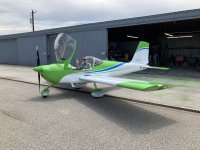

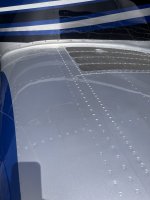
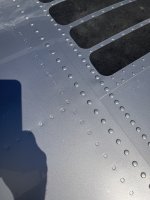
Pulled flush rivets ( filled ) example on Sling TSIAnother often mentioned downside of pulled rivets is impact on paint. I just finished painting my RV12 in single stage paint. The impact is negligible. I even hand filled the mandrel holes with thickened epoxy (on the upper wing surface only). In the end, I think it was a waste of time ( worrying about looks of pulled rivets, and whether filled or not).
Attachments

Muttley
Member
Those look pretty fantastic!Pulled flush rivets ( filled ) example on Sling TSI

Fffflats
Well Known Member
Golf ball divotsBetter to have the drag though, right?

This. It comes down to mission profile. Why go to the trouble of flush riveting the leading edge of a bush plane? Many of the owners of these type of aircraft add leading edge VG's. So why not have a little bit more energizing of the boundary layer by leaving the rivets as-designed protruding head? Burt Rutan was at OSH a couple of years after releasing the Vari-Eze plans and there was a lot of talk from builders about the canard loosing lift in rain. Burt finally asked one of the attendees if he would allow him to fix the problem on his bird. The guy said yes. So Burt took some 40 grit sandpaper out of his pouch and proceeded to sand the top surface of the fellow's canard in opposing 45 degree angles. The owner practically had a heart attack but how could he make scene with the almighty Rutan? Burt explained that builders were being too perfect in profiling their canards for esthetic purposes. The factory prototype was very crude and never had any issues in the rain. Many builders ended up sanding their canards or adding turbulator tape if they couldn't stomach the sand paper. Problem solved (mostly). While glossing over a multitude of aerodynamic details, compare that highly efficient fast design to that of a bush plane like an RV-15. Don't waste your time on flushing the leading edge if you think it's about top end speed.If you are looking to go fast, the -15 is the wrong choice.
Yep, mission profile.This. It comes down to mission profile. Why go to the trouble of flush riveting the leading edge of a bush plane? Many of the owners of these type of aircraft add leading edge VG's. So why not have a little bit more energizing of the boundary layer by leaving the rivets as-designed protruding head? Burt Rutan was at OSH a couple of years after releasing the Vari-Eze plans and there was a lot of talk from builders about the canard loosing lift in rain. Burt finally asked one of the attendees if he would allow him to fix the problem on his bird. The guy said yes. So Burt took some 40 grit sandpaper out of his pouch and proceeded to sand the top surface of the fellow's canard in opposing 45 degree angles. The owner practically had a heart attack but how could he make scene with the almighty Rutan? Burt explained that builders were being too perfect in profiling their canards for esthetic purposes. The factory prototype was very crude and never had any issues in the rain. Many builders ended up sanding their canards or adding turbulator tape if they couldn't stomach the sand paper. Problem solved (mostly). While glossing over a multitude of aerodynamic details, compare that highly efficient fast design to that of a bush plane like an RV-15. Don't waste your time on flushing the leading edge if you think it's about top end speed.
That doesn't mean you shouldn't flush rivet if you want to; every little bit of drag reduction helps. The point is, it will be a lot of extra work and the performance gain, if any, will likely be negligible...especially if you put the 26" tires on it!
N10KE
Well Known Member
Maybe some folks like the look of a flush riveted surface better? Easier to prep and paint plus arguably a stronger airframe using either flush CherryMax or AN426 rivets. Seven pounds of weight reduction isn’t a huge deal nor is the couple of knots of increased speed - but it’s not insignificant either.Yep, mission profile.
That doesn't mean you shouldn't flush rivet if you want to; every little bit of drag reduction helps. The point is, it will be a lot of extra work and the performance gain, if any, will likely be negligible...especially if you put the 26" tires on it!
Actually, it's a little over 2 pound difference. Figuring 15,000 rivets, solid rivets would be about 3.125 pounds and LP4-3 would be about 5.25 pounds. Probably less because the weight of the LP4-3 includes the part of the mandrel that you don't keep.Maybe some folks like the look of a flush riveted surface better? Easier to prep and paint plus arguably a stronger airframe using either flush CherryMax or AN426 rivets. Seven pounds of weight reduction isn’t a huge deal nor is the couple of knots of increased speed - but it’s not insignificant either.
Arguably stronger airframe? I'd like to see the data on that one. Obviously, If the airframe was designed around the LP4-3, it is arguably strong enough.
A couple of knots speed increase? I doubt it; at the projected operating speeds of the -15, more like a couple of tenths of a knot.
Easier to prep and paint? Possibly but it doesn't matter if you are having someone else paint it!

Like the looks better...well, as always, "beauty is in the the eye of the beholder". Can't argue with that statement.
As always, it's experimental aviation. I doubt that there will be two identical RV-15 built...and that's what makes it interesting.
N10KE
Well Known Member
I’m sure you are right Bob, but here is some data that shows dimpled, riveted joints are stronger than non-dimpled joints and the failure mode is deformation vs. catastrophic failure.Actually, it's a little over 2 pound difference. Figuring 15,000 rivets, solid rivets would be about 3.125 pounds and LP4-3 would be about 5.25 pounds. Probably less because the weight of the LP4-3 includes the part of the mandrel that you don't keep.
Arguably stronger airframe? I'd like to see the data on that one. Obviously, If the airframe was designed around the LP4-3, it is arguably strong enough.
A couple of knots speed increase? I doubt it; at the projected operating speeds of the -15, more like a couple of tenths of a knot.
Easier to prep and paint? Possibly but it doesn't matter if you are having someone else paint it!
Like the looks better...well, as always, "beauty is in the the eye of the beholder". Can't argue with that statement.
As always, it's experimental aviation. I doubt that there will be two identical RV-15 built...and that's what makes it interesting.
Out of curiosity, I looked up the weight of an LP4-3 rivet. It weighs .00127 lbs. 15k of rivets are right around 19lbs. You could then deduct the weight for stem. Don't know what that weighs. I'll weigh one tomorrow at the hangar and post here.
ACS lists the weight of an AN470-4-4 rivet at 1529/ib. Approximate. So 9.81 lbs for the solid rivets.
ACS lists the weight of an AN470-4-4 rivet at 1529/ib. Approximate. So 9.81 lbs for the solid rivets.
Last edited:
I think that applies only to round objects, which i believe are the highest drag of all shapes. Pretty sure that doesn’t apply to airfoil shapes.Golf ball divots
i suspect the discarded stem is 3/4 of the initial weight.Out of curiosity, I looked up the weight of an LP4-3 rivet. It weighs .00127 lbs. 15k of rivets are right around 19lbs. You could then deduct the weight for stem. Don't know what that weighs. I'll weigh one tomorrow at the hangar and post here.
ACS lists the weight of an AN470-4-4 rivet at 1529/ib. Approximate. So 9.81 lbs for the solid rivets.
Canadian_JOY
Well Known Member
Ah time to clean those glasses. There are VERY few pulled rivets on a Glastar or Sportsman. They are only in locations where a bucking bar can't reach.RV15! Where? I’d like to see that before I go to the hangar in the sky
As far as pop 2 solids go take a look at the Glastar, fancy streamlined glass or carbon fuz with big wings full of pops!Someone got confused me thinks
N10KE
Well Known Member
So how much weight will Evoke add when they fill all the holes in those LP4-3 rivets? And you know they will!Actually, it's a little over 2 pound difference. Figuring 15,000 rivets, solid rivets would be about 3.125 pounds and LP4-3 would be about 5.25 pounds. Probably less because the weight of the LP4-3 includes the part of the mandrel that you don't
And yes much easier to prep and if you ever repaint - a world easier.Easier to prep and paint? Possibly but it doesn't matter if you are having someone else paint it!
