The other day, I was using blind 1/8" rivets to repair a non-aeronautical thing (cat carrier). It's made of plastic that is soft enough that I wanted to add a washer on each side, so that the rivet would not pull through. Probably not the ideal way to do that repair, but I didn't have enough small bolts/screws with matching nuts and washers, or enough epoxy...
The 1/8" rivet would not fit through the .125" hole in the washer.
I vaguely recalled that these blind rivets (not just the ones in RVs but the similar ones in other kitplanes/LSAs, and also the cheap-o ones that do not belong in an airplane) are designed to an IFI standard, and some quick Googling took me to IFI-114.
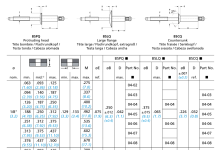
As you can see in the attached excerpt, the standard requires that size 4 (eighth-inch) break-mandrel (blind) rivets should have a body diameter between .122" and .128" and fit a hole between .129" and .133", specifically recommending a #30 hole.
I have enjoyed (and trusted) Budd Davisson's columns for many years (since the year I got my PPL and started to learn about airplanes that are more fun than a 172), and I vaguely remember hearing that he had started out as an engineer who worked on rivets (maybe he said that in a Green Dot podcast? Or am I imagining things?). In any case; I was very surprised to see him get something like this wrong!
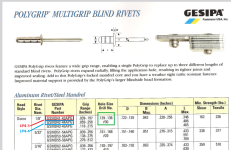
By the way, here's yet another small way in which we have it really good and might not even appreciate it. As you know, the "grip range" of a rivet is the range of allowable thicknesses in the stack-up being riveted, for which the rivet will have the required strength. (Thinner or thicker stack-ups may still work, but the strength will be reduced). As you can see in the IFI standard - and as is true in the vast majority of blind rivets that exist out in the world - a "...4-1" rivet should have a grip range from .020" to .062", a "...4-3" rivet should have a grip range from .126" to .187", a "...4-4" rivet should have a grip range from .188" to .250", etc. So, as with solid rivets, a slight increase in thickness might require changing the rivet to the next length up. However, if you look at the table in the
first reply: When it comes to the Gesipa rivets that we use (and there is maybe one other manufacturer that can pull this off... I had to research rivet suppliers once at work, as you might be able to tell...), the LP4-3 has a range from .039" to .197" (i.e. from the middle of the standard "...4-1" range to beyond the upper limit of the standard "...4-3" range), and the LP4-4 has a range from .059" to .256" (i.e. from near the upper end of the standard "...4-1" range to beyond the upper limit of the standard "...4-4" range). In other words, these rivets are exceptionally versatile, and each size can handle a far greater range of stack-up thicknesses than the industry standard requires as a minimum. Just the LP4-3 and LP4-4 cover a huge range of thicknesses (from .039" to .256") and their ranges overlap quite a bit (i.e. you can often use either one or the other), so you can use just those two rivets for almost everything in a light airplane (assuming they have enough strength) instead of having to go find a rivet of just the right length for each stack-up, the way you do with solid rivets and with other manufacturers' blind rivets. (And, along similar lines, the standard requires a size-4 blind rivet to fit in any hole with diameter from.129" to .133", but the Gesipa rivets are good for holes up to .136", another small advantage, not requiring the holes to be cut as precisely).