Van's Air Force

The definitive Van's Aircraft support community! Buying, building or flying an RV? Join our exclusive family of mentors and enthusiasts!

AntiSplatAero sump heater: One year report

@Jjackh10. Tried to send you a DM as to not continue the drift clutter here but the system wouldn't let me. I'll try again later or try one to me, if you care.
All good buddy. I don't know if I have much more useful to add but I'm happy to share whatever I've learned. I'll try dm'ing you to see if that works.

And to the OP I'm sorry for contributing to the thread drift. Carry on.
 
I found this pretty interesting.
It might explain some of the difference between cars and airplane engines, I also think I will get religious about adding camguard.

.
Project Farm
 
Instead of trying to reduce the power to the 110V unit to make it "less hot", another possibility here is to order the 220V unit, wire it for a NEMA 1-15P and plug it into the 110V mains.

Huh? Why? You CAN'T DO THAT!!! You'll electrocute yourself!! Burn the witch!!!

Bear with me -- Per the AS website, the wattage of the 110V unit is 250W. Applying Ohm's law for power (W = I*V), this suggests that the current flow (I) of the 110V unit is ~2.1A. More Ohm's law ( R = V / I ) puts the resistance of the 110V unit at ~57 Ohms.

In order to generate the same heat from the 220V unit at 240Vac RMS, the 220V unit internal resistance would need be to ~114 Ohms (Else the 220V unit would put out 500W...which it DOESN'T do.)

So, if you were to apply 110V to a 220V unit ( I = V / R, W = I * V ), the resulting power would be ~125W. Should be plenty warm enough and NOT risk coking the oil.


Just a thought -- I bought a 220V unit to measure and try out.

---

Edit: I made a mistake in the explanation above -- in order to achieve the same output power (250 W) with the voltage doubling (110/120V -> 220/240V), the resistance would need to be 4x ==> 57 0hms -=> 230.4 Ohms

Now, assuming that the 220V unit has an internal resistance of 230.4 Ohms, applying 120Vrms to it, should yield 62.5W...
 
Last edited:
Instead of trying to reduce the power to the 110V unit to make it "less hot", another possibility here is to order the 220V unit, wire it for a NEMA 1-15P and plug it into the 110V mains.

Huh? Why? You CAN'T DO THAT!!! You'll electrocute yourself!! Burn the witch!!!

Bear with me -- Per the AS website, the wattage of the 110V unit is 250W. Applying Ohm's law for power (W = I*V), this suggests that the current flow (I) of the 110V unit is ~2.1A. More Ohm's law ( R = V / I ) puts the resistance of the 110V unit at ~57 Ohms.

In order to generate the same heat from the 220V unit at 240Vac RMS, the 220V unit internal resistance would need be to ~114 Ohms (Else the 220V unit would put out 500W...which it DOESN'T do.)

So, if you were to apply 110V to a 220V unit ( I = V / R, W = I * V ), the resulting power would be ~125W. Should be plenty warm enough and NOT risk coking the oil.


Just a thought -- I bought a 220V unit to measure and try out.
Or, will it just draw 4.2A?
 
So, if you were to apply 110V to a 220V unit ( I = V / R, W = I * V ), the resulting power would be ~125W. Should be plenty warm enough and NOT risk coking the oil.
Good idea to try running a 220v heater in a "de-rated" mode. just a small correction. Power = V² / R so dropping the voltage by half (220 to 110) would reduce "watts" by a factor of 4 (in practice a little less than 4 since the resistance of the heating element is going to be lower at lower temps)
 
Despite my pledge to experiment with a one year heating cycle, I have been less than pleased this winter with the reduced power settings. So, going forward, I am going to use my ducted hot air at home, and leave the ASA heater as an option (at full power) away from home.
 
Good idea to try running a 220v heater in a "de-rated" mode. just a small correction. Power = V² / R so dropping the voltage by half (220 to 110) would reduce "watts" by a factor of 4 (in practice a little less than 4 since the resistance of the heating element is going to be lower at lower temps)
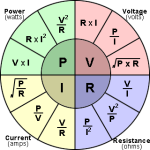
Not a correction, but an expansion -- Ohm's law is pretty cool

Power (W) = V^2 / R, = R * I^2, = V*I

IMG_5961.png
 
I obtained a Twin Hornet 22. I have used it this winter where here in VA we have had some REALLY cold (for us!) single digit mornings.
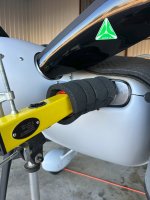
I made a little cowling inlet plate and use an old tripod to put it on with 3 Harbor Freight moving blankets for the top cowl. This little
critter really does a fantastic job. The power draw is small and I leave it on overnight and it heats up the engine very well!!! I check the oil
during preflight and it is warm to the touch....the heater unit claims to heat to 75-80 degrees which is ample for preheat and heats from the
top of the engine down.
I have used sump and dipstick heaters in years past but with the availability of multi-viscosity aviation oil the issue of turning
engine molasses into engine oil isn't an issue as in the "old days".

I also agree with the premise that what preheating is supposed to do is get the steel/aluminum parts heated in order to loosen
tolerances due to their different expansion/contracting characteristics. I agree that using a single viscosity oil may really require
heating to get it flowing better. The problem is when the heating is "coking" the oil and even heating the oil where it releases
the water vapor trapped within it to go sit on the parts above and potentially facilitate corrosion.

I know that preheating opinions probably rival primer opinions......but that is my humble opinion on the matter.

Engine Preheater.jpeg
 
A couple of posters on here talked about accidentally leaving their heaters on for long periods. If you use a "smart switch" many of those allow for an auto off settting. I have mine set to automatically turn off at 6pm every day just in case I ever happen to accidentally leave it on.
 
Yes, all of the mentioned workarounds make the glass half full or half empty. it's just much easier to use a different glass :D
 
Yes, all of the mentioned workarounds make the glass half full or half empty. it's just much easier to use a different glass :D
Agree, I do use a different glass (Reiff). but I still have the smart switch on my sump heater set to turn off every day so i can't forget it.
 
- Lycoming Service Instruction 1505. First note on page 1. “The use of a heated dipstick is not approved...”
Yeah, i am sure they figured out what alan didn’t - placing heating elements directly in the oil results in burning/ cooking said oil. Pan heaters are a totally different animal. The heat dissipates via the pan metal and avoids overheating at the contact point.
 
I found this pretty interesting.
It might explain some of the difference between cars and airplane engines, I also think I will get religious about adding camguard.

.
Project Farm
I'm curious about the economics, if CamGuard had desirable properties the oil lacked, why wouldn't the oil companies just make it part of their formulation?
 
I'm curious about the economics, if CamGuard had desirable properties the oil lacked, why wouldn't the oil companies just make it part of their formulation?
$$$$$$ Google "Edward Kollin" or "Edward Kollin & Camguard". Most anyone can learn something from his interviews. His new formulation for aviation oil ( ??at Exxon??) would have led to the most expensive product in an open market; a recipe for product failure. The product went to market as an additive instead.

Since the product has gained a following, it may well become an oil product; kinda like Aeroshell -> Aeroshell plus evolved.
 
Agree, I do use a different glass (Reiff). but I still have the smart switch on my sump heater set to turn off every day so i can't forget it.
I could see that the AntiSplat heater could be useful in some light-duty pre-heating applications. If we're talking serious pre-heating needs, whole-engine heating with Reiff sump heater and cylinder bands is still going to lead the pack.

And yeah...a remote switch. I wouldn't be afraid to leave my Rieff on all the time, but I see it as unnecessary.
 
I could see that the AntiSplat heater could be useful in some light-duty pre-heating applications. If we're talking serious pre-heating needs, whole-engine heating with Reiff sump heater and cylinder bands is still going to lead the pack.

And yeah...a remote switch. I wouldn't be afraid to leave my Rieff on all the time, but I see it as unnecessary.
I am not sure cyl bands are a better answer. The bands will super heat the cyl in one area, just as the discussed heater above super heats the oil in direct contact and burns it. I believe this will super heat the oil clinging to the wall in that area and greatly reduce the viscosity (encouaging it to run off) or simply burn it off. I have heard from folks that have pulled cylinders with these bands and find a band of corossion pitting on the cyl wall that exactly matches the heater band size and position. Not definitively saying they are bad, just words of caution. This would be a great question for the shops that overhaul cylinders every day. I am sure they have seen it all.
 
Last edited:
$$$$$$ Google "Edward Kollin" or "Edward Kollin & Camguard". Most anyone can learn something from his interviews. His new formulation for aviation oil ( ??at Exxon??) would have led to the most expensive product in an open market; a recipe for product failure. The product went to market as an additive instead.

Since the product has gained a following, it may well become an oil product; kinda like Aeroshell -> Aeroshell plus evolved.
Is there actual quantitative and unbiased evidence for its efficacy?
 
new formulation for aviation oil ( ??at Exxon??) would have led to the most expensive product in an open market; a recipe for product failure.
phillips xc with camguard appears to cost about the same as the aeroshell Plus with the additives included. if cost isn’t a factor how do we pick the right product?
 
In order to generate the same heat from the 220V unit at 240Vac RMS, the 220V unit internal resistance would need be to ~114 Ohms (Else the 220V unit would put out 500W...which it DOESN'T do.)

So, if you were to apply 110V to a 220V unit ( I = V / R, W = I * V ), the resulting power would be ~125W. Should be plenty warm enough and NOT risk coking the oil.
Given the fact that P = V^2/R (11-12 o'clock in the Ohms Law figure), in order to maintain P at a given level when you double V, wouldn't you have to multiply R by 2^2=4?
S'pose Vrms = 110V, R = 48.4 Ohms, 110^2/48.4 = 250. Now let Vrms = 220V, P = 250W, what does R need to be? R = V^2/P (4-5 o'clock in the Ohms Law figure), thus R = 193.6 Ohms.

By the same sort of logic, if you apply 110Vrms to a 220V unit that is designed for 250W, wouldn't you expect to see it put out 62.5W?
 
By the same sort of logic, if you apply 110Vrms to a 220V unit that is designed for 250W, wouldn't you expect to see it put out 62.5W?

Thank you @ve0kog and @CF86301 for showing me the mistake. I corrected it.

So -- I received the 220V unit yesterday and the element+wires measured 209.4Ohms. My house mains measure 125Vrms, so the amps drawn are ~.6A and the Watts are ~75. (If my house mains were 120, then the amps would be 573mA and watts would be ~69.)

Net - Net; the 220V can run at 110V and will produce 1/4th the power -=> heat.

Is that going to coke the oil? how long will it take to bring the oil&engine up to a reasonable (72°F) temperature? Time will tell...
 
Is that going to coke the oil? how long will it take to bring the oil&engine up to a reasonable (72°F) temperature? Time will tell...
We discussed this a bit offline with @CF86301 and with the Grok.

I can get about 20F temperature rise from 150W desktop heater blowing warm air for ~8 hours. Insulating from heat losses will drive the max possible temp raise. When the loss equals input power the temperature will reach equilibrium and stop raising. It seems like 69 Watts is not much.. but if the cowling is completely wrapped around with a couple of sleeping bags that heater may be somewhat usable. It might be cool enough to save the oil but this is hard to model :)
 
I asked the question when this product was announced with a scorching 650 watt draw. That was later changed I think.

Don’t recall ever getting an answer about watt density but figured the product may prove itself in field validation.

If anyone can measure/approximate the heated surface area of the product, it would be helpful. The safe watt density of most motor oils is 20/in^2 IIRC. Below that, it should!’t coke the element.

Anybody got #s?
 
The coking of the oil may be a result of the 250W heat input and the fact that motor oil conducts heat about 1/4 to 1/6 as well as water, which I learned from offline Q&A sessions with three AIs: ChatGPT, Claude.AI, and Bing Copilot.

This AntiSplat Aero web page on the No Hassle Engine Pre-Heater gives the dimensions as "2.75”X .875” with ½” NPT". If 2.75 is the overall length, the heating element itself appears to be less than 2" long. A 1/2" NPT plug has a major diameter of 0.84" and 14 threads/inch. The heating element appears to have a slightly smaller diameter than the plug. If the heating element has a diameter of 0.75" and a length of 2", the surface area of the cylinder that outlines the heating element coil, not counting the ends, would be 2*pi*r*h = 4.712 in^2. So the watt density would be 250W/4.712 in^2 = 53W/in^2. That's > 20W/in^2 (see post #127.) And note that the heating element is a coil, so its actual surface area is significantly smaller than the cylinder that outlines it.

That's only an approximation based on photos of the heater on the ASA web page and the dimensions they give on that page.
 
I asked the question when this product was announced with a scorching 650 watt draw. That was later changed I think.

Don’t recall ever getting an answer about watt density but figured the product may prove itself in field validation.

If anyone can measure/approximate the heated surface area of the product, it would be helpful. The safe watt density of most motor oils is 20/in^2 IIRC. Below that, it should!’t coke the element.

Anybody got #s?
The portion of the element in the oil measures 1.57" x .6925". Ignoring the inner/outer steps/fins, gives you 4..17in.sq.
 
The portion of the element in the oil measures 1.57" x .6925". Ignoring the inner/outer steps/fins, gives you 4..17in.sq.
Thanks for the measurement. So 250W/4.17 in^2 is about 60W/in^2, or 3x the "safe" figure mentioned in post #127. But 110V into a 220V heater would provide a "safe" watt density. Depending on how well insulated the engine is, and the ambient temperature, that may or may not provide adequate pre-heating... eventually.

However, for a cylinder diameter of 0.6925" and a height (length) of 1.57", I get an area of 2*pi*0.6925"/2*1.57" = 3.416 in^2 (assuming no end caps). If the mains voltage is 125Vrms (which it often is here at my house) and the heating element resistance is 209.4 Ohms (post #125), the heat output is 125^2/209.4 =~74.6W and the power density is =~21.8W/in^2, which is more than the "safe" limit.

Regarding the "safe" limit, the Grok AI says a safe power density limit for an oil immersion heater for non-circulating oil is 10W/in^2, or 15W/in^2 for circulating motor oil. Other websites give limits of 15-25W/in^2. So I think Freemasm's number in post #127 is in the right ballpark.
 
Last edited:
The only surface area that matters for this discussion is component area that is wetted by oil. The finned area counts as/contributes to the heat xfer surface.

It’s tough to say for sure as a lot of assumptions had to be made. 20W/in^2 might have some (coking) margin in it. It’s the plethora of additives that I’ve got no clue about that is another set of unknowns. My personal design experience is with (very) large industrial gas turbine’s bearing lube systems and hydraulic systems.

The coking in itself may not contribute to an engine issue. Once the component cokes, the heat xfer goes to crap. If the element can’t shed its heat, it’s life diminishes quickly.

Some hangar testing would be interesting. Anybody got an old sump?

Would also be a fun project/product to make an electrical reg for this.

Edit = ASA makes some quality products. Hopefully he can share some testing/validation with us.
 
the heater is not simply suspended in oil but attached to the case a 1000 times more conducive than oil. it delivers most of the energy to the case. my guess is the fins exposed to oil whether covered with crud or clean would have almost the same surface temp as the outside section of the heater hanging in the air.
 
In the name of science :)

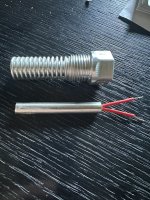
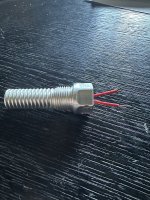
IMG_7003.jpgIMG_7004.jpg

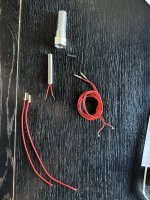
The unit I received was loose & rattling -- not enough heatsink grease/potting compound was used. I am going to rebuild it, switching the wires from 20ga to 18ga and eliminating the first junction/splice.

IMG_6999.jpg
 
I misinterpreted the photo on ASA. Brian's photos and measurements (DM) are very helpful. Here's an updated area analysis:

There are 13 fins. The inner radius Brian measured is 0.473", the outer diameter was measured at 0.6925" (I'll call it 0.693"). The fins are about 0.062" thick and have about a 0.031" radius at the top and bottom (I think). I modeled the heat sink as a stack of 13 larger washers with 13 smaller washers 0.473" in diameter between the head and the first fin from the head and between every pair of fins thereafter. I "flattened" the fins by adjusting for the curvature of the peaks and troughs, and came up with an effective outer diameter for the larger washer representing the fin of 0.729". I then applied the formula for the surface area of an annulus, pi * (R^2 - r^2), where R is half the outer diameter, i.e. 0.3645", and r is half the inner diameter, or 0.2365". That resulted in the area of one side of one fin. Then I multiplied by 26, and added the area of the end cap. I came up with a surface area for the heat sink part of the heater of about 6.7 in^2. I didn't take into account any part of the NPT threads that might be inside the sump.

250W/6.7 in^2 gives a power density of about 37.3W/in^2. 62.5W/6.7 in^2 gives a power density of about 9.33 W/in^2, which should be OK.

And that's assuming all of the heat is dumped into the oil. I don't have any info on how thick the fitting in the sump is. Perhaps someone who can obtain that info would like to take on trying to calculate the heat transfer into the case of the sump.
 
Last edited:
I don't have any info on how thick the fitting in the sump is. Perhaps someone who can obtain that info would like to take on trying to calculate the heat transfer into the case of the sump.
im coming up with something between 70% to 90% of heat is transferred to the case first and the rest is used to gradually damage the oil and vaporize the additives. 😝
 
the heater is not simply suspended in oil but attached to the case a 1000 times more conducive than oil. it delivers most of the energy to the case. my guess is the fins exposed to oil whether covered with crud or clean would have almost the same surface temp as the outside section of the heater hanging in the air.
Most? Debatable and probably not probable or even provable with math alone. There are equations for heat xfer at metal junctions but not too reliable and you’ll see a discontinuity of the heat flux ( vs distance or time) at best for these junctions. I’d argue that this energy flow path is undesirable since the the sump can then xfer heat to the air vs the oil.

Anyway, when sizing similar heating elements it’s very common to only consider the primary contact surface area; in this case, oil/element. The related conduction is attempted to be minimized. For what it’s worth.
 
If someone wants to buy one, I won't be installing mine. Still in the bag.
1/2 price plus shipping? $65 + shipping
 
I asked the question when this product was announced with a scorching 650 watt draw. That was later changed I think.

Don’t recall ever getting an answer about watt density but figured the product may prove itself in field validation.

If anyone can measure/approximate the heated surface area of the product, it would be helpful. The safe watt density of most motor oils is 20/in^2 IIRC. Below that, it should!’t coke the element.

Anybody got #s
I installed one for a buddy who ignored my warnings of it cookig the oil. Heating area is 2” long and 5/8” diameter. I believe the heating element is 2”@3/8” diameter core . The heating area is only the outside skin, so 3.5”circumference. That makes 7 sq in of heating area. Unit is 250 watts, so about 35 watts/sq in
 
Last edited:
the heater is not simply suspended in oil but attached to the case a 1000 times more conducive than oil. it delivers most of the energy to the case. my guess is the fins exposed to oil whether covered with crud or clean would have almost the same surface temp as the outside section of the heater hanging in the air.
Your conclusion here is pretty much proven wrong in the first post. It is obvious that significant heat is being transferred directly to the oil ,as designed. The excessive heat is turning the oil to coke, which really ramps up around 300C. Clearly all the heat is NOT going to the case.
 
The excessive heat is turning the oil to coke, which really ramps up around 300C. Clearly all the heat is NOT going to the case.

oil flashpoint is around 240C per my last blackstone report. at 300 we are going to see the magic smoke escape or worse. i really think we beat this horse to death… i plan to remove my heater at the next oil change and can donate it to any scientist for further analysis
 
one of those little single cup coffee warmers pulls 25 watts and has about 7 sq inches of surface. i have put an infrared thermometer on it and its about 210-220 deg f.
 
I finally returned from warmer climes to cold weather (but no snow, boo). To address some comments, I am trying this same heater again because:
  1. I had the replacement heater in hand prior to discovering the coking.
  2. Oil analysis, including the most recent one I received yesterday, show no issues.
  3. Experimental, so let's experiment.
One detail I neglected to mention is that I use Phillips XC 20w50 with Camguard.

I did another heating cycle today, 5.5 hours at 1.45 amps, so about 175 watts. Ambient temperature started at 17F, ended at 41F, so let's say 29F average.

View attachment 78857

Sump case at heater 85F
Sump case corner opposite heater 52F
Oil temp top of oil in sump 65F
Oil temp bottom of dipstick 60F

All of the above were taken with a thermocouple. I did do some temperature probing around the plug hole where the heater is installed with the IR temperature reader, and did find spots that read up to 145F. Still not the heating I would like at the cylinders.

I think I will do one more heating cycle at approximately 200 watts. Given the localized elevated temperatures I saw using the IR reader, I am not sure I want to go much above that power setting. Then I will close things back up and heat as I normally would for a full winter cycle at a to-be-determined reduced wattage to see if the buildups come back.

Catmandu,
I applaud your scientific approach to engine heating.
I own the same oil temperature heater, yet did not install it.
The wear on the lycoming engines below 42 degrees F is not from cold oil, it is from cold piston/cylinder contact.
I thought that having warm oil does not change that, so circulating warm oil did little to positively reduce wear.

Your thoughts?

Daddyman58
 
Catmandu,
I applaud your scientific approach to engine heating.
I own the same oil temperature heater, yet did not install it.
The wear on the lycoming engines below 42 degrees F is not from cold oil, it is from cold piston/cylinder contact.
I thought that having warm oil does not change that, so circulating warm oil did little to positively reduce wear.

Your thoughts?

Daddyman58
I'll bet you that there are a bunch of us who use the heater with no problems. Lets call them the silent majority. I don't live in Canada or anywhere like that. I am just trying to heat the oil up a bit from the freezing temp in my hangar. I don't leave it connected any more than an hour or an hour and a half. I plug in the heater to my extension cord then plug it into the wall. Removal of power is just the opposite. Not happy about the two wire plug but trying to mitigate the risk by not powering the unit until I am not touching the airplane. I would not recommend leaving it plugged in unattended, especially for extended periods of time. There was a video on ASAs website that showed the unit in a oil pan and the oil didn't get outrageously hot. Cant seem to find it now. As near as I can tell from this discussion, one person had trouble with oil coking after leaving it plugged in for a couple of days. Seems like a pretty small data point to condemn the unit out of hand. I have had zero evidence of oil failure or overheating backed up by Blackstone oil monitoring. IMO it is a good affordable unit when used in a reasonable manner. It is not pilot proof so don't try to make it do something it wasn't designed to do. You get what you pay for.
BTW if all of you who after reading these posts decide to throw away your heater, I will properly dispose of yours if you mail them to my house.
Harvey
 
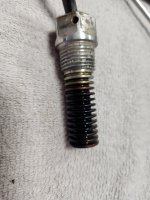
Today I began my annual, and immediately pulled the ASA heater to inspect. Some discoloration, but zero coke on the heater or in the oil screen. I generally run mine for 1-6 hours, depending on requirements. I installed it over a year ago, and probably 150 engine hours, with maybe 30 hours of heater operation.
Just another data point.
1000005955.jpg
 
Back
Top