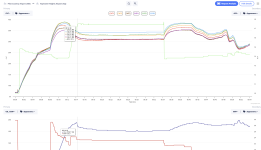
I recently spoke directly with Al at AntiSplat and he mentioned that significant testing was done in Brazil with the EZ Cool cowl flaps on RV-10s with IO-540 engines. The results apparently showed that side placement at 3 and 9 o’clock outperforms bottom placement on the RV-10 specifically, and that a 4-flap configuration — sides plus two on the upper cowl just forward of the firewall — produced the best overall results for the IO-540 heat load.
I’m building a custom fiberglass cowl on my RV-10 with a Barrett IO-540-D4A5 at 300 HP, 9:1 compression, cold air induction. I have a hard fiberglass plenum top, twin tunnel exit geometry, and I’m instrumenting with piccolo tubes for the first flight program.
I’m looking to size my fixed cruise exit area correctly and determine whether to provision for 2 or 4 flap locations before the cowl is finalized.
A few specific questions for anyone who has done this testing or spoken with Al about it:
1. What inlet and exit areas were the test aircraft running when the 4-flap configuration was evaluated?
2. What was the measured CHT improvement with 4 flaps versus 2 on the IO-540?
3. Did the top flap placement — just forward of the firewall — open inward into the plenum or outward through the upper cowl surface?
4. Was the fixed exit area reduced as part of the test program, or were the flaps added to a stock exit?
5. Any data on cruise speed penalty with all 4 flaps open versus closed?
I understand this may be proprietary to Al’s testing program, but if anyone has firsthand knowledge or has had a similar conversation with him I’d appreciate hearing what you know. I’m not looking to reinvent the wheel — just trying to make informed decisions before fiberglass sets.
Thanks
I’m building a custom fiberglass cowl on my RV-10 with a Barrett IO-540-D4A5 at 300 HP, 9:1 compression, cold air induction. I have a hard fiberglass plenum top, twin tunnel exit geometry, and I’m instrumenting with piccolo tubes for the first flight program.
I’m looking to size my fixed cruise exit area correctly and determine whether to provision for 2 or 4 flap locations before the cowl is finalized.
A few specific questions for anyone who has done this testing or spoken with Al about it:
1. What inlet and exit areas were the test aircraft running when the 4-flap configuration was evaluated?
2. What was the measured CHT improvement with 4 flaps versus 2 on the IO-540?
3. Did the top flap placement — just forward of the firewall — open inward into the plenum or outward through the upper cowl surface?
4. Was the fixed exit area reduced as part of the test program, or were the flaps added to a stock exit?
5. Any data on cruise speed penalty with all 4 flaps open versus closed?
I understand this may be proprietary to Al’s testing program, but if anyone has firsthand knowledge or has had a similar conversation with him I’d appreciate hearing what you know. I’m not looking to reinvent the wheel — just trying to make informed decisions before fiberglass sets.
Thanks