Van's Air Force

The definitive Van's Aircraft support community! Buying, building or flying an RV? Join our exclusive family of mentors and enthusiasts!

Air Temp Probe Location

Freemasm

Well Known Member
Patron
Thumb typing m, pardon the brevity.

Where did you locate your air temp probe? Heeding the install manual regarding engine/exhaust heat avoidance, would like to put it at the access panel in either wing for access/install/inspection purposes. The GTP only come with 10 ft of lead. Obviously a home run to the ADAHR would be desirable to help keep the signal error down.

What location and/or what compromises were done? Did you get acceptable readings? Thx.
 
On my Rocket I put it in the right wing inspection cover. Simple install and works great.
My -4 has it on the port side of the fuselage under the horizontal stab. Works great but likely not feasible for you given the length of your lead. More work, too!
 
I put mine under the H stab about 6" below on the fuselage and the same back of the LE on both my 7 and 8. This keeps it out of the sun and in the airstream as required by Dynon. The 7 was Dynon Skyview and the 8 AFS 6600. Both are accurate. Some put them on or around an inspection cover on the bottom of the wing. I think either location works fine. I chose my location since the ADHRS box is in the fuse behind the baggage area so it was the most convenient spot.
 
Thumb typing m, pardon the brevity.

Where did you locate your air temp probe? Heeding the install manual regarding engine/exhaust heat avoidance, would like to put it at the access panel in either wing for access/install/inspection purposes. The GTP only come with 10 ft of lead. Obviously a home run to the ADAHR would be desirable to help keep the signal error down.

What location and/or what compromises were done? Did you get acceptable readings? Thx.
I put my Dynon temp probe in front of the (stock) pitot tube on my RV-4, thinking it might reduce drag ever so slightly.
 
I use two ADHARS modules, so run a single four #22 conductor cable to the probes (easy to run one cable instead of four skinny wires). The probes are mounted just inboard of the first inspection panel, easy to reach in to touch and does not mess up taking the panel off. The added length of wire does nothing to the probe accuracy.

Compared to the two different locations I tried in the tail, and one in the forward NACA inlet, the wing mount is far more accurate.

Carl
 
@Freemasm No signal error -- it's an RTD device - If you don't think 10ft is enough, add more wire.

Inboard Access panel or adjacent to it is a great place -- no heat from sunlight (like the NACA duct location), or possible free stream heating from exhaust under the H-Stab.
 
My Dynon OAT probe is in the bottom of the wing/fuselage intersection fairing on the right side a few inches back from the leading edge. Works fine.
 
@Freemasm No signal error -- it's an RTD device - If you don't think 10ft is enough, add more wire.

Inboard Access panel or adjacent to it is a great place -- no heat from sunlight (like the NACA duct location), or possible free stream heating from exhaust under the H-Stab.
Figured it wouldn’t be as sensitive as a TC but a change in resistance has to do something. Guess if that a junction R would be a very small portion of total so negligible?
 
Just installed the Garmin GTP under the Horizontal stab next to one for the bulkhead openings so it's shaded, can't be bumped into and mostly can't see it. I can't easily fish wire in the wing, or I would have put it near the inspection cover in the left wing.
 
Was dubious at best about a proposed OAT probe located in the wing root leading edge outside the fuselage. Installed a temporary TC in a friends 14 to test the location. Seemed relatively close compared to Foreflight altitude temps. Located in my 14 wing root leading edge and seems to be close. The 14 (and 10) do not have wing root seals so air can get into the wing root pretty easy. Seems to be ok. Results may vary.
 
Mine in teh F1 is right where I have had it on the RV-3 for years, and it works great - under the wing, outboard of the aileron bellcrank inspection cover. Essentially a mirror image to the Pitot on the other wing. Out of the exhaust, in the shade, and the wire doesn’t get in the way when removing the inspection cover for maintenance.
 
On my purchased RV7A it is installed in the Pilot side NACA Duct air inlet, love it and obviously its good clean air. But this thread has me wondering why this location was not already mentioned. Ed S.
 
On my purchased RV7A it is installed in the Pilot side NACA Duct air inlet, love it and obviously its good clean air. But this thread has me wondering why this location was not already mentioned. Ed S.
Unfortunately, it has been documented quite a few times that warm air leaks out of the cowling in flight, and the temperature measured in the forward NACA ducts is measurably warmer that ambient. In the good old days when OAT was sot of a curiosity, it didn;t make much difference - pilots rarely actually computed a TAS. But in the days of modern EFIS’s, an incorrect OAT affects the TAS, wind computations, and even (in some cases) percent power calculations. So….getting accurate OAT in the shade and out of the effects of engine and exhaust is important if you want to take advantage of your fancy panel.
 
@Freemasm No signal error -- it's an RTD device - If you don't think 10ft is enough, add more wire.

Inboard Access panel or adjacent to it is a great place -- no heat from sunlight (like the NACA duct location), or possible free stream heating from exhaust under the H-Stab.
+1

Iirc, it is a P100 rtd, so 100 ohms at 0C. At least the garmin is, as i made one. An extra 1/10 ohm from longer wire will make no meaningful difference. I had to splice more wire on to get to the tail.
 
When I converted my Advanced Flight 4500 to a 5400, I had to install the temp probe. I mounted it so that the wire could get to the fuselage via the corrugated tubing in the wing, so it was easiest to mount on the left wing outboard inspection panel, which is where the pitot and AoA tubing also entered.
 
I have dual Dynon ADAHRS with both temp probes under the horizontal stabilizer, on opposite sides. In flight they have yet to differ in OAT.
 
My experience with the probes not mounted on the wing. In hindsight I estimate they read 2-3 degrees high. Now add an IFR flight at ~170 knots providing ~1-2 degrees of ram rise. Now add ATC directing a decent though IMC with OAT reading 34-35 degrees and the margin I thought I had to icing proved to be fiction. 15 seconds clipping the top of a build up and the leading edges of the wings and windshield had 1/8” - 1/4” or clear ice (classic super cooled water in the top of the build up). Luckily the air got warmer as I continued the decent and the ice broke off.

The point. Accurate OAT is more important than just TAS calculations.

Side notes:
- I promptly moved the OAT probes from the HS to the wing.
- I have new rules for OAT margins if there is any chance of IMC, including avoiding any cloud penetration if OAT is below ~40 degrees.

This was my first icing exposure. As with all such educational experience it gave me a renewed respect for icing.

Carl
 
My criteria were:
No ram rise
No direct sun exposure
No direct exposure to radiant heat fromthe ramp
No exposure to engine/exaust heat
No drag from one of the draggiest shapes (a cylinder)

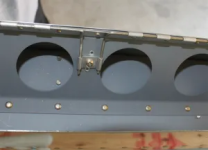
My solution was to put the probe in the void just aft of the rear spar behind the lightening holes for the flap hinge support. There seems to be adequate air exchange although I don't expect instantaneous readings of sudden temperature change.

Thanks to Ethan for the photo.
1764040373489.png
 
From the Garmin manual:

Consider the following recommendations when determining the mounting location for the GTP 59:

• Do not mount the GTP 59 where aircraft exhaust gases will flow over it.

• Do not mount the GTP 59 where it would be affected by heated air from the engine or exhaust. On most aircraft this includes any location downstream of the engine compartment.

• The GTP 59 must be exposed to the outside airflow. Do not mount the GTP 59 in a sheltered location where it is not exposed to outside airflow (for example, inside a wing or landing gear bay).

• For best results, do not mount the GTP 59 where it will be directly heated by the sun when the aircraft is parked.


I personally think placing it on one of the aircraft wing access panels is the best place. I’m trying to keep mine out of the prop wash as well as all the above.
 
My criteria were:
No ram rise
No direct sun exposure
No direct exposure to radiant heat fromthe ramp
No exposure to engine/exaust heat
No drag from one of the draggiest shapes (a cylinder)

My solution was to put the probe in the void just aft of the rear spar behind the lightening holes for the flap hinge support. There seems to be adequate air exchange although I don't expect instantaneous readings of sudden temperature change.

Thanks to Ethan for the photo.
View attachment 103084
Clever. On my 10, i put it on a bracket attached to the rear hs spar, under the cover. Pretty sure i am not sucking exhaust in through the gaps of the rudder up that high, yet it is a natural low pressure point wher air gets sucked into the cabin. Reading seem accurate. On my 6 it is under the hs, near the fuse. I believe i am reading a bit high due to exhaust contaminating the slip stream there
 
My experience with the probes not mounted on the wing. In hindsight I estimate they read 2-3 degrees high. Now add an IFR flight at ~170 knots providing ~1-2 degrees of ram rise. Now add ATC directing a decent though IMC with OAT reading 34-35 degrees and the margin I thought I had to icing proved to be fiction. 15 seconds clipping the top of a build up and the leading edges of the wings and windshield had 1/8” - 1/4” or clear ice (classic super cooled water in the top of the build up). Luckily the air got warmer as I continued the decent and the ice broke off.

The point. Accurate OAT is more important than just TAS calculations.

Side notes:
- I promptly moved the OAT probes from the HS to the wing.
- I have new rules for OAT margins if there is any chance of IMC, including avoiding any cloud penetration if OAT is below ~40 degrees.

This was my first icing exposure. As with all such educational experience it gave me a renewed respect for icing.

Carl
This^^

If you plan to fly IFR then you need to understand what your OAT is telling you.
SAT/TAT/RAT etc. Even at RV cruise speeds the difference is significant. Like 5-6F.

Idk about others but Garmin are very specific about their GtP59 mounting (outside in the airflow - away from any heat sources - ie not on the fuselage) for a reason. The temps are adjusted before they are displayed. If you mount them hidden out of the airstream they will be significantly inaccurate.
 
I put mine adjacent to the middle wing inspection panel on my 9A. Probably not an issue, but I didn't want the panel hanging by the probe wire during the condition inspection.
 
I didn't see any need to re-invent the wheel here so like many others, I stuck it under the left wing. Mine is aft of the fuel tank and adjacent to the innermost inspection panel (RV7). Garmin has specific guidance about location, which has already been mentioned, and this location satisfies it.

From there, I was able to get a home run with the provided 10' lead, although as I recall, Garmin doesn't have a problem with extending the harness if necessary (check me on this, it's a foggy memory)

I've had people point out that Cessna violates the generic Garmin instructions all sorts of ways by putting a probe that looks just like the GTP59 smack on top of the cabin. Cessna liked this location for whatever reason (probably a shorter wire run), but what people tend to forget is that they also validated it for their purposes with legions of engineers and flight test.

If you go off the reservation with regard to putting it under a fairing, or in a NACA or whatever, it may indicate right or it may not. You owe it to yourself to validate it in flight test because as has been mentioned, it will induce all kinds of errors in fancy glass displays
 
I used my OAT probe to fill the hole left by my original plain pitot tube (which was just outboard of the bellcrank access panel in the left wing) since I was also installing a heated pitot at the time. Seems to work fine, having compared its readings to forecast temperatures. They’re usually pretty close.
 
My criteria were:
No ram rise
No direct sun exposure
No direct exposure to radiant heat fromthe ramp
No exposure to engine/exaust heat
No drag from one of the draggiest shapes (a cylinder)

My solution was to put the probe in the void just aft of the rear spar behind the lightening holes for the flap hinge support. There seems to be adequate air exchange although I don't expect instantaneous readings of sudden temperature change.

Thanks to Ethan for the photo.
View attachment 103084
I'd be interested in seeing how that plays out as Garmin states NOT to put it in a sheltered location, it is SUPPOSED to be in the airflow, and located there, it will be heated by the sun on the ramp. The wing can get pretty warm while baking in the sun and there will not be much airflow within the wing structure when stationary.

My GTP59 is mount on an access panel beneath the left wing; works fine.
 
So, back to the beginning -> my take-aways.

- A junction in the device lead won't introduce unacceptable (probably undetectable) error in the temp reading; therefore,

- The device location isn't limited by the lead length.

- No compromise required in following the Garmin installation/location/mounting recommendations.

Said junction could be useful in the very unlikely event a wing removal is required in the future. Thanks for all the input.
 
So, back to the beginning -> my take-aways.

- A junction in the device lead won't introduce unacceptable (probably undetectable) error in the temp reading; therefore,

- The device location isn't limited by the lead length.

- No compromise required in following the Garmin installation/location/mounting recommendations.

Said junction could be useful in the very unlikely event a wing removal is required in the future. Thanks for all the input.
Make a small service loop (2 - 3") at the junction, solder the wires together and cover in heat shrink.

If you need to remove the wing, just cut it at the junction. You'll never worry about spurious readings caused by a flakey [insert name here] connector :)
 
Probably should be a different question in a new thread but…..

Six f’ing teen (16) gage wire for the shield drain at the GSU25 back shell connection?

Is there some static (airflow induced at the probe) fear or lightning mitigation?

Once again, help a EE challenged brother out.
 
Probably should be a different question in a new thread but…..

Six f’ing teen (16) gage wire for the shield drain at the GSU25 back shell connection?

Is there some static (airflow induced at the probe) fear or lightning mitigation?

Once again, help a EE challenged brother out.
It's what they had in the bin when the TSO writer was in town...
 
Back
Top