Van's Air Force

The definitive Van's Aircraft support community! Buying, building or flying an RV? Join our exclusive family of mentors and enthusiasts!

Aileron pushrod rod end length

Maxrate

Well Known Member
Patron
Well, I decided to weld the W-818 pushrods. I was careful to get the exact length that the plans call for on the cut, 23 13/16". After the rods were installed and the W-730 bellcrank jig in place, I'm a whole 1/8 inch difference on the number of threads that are in the rod end bearings. the plans show almost 5/8" of the threaded shank inside the bearing, and all I have is 1/2" on both ends. After searching DWG-15A and the construction manual I can't find anything that has a minimum number of acceptable threads inside of the rod end bearings. I imagine this is acceptable, but has anyone else run into this?

34fg1au.jpg
fmpaxl.jpg
e658pz.jpg
 
1/2" would be fine.

The other important variable is that the threads need to be over 1/2 way in the bearings. If you loosen the stop nuts fully and twist the rod all the way one direction and all the way the other, the thread should not come out of the bearings.
 
From Aurora bearing FAQ section:

What is the minimum thread engagement required to support the advertised load ratings in the Aurora Bearing Company catalog?

The minimum thread engagement is 1.5 times the major thread diameter unless otherwise stated.
 
When assembled, a final safety check involves using something like a paper clip, or 0.032" lockwire and pushing it into the rodend bearing pin hole. The lockwire should not pass through, it should contact the threaded rod. If not, the thread engagement is insufficient.
From the pics provided, rod engagement in the rodend is fine.
 
Have you already constructed the large aileron pushrods? Many find the stock dimensions 1/4" or more too short. Mine were. They would twist off the rod end bearing when installed in my RV-7A and controls set to neutral. I ended up fabricating a 2nd set 3/8" longer that worked perfectly.
 
Target pushrod length?

Russ-

I'm about to the point of cutting my long aileron push rod tubes and I'd like to benefit from your experience. Can you confirm the extra length that you came up with was 66 1/8 and that worked? A close look at your photo seems to show a smidge over 66 1/8.

What length do you suggest I shoot for when cutting mine?

Thanks for your great posts.

-Ivan
 
I've already cut my long pushrods to the length called for on the plans. If that turns out to be too short, then I would expect Vans to replace them!
 
"I've already cut my long pushrods to the length called for on the plans."
Yep, same here. There`s multiple revisions on the drawing for this measurement so I made the assumption that it was correct. Time will tell. I dread to think how much it costs to send that tube to Australia. 188USD for a 4 foot postal tube last time I ordered 40USD worth of parts.
I`ve actually made the long and short aileron control rods to the drawings ready for fitment later.
 
Last edited:
1/2" would be fine.

The other important variable is that the threads need to be over 1/2 way in the bearings. If you loosen the stop nuts fully and twist the rod all the way one direction and all the way the other, the thread should not come out of the bearings.

Can a sleeve be used to prevent excessive "threading" if both ends come loose?
 
Russ-

I'm about to the point of cutting my long aileron push rod tubes and I'd like to benefit from your experience. Can you confirm the extra length that you came up with was 66 1/8 and that worked? A close look at your photo seems to show a smidge over 66 1/8.

What length do you suggest I shoot for when cutting mine?

Thanks for your great posts.

-Ivan

I'll re-measure tonight. :-)
 
Can a sleeve be used to prevent excessive "threading" if both ends come loose?

It could, just like an extra jam nut would too. But I was worried about too little threads left to secure the ends well, so went with longer rods.
 
I just cut the 4 feet stock Vans send you in the kit in two. Mine is therefore 2 feet long each and it worked great. With the aileron neutral I show 3 to 4 threads between the jam nuts and the pushrod.
 
Russ-

I'm about to the point of cutting my long aileron push rod tubes and I'd like to benefit from your experience. Can you confirm the extra length that you came up with was 66 1/8 and that worked? A close look at your photo seems to show a smidge over 66 1/8.

What length do you suggest I shoot for when cutting mine?

Thanks for your great posts.

-Ivan

Hi Ivan,

I carefully measured my longer aileron tubes. They are 66 7/32" long. 7/16" longer than spec.

One thing you could do to avoid rework: Cut them on the long side like mine, but hold off riveting one of the ends on until you do your wing fitting. You can then trim them if need be, then rivet the remaining ends on.

Good luck!
Russ
 
One thing you could do to avoid rework: Cut them on the long side like mine, but hold off riveting one of the ends on until you do your wing fitting. You can then trim them if need be, then rivet the remaining ends on.

Good luck!
Russ

That's the way we did it in the olden, pre-CAD days, and is still the way I'd do it even if building a current kit. There is no need to assemble the pushrods prior to rigging the wings. Build to fit. :)
 
  • Like
Reactions: Mel
Hi Ivan,

I carefully measured my longer aileron tubes. They are 66 7/32" long. 7/16" longer than spec.

One thing you could do to avoid rework: Cut them on the long side like mine, but hold off riveting one of the ends on until you do your wing fitting. You can then trim them if need be, then rivet the remaining ends on.

Good luck!
Russ

Russ-
Thanks very much. That is exactly what I will do: Cut them long but leave the inboard end loose until later. Don't know why that didn't occur to me, it makes so much sense!

Thanks again!
 
You're quite welcome Ivan. As Sam says, there are some areas where it's best to wait until later to trim to fit. The catch is: predicting these. :-)
 
You're quite welcome Ivan. As Sam says, there are some areas where it's best to wait until later to trim to fit. The catch is: predicting these. :-)

You`re quite correct on that one! what catches me out with my build is that Vans put a measurement on their quite comprehensive drawings, sometimes with multiple revisions. It leads me to assume they have done the homework when it`s obvious they haven`t. If they left it as "make to fit", then that`s entirely acceptable to me. Considering the spar in this case is jig built and a know entity, and so are the all the 4130 weldments that effect the rod length, there`s a revised measurement given, AND the rod ends are adjustable you`d think they worked it out! In my case, if the rod doesn`t fit, I`ll be ordering the appropriate heim bearings and lock washers to make the rods serviceable and airworthy. Shipping cost is a real waste of money that`s better spent on the final product.
After a couple of these incidents on a built you learn to disregard the drawings almost entirely and build from common sense and experience. IE - Don`t do anything to a part that affects it`s fit to another part if you don`t have them both on the bench or in a jig!
 
After a couple of these incidents on a built you learn to disregard the drawings almost entirely and build from common sense and experience. Don`t do anything to a part that affects it`s fit to another part if you don`t have them both on the bench or in a jig!

You have now made the transition from being an airplane assembler to an aircraft builder. ;)
 
That little hole in the side of the rod end is a witness hole. Use it to verify that the male threads are screwed in at least that far. If it's assembled that far it's acceptable. Of course deeper is acceptable too.

Easy to inspect with a piece of safety wire as a probe.

Dave
 
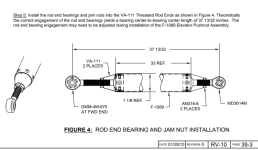
As I am in a Condition Inspection now and my AP was scratching his head looking at the long length of the exposed threads on the Forward elevator rod end bolt (part #GMM-4M675 3/8" diameter and 1.5" of threads). He had a rule-of-thumb of "50% exposed and 50% engaged" for threads. Well, that % is "close" for some rod ends but it all depends on the length of the rod. For the aft rod at 3/8" diameter rod and 3/4" thread lengths (like rod end MD3614M), that 50% rule gives you 3/8" threads engaged close to the recommended RBC and Aurora suggest 1.5 x dia (so 1.5 x 3/8" = 9/16") for "full load capacity".
Per the RV10 plans, the cone on the push rod (VA-111) is only threaded 9/16" deep (and they expect you to drill a hole for a safety wire at that location) so with GMM-4M675 being 1.5" long . . no way to have 50% engaged and no use in more than 9/16" engaged (which you can't do if you add the safety wire per Vans drawings).
Funny that 9/16" recommended just like VA-111 thread depth. Now if you only have 1/2" (original poster) you won't get the theoretical 3160 lbs capacity but your are pretty close.
(and all that to say that my AP is now happy with the ~1" of exposed threads on my forward rod end.
 
Interesting comment by Greyforge in recommending the exposed threads not being longer than the engaged threads on the other end to avoid spinning the push rod free of the end rods and disengaging (if jamb nut didn't prevent that).
Obviously Vans doesn't align with that in the RV-10 build as the control rod could thread itself forward on the exposed forward rod end and disengage from the aft end (but requires jamb nut and safety wire failures).
 

Attachments

  • elevator rod ends.png
    elevator rod ends.png
    81.5 KB · Views: 7
Interesting comment by Greyforge in recommending the exposed threads not being longer than the engaged threads on the other end to avoid spinning the push rod free of the end rods and disengaging (if jamb nut didn't prevent that).
Obviously Vans doesn't align with that in the RV-10 build as the control rod could thread itself forward on the exposed forward rod end and disengage from the aft end (but requires jamb nut and safety wire failures).

This is the only rod-end across all RV pushrods where the standard practice of greater than half engagement is not observed. It’s a specific case due to the interference of the WD-1010 tie rod with the F-1089 pushrod at full aft stick.

It’s super tight and everything needs to be very close to plans when rigging to avoid interference. Definitely a place for very close inspection. If your A&P is not familiar with this particular nuance of RV control design then maybe give him the plans and explain it to him. Winding that rod end in and or adjusting it to get 50% could well introduce jamming.
 
Back
Top