Van's Air Force

The definitive Van's Aircraft support community! Buying, building or flying an RV? Join our exclusive family of mentors and enthusiasts!

Aerodynamic Experts Please Eval my DIY Pitot AOA Help & Calculate Drag (for two different Pitot Tubes)

jackking123

Well Known Member
Patron
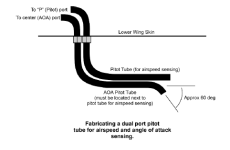
Please see my sketch. I am making my own two tube Pitot AOA. Variation on Van's design but two tubes, second for AOA. It will not use AN fitting but machined fitting. I don't want heated Pitot. I could go Dynon non heated and a mast, for under $400. This design is free and I hope will do the same thing, lighter. .

I tried to look up Cd (Drag Coefficient) for the two pitot tubes. I assume Cd of 0.40 for the aero shape mast version. And Cd 0.9-1.0 for the two 1/4" diameter tube. However that is harder to nail down, but I think pretty close.

What doe you think of the two tube design? Drag comparison?

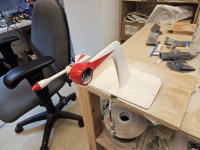
(My calculations est 0.5 lbs drag for either one, about the same? You have 3 times the Cd but 1/3rd of the area for the round tubes. . Seems to be pretty close. I have a machined fitting that holds the two alum tubes and will be coming out of the access cover (RV-7), supported off the main spar flange with a bracket. I love how it is coming out. It will look similar to picture I photoshopped below (but better):
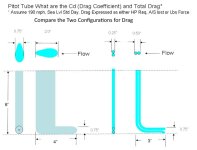
Pitot Drag coefficient.jpg


Pitot tube mockup.jpg
 
@scsmith Your briar patch, Sir.
:oops: What? I know it is a folktale "Br'er Rabbit and the Briar Patch" by Joel Chandler Harris. It is just math, physics and science. Just curious what the drag is... Just for fun. It is unlikely this will change my mind. As I said estimate the difference is small and both produce negligible drag in the big scheme of things. Per TParker some fairing around the tubes would lower the Cd (Drag Coefficient).
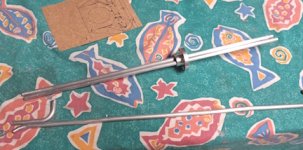
Here's mine:
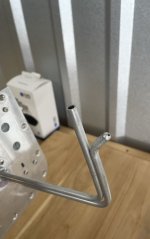
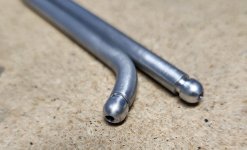
Thanks... I am using this. Some practice bends in bottom left of picture. The two tubes loose in the fitting. Only a small part of the fitting will protrude. I was thinking of using epoxy to bond the tubes to each other and the fitting, but a local metal fab shop has a TIG driver that can spot weld it. Although AOA is adjustable in the software, I will have some limited adjustment with the AOA tube being bent down 30 degrees.

I will change the bend radius so the tubes nest nice in the 90 bends. Tube bending can be a bit hit or miss. I will likely make bending mandrels and jig out of wood. Pretty easy. I did these two with a small Harbor Freight $9 1/8, 3/16. 1/4 only tube bender makes a very tight but nice 90 bend with radius about 3/4" (inside R). No kink or flattening. 3003-0 is easy. I am thinking of getting 5052 tube, which comes straight. Getting the coiled tube perfect is hard to do, can get darn close. 5052 is better however...
20250521_190546.jpg

Why not design and 3D print an aero fair

Yes there are some nice fairings I could make... May be down the road.

3D print, done it, but no access to a printer anymore. My 3D CAD skills are kind of weak. I started life as an Engineer for Boeing Structures Engineer in the 80's. CAD and CATIA were used. I was more into analysis not drafting. I do have LibreCad (nice free 3D program). I did my panel on that and had it laser cut. I just don't put the time into it... I dabble. As far as 3D print, made a spacer for my GRT EIS4000, auto-jack isolation rings. If I were to make 3D printed fairing I'll let you know. Are you willing to 3D print me a Pitot/AOA fairing, I'll send you a file, or at least the cross section. If you can extrude it and slice it that would be awesome.

My go to is old school, balsa wood, hand shaped, bonded onto the tubes. May be some micro-balloons, to fill the space between tubes. Than covered in fine lightweight RC/ Surfacing Fiberglass, style #106 and #108, epoxy resin. I doubt it will make much difference in drag. I like the looks of the raw tube and spot welds. I also like the fact if it ever gets wacked. very unlikely to bend anything important and tubes will fold and bend.

Right now focused on getting my pitot, static, AOA set-up, parts, runs, before closing bottom wing skin. I'm happy with this. Meets my criteria of: light, works well, reliable, cheap (or not arm and leg). If it does turn out, there is always blowing $400 on the Dynon non-heated Pitot/AOA + Mast. I really don't think I will have a problem with getting Airspeed and AOA (delta pressure) with these tubes sticking out in the breeze.

I was going to use a rivet in the lower forward leading edge for AOA like the RV-12 guys do for AOA. Pitot on RV-12 is in the prop spinner!!! I researched the RV-12 AOA, and using an existing rivet hole in the leading edge of the RV-7. It is at the perfect angle to AOA, and it has been done before and reported to work on RV-7's. This means I could go with single Pitot tube. I'm NOT a fan of putting tubing on blind / Pull / Pop rivets with a blob of RTV, as Van's does for the RV-12 AOA and Static ports kit. It is kind of jury-rig'ed. It is light, simple and cheap however. I like solid AN or Polyflow connections all the way. Pitot-Static Leaks are a bummer, especially when paying an Avionics Tech and it fails at your 24 mo cert. You want it to be sealed and stay that way.
 
Last edited:
...
I was going to use a rivet in the lower forward leading edge for AOA like the RV-12 guys do for AOA. Pitot on RV-12 is in the prop spinner!!! I researched the RV-12 AOA, and using an existing rivet hole in the leading edge of the RV-7. It is at the perfect angle to AOA, and it has been done before and reported to work on RV-7's. This means I could go with single Pitot tube. I'm NOT a fan of putting tubing on blind / Pull / Pop rivets with a blob of RTV, as Van's does for the RV-12 AOA and Static ports kit. It is kind of jury-rig'ed. It is light, simple and cheap however. I like solid AN or Polyflow connections all the way. Pitot-Static Leaks are a bummer, especially when paying an Avionics Tech and it fails at your 24 mo cert. You want it to be sealed and stay that way.
I'm trying the rivet port in the leading edge for Dynon AOA. It's not flying yet so I cannot confirm that it works, but the port is in the location that has worked for others.
The port is a wide flange rivet with a 3/16" diameter stem that is mechanically connected to a 3/16" diameter nylon tube to the ADAHRS module, so there is no silicone RTV holding it on (I didn't like the idea of that method much either).

20250522_093439.jpg
 
Last edited:
I'm trying the rivet port in the leading edge for Dynon AOA. It's not flying yet so I cannot confirm that if works, but the port is in the location that has worked for others.
The port is a wide flange rivet with a 3/16" diameter stem that is mechanically connected to a 3/16" diameter nylon tube to the ADAHRS module, so there is no silicone RTV holding it on (I didn't like the idea of that method much either).

View attachment 88271
I did that on my 10 and working very well. However, mine is much more forward than yours. It may be the pic, but it looks like yours is pointing 80* from vertical. Mine is somewhere around 50*+
 
I did that on my 10 and working very well. However, mine is much more forward than yours. It may be the pic, but it looks like yours is pointing 80* from vertical. Mine is somewhere around 50*+
Measured with a digital level mine is 63 degrees from vertical. There was some discussion on VAF about not putting the port too close to the leading edge, so as to avoid turbulence, per some studies by Van's for the RV-12. The AOA probe on my other aircraft is the Dynon unit and the AOA port is about 60 degrees from vertical. Hopefully the RV's will work OK, apparently the calibration process is not overly sensitive to the orientation of the port.
I made the hole for the port bigger than those of the static port rivets and it is about the the same size as the ID of the nylon tube (1/8"). This should let in more airflow and make it as responsive as possible. Time will tell if it is a success.
 
:oops: What? I know it is a folktale "Br'er Rabbit and the Briar Patch" by Joel Chandler Harris. It is just math, physics and science. Just curious what the drag is... Just for fun. It is unlikely this will change my mind. As I said estimate the difference is small and both produce negligible drag in the big scheme of things. Per TParker some fairing around the tubes would lower the Cd (Drag Coefficient).
Been using the phrase for so long I had to think about it. The rabbit pleaded to not be thrown into so he could escape. Ultimately, it was where he was most comfortable.

Many know that a teardrop has less drag than a circle even though it has more wetted area. "Stacked" tubes would seem even worse as I'd expect more turbulated wake. Will none of the available pitot masts work?

Anyway, Mr. SCSmith knows aero. I'd certainly trust his opinion over others if he responds.
 
My go to is old school, balsa wood, hand shaped, bonded onto the tubes. May be some micro-balloons, to fill the space between tubes. Than covered in fine lightweight RC/ Surfacing Fiberglass, style #106 and #108, epoxy resin.


I doubt it will make much difference in drag.

Oh yeah, 10 knots. Always 10 knots....;)


Oh yeah, 10 knots. Always 10 knots....;)
Ha ha ha ha ha... Yes 10 kts.... Thanks for the thread... your post are always informative and epic.... t
 
The drag is not going to be worth your time trying to figure out given how little impact it will have upon you. Consideration for the alignment of your holes, however, matters. You can compensate for this electronically via math, or you can position them physically. You want the angle between the two holes equal to twice your critical angle and the midpoint to be evenly split at critical angle (meaning forward hold truly parallels longitudinal axis). See recent discussion: https://vansairforce.net/threads/aoa-recommendations.234762/
 
Been using the phrase for so long I had to think about it. The rabbit pleaded to not be thrown into so he could escape. Ultimately, it was where he was most comfortable.

Many know that a teardrop has less drag than a circle even though it has more wetted area. "Stacked" tubes would seem even worse as I'd expect more turbulated wake. Will none of the available pitot masts work?

Anyway, Mr. SCSmith knows aero. I'd certainly trust his opinion over others if he responds.
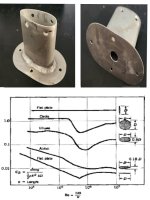
Found a pre WWII NACA / DOD research papers on flying wires and distance between wires and difference between "streamlined" and round flying wires. I don't have time to worry about it. You are right there are standard shape Cd charts of all different shapes... Cd is only one factor, along with frontal Area, Air-Density, Velocity, and Reynolds number, all come into the equation.

I'd love to see a Computational Fluid Dynamic Model. Come on Aerodynamic guys. Oh and you have the affect boundary of the wing it self, Interaction with wing (interference drag), parasitic drag (friction).

Looking at Cd you can see below the difference. There is a mountain of data. The stream lined shape is less "draggy" to be sure.

So if we take a simple approach of just comparing frontal area and Cd:

Cd's
Tube (6" long 0.25" Dia) = For a Tube, 0.63 to 1.2. **[Since two tubes in-line is similar to an ellipse (Cd low as 0.07) I guess at Cd = 0.63]
Streamlined shape (6" long 0.875 wide) = Cd as low as 0.045, but can be as high as 0.22. From all the data I guess at Cd = 0.12.

Frontal Areas
Tube 6" x 0.25 = 1.5 sq-in
Stream line shape 6" x 0.875 = 5.25

Ratio of Cd's (round vs streamlined) = 0.63/0.12 = ~ 5.2
Ratio of Area (round vs streamlined) = 1.5/5.25 = 0.28

So it appears the streamlined is less drag (5.2*0.28) = 0.728, Round tube has about have 27% MORE drag. 27% more of nil is not much.

I looked at this, and I declare SCIENCE!!!! :) Believe the SCIENCE!!!! This is SWAG (Scientific Wild *** Guessing).
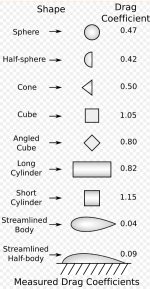
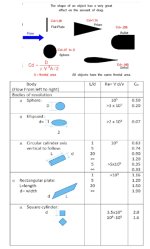
My guess is drags are almost identical and so small for all practical purposes to not be important.

Bottom line I don't know? Calling all Aerodynamic experts. If I filled in the sides of the two round tubes, slightly wider than 0.25 tube diameter, drag would be reduced. Add a trailing edge, more reduction in drag. Add a leading edge... The calculated drag is 27% of 0.001 kts. or I will be 0.00027 kts slower. Ha ha. There are too many factors to really know.

Cost of a Dynon unheated pitot and mast tax and shipping $430 and weights more. My free pitot / AOA light. simple tube. will be reliable, work as well as any pitot/AOA out there. Plus I will be the only one... and one day, at Oshkosh someone will walk up and ask about it. Several minutes later.... like the scene in "Airplane!" the movie, where Striker won't stop talking people to death.

. Cd picture 1.jpgCd picture 2.jpg
 
Last edited:
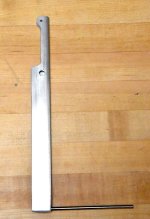
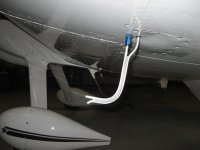
You might want to consider jury strut material. Wicks Aircraft sells an aluminum version. Here's the link. It's the top one in the list and the bottom one in the pictures. Here's a photo of the non-AOA pitot tube I made for my RV-3B with some of that. The tube at the bottom is 3/16" stainless. It's all held together with JBWeld. The larger hole is for the pitot pressure fitting; just above that, not shown, is a JBWeld plug to make the tube air-tight.

The tube is considerably smaller than your concept.

Worth thinking of is what the Reynolds Number it'll operate at as that might affect the drag coefficient in your data.

Pitot Tube S.jpg

Dave
 
You might want to consider jury strut material. Wicks Aircraft sells an aluminum version. Here's the link. It's the top one in the list and the bottom one in the pictures. Here's a photo of the non-AOA pitot tube I made for my RV-3B with some of that. The tube at the bottom is 3/16" stainless. It's all held together with JBWeld. The larger hole is for the pitot pressure fitting; just above that, not shown, is a JBWeld plug to make the tube air-tight.

The tube is considerably smaller than your concept.

Worth thinking of is what the Reynolds Number it'll operate at as that might affect the drag coefficient in your data.


Dave

There is nothing you can do about Reynolds number and it is 1 million to 10 million. This is totally turbulent flow (see Pic below). I don't need to calculate this because area and drag are tiny compared to total aircraft.

I don't understand "The tube is considerably smaller than you concept"? How is it smaller? Two 1/4" tubes front to back are 0.25" x 0.50".

A typical Pitot mast is 0.875 x 2.0". I am not using that. That is the standard however to mount a typical heated pitot tube assembly.

I do appreciate your tip on Wick's. I see they make small "strut" tubes. Cool. The smallest being 0.375" by 1.125". The down side it is $48 and comes only in 6' lengths. I need a tube length of 7". If I was going to fair it in, streamlined, 0.375" x 1.125" would be the L/d ratio of 3, a typical ratio, that is fine, but it would not be a metal tube. Not likely do any fairing of any kind, metal or fiberglass or 3D printed. Why?

Mounting and maintenance come into play.

I have a single 0.7" round hole. Clean. The pitot/AOA fitting (see above) will be on a bracket off the spar and rib. The hole in lower wing surface will be in the access cover. I need to slide the access cover off. Not cutting larger odd shapes into my spar flange, lower wing skin or access cover.

This is not a concept; it is being done right now. I'm committed to it and it is coming out real slick, clean, simple. Very happy, but thank you for the tip. I need to peruse Wick's catalog and web site more.

FYI - made the streamlined tube weldment decades ago; have it in my junk drawer (Pic Below). This allows you to rivet it on and only have a small round hole tube and wiring if heated. I could do something similar for two 1/4" tubes with a tiny strut (the 1.25 x 0.375 size Wick sells), but it's money, time and NOT value added, at least from cost, weight and ease of assembly. I am not a fan of the weird look at bottom where it just ends and a tube or two stick out. Not bad, just not my jam. Also those soft aluminum tubes BEND....

STORY TIME. On my RV-4 I had a single aluminum tube pitot per plans. I was leaving an air show and just got into the cockpit. The kid was waiting on his scooter for me to start and marshal me out around the people in attendance walking around the ramp and taxiway. I said hey can you get my pitot cover off, as I realized I did not have it (has a storage spot in cockpit and checklist item). It was RED rubber cap which slipped on the 1/4" aluminum tube, which I safety wired a red pendant streamer on to. You have to hold the tube with one hand and wiggle the rubber cap off with your fingers. The kid yanked on the streamer, he bent the tube and pulled the streamer off the cap, safety wire ripped through rubber. I knew what had happened. Good news easy fix. The tube bent back nicely and the streamer was re-attached to another red rubber cap. Lesson don't let people touch your plane.

Picture 2.jpg

 
Last edited:
The OP concept shows streamline section at 2" x 3/4". This section is 1 1/8" x 3/8". I was comparing it to your mast since this is a mast, not a round tube.

And hey, if you don't like the concept, no problem, you're building your plane and have your own desires. Everyone's different. I was after low drag and low weight, and unconcerned with possible icing, so mine doesn't have a pitot heater. Since I'm building an RV-3B, I wasn't worried about a pre-existing mounting hole; the RV-3 series isn't prepunched. I had to come up with my own mounting arrangement. On an RV-3B, that gave me additional design flexibility. Other models may differ.

When you get your pitot tube done, please post a photo. We're interested.

Dave
 
The OP concept shows streamline section at 2" x 3/4". This section is 1 1/8" x 3/8". I was comparing it to your mast since this is a mast, not a round tube.

And hey, if you don't like the concept, no problem, you're building your plane and have your own desires. Everyone's different. I was after low drag and low weight, and unconcerned with possible icing, so mine doesn't have a pitot heater. Since I'm building an RV-3B, I wasn't worried about a pre-existing mounting hole; the RV-3 series isn't prepunched. I had to come up with my own mounting arrangement. On an RV-3B, that gave me additional design flexibility. Other models may differ.

When you get your pitot tube done, please post a photo. We're interested.

Dave

Yes I am OP. I mention the streamline mast... which is now $115, $40 more than it was last time I looed. Booo. :mad: It is off the shelf and needed if I go heated pitot. I'm set up to retrofit, even after bottom wing skin is nailed down, if I changed my mind..

It is not that I am unconcerned about ICE. I do fly IFR, I avoid ICE... flying 40 years GA and Airlines, got ice. I have an Inst Student getting close to check ride, spent a good amount of time talking to him about weather, ice, TS, wind shear last ground session.

In the early days, flying freight in light twins certified for "known ice", was frankly spooky when I got in real icing. Not doing that again. You need a lot more than heated pitot to tangle with ice. You loose airspeed indication, GPS ground speed is all you have. But that is the least of your concern. Airlines typically blast through ice and get on top where ice is not much of an issue (too cold all visible moisture is already ice crystals or snow). However down low if you have to hold it can be a little pucker. The Chicago American Eagles ATR was caused by icing. It is serious even for airliners...

When giving dual instruction as a CFII, Seattle decades ago, common to get un-forecast trace or light RIME or mixed above 4000 feet, but typical approach altitudes below 3,000 ft it was above freezing. Now flying over the Cascades in winter, IMC with a C-172, forget it, heated pitot or not, unless you have a turbo charged twin with boots, hot prop, heated window panel.

Again no need to do this for fun and recreation or even travel. Get a hotel or rental car or commercial flight home... My RV-4 was IFR... heated pitot. I flew it 12 yrs and over 12000 hrs. I flew IFR (filed) 10% of the time, may be half of that was in actual IMC. Pitot ice was "needed" may be once. Heated Pitot is NOT required equipment by FAR's to fly IFR.

My IFR with be under hood with safety pilot for my training (and fun), and light IFR.... climbing and descending through layers and approach to high mins. I am comfortable with not having heated pitot and flying IFR. Heated pitot would not make a difference in my Go, No-Go decision. If there is a chance of ICE, I will have big outs, like a lot of ABOVE freezing temps below me.

I am NOT giving advice and telling anyone not to install heated pitot tube. That is up to the builder and pilot.

I will post a pictures. Thank you for your advice.
 
Last edited:
Yes I am OP. I mention the streamline mast... which is now $115, $40 more than it was last time I looed. Booo. :mad: It is off the shelf and needed if I go heated pitot. I'm set up to retrofit, even after bottom wing skin is nailed down, if I changed my mind..
It is not that I am unconcerned about ICE. I do fly IFR, I avoid ICE... flying 40 years GA and Airlines, got ice. I have an Inst Student getting close to check ride, spent a good amount of time talking to him about weather, ice, TS, wind shear last ground session.

In the early days, flying freight in light twins certified for "known ice", was frankly spooky when I got in real icing. Not doing that again. You need a lot more than heated pitot to tangle with ice. You loose airspeed indication, GPS ground speed is all you have. But that is the least of your concern. Airlines typically blast through ice and get on top where ice is not much of an issue (too cold all visible moisture is already ice crystals or snow). However down low if you have to hold it can be a little pucker. The Chicago American Eagles ATR was caused by icing. It is serious even for airliners...

When giving dual instruction as a CFII, Seattle decades ago, common to get un-forecast trace or light RIME or mixed above 4000 feet, but typical approach altitudes below 3,000 ft it was above freezing. Now flying over the Cascades in winter, IMC with a C-172, forget it, heated pitot or not, unless you have a turbo charged twin with boots, hot prop, heated window panel.

Again no need to do this for fun and recreation or even travel. Get a hotel or rental car or commercial flight home... My RV-4 was IFR... heated pitot. I flew it 12 yrs and over 12000 hrs. I flew IFR (filed) 10% of the time, may be half of that was in actual IMC. Pitot ice was "needed" may be once. Heated Pitot is NOT required equipment by FAR's to fly IFR.

My IFR with be under hood with safety pilot for my training (and fun), and light IFR.... climbing and descending through layers and approach to high mins. I am comfortable with not having heated pitot and flying IFR. Heated pitot would not make a difference in my Go, No-Go decision. If there is a chance of ICE, I will have big outs, like a lot of ABOVE freezing temps below me.

I am NOT giving advice and telling anyone not to install heated pitot tube. That is up to the builder and pilot.

I will post a pictures. Thank you for your advice.
Must be a luck element. I have way less hours than you , but have needed pitot heat several times. Ambients were right for it, but was not in a cloud. I think the air can be pretty moist between layers and the venturi effect of the air accelerating around the cone at the pitot entrance does it, like carb ice on a warm moist day. On each of those occasions, the airspeed started dropping and heat brought it back. Each time had zero visible ice anywhere on the plane and i have seen where it starts in the past. I went through a small top section of a Cu cloud, maybe 15 seconds in it and got 4” inch horns sticking out of the lip at the top of the LL lens. Pretty sure it was SLD; it sounded like gravel smashing into the plane. Gave me a whole new fear of icing. I suspect those of us that fly in colder climates are more likely to see this.

Your tube based pitot is probably immune from this, as there is no cone shape at the tip.

Not condemning your decision, just a data point.
 
Last edited:
Airspeed indication is vastly overrated... IMHO.
Having build up ice a few times, mostly during my little tour, and consequently lost the ASI (once for about 45' over northern Canada) one uses pitch/power to maintain adequate speed. No big deal... if u know your numbers and strictly fly by them.
This has been taught in the airlines for a few years now, mostly thanks to that AF SA disaster...
The caveat being that increased ice accumulation will lead to higher a AOA value associated with higher power requirements, but I'd say that in our non de-iced RV the name of the game is not to, or get out of icing conditions ASAP anyway. If in, monitoring the build-up is a must, followed by avoiding action(s).
 
Unless, you have a relatively old EFIS that needed good airspeed data to reach an accurate long term horizon solution.
I believe that even those that can provide a reliable attitude indication without it, still use it to provide an optimum attitude.


Right now focused on getting my pitot, static, AOA set-up, parts, runs, before closing bottom wing skin. I'm happy with this. Meets my criteria of: light, works well, reliable, cheap (or not arm and leg). If it does turn out, there is always blowing $400 on the Dynon non-heated Pitot/AOA + Mast. I really don't think I will have a problem with getting Airspeed and AOA (delta pressure) with these tubes sticking out in the breeze.

….
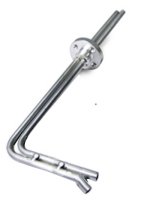
I applaud your pursuit of neat looking and cheaper pitot/AOA probe unit that doesn’t cost $400. Might you have seen the article in the recent Kitplanes implementing a Piper style probe? These are available on eBay and even for $100, they are known to work, are robust, are streamlined, and one of the ports can be easily be modified as the AOA.
 
Measured with a digital level mine is 63 degrees from vertical. There was some discussion on VAF about not putting the port too close to the leading edge, so as to avoid turbulence, per some studies by Van's for the RV-12. The AOA probe on my other aircraft is the Dynon unit and the AOA port is about 60 degrees from vertical. Hopefully the RV's will work OK, apparently the calibration process is not overly sensitive to the orientation of the port.
I made the hole for the port bigger than those of the static port rivets and it is about the the same size as the ID of the nylon tube (1/8"). This should let in more airflow and make it as responsive as possible. Time will tell if it is a success.
There's not really any airflow in the port and tube. There's nowhere for the air to flow to. All you get is a pressure change as the velocity at the face of the port changes. If you want to increase sensitivity in your installation:

1. Use a flush rivet instead of the domed port
2. Use a small diameter hole and tube, and put your sensor as close as possible to the port
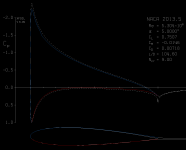
3. Put the port close but not too close to the leading edge. A bit less than 10% chord back from the leading edge should be fairly close to the best location. To illustrate, here's a quick and dirty XFoil pressure coefficient (Cp) calculation for the upper and lower surfaces of the wing section of the early RV aircraft, using reasonably representative flight conditions.

Screenshot at 2025-05-24 18-28-52.png

You can see it's not good to put the port too close to the leading edge, and as you move it further aft you decrease sensitivity quite a bit.

If you want lots more info about behaviour of pressure ports, have a look at this summary by Gracey: https://ntrs.nasa.gov/citations/19800015804

One other thought about sensitivity. You really only want to measure at frequencies up to about 5Hz, since anything above that is going to be due to turbulence or structural deflection rather than due to aircraft flightpath. Using a larger tube is a way of filtering this stuff out, but having it too big or too long can introduce lags or resonances.
 
I applaud your pursuit of neat looking and cheaper pitot/AOA probe unit that doesn’t cost $400. Might you have seen the article in the recent Kitplanes implementing a Piper style probe? These are available on eBay and even for $100, they are known to work, are robust, are streamlined, and one of the ports can be easily be modified as the AOA.
I actually did that on my first RV, but chickened out, only because it is about 3.5 inches. (no that is what she said jokes please, that is my job to make jokes, ha ha). Again I am not an aerodynamics guy, but sat next to them when I worked at Boeing decades ago. I wonder if not being 6" - 7" from wing bottom, as Van's suggests in plans is cool? I think others have used Piper pitot "blades" with success.

eBay says $195 to $700, many in the $500-$600 range for heated pitot. Some or most of them all look old and crusty. Can only have one old crusty thing in my plane, and that we be me, the pilot. Ha ha. Also some of them are 28 volts as well.

If I was going to go heated, I'd get a NEW Dynon regulated heated pitot/AOA with mast for $700. An old Piper heated pitot might fail and to fix or replace it a pain and $$$. My DIY homebrew will work well and last a long time with zero point zero maintenance.

Again per my long winded justification above for my apathy towards heated pitot (even if IFR flying) pretty much seals the deal, combined with love of being lighter (again pilot already has taken care of extra Lbs) and cheap-skate. You have wires, switch's, CB's... to add one more doo-dad to the plane. The heated Dynon and a mast is

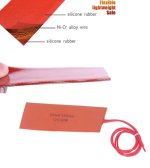
Not that I will do this but they see silicon tape imbedded heating pads, say 2" x 9", pack of 4 for less than $20 on popular online retailers, with wires, that heats pipes from freezing or heats whet ever you want.... I could then wrap that around pitot/AOA tubes, put some fairing over it, .. VOILÀ, taa-daa home made heated pitot for $20. Ha ha. May be 20 Watts is too little? About 1.5 amp draw. Me think tho horse has been beatened to death. Again I dare to fly IMC with no heated Pitot. IMC but not sub freezing temps if I can avoid it, and I will. I just don't do ICE in light planes. Hotel, wait, rental car or commercial if I have to get there.


heatpad.jpg
 
Last edited:
There's not really any airflow in the port and tube. There's nowhere for the air to flow to. All you get is a pressure change as the velocity at the face of the port changes. If you want to increase sensitivity in your installation:

1. Use a flush rivet instead of the domed port
2. Use a small diameter hole and tube, and put your sensor as close as possible to the port
3. Put the port close but not too close to the leading edge. A bit less than 10% chord back from the leading edge should be fairly close to the best location. To illustrate, here's a quick and dirty XFoil pressure coefficient (Cp) calculation for the upper and lower surfaces of the wing section of the early RV aircraft, using reasonably representative flight conditions.

View attachment 88465

You can see it's not good to put the port too close to the leading edge, and as you move it further aft you decrease sensitivity quite a bit.

If you want lots more info about behaviour of pressure ports, have a look at this summary by Gracey: https://ntrs.nasa.gov/citations/19800015804

One other thought about sensitivity. You really only want to measure at frequencies up to about 5Hz, since anything above that is going to be due to turbulence or structural deflection rather than due to aircraft flightpath. Using a larger tube is a way of filtering this stuff out, but having it too big or too long can introduce lags or resonances.

There is the Aero guru I was looking for... Anyone rocking XFoil is an expert to me.... I was very close to drilling out that rivet in the leading edge to put a "pop rivet" for AOA, Ala RV-12. As PaulvS said that first most forward rivet lower, existing leading edge skin to rib rivet is pretty dang close to 60 degrees from chord line.

60 degrees is the generic angle most cite. My GRT EFIS has AOA and it is in the manual.... It has been done and has worked I recall, and it is posted here on the VAF forum...

Pitot aoa.png


HOWEVER as you point out the RV-12 AOA port is not ideal. (Yes RV-12 has different airfoil than RV-7 but still....) When people say for example my Archer inside the wing tip VOR or COM antenna "Works" that is a qualified "works". I am more comfortable talking RF than air molecules. What I am trying to say EVERYTHING is a compromise. Sure they WORK but far from ideal. Like all things there are Pros and Cons. Not having external antenna looks better? Less drag, to a tiny degree. Is it worth it? Up to the builder.

Your post makes me even more confident in my choice to put the AOA hanging out the bottom of the wing (6.5") at Approx Max chord (just aft of main spar). The big draw back of the RV-12 in the leading edge port is connecting the tube... that is a tiny teeny bit of a jury rig. I am going ALL AN and Nylaflow fittings and tubes. It is more "aerospace-hee", even though no one will see it. I plan on passing 24 mo pitot static transponder checks maintenance free with ease, verses hunting down leaks.

With that said you talk of shape of the PORT? Humm so 3003-0 1/4" tube has a wall thickness of 0.032. My plan is to cut it squared to tube axis, chamfer the ID and a little OD. How much Chamfer? Mark XII Eye Ball. For sure break sharp edge. I actually have little turned, machine bullets that fit into the tubes, could be drill out to any orifice size, to reduce the 0.186 ID. I could chamfer to make it more cone like vs bullet. This will be fun to play with down the road. The advantage of my DIY Homebrew I can play with it and change it all day long for a few bucks in tubing. The GRT EFIS has calibration like they all do. I did a Garmin G3X and it was frankly a pain and failed a few times. It is a derivative of AOA. Most large commercial jets I know of have AOA vanes and they are heated btw,

20250524_150240.jpg
 
Last edited:
Might you have seen the article in the recent Kitplanes implementing a Piper style probe? These are available on eBay and even for $100, they are known to work, are robust, are streamlined, and one of the ports can be easily be modified as the AOA.
Yep, and I think first experimented, name of the game ain't it, by Paul Dye, heated, AOA, streamlined, solid, etc... here's my recent "upgrade".
 

Attachments

  • PP.jpg
    PP.jpg
    793.1 KB · Views: 54
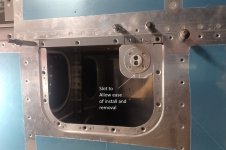
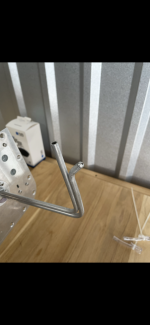
I finished my mock up, ordered parts to finish the Pitot / AOA wing installation. It came out very nice. Please note this is mock up not final pics... the tube bending will be straight forward, and for now no fairing.

Pic 1 - The bracket is attacked with existing rivets plus to extra. I will slot the bracket 1/4 wide so I can remove the Pitot/Static. With AN 816 fittings and nut you can't get it out and would have to flare tubes in place. I will transition to Polyflow fitting and tube to instrument. Considered slip on, but going with tried and true. If some one says there is no room for bell crank control access, no issue. The picture is deceiving. There is a lot of room. This wing LEFT. Now wing RIGHT has the autopilot servo, and it would be in the way. No issue.


20250526_192618.jpg

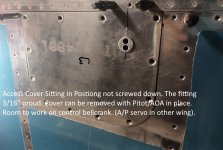
Pic 2 - With cover on (just sitting not screwed down) the fitting is proud 3//16". Still have not bent up the tubes yet.

20250526_192717.jpg

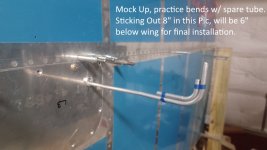
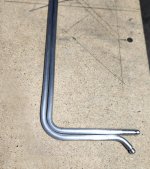
Pic 3 - This is some spare tube I am practicing with. It is sticking out 8" in this pic. Van calls for 6" to 7", which is what I am going to do.
The Horizontal part of the "L" Van calls for 3" to 4".


20250526_160259.jpg
 
Last edited:
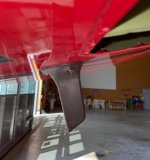
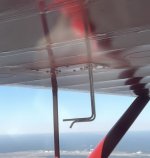
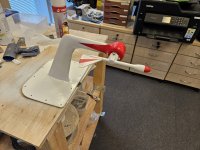
6.5 inches is fine, and anything between 25-50% chord placement will work. Exact angle of the lower bend isn't critical as long as you calibrate. I'd recommend you normalize by simply dividing the lower pressure by your upper (dynamic) pressure to avoid a divide by zero error. The small inserts you have are perfect. Drill a #40 hole and insert it in the lower, bent tube--it will reduce noise. We just spot welded the tubes. We fly a similar probe on our RV-4 test bed (top pic) and here it is mounted to an inspection plate on a Citabria (bottom pic):

IMG_9970.jpg
IMG_9968.jpg

Excellent experiment! Let us know how it works :)

Cheers,

Vac
 

Attachments

  • IMG_9970.PNG
    IMG_9970.PNG
    5.8 MB · Views: 7
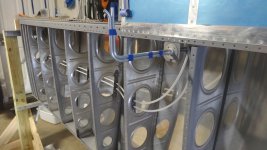
I got the routing and hardware (AN and nylo flow) to connect everything, and structure finished. Still have to spot weld tubes, flare tubes for AN816.

Per VIC I am still thinking of the Orifice diameter and shape. Also don't want AOA interfering with Pitot, so may move it back an inch?

Per David, thinking of faring the tubes in. Mr. Paule was kind enough to send me a foot of small extrusion (airfoil shaped). Thank you David.

Any suggestions on metal adhesive. I was thinking spot tig weld. It would be metal... Epoxy adhesive will stick out being black or grey.

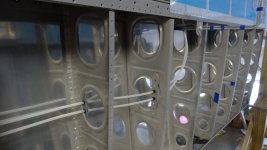
Routing roughed out. Tape is just mock up. Tubing not connected yet.
DSC00214.JPG

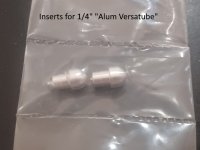
The inserts are not seated. The ratio of orifice to tube diameter can be 0.1 to 0.75. The tube ID is about 0.180, So max orifice Dia would be 3/32. Holes are now at 5/64. I may fly without insert. Can always add them in.

pitot aoa 2.jpg


Partially inserted, drilled plugs. 5/64" holes but will drill to 3/32" (#40 as Vic suggest). I think inserts are optional but will likely assure smoother air flow, less turbulence which could affect accuracy. Subsonic it's not crazy critical, now transonic speed the probes have to have conical shape and internal diffusers.
pitot aoa 1.jpg
 

Attachments

  • pitot aoa 3.JPG
    pitot aoa 3.JPG
    655.9 KB · Views: 48
Last edited:
I got the routing and hardware (AN and nylo flow) to connect everything, and structure finished. Still have to spot weld tubes, flare tubes for AN816.

Per VIC I am still thinking of the Orifice diameter and shape. Also don't want AOA interfering with Pitot, so may move it back an inch?

Per David, thinking of faring the tubes in. Mr. Paule was kind enough to send me a foot of small extrusion (airfoil shaped). Thank you David.

Any suggestions on metal adhesive. I was thinking spot tig weld. It would be metal... Epoxy adhesive will stick out being black or grey.

Routing roughed out. Tape is just mock up.
View attachment 89698


The inserts are not seated. The ratio of orifice to tube diameter can be 0.1 to 0.75. The tube ID is about 0.180, So max orifice Dia would be 3/32. Holes are now at 5/64. I may fly without insert. Can always add them in.
View attachment 89699


Partially inserted, drilled plugs... 5/64 holes but will drill to 3/32" (#40 as Vic suggest). I think inserts are optional but will likely assure smoother air flow pressure, less turbulence.
View attachment 89700
Looks good, but DON'T put an insert in the pitot, just the "offset" pressure (i.e., the one bent down). The basic Van's tube doesn't use an insert, and there is an art to pitot tube intake design. The bent pitot tube works, but not as well as a purpose-designed probe at higher AOA. Also, the quality of the hole in the insert is important to reduce noise, so endeavor to get that as round and smooth as practical, then lightly camphor the edges front and back with a de-burring tool. Offset port likely won't interfere with pitot, but you might want to consider shortening the offset tube just a bit to ensure the pitot is riding in "clean" air, even at high alpha.

Great work, and what EAB is all about! I know it will be a minute or two, but don't forget about static source pressure error flight test when you get to Phase 1 :). Your flight advisor can help you out with some techniques for accomplishing that as well as correcting any error you may encounter.

Cheers,

Vac
 
Working on a On-speed inspired AOA. For the probe used left over 1/8" tubing from the primer system, inside a wood block. Bit of a sloppy paint job.

IMG_4174.jpg


Probably draggier than your two 1/4 tubes, maybe a bit stiffer? Certainly doesn't look as good.

Had my first calibration flight on it yesterday. Data looks good. Just using inside of the cockpit as the static source. Interestingly, once I got the digital->psi calculation correct it is more accurate than my ASI.

Am jealous of running the tubes while the wing is under construction. Even with a conduit in the wing to be able to add stuff later, after running the tubes this is what my arm looked like:

IMG_4171.jpg
 
Working on a On-speed inspired AOA. For the probe used left over 1/8" tubing from the primer system, inside a wood block. Bit of a sloppy paint job.

Brother really like your design... but take care of yourself... I can image what a pain it was and painful. Yea, delayed bottom skin until everything full sorted. I had nightmares of routing inside the wing with skins on. Ha ha. Thanks for the post.
 
Hi,
Recently, I started working on my own AoA System.
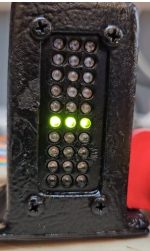
This AoA system is based on a Vane Sensor which will be installed undernith the right wing (symetrical to the Vans original pitot) and u-controller (Arduino PICO) and 10 rows of coloured LEDs (5 of them - green, for crouse AoA, 3 (yellow combined with red) for final approach and 2 red rows for critical (Stall) AoA. When the yellow rows lit tone is heard in the intecom system. The frequency of the tone increases as the AoA increases. Attached some photos -
1758818820499.png
 

Attachments

  • AoA Sensor in LAB.jpg
    AoA Sensor in LAB.jpg
    345.4 KB · Views: 32
  • AoA Sensor in LAB #2.jpg
    AoA Sensor in LAB #2.jpg
    224.2 KB · Views: 32
Last edited:
Hi,
Recently, I started working on my own AoA System.
This AoA system is based on a Vane Sensor which will be installed undernith the right wing (symetrical to the Vans original pitot) and u-controller (Arduino PICO) and 10 rpws of coloured LEDs (5 of them - green, for crouse AoA, 3 (yellow combined with red) for final approach and 2 red rows for critical (Stall) AoA. When the yellow rows lit tone is heard in the intecom system. The frequency of the tone increases as the AoA increases. Attached some photos -

Sweet.... That is a AOA vane like the big boys. Thanks for sharing. Cool.

There is an off shelf version (not as fun as making your own) from RiteAngle. https://www.riteangle.com/advantages-and-mounts/

Make a new thread when you get it all dialed in if you can.
 
Hi,
Recently, I started working on my own AoA System.
This AoA system is based on a Vane Sensor which will be installed undernith the right wing (symetrical to the Vans original pitot) and u-controller (Arduino PICO) and 10 rows of coloured LEDs (5 of them - green, for crouse AoA, 3 (yellow combined with red) for final approach and 2 red rows for critical (Stall) AoA. When the yellow rows lit tone is heard in the intecom system. The frequency of the tone increases as the AoA increases. Attached some photos -
View attachment 98138

You may want minimal lights to zero showing for cruise so they’re not annoying. Perhaps a point at which they’re all off. Also, consider marking L/Dmax for best glide and proxy of Vy. Don’t use up too much of the green real estate for areas you won’t really be using AOA. Able to show the AOAref or AOA for approach scheme? Might want more real estate from L/Dmax to stall and more real estate AOAref to stall as this area is where your AOA sensitivity and value all plays. Maybe all lights out at cruise coming on one row at a slower cruise like Carson, two or three rows for L/D, a row of green and a row yellow or maybe two yellows for AOAref (and proxy for both Vx and min power req), continuing up the rest of the scheme to stall. As you have two red, have potential for one bar as no flap imminent stall two bar flap imminent stall. Note you don’t need too many lights at critical as you’re not flying there, rather instead use the lights approaching such.

Note as you are true vane not pressure diff, you don’t have to resolve accelerated stall, but you also cannot use it as a takeoff instrument rather only a post rotation instrument (you can still check it be working as you takeoff roll but that is mere function test (and probably won’t need to as your design should be readily preflight inspection testable)).
 
You may want minimal lights to zero showing for cruise so they’re not annoying. Perhaps a point at which they’re all off. Also, consider marking L/Dmax for best glide and proxy of Vy. Don’t use up too much of the green real estate for areas you won’t really be using AOA. Able to show the AOAref or AOA for approach scheme? Might want more real estate from L/Dmax to stall and more real estate AOAref to stall as this area is where your AOA sensitivity and value all plays. Maybe all lights out at cruise coming on one row at a slower cruise like Carson, two or three rows for L/D, a row of green and a row yellow or maybe two yellows for AOAref (and proxy for both Vx and min power req), continuing up the rest of the scheme to stall. As you have two red, have potential for one bar as no flap imminent stall two bar flap imminent stall. Note you don’t need too many lights at critical as you’re not flying there, rather instead use the lights approaching such.

Note as you are true vane not pressure diff, you don’t have to resolve accelerated stall, but you also cannot use it as a takeoff instrument rather only a post rotation instrument (you can still check it be working as you takeoff roll but that is mere function test (and probably won’t need to as your design should be readily preflight inspection testable)).
Yes. I'm considering calibration of the "Lo AoA" at speed of around 120knt where the AoA is just higher then the AoA at cruise speed so at cruise there will be no any LED lit. I'm also plan to find the Best Glide Ratio (L/D max) AoA and make some color change in that AoA display for "in case of..". Anyway, it is all in study and development. As soon as I have the final system, I'm gone to put a short movie in YouTube.
 
Back
Top