Van's Air Force

The definitive Van's Aircraft support community! Buying, building or flying an RV? Join our exclusive family of mentors and enthusiasts!

Abnormally high CHT, EGT on single cylinder

benglish

Member
Patron
Setup:
RV-7A, Superior XP-IO-360 with a constant speed prop. ~800h since new. This was the first flight after a 2-3 week holiday. I recently switched to running G100UL fuel and have put about two tanks through. 45F OAT

Story:
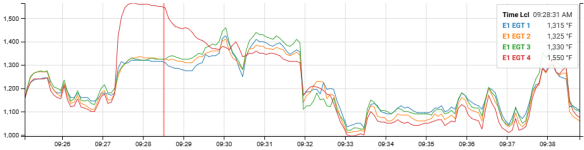
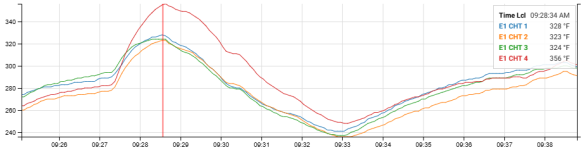
The runup and checks were normal. During takeoff the engine was running strong and I thought thought to myself how amazing it is to be able to fly and in particular a lightly loaded RV! At perhaps around 1000 ft AGL, I glanced over at the expanded engine monitor area on the second display and noticed that the cylinder 4 EGT was significantly higher than the others and the CHT was also significantly higher than the others. This is abnormal! I pulled the throttle back to about 50% and the abnormally high cylinder 4 CHTs started dropping. Satisfied that I wasn't going to be melting a cylinder immediately, I flew a normal-but-slightly-high pattern and landed. The engine seemed to be running normally on the ground, so in the interest of data collection I ran some tests: I performed a mag check which was normal, with EGTs rising as expected. I then ran the engine up to about 2200RPM, which is as much as I can do before the airplane starts skidding. The result was that the cylinder 4 EGT was hotter than the others and the #4 CHT climbed more rapidly and didn't level off as the other CHTs did. I should have swept the mixture during this process, but I didn't.

Data:
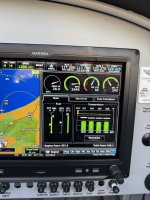
  • Attached is a photo I took of the engine monitor during climb out.
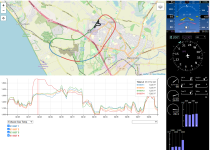
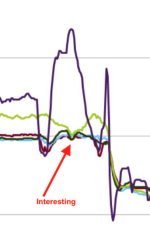
  • Attached are screenshots from the G3X Touch data log.
  • A review of previous flights shows good alignment normally between the cylinders for EGT, CHT
  • Fuel pressure on takeoff was ~37 PSI, dropping to ~25 PSI when I turned the fuel pump off. Looking back through the data from five or six recent flights, it seems this fuel or the correlation of a higher fuel pressure during periods where I think I was running the electric fuel pump is something that has only occurred recently, within the last 3 or 4 flights. Before then it was steady for the whole flight at ~25 PSI
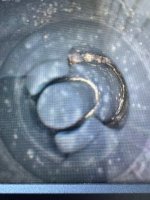
  • I was time limited today, so my inspection thus far has been: Remove top cowling. Nothing visually amiss. Remove #4 injector. No visible debris, obstructions. Remove #4 top spark plug. Looks undamaged, but needs a better inspection. Borescoped cylinder #4. Looks normal. The only thing I saw abnormal were two small metallic balls in the lower spark plug well. Checked intake and exhaust for security. Secure.
  • I plan on removing the bottom spark plug. Checking the intake and exhaust. Checking the fuel filters. Performing a flow test.
Theory:
This is where I could use your help! My guess is that cylinder 4 was running leaner than the others. This could be due to less fuel (restricted injector, spider issue) or more air (intake leak). I'm not sure what to make of the higher fuel pressure.

Have you encountered this before or have ideas of what might be going on?

Thanks!
 

Attachments

  • 2024-1-4 High CHT EGT pic.jpg
    2024-1-4 High CHT EGT pic.jpg
    785.5 KB · Views: 94
  • 2025-01-04 CHT Graph.png
    2025-01-04 CHT Graph.png
    45.1 KB · Views: 97
  • 2025-01-04 EGT Graph.png
    2025-01-04 EGT Graph.png
    61.8 KB · Views: 80
  • 2025-01-04 Overview.png
    2025-01-04 Overview.png
    519.7 KB · Views: 96
My guess is that cylinder 4 was running leaner than the others. This could be due to less fuel (restricted injector, spider issue) or more air (intake leak).
Seems like a reasonable guess. I'd go for the easy stuff first - check the injector for crud, then spider. Also look at the plugs. I'd also look at all the fuel filters - perhaps the change to G1000UL "cleaned" something and that crud moved downstream? Clogged filters might cause increased fuel pressure.
 
I have had a similar issue, the nozzle was partially clogged.
Looking at it with a flash light I saw no problem. Light coming through.
But with more light and looking very close, I saw that there was a restriction in the nozzle.
Cleaned and tested, problem gone.

Good luck
 
Sure sounds like a plugged injector nozzle to me. All the symptoms are there. It takes very little schmutz to affect the flow--you may not even see it. Soak the nozzle in some solvent and blow some air through it afterwards. Be sure to hold on tightly when you blow it out, and don't use a wire to clean it. Try running it again. If the problem is still there, perform a flow test with all four nozzles to see if there's something obstructing flow upstream in the flow divider (a.k.a. spider).

I am a little curious what the two small metallic balls were in the spark plug. Perhaps some lead build-up? Pull that plug and clean it if it's just some lead deposits, or replace it if it won't clean up.
 
I had similar situation on my 7's IO-360 180HP engine. I kept thinking it had to be a clogged injector. It ended up being a bad spark plug, that only had a problem at higher manifold pressure, than is possible during a run up.

At another time I saw similar indications, I switched plugs and injector pills to another cylinder, and
the symptoms did not follow to the switched cylinder. I then switched the EGT probe to the other cylinder and the symptoms followed the EGT probe. Replacing the probe cured the indication.
 
Last edited:
Setup:
RV-7A, Superior XP-IO-360 with a constant speed prop. ~800h since new. This was the first flight after a 2-3 week holiday. I recently switched to running G100UL fuel and have put about two tanks through. 45F OAT

Story:
The runup and checks were normal. During takeoff the engine was running strong and I thought thought to myself how amazing it is to be able to fly and in particular a lightly loaded RV! At perhaps around 1000 ft AGL, I glanced over at the expanded engine monitor area on the second display and noticed that the cylinder 4 EGT was significantly higher than the others and the CHT was also significantly higher than the others. This is abnormal! I pulled the throttle back to about 50% and the abnormally high cylinder 4 CHTs started dropping. Satisfied that I wasn't going to be melting a cylinder immediately, I flew a normal-but-slightly-high pattern and landed. The engine seemed to be running normally on the ground, so in the interest of data collection I ran some tests: I performed a mag check which was normal, with EGTs rising as expected. I then ran the engine up to about 2200RPM, which is as much as I can do before the airplane starts skidding. The result was that the cylinder 4 EGT was hotter than the others and the #4 CHT climbed more rapidly and didn't level off as the other CHTs did. I should have swept the mixture during this process, but I didn't.

Data:
  • Attached is a photo I took of the engine monitor during climb out.
  • Attached are screenshots from the G3X Touch data log.
  • A review of previous flights shows good alignment normally between the cylinders for EGT, CHT
  • Fuel pressure on takeoff was ~37 PSI, dropping to ~25 PSI when I turned the fuel pump off. Looking back through the data from five or six recent flights, it seems this fuel or the correlation of a higher fuel pressure during periods where I think I was running the electric fuel pump is something that has only occurred recently, within the last 3 or 4 flights. Before then it was steady for the whole flight at ~25 PSI
  • I was time limited today, so my inspection thus far has been: Remove top cowling. Nothing visually amiss. Remove #4 injector. No visible debris, obstructions. Remove #4 top spark plug. Looks undamaged, but needs a better inspection. Borescoped cylinder #4. Looks normal. The only thing I saw abnormal were two small metallic balls in the lower spark plug well. Checked intake and exhaust for security. Secure.
  • I plan on removing the bottom spark plug. Checking the intake and exhaust. Checking the fuel filters. Performing a flow test.
Theory:
This is where I could use your help! My guess is that cylinder 4 was running leaner than the others. This could be due to less fuel (restricted injector, spider issue) or more air (intake leak). I'm not sure what to make of the higher fuel pressure.

Have you encountered this before or have ideas of what might be going on?

Thanks!
I had nozzles look fine but deposits had "coated" the orifice invisible to the naked eye. Soaking in carb cleaner overnight cured it.
 
Update #1

Here is what I've done so far:
  • I cleaned the cylinder 4 injector. (#4 cylinder had the high CHT/EGT event described in the first post)
  • I replaced the cylinder 4 spark plugs with different ones.
  • I visually inspected the intake and exhaust for looseness / leaks / cracks etc. None found.
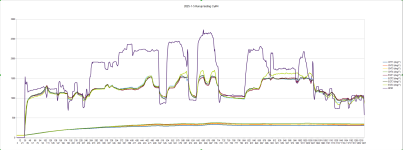
Then I ran the engine (cowling off) to see what effect these changes had. At low power, cylinder 4 temps were in good alignment with the other cylinders, but at higher powers and leaner mixtures, the cylinder 4 EGT was substantially hotter than the other cylinders. And even more strange (to me) was that as I leaned out the mixture past peak EGT on the other cylinders, resulting in cooler EGTs and eventually a rough running engine, the cylinder 4 EGT just kept getting hotter! I'll post a graph showing this. The first run at ~2300 RPM did not have this result, but the next run at ~2400 RPM did, as did the run at ~2600 RPM.

After shutting down, I performed a flow test on the injector lines coming from the flow divider. The amount of fuel collected over a 30 second boost pump run seemed to be even, but without taking a very scientific approach.

Questions:
  • How precise does the flow divider test need to be? What difference are we looking for?
  • Could a valve issue cause these symptoms?

I think my next steps are:
  1. Ask the Good Ship VAF for more advice! Thank you everyone who replied to my first post. It has been really helpful!
  2. Swap EGT sensors to confirm sensor functionality and re-run the engine test, with a bit more of a scientific approach to it.
  3. Re-borescope the cylinder, more thoroughly
  4. Perform a compression check
  5. Perform checks for an intake air leak, although, my understanding is that this would be cause more of an issue at lower powers than higher powers and I'm seeing the opposite.
  6. ?
Thanks!
Blake
 

Attachments

  • 2025-1-5 Runup testing Cyl4.png
    2025-1-5 Runup testing Cyl4.png
    588.8 KB · Views: 40
  • Fuel Flow Test.jpg
    Fuel Flow Test.jpg
    2.1 MB · Views: 38
Sure sounds like a plugged injector nozzle to me. All the symptoms are there. It takes very little schmutz to affect the flow--you may not even see it. Soak the nozzle in some solvent and blow some air through it afterwards. Be sure to hold on tightly when you blow it out, and don't use a wire to clean it. Try running it again. If the problem is still there, perform a flow test with all four nozzles to see if there's something obstructing flow upstream in the flow divider (a.k.a. spider).

I am a little curious what the two small metallic balls were in the spark plug. Perhaps some lead build-up? Pull that plug and clean it if it's just some lead deposits, or replace it if it won't clean up.
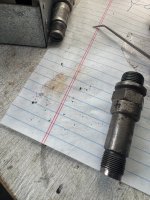
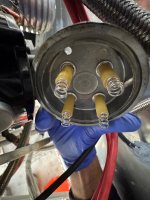
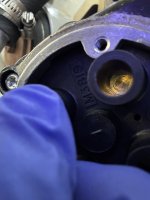
Here are images of the spark plug balls: Lead deposits? They crumbled when squished. The G100UL briefing warned to expect a black powder deposit on the plugs. They cleaned up easy.
 

Attachments

  • IMG_0474.jpg
    IMG_0474.jpg
    2.2 MB · Views: 49
  • IMG_0428.jpg
    IMG_0428.jpg
    3.2 MB · Views: 49
Yes lead. Ive run 99% unleaded for past 700 hrs /120 a year no issues . These dirty plugs certainly aren’t related to your new to you fuel type. Clean them all and rotate.
 
I'm scratching my head, as you've addressed what would appear to be the obvious causes. To answer your question about the deposits, yes, that looks like lead. Since you've made the fuel switch, that should be a thing of the past. And the flow test would appear to be pretty even, so it looks like the flow divider is likely okay.

The next steps you've outlined make sense to me. The EGT probe appears to be acting normally, but you need to rule that out as a possibility.
 
The injector was the highest probability, but it appears to be OK. Next on my list would be the sensors - time to determine if you really have a legitimate problem or just an instrumentation issue.
 
I may have missed it, but what ignition system do you have? 2 mags? 1 mag + 1pmag or ???

How do the ignition wires and ends look and measure?
Is any arcing visible at the ends?
How does the spring-end where it contacts the plug appear?
What's the resistance of the wire measure end-to-end (should be about 50 Ohms per foot; so a 3 foot wire will measure about 150 ohms).
The plug itself should measure ~3K - 5Kohms --- any more than that and it will not fire well, less than that and it will create noise in the audio system.

@BoydBirchler mentioned this in post #5: A failed/failing plug will tend to show up at higher manifold pressures than at idle/run up. The resistance at 12"MAP is much lower than at 25"MAP -- this is why spark plug testers pressurize the test chamber.
 
I think you are only running on one of the ignitions on that cylinder at power. Tie the plane down and do a full power ignition check or do one in the air if you fly it again. My guess is you will see that cylinder isn't firing on one of the ignitions. Good Luck, Mahlon
 
Update # 2 - Resolved…but how?
TLDR: Issue appears to have resolved after a second spark plug swap.

I really appreciate the folks posting in this thread with advice and knowledge! It has been very informative and comforting! Thank you!

Original issue: Cylinder 4 high EGT, CHT on takeoff and climb-out. Engine is ~900h since new with dual slick magnetos that have 400h and 450h since overhaul. I was able to duplicate the issue in the runup area after the flight.

Troubleshooting/data collection actions taken so far (in order):
  1. Saw high EGT, CHT on only cylinder 4 on takeoff. Was able to duplicate issue on the ground with an engine runup.
  2. Removed #4 injector, visually inspected, no blockage seen. Cleaned #4 injector and re-installed. Replaced #4 top and bottom spark plugs with used plugs borrowed from an airport neighbor. Tested and noted similar issues as the first test, but maybe not exactly the same (see update 1).
  3. Tested the flow divider and observed approximately even fuel from each branch. I swapped the EGT sensors for cylinders 2 and 4 to rule out a sensor issue. Reinstalled and tested, and saw similar issues, but I was more scientific during this runup and was able to isolate the poor behavior to running on the left mag, where the EGT would drop significantly when running at high power and leaned when running on the left mag only. I’ll post data from this run after I process it.
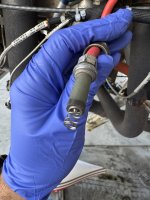
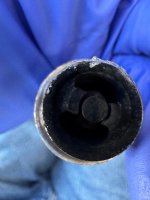
  4. Based on the engine run where the left mag issue was observed. I focused on the left mag -> cylinder 4 bottom sparkplug. I measured the resistance of the ignition harness from the left mag to the bottom plug. At 31.6ohms with a length of about 27”. I tested for a short between the conductor and insulator and found none using the 20Mohm setting on the multimeter. The harness ends looked good. No indication of arcing. I measured the resistance of the #4 bottom borrowed spark plug at 800ohms (Champion REM40E). I measured the resistance of the original plugs that were removed for troubleshooting at 1350 and 1130 ohms (Autolite / Tempest UREM-40E).
  5. As another datapoint, I installed a BRAND NEW Tempest REM-40E plug and tested. I was able to perform all the runup tests without seeing any issues. All seemed normal. This test was performed with a warm engine from the previous test.
  6. The next day, I repeated the engine runup tests with a cold engine and still did not observe the issues. I did this because I was trying to rule out a sticky valve that might be exhibiting “morning sickness”.
  7. Pulling the prop through 4 compression strokes, it felt like one of the compressions was less strong than the others.
  8. After two passing tests, and a lot of advice from airport neighbors, I felt confident enough to fly it. It flew normally without seeing the original issues. I had some other observations that I’ll discuss below, but those could be due to an increased focus and scrutiny during this process. In-flight mag check showed when running on one mag resulted in an increase of EGT and a slow decrease of CHT. Much different than the initial event.
So…I feel like I haven’t isolated the cause to my satisfaction, or what action fixed it. Here are some possibilities:
  1. The issue is intermittent and the spark plugs are not the cause. Something like a sticky exhaust valve. The engine is at 900h, and I’ve been told that would be common. This could be backed up by the data from one of the compressions being weaker than the others when pulling the prop through. I haven’t run a compression test yet. It could also have been a fuel flow restriction due to various reasons. The original event had high EGT and rising CHT. Subsequent flight testing showed a cooling CHT when running on one mag, but perhaps that was because the engine was already at a steady state temperature during the in flight test but warming up during the initial event on takeoff.
  2. Occam’s razor explanation: One of the original spark plugs was bad, and when I replaced both plugs with used plugs, one of the borrowed plugs was bad. Replacing the second bad plug with a new plug fixed the issue.
  3. The could also be an issue with the magnetos, exasperated by plugs. The time since overhaul on the mags is 400h and 450h and the differential RPM drop is large during normal runup mag tests at >150 RPM.
  4. The issues was inadvertently resolved by the disassembly/reassembly process, such as dislodging a blockage or better seating a connector, etc. Both this and the replacement spark plug issues could be true if the original issue and the second issue were coincidental.
  5. ?
I’m not satisfied because I don’t have a definitive answer. I suppose I could reverse some of the actions taken before the issue disappeared to verify, such as putting the original spark plugs back in, but i’m not sure even that would provide a solid answer.

Things I haven’t done:

  1. Check mag timing.
  2. Compression test
  3. Investigate valves for sticking.
Other things I’ve observed, I’m not sure if they are real or imagined or relevant:

-The fuel flow meter has always read higher when the electric fuel pump is on, which is a know issue for the installation arrangement. On the test flight, when the electric fuel pump was turned on, the fuel flow reading would shoot up, then settle back down to near the original value. When the electric pump was turned off, the fuel flow reading would drop then restore to the original value. I’m now noticing an increase in fuel pressure with the electric pump on, which I don’t recall seeing in previous flights, but maybe I just never noticed it. I looked at data from previous flights and the fuel pressure seemed to stay constant through the whole flight, but I’m not confident enough to say this for certain.

Here are my notes from the latest engine runs:

Run with borrowed plugs:


0 - 2:49 - Startup
100 - taxi (mid)
200 - In runup area. Runup 1900 RPM, Mag check (L off, Right off) then prop cycle. Trying full rich. Drop with L off seemed more than right off, doing again at 2:55 (1660 vs 1740). Runup leaned. Loft 1720, R off 1770. Both on 1880.
300 - Runup completed
500 - 2300 RPM - Dual Mag, Mixture out then in.
600 - 2300 RPM - Dual Mag, Lean somewhat, then L mag off (increased EGT), then both, then Right off (audible pops, aborted tests).
700 - Higher RPM, on Right mag (left off) 2500 RPM, leaned to roughness / pops and back.
800 - 3:06. - Higher RPM, on Left mag (right off) 2500 RPM, leaned to roughness / pops and back, but happened significantly sooner than the other mag. With very little mixture pull.
900 - Both to high RPM and lean - 3:09 - Saw the high EGT issue on cylinder 4.
1000 - Left mag higher RPM (right mag off) - 3:12 - 2650 RPM. Leaned slightly and Cyl 4 EGT fluctuating.
1100 - Right mag, high RPM (left mag off) - 3:13 - Substantial leaning possible and performed.
1200 - Duplicate Left mag on higher RPM 2650 (right mag off) + leaning = immediate pops and then drop on EGTs. Same as 1000.
1300->1500 - Test concluded Taxi back. 3:18
1600 - Mag test, Shutdown.

Run after replacing #4 bottom sparkplug with brand new:

100 - Startup 2:05pm
500 - Runup 2:09. First full rich, then leaned normally. Left off, Right off.
700 - High power on both mags, lean. 2650 RPM. Leaned without issue.
900 - High power on left mag on. Lean. 2650 RPM. A bit rougher but leaned without issue.
1100 - High power on right mag only. Lean. 2650 RPM.
Interesting that on left mag or right different pairs of cylinders have hotter EGTs than others, likely a top/bottom plug difference.
1200 - Higher power runup with alternating mags, first rich then lean. Left off first then right off. Then both.
1400 - Taxi back.
No issues.

In flight:
All operating normally. In flight mag checks as expected without issue. In-flight mag check showed when running on one mag resulted in an increase of EGT and a slow decrease of CHT. Much different than the initial event.

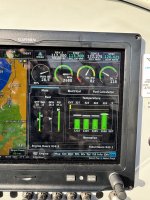
Attached photos show the ignition lead, removed borrowed plug from 4 bottom, and engine monitor during takeoff.
 

Attachments

  • IMG_0592.jpeg
    IMG_0592.jpeg
    1.3 MB · Views: 32
  • IMG_0597.jpeg
    IMG_0597.jpeg
    1.5 MB · Views: 27
  • IMG_0608.jpeg
    IMG_0608.jpeg
    1.7 MB · Views: 26
  • IMG_0613.jpeg
    IMG_0613.jpeg
    897.6 KB · Views: 29
  • IMG_0639.jpeg
    IMG_0639.jpeg
    2.8 MB · Views: 31
Last edited:
Back
Top