

Van's Air Force
You are using an out of date browser. It may not display this or other websites correctly.
You should upgrade or use an alternative browser.
You should upgrade or use an alternative browser.
61 knots dirty - Mosaic
- Thread starter KMMUflyer
- Start date

If that’s true that’s going open pretty much all the vans aircraft fleet to this ruling.That's quite a change if true. 54 clean to 61 landing configuration.
We'll see! I wouldn't start counting chickens just yet. Still hopeful.

Does he know what that means? AFAIK, he doesn't have any sort of pilot's license or previous experience in aviation.Duffy definitely did say "61 knots dirty". However, it just seems too good to be true. I am in disbelief until the actual rule is published in writing.
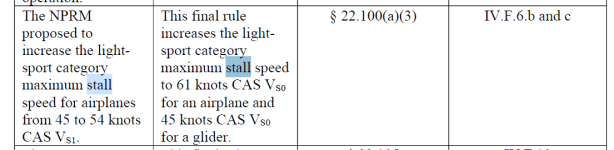

Link at very bottom is the actual faa documentEAA just released this. Clarifies 59 KCAS Clean

Source41
Member
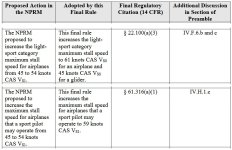
I saw this. I am a little confused now cause a bit lower it mentions for sport pilots the maximum is 59 kcas clean. So does that mean that as a sport pilot I won't be able to fly some potentially new LSA's? Or does it mean for I can fly LSA's that stall at 61 vs0 but only fly non-lsa's that stall at 59 vs1?This is the latest from the FAA publication regarding the changes in the final MOSAIC rules:
View attachment 93135
See pages 23-25 of the above link for actual rules.

I saw the same thing.I saw this. I am a little confused now cause a bit lower it mentions for sport pilots the maximum is 59 kcas clean. So does that mean that as a sport pilot I won't be able to fly some potentially new LSA's? Or does it mean for I can fly LSA's that stall at 61 vs0 but only fly non-lsa's that stall at 59 vs1?

I saw this. I am a little confused now cause a bit lower it mentions for sport pilots the maximum is 59 kcas clean. So does that mean that as a sport pilot I won't be able to fly some potentially new LSA's? Or does it mean for I can fly LSA's that stall at 61 vs0 but only fly non-lsa's that stall at 59 vs1?
If I'm reading this right, this de-couples the definitions of "Sport Pilot" and "Light Sport Airplane" in an interesting way.
- A Sport Pilot can only fly airplanes that stall at 59 knots or slower (clean).
- If you want to certify an airplane as an S-LSA, it can have a stall speed as fast as 61 knots (dirty).
A real example: I'm pretty sure the RV-10 stalls faster than 59 knots clean but slower than 61 knots dirty. This means it could be certified as an S-LSA but could not be flown by a Sport Pilot.
... I think. Is that right?
want to get further confused: Vans Brochure says RV10 stall speed in Mile Per Hour (not knots) Is 57mph "LIGHT" and 63mph "Heavy" of course the builder is the Manufacturer and valid testing will have final say in POH.
Good point. If a builder says that their RV-10 stalls at 59 knots clean at max gross (Maybe they added VGs and seaplane-style drooped wingtips? Or the "zero degrees" flap position isn't really zero degrees, and neither are the ailerons...) then it could be flown by a Sport Pilot. Right? Or something like that.
Translation: 61KNOTS = 70 MPH stall speed in landing configuration. seems to qualify the RV10 or am I getting it backwards?
Like I wrote above,
I'm pretty sure the RV-10 stalls faster than 59 knots clean but slower than 61 knots dirty. This means it could be certified as an S-LSA but could not be flown by a Sport Pilot.
... I think. Is that right?
Source41
Member
You are probably right. I am mostly thinking of it from the perspective as a sport pilot vs S/E-LSA. From a ownership perspective being a E-LSA vs EAB would allow a secondhand owner/non-builder to do maintenance if they have the LSA repairman cert right?Translation: 61KNOTS = 70 MPH stall speed in landing configuration. seems to qualify the RV10 or am I getting it backwards?
Last edited:
This is all gonna change, cuz it's too confusing. VS0 is landing config right (ala dirty), VS1 is clean.
He said 61 dirty, under what system is clean stall lower than dirty stall. Me thinks there is some swapping of vs0/vs1going on. Here is the vans published RV14 numbers for reference - https://www.vansaircraft.com/wp-content/uploads/2022/03/RV-14-V-speeds-Web-Post-Rev-3.pdf
He said 61 dirty, under what system is clean stall lower than dirty stall. Me thinks there is some swapping of vs0/vs1going on. Here is the vans published RV14 numbers for reference - https://www.vansaircraft.com/wp-content/uploads/2022/03/RV-14-V-speeds-Web-Post-Rev-3.pdf
There are two separate issues here:This is all gonna change, cuz it's too confusing. VS0 is landing config right (ala dirty), VS1 is clean.
He said 61 dirty, under what system is clean stall lower than dirty stall. Me thinks there is some swapping of vs0/vs1going on. Here is the vans published RV14 numbers for reference - https://www.vansaircraft.com/wp-content/uploads/2022/03/RV-14-V-speeds-Web-Post-Rev-3.pdf
- Can a sport pilot fly it? 59 clean.
- Can a newly-built (or newly-designed airplane) be given an E-LSA or S-LSA airworthiness certificate? 61 dirty.
Yes, but only if it was built way. The text of the new 61.316 says "If you hold a sport pilot certificate, you may act as pilot in command of an aircraft that, since its original certification, meets the following requirements"... (emphasis mine). That means that, just like the current sport rules, you can't modify a noncompliant aircraft back into something that a sport pilot can fly.Good point. If a builder says that their RV-10 stalls at 59 knots clean at max gross (Maybe they added VGs and seaplane-style drooped wingtips? Or the "zero degrees" flap position isn't really zero degrees, and neither are the ailerons...) then it could be flown by a Sport Pilot. Right? Or something like that.
Here’s the proposal: Among other things, an aircraft can be certified as an LSA if it meets the present single engine stall rule: 61 kcas or less at gross weight. But the pilot must have a private or higher rating. For a Sport pilot to be PIC the airplane has to meet the more stringent, Vs1 requirement of 59 kcas or less. The proposal does not say if you are allowed to meet that requirement by operating at a lower weight, or not.This is all gonna change, cuz it's too confusing. VS0 is landing config right (ala dirty), VS1 is clean.
He said 61 dirty, under what system is clean stall lower than dirty stall. Me thinks there is some swapping of vs0/vs1going on. Here is the vans published RV14 numbers for reference - https://www.vansaircraft.com/wp-content/uploads/2022/03/RV-14-V-speeds-Web-Post-Rev-3.pdf

Phyrcooler
Well Known Member
I found this explanation interestingIf I'm reading this right, this de-couples the definitions of "Sport Pilot" and "Light Sport Airplane" in an interesting way.
So: It is possible that there would be airplanes that will be certified as S-LSA, but that Sport Pilots would not be allowed to fly.
- A Sport Pilot can only fly airplanes that stall at 59 knots or slower (clean).
- If you want to certify an airplane as an S-LSA, it can have a stall speed as fast as 61 knots (dirty).
A real example: I'm pretty sure the RV-10 stalls faster than 59 knots clean but slower than 61 knots dirty. This means it could be certified as an S-LSA but could not be flown by a Sport Pilot.
... I think. Is that right?
View attachment 93145
Attachments
I think you got that wrong. Vs0 -59, vs1 - 61 is what I read
No, it's 59 clean (regarding what Sport Pilots can fly) and 61 dirty (regarding what airplanes may be certified as S-LSA/E-LSA). I think...
Yeah I got confused and so I removed my comment. Thanks for point out my poor thinkingNo, it's 59 clean (regarding what Sport Pilots can fly) and 61 dirty (regarding what airplanes may be certified as S-LSA/E-LSA). I think...
 .
.
rmartingt
Well Known Member
Nope. It's better. Get your LSA repairman cert and you could do either:You are probably right. I am mostly thinking of it from the perspective as a sport pilot vs S/E-LSA. From a ownership perspective being a E-LSA vs EAB would allow a secondhand owner/non-builder to do maintenance if they have the LSA repairman cert right?
The changes adopted in § 65.109(a) and (b) of this final rule do not impose additional restrictions but rather expand the privileges of a light-sport repairman. Specifically, § 65.107(c) will allow a light-sport repairman with an inspection rating to perform the annual condition inspection on an EAB aircraft that is owned by the repairman and that is in the same category of aircraft for which the certificate holder was trained. In addition, § 65.109(b) will permit a light-sport repairman with a maintenance rating to perform the annual condition inspection on an EAB aircraft that is in the same category of aircraft for which the certificate holder was trained.

Apparently yes. And some older TBMs may be among them.There are gonna be LSA aircraft that a sport pilot cannot fly?
All this confusion over 2 knots?
There are gonna be LSA aircraft that a sport pilot cannot fly?
How did something that should be so simple get so convoluted?
What a ridiculous and unnecessary mess!
It's way more than 2 knots in practice. More like 10-15 at touchdown depending on the airframe.
It is super confusing that a sport pilot would not qualify to fly all light sport aircraft.
It is nice that something like the RV10 or RV14 or RV15 (or C182 or SR22 or PA28 or..) could be factory built as a S-LSA or amateur built as a E-LSA if it were updated to ASTM standards.

The difference between 59 knots Vs1 and 61 knots Vs0 is considerably more than 2 knots.All this confusion over 2 knots?
What a ridiculous and unnecessary mess!
I agree 100% about the ridiculous part!

An airplane that stalls at 59 knots clean is almost always going to stall less than that dirty. -Sport Pilot AllowedThe difference between 59 knots Vs1 and 61 knots Vs0 is considerably more than 2 knots.
I agree 100% about the ridiculous part!
An airplane that stalls at 61knots dirty is almost always going to stall higher than that clean. -Sport Pilot Not Allowed
So yes the real spread is more than 2 knots depending on the airplane but these new final rules seem totally counterintuitive to what was trying to be accomplished.
This confusion will result in accidents and unintentional rule infractions.
An airplane that stalls at 59 knots clean is almost always going to stall less than that dirty. -Sport Pilot Allowed
An airplane that stalls at 61knots dirty is almost always going to stall higher than that clean. -Sport Pilot Not Allowed
So yes the real spread is more than 2 knots depending on the airplane but these new final rules seem totally counterintuitive to what was trying to be accomplished.
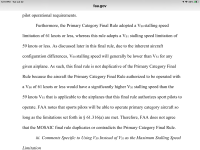
Page 239 gives their reasoning:
This final rule intentionally
separates aircraft certification requirements from pilot certification requirements, as the
established 61 knot VS0 stalling speed limitation for the certification of primary category
aircraft is a distinctly separate issue from the sport pilot aircraft limitation requirements
of § 61.316. The former establishes aircraft certification requirements while the latter sets
pilot operational requirements.
Furthermore, the Primary Category Final Rule adopted a VS0 stalling speed
limitation of 61 knots or less, whereas this rule adopts a VS1 stalling speed limitation of
59 knots or less. As discussed later in this final rule, due to the inherent aircraft
configuration differences, VS0 stalling speed will generally be lower than VS1 for any
given airplane. As such, this final rule is not duplicative of the Primary Category Final
Rule because the aircraft the Primary Category Final Rule authorized to be operated with
a VS0 of 61 knots or less would have a significantly higher VS1 stalling speed than the
59 knots VS1 that is applicable to the airplanes that this final rule authorizes sport pilots to
operate. FAA notes that sports pilots will be able to operate primary category aircraft so
long as the limitations set forth in § 61.316(a) are met. Therefore, FAA does not agree
that the MOSAIC final rule duplicates or contradicts the Primary Category Final Rule.
Thanks! I will have to read that about 5 times to understand what it meansPage 239 gives their reasoning:

I’m not a lawyer, but I think the answer is no. If you use a drivers license you have essentially downgraded yourself to light sport.Can a private pilot using a drivers license medical fly a light sport aircraft with a 61kt Vs0?

BoydBirchler
Well Known Member
"Can a private pilot using a drivers license medical fly a light sport aircraft with a 61kt Vs0?"
My reading of things. A "sport pilot" is different than a "Light Sport Pilot" I think you will no longer need a medical. You will self certify; just like sail plane pilots do.
My reading of things. A "sport pilot" is different than a "Light Sport Pilot" I think you will no longer need a medical. You will self certify; just like sail plane pilots do.

On the Vs1 discussion. Add some VG’s to the wing and measure your Vs1 CAS speed during Phase 1 and record it in the aircraft log. You as the manufacturer declare performance numbers.
https://microaero.com/wp-content/uploads/2023/06/rv-ocs.pdf
https://microaero.com/wp-content/uploads/2023/06/rv-ocs.pdf

Dan, I believe that I read somewhere in the multipage documents that "lift enhancement changes or devices not included by the original manufacturer may not be used to calculate or adjust Vs1. It may be in the definition of Vs1? So this idea may only apply to the builder prior to first Phase 1 and could not be of use after. But if Vans is publishing KCAS this may all be mute point.On the Vs1 discussion. Add some VG’s to the wing and measure your Vs1 CAS speed during Phase 1 and record it in the aircraft log. You as the manufacturer declare performance numbers.
https://microaero.com/wp-content/uploads/2023/06/rv-ocs.pdf
There is no such thing as a "Light-Sport Pilot"!"Can a private pilot using a drivers license medical fly a light sport aircraft with a 61kt Vs0?"
My reading of things. A "sport pilot" is different than a "Light Sport Pilot" I think you will no longer need a medical. You will self certify; just like sail plane pilots do.
Thanks! I will have to read that about 5 times to understand what it means
If I'm reading it correctly the argument is that sport pilots are less capable than private pilots and if things go real bad and the flaps & slats don't work you'll get down at 59 kts vs whatever the vs1 is for a plane with a vs0 of 61 (call it somewhere around 70-75). The difference in kinetic energy between 60 and 70 knots is huge.
This ruling divorces the sport pilot certificate from the light sport aircraft category. A sport pilot will be able to fly most but not all LSA category and a good number of other category single engined aircraft with 4 or less seats. A private pilot will be able to fly all LSA along with the other aircraft they can fly now that a sport pilot can't.

what's the point of calling an airplane a light sport airplane if a sport pilot cannot fly it? is there any benefit to having a PPL and flying a light sport airplane vs a regular non-light sport plane? whats the purpose of the LSA category if not for sport pilots to fly them?If I'm reading it correctly the argument is that sport pilots are less capable than private pilots and if things go real bad and the flaps & slats don't work you'll get down at 59 kts vs whatever the vs1 is for a plane with a vs0 of 61 (call it somewhere around 70-75). The difference in kinetic energy between 60 and 70 knots is huge.
This ruling divorces the sport pilot certificate from the light sport aircraft category. A sport pilot will be able to fly most but not all LSA category and a good number of other category single engined aircraft with 4 or less seats. A private pilot will be able to fly all LSA along with the other aircraft they can fly now that a sport pilot can't.

If I'm reading it correctly the argument is that sport pilots are less capable than private pilots and if things go real bad and the flaps & slats don't work you'll get down at 59 kts vs whatever the vs1 is for a plane with a vs0 of 61 (call it somewhere around 70-75).
I think part of this rationale isn't so much a matter of things not working as it is the handling of an emergency like power loss with the airplane in a clean takeoff configuration. LOTOT is a real thing and the consensus is that it's mitigated with a lot of training that may not take place for someone on the sport pilot path.
The funny thing is that training for Sport Pilots is very similar to that of PP…. frankly, the hard parts like landings and the overall concept of “keeping up with then plane” that usually result in people abandoning their training if they cannot master them , are exactly the same or even more difficult in Light Sport planes due to their light loading and greater susceptibility to crosswinds and such - the only true difference being about 50 miles longer cross country and some additional basic night training ( the easy parts)I think part of this rationale isn't so much a matter of things not working as it is the handling of an emergency like power loss with the airplane in a clean takeoff configuration. LOTOT is a real thing and the consensus is that it's mitigated with a lot of training that may not take place for someone on the sport pilot path.
Frankly, to me the cost/benefit ratio was just not there for SP certs as compared to PP certificates and I believe most pilots flying Light Sport planes were just PPs with expired medicals flying under Sport Pilot privileges - this may change now , will see.
what's the point of calling an airplane a light sport airplane if a sport pilot cannot fly it? is there any benefit to having a PPL and flying a light sport airplane vs a regular non-light sport plane? whats the purpose of the LSA category if not for sport pilots to fly them?
I haven’t made it through all 700+ pages but it seems prudent to ignore the naming conventions.
We’ve got a sport pilot that can do basically what most private pilots do (minus carrying more than one passenger). They can fly almost all the same planes including car and part 23 aircraft that they couldn’t fly before. All on a drivers license.
And we’ve got an expanded lsa category that could lead to new s-lsa and e-lsa 4 seat designs with similar performance to an rv10 or 182 or rv14 or sr22 or whatever that is slower than 250 knots and has a dirty stall of 61 knots. They need to meet industry and consensus standards vs the prescriptive standards of part 23.
Silly naming aside, it does mean that private pilots can build one of the new ELSA types without having to adhere to the 51% rule. Or they can buy a factory built SLSA (e.g. a ready to go RV-10 from Vans).what's the point of calling an airplane a light sport airplane if a sport pilot cannot fly it? is there any benefit to having a PPL and flying a light sport airplane vs a regular non-light sport plane? whats the purpose of the LSA category if not for sport pilots to fly them?
