

Van's Air Force
You are using an out of date browser. It may not display this or other websites correctly.
You should upgrade or use an alternative browser.
You should upgrade or use an alternative browser.
3D printed airplane parts
- Thread starter N804RV
- Start date

I would not rely on FDM printing for anything aircraft related, but that is just me.
I do all of my aircraft-related parts in HP-MJF.
HP-MJF Nylon 12 is a decent choice. Go to Xometry.com and you can get quotes to have parts made. If you choose the international option, the pricing is pretty impressive.
-Chris
I will ammend earlier my statement - I would not rely on FDM parts for anything on my aircraft that is firewall forward, or in an enclosed structure (like buried in a wing). For non-critical items, that are easily inspected as time goes on, it has its place I guess.
FDM gets better all the time, but for ME, that is what I am comfortable with.
I do all of my aircraft-related parts in HP-MJF.
HP-MJF Nylon 12 is a decent choice. Go to Xometry.com and you can get quotes to have parts made. If you choose the international option, the pricing is pretty impressive.
-Chris
I will ammend earlier my statement - I would not rely on FDM parts for anything on my aircraft that is firewall forward, or in an enclosed structure (like buried in a wing). For non-critical items, that are easily inspected as time goes on, it has its place I guess.
FDM gets better all the time, but for ME, that is what I am comfortable with.
Last edited:

That's a pretty broad statement.I would not rely on FDM printing for anything aircraft related, but that is just me.
I do all of my aircraft-related parts in HP-MJF.
HP-MJF Nylon 12 is a decent choice. Go to Xometry.com and you can get quotes to have parts made. If you choose the international option, the pricing is pretty impressive.
-Chris
Proper executed FDM parts work fine for some things aircraft related, others not so much. FWF parts I would definitely have doubts about; brackets, shelves, scoops, hangers, and most non structural parts would be ok, I think.
Yes, there are really good places that can make commercial grade products for a reasonable cost...

Most of the parts I have printed for my RV-12 are CF Nylon (rudder pedal extensions), CF Polycarbonate (engine compartment parts), ASA (excellent cockpit UV resistance), and some PETG. Prototypes are usually made using lower cost PLA. Most of the new higher end 'hobbyist' 3D printers handle the high print temperature (400C) materials like PEKK-CF, PPS-CF, PPSU, PPA, and PPA-CF. ULTEM would need a 400C rated nozzle and a 160C rated heated print bed.
You really need to match the material properties and the application use to get the best result. PRUSA has a handy materials guide that is suitable for most non-commercial 3D FDM printers. If you go the commercial printing route the high-temp material selection range is much better.
 help.prusa3d.com
You really need to match the material properties and the application use to get the best result. PRUSA has a handy materials guide that is suitable for most non-commercial 3D FDM printers. If you go the commercial printing route the high-temp material selection range is much better.
Filament Material Guide | Prusa Knowledge Base

Related, this just in:

 ca.news.yahoo.com
Plane crashed after 3D-printed part collapsed
The aircraft was completely destroyed after a spare part bought at an air show in America collapsed.

Related, this just in:
Plane crashed after 3D-printed part collapsed
The aircraft was completely destroyed after a spare part bought at an air show in America collapsed.
 Maybe I’ll re think that. Perhaps I could use the 3d printed example in making a part out of fiberglass/epoxy, like the snorkel is.
[email protected]
Active Member
We have extensive and excellent experience with FDM parts made from US-produced PETG filament made by Atomic Filament in Indiana on our Bambu P1S printers. But as with any material, one must take its application and environment into consideration. We have not made anything that would be exposed to the heat of an engine compartment, where we would likely use a high-temperature, flame-retardant composite using ProSet epoxies. FDM parts that are externally located should be sealed with paint/primer or clear-coated since they are not 100% watertight. Quality PETG filaments include excellent UV inhibitors and are quite appropriate for homebuilts, we believe. They are also naturally flame-retardant, although special flame-retardant filaments are available. We would not use them for any load-bearing applications, at least not yet. The technology is advancing rapidly and can not be ignored since the cost savings are considerable. See what we are doing now at aerosouth.net We will be adding a few more PE / FDM fairings soon.Was reading another thread and had a question. But I don’t want to send someone else’s thread off the rails.
Do we have any 3D printing experts on the forum?
How hard is it to print with the ULTEM filament? Is there a specific type of printer needed?
Back to making sure the material matches the application, it would be interesting to know what that part was made of. The ULTEM material originally mentioned has a glass transition temperature of 270C/518F, which should be fine for engine compartment parts (still need to look at other characteristics). At $500/kg for ULTEM filament those parts will be expensive. A number of commercial 3D print services can also print the parts using metal powders or metal infused plastic that is post processed to an all-metal part.
PLA is a great material to use for making FRP molds. I have made a few vacuum bagged parts, like NACA ducts, using PLA printed molds.
Is ULTEM 1010 the same as PRUSA's PEI 1010? If so, a mere $11,380 will get you the appropriate PRUSA printer.ULTEM would need a 400C rated nozzle and a 160C rated heated print bed.
You really need to match the material properties and the application use to get the best result. PRUSA has a handy materials guide that is suitable for most non-commercial 3D FDM printers. If you go the commercial printing route the high-temp material selection range is much better.
Filament Material Guide | Prusa Knowledge Base
Thanks a lot for all the responses. My buddy has printed up some test pieces for me to use to figure out which orientation will work best for my engine install. I think after that, I may try and use it as a pattern or mold in making something out of more suitable material.

Tg is not the right number. Nylon, for example, has a surprisingly low Tg (50-70 celsius!) but can bear significant structural load far above that. There's a goodI was under the impression that PPS-CF would be a good hi-temp filament to print under-cowl parts. After reading this thread its Tg is similar to ABS-CF, so it may not be suitable after all.
What you probably want to be looking at is HDT, the heat deflection temperature.
mike_tailwind
Member
The AAIB preliminary report says that the glass transition temperature of test samples of the failed part was 52.8C and 54C.
This was PLA and not the CF-ABS the owner was told. PLA should never be used in the engine compartment. It won't even survive in the cockpit in the summer sun.
This was PLA and not the CF-ABS the owner was told. PLA should never be used in the engine compartment. It won't even survive in the cockpit in the summer sun.
I don't think it was PLA, as per the report this had already done 50 hours. Under cowl temps can get very high and ABS doesn't have a particularly high working temp.The AAIB preliminary report says that the glass transition temperature of test samples of the failed part was 52.8C and 54C.
This was PLA and not the CF-ABS the owner was told. PLA should never be used in the engine compartment. It won't even survive in the cockpit in the summer sun.
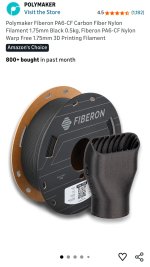
PA6-CF has worked well for under cowl cooling ducts in my experience but wouldnt use it on anything critical.
johnpaul44
Well Known Member
I don't think it was PLA, as per the report this had already done 50 hours. Under cowl temps can get very high and ABS doesn't have a particularly high working temp.
Keep in mind the accident aircraft was a pusher and I believe used an updraft cooling arrangement in the cowling. (Cool) air enters along the belly, flows up through the cylinders, and exits behind the prop... The reverse of an RV setup. As such the air below the cylinders at the intake would-be a lot cooler in general than in an RV.
Still, it was clearly hot enough to deflect *this* plastic.

It appears that Xometry can do HP-MJF Nylon 12 domestically but not internationally. I've been doing SLS Nylon 12, which can be done internationally. I just ordered a part made with HP-MJF and we will see if I can tell the difference.I would not rely on FDM printing for anything aircraft related, but that is just me.
I do all of my aircraft-related parts in HP-MJF.
HP-MJF Nylon 12 is a decent choice. Go to Xometry.com and you can get quotes to have parts made. If you choose the international option, the pricing is pretty impressive.
-Chris
I will ammend earlier my statement - I would not rely on FDM parts for anything on my aircraft that is firewall forward, or in an enclosed structure (like buried in a wing). For non-critical items, that are easily inspected as time goes on, it has its place I guess.
FDM gets better all the time, but for ME, that is what I am comfortable with.

After nearly 20 years of lurking I was asked to finally contribute and comment on this. (Hi Mike!). I suppose it's time for me to give back to the community
So:
Yes, there is a 3D printer expert on the forum, he's always listened rather than talked.
Yes, 3D printed parts are appropriate for aircraft
Yes, you can use 3D printed parts fire wall forward. Ive done it for over a decade.
And no, you shouldn't do it if you dont know what you are doing (just like anything)
I've been in the RP, 3D printing, Additive Manufacturing business since 1996. I also happen to own a 3D printer development startup which includes a print service bureau with industrial printers.
3D printing is like any other manufacturing process. Success of any design requires a combination of the right geometry, the right material, the right production process, and sufficient testing. No one would say that sheet metal is not appropriate for aircraft construction after the LCP problems. No one would say sheet metal is not acceptable for aircraft constriction if someone made wing ribs out lead sheet rather than aluminum. 3D printing is just the same. It's just gotten more accessible recently and there is a lot of poor understanding, lack of information, and many, many uninformed opinions floating around.
I'll try to start simply (if not briefly):
FDM printing has materials that work firewall forward and are strong. Here's the biggest problem: When you buy aluminum you are buying to international standards so you know what properties you are getting. There are NO international standards for polymers and that's just for raw pellets. 3D printing filament is even worse. Properties vary all over the map for materials that are sold claiming to be known resin types like ABS, ASA, PC etc. If you are buying internet filament you have no idea what you are getting. Allow me to explain.
When we print layered parts, thermal expansion or shrink that takes place as the part cools will distort your part. When we lay down a layer it will bond to the layer below then shrink. This is like a bi-metal spring where the layers now want to be different sizes. The result is warp, curl and other distortion. There is only 1 definitive solution for this on FDM parts: build the parts at a temperature where those warp forces can anneal out before they add up to enough to ruin the part. This is why production FDM printers build inside a heated oven at controlled temps. This has been well understood since the early 1990s and is very effective. For high performance polymers these warp forces can be enormous and any support structures for overhang are actually designed to stop upward warp rather than downward droop due to gravity.
There are also many forms of mitigation in use but they only work some time. (Very open fills, zig/ zag fills, some fiber filling, heated build plates, low Tg materials, etc.). These have become common place since the explosion of consumer 3D printers on the market that us mortals can afford and for hobby use that is fine. But it is mitigation not a cure. Low Tg materials are the norm here.
The scary thing now is we see "special 3D printing grade formulas" of filament claiming to be specific materials. The special formula is a common base material (like ABS) doped full of plasticizers or impact modifiers. The purpose is to make them print successfully on low temperature or open frame printers and it works. Unfortunately, the thermal and mechanical properties are also affected and sometimes drastically.
Take the recent UK crash. ABS typically has a Tg of 100C - 115C so it needs a printer with oven temp 90C or above. But, this material was tested to have a Tg between 50C and 55C. It was heavily doped material. It gets worse. When we test materials purchased off the internet, we get different properties on different spools or the same part number material. If you are buying "PEI". (polyetherimide) off the internet are sure you know what you are getting?
So what to do? A couple of things.
1) for firewall forward I would not use any material that is not brand name Ultem. It is eye watering expensive as filament ($300/ kg). The pellets alone cost more than $50/kg and it is finicky to turn into accurate filament. Add consistency and traceability and yeah, it adds up. Choose wisely.
2) Do not use an FDM part in an application that requires temp greater than 10 degrees below the build chamber temp that it was printed at. If its stress relieving at 60C in the printer it will always distort at 60C.
3) Dont believe that when you buy filament as something sold as ABS, PEI, PC, etc that you know what you are getting . You do not know what you're getting.
4) Prototype on your home printer than pay a real print shop to make a part for you. Xometery and others are fine. It won't be cheap.
Feel free to ask more.
I apoligize for the length and preachiness of this post. There is a lot to cover and this is just the beginning. I can cover powder based parts in another post. PBF, SLS, HSS, MJF, SAF, etc are all trade names for powder bed fusion parts that have their own can of worms.
It's the Wild West out there. Be careful.
PS: if you find this useful, thank P Howell for poking me into posting.
So:
Yes, there is a 3D printer expert on the forum, he's always listened rather than talked.
Yes, 3D printed parts are appropriate for aircraft
Yes, you can use 3D printed parts fire wall forward. Ive done it for over a decade.
And no, you shouldn't do it if you dont know what you are doing (just like anything)
I've been in the RP, 3D printing, Additive Manufacturing business since 1996. I also happen to own a 3D printer development startup which includes a print service bureau with industrial printers.
3D printing is like any other manufacturing process. Success of any design requires a combination of the right geometry, the right material, the right production process, and sufficient testing. No one would say that sheet metal is not appropriate for aircraft construction after the LCP problems. No one would say sheet metal is not acceptable for aircraft constriction if someone made wing ribs out lead sheet rather than aluminum. 3D printing is just the same. It's just gotten more accessible recently and there is a lot of poor understanding, lack of information, and many, many uninformed opinions floating around.
I'll try to start simply (if not briefly):
FDM printing has materials that work firewall forward and are strong. Here's the biggest problem: When you buy aluminum you are buying to international standards so you know what properties you are getting. There are NO international standards for polymers and that's just for raw pellets. 3D printing filament is even worse. Properties vary all over the map for materials that are sold claiming to be known resin types like ABS, ASA, PC etc. If you are buying internet filament you have no idea what you are getting. Allow me to explain.
When we print layered parts, thermal expansion or shrink that takes place as the part cools will distort your part. When we lay down a layer it will bond to the layer below then shrink. This is like a bi-metal spring where the layers now want to be different sizes. The result is warp, curl and other distortion. There is only 1 definitive solution for this on FDM parts: build the parts at a temperature where those warp forces can anneal out before they add up to enough to ruin the part. This is why production FDM printers build inside a heated oven at controlled temps. This has been well understood since the early 1990s and is very effective. For high performance polymers these warp forces can be enormous and any support structures for overhang are actually designed to stop upward warp rather than downward droop due to gravity.
There are also many forms of mitigation in use but they only work some time. (Very open fills, zig/ zag fills, some fiber filling, heated build plates, low Tg materials, etc.). These have become common place since the explosion of consumer 3D printers on the market that us mortals can afford and for hobby use that is fine. But it is mitigation not a cure. Low Tg materials are the norm here.
The scary thing now is we see "special 3D printing grade formulas" of filament claiming to be specific materials. The special formula is a common base material (like ABS) doped full of plasticizers or impact modifiers. The purpose is to make them print successfully on low temperature or open frame printers and it works. Unfortunately, the thermal and mechanical properties are also affected and sometimes drastically.
Take the recent UK crash. ABS typically has a Tg of 100C - 115C so it needs a printer with oven temp 90C or above. But, this material was tested to have a Tg between 50C and 55C. It was heavily doped material. It gets worse. When we test materials purchased off the internet, we get different properties on different spools or the same part number material. If you are buying "PEI". (polyetherimide) off the internet are sure you know what you are getting?
So what to do? A couple of things.
1) for firewall forward I would not use any material that is not brand name Ultem. It is eye watering expensive as filament ($300/ kg). The pellets alone cost more than $50/kg and it is finicky to turn into accurate filament. Add consistency and traceability and yeah, it adds up. Choose wisely.
2) Do not use an FDM part in an application that requires temp greater than 10 degrees below the build chamber temp that it was printed at. If its stress relieving at 60C in the printer it will always distort at 60C.
3) Dont believe that when you buy filament as something sold as ABS, PEI, PC, etc that you know what you are getting . You do not know what you're getting.
4) Prototype on your home printer than pay a real print shop to make a part for you. Xometery and others are fine. It won't be cheap.
Feel free to ask more.
I apoligize for the length and preachiness of this post. There is a lot to cover and this is just the beginning. I can cover powder based parts in another post. PBF, SLS, HSS, MJF, SAF, etc are all trade names for powder bed fusion parts that have their own can of worms.
It's the Wild West out there. Be careful.
PS: if you find this useful, thank P Howell for poking me into posting.
Thanks for that!
Dave
Dave

Other than being annoyingly intelligent and super friendly - Bill here is a great guy. He really knows the 3-d printing space, and engineering in general, and should be listened to. He has helped me think thru things many times and I always get a better result b/c of his knowledge. Now that he is "out of the closet" please take advantage of his knowledge and skills.After nearly 20 years of lurking I was asked to finally contribute and comment on this. (Hi Mike!). I suppose it's time for me to give back to the community
So:
Yes, there is a 3D printer expert on the forum, he's always listened rather than talked.
Yes, 3D printed parts are appropriate for aircraft
Yes, you can use 3D printed parts fire wall forward. Ive done it for over a decade.
And no, you shouldn't do it if you dont know what you are doing (just like anything)
I've been in the RP, 3D printing, Additive Manufacturing business since 1996. I also happen to own a 3D printer development startup which includes a print service bureau with industrial printers.
3D printing is like any other manufacturing process. Success of any design requires a combination of the right geometry, the right material, the right production process, and sufficient testing. No one would say that sheet metal is not appropriate for aircraft construction after the LCP problems. No one would say sheet metal is not acceptable for aircraft constriction if someone made wing ribs out lead sheet rather than aluminum. 3D printing is just the same. It's just gotten more accessible recently and there is a lot of poor understanding, lack of information, and many, many uninformed opinions floating around.
I'll try to start simply (if not briefly):
FDM printing has materials that work firewall forward and are strong. Here's the biggest problem: When you buy aluminum you are buying to international standards so you know what properties you are getting. There are NO international standards for polymers and that's just for raw pellets. 3D printing filament is even worse. Properties vary all over the map for materials that are sold claiming to be known resin types like ABS, ASA, PC etc. If you are buying internet filament you have no idea what you are getting. Allow me to explain.
When we print layered parts, thermal expansion or shrink that takes place as the part cools will distort your part. When we lay down a layer it will bond to the layer below then shrink. This is like a bi-metal spring where the layers now want to be different sizes. The result is warp, curl and other distortion. There is only 1 definitive solution for this on FDM parts: build the parts at a temperature where those warp forces can anneal out before they add up to enough to ruin the part. This is why production FDM printers build inside a heated oven at controlled temps. This has been well understood since the early 1990s and is very effective. For high performance polymers these warp forces can be enormous and any support structures for overhang are actually designed to stop upward warp rather than downward droop due to gravity.
There are also many forms of mitigation in use but they only work some time. (Very open fills, zig/ zag fills, some fiber filling, heated build plates, low Tg materials, etc.). These have become common place since the explosion of consumer 3D printers on the market that us mortals can afford and for hobby use that is fine. But it is mitigation not a cure. Low Tg materials are the norm here.
The scary thing now is we see "special 3D printing grade formulas" of filament claiming to be specific materials. The special formula is a common base material (like ABS) doped full of plasticizers or impact modifiers. The purpose is to make them print successfully on low temperature or open frame printers and it works. Unfortunately, the thermal and mechanical properties are also affected and sometimes drastically.
Take the recent UK crash. ABS typically has a Tg of 100C - 115C so it needs a printer with oven temp 90C or above. But, this material was tested to have a Tg between 50C and 55C. It was heavily doped material. It gets worse. When we test materials purchased off the internet, we get different properties on different spools or the same part number material. If you are buying "PEI". (polyetherimide) off the internet are sure you know what you are getting?
So what to do? A couple of things.
1) for firewall forward I would not use any material that is not brand name Ultem. It is eye watering expensive as filament ($300/ kg). The pellets alone cost more than $50/kg and it is finicky to turn into accurate filament. Add consistency and traceability and yeah, it adds up. Choose wisely.
2) Do not use an FDM part in an application that requires temp greater than 10 degrees below the build chamber temp that it was printed at. If its stress relieving at 60C in the printer it will always distort at 60C.
3) Dont believe that when you buy filament as something sold as ABS, PEI, PC, etc that you know what you are getting . You do not know what you're getting.
4) Prototype on your home printer than pay a real print shop to make a part for you. Xometery and others are fine. It won't be cheap.
Feel free to ask more.
I apoligize for the length and preachiness of this post. There is a lot to cover and this is just the beginning. I can cover powder based parts in another post. PBF, SLS, HSS, MJF, SAF, etc are all trade names for powder bed fusion parts that have their own can of worms.
It's the Wild West out there. Be careful.
PS: if you find this useful, thank P Howell for poking me into posting.
I do understand associating with me does show a certain lack of judgement by Bill. He is in counseling to make better friend choices.......Please don't hold that against him.

Wow. Thats a great read!
My first exposure were manufacturers I represented using it for “rapid prototyping”. No products were actually printed, just prototypes and patterns for mold or die development.
This really sheds light on the challenges to actually produce a “real” product.
I’ve seen some benign looking home brewed stuff shared in the forums that may not be so benign in the long run.
My first exposure were manufacturers I represented using it for “rapid prototyping”. No products were actually printed, just prototypes and patterns for mold or die development.
This really sheds light on the challenges to actually produce a “real” product.
I’ve seen some benign looking home brewed stuff shared in the forums that may not be so benign in the long run.

Thanks @BillTC - I now know a bit more about additive manufacturing. Understanding that "it's more complex than it seems" is very helpful. I predict that in the coming years more and more of our parts will be "printed" and it behooves us to have at least a basic understanding of the process and its limitations. I look forward to more of your posts.Feel free to ask more.

I thank you for your preaching! And I'd love for you to present a deep-dive into powder-based parts.Feel free to ask more.
......... I can cover powder based parts in another post. PBF, SLS, HSS, MJF, SAF, etc are all trade names for powder bed fusion parts that have their own can of worms.........

This report indicates Airbus is using this technology in both new aircraft and maintenance of existing aircraft.
Im happy to do that but I'm not sure how to make that happen,Bill the Cat -- I think you should do a EAA webinar on 3D printing aircraft parts.
All those words and I never attempted to answer your question.Was reading another thread and had a question. But I don’t want to send someone else’s thread off the rails.
Do we have any 3D printing experts on the forum?
How hard is it to print with the ULTEM filament? Is there a specific type of printer needed?
For Ultem 9085 (a blend of PEI and PC from Sabic): Unless the part is very small you will need an industrial printer where the build chamber reaches 190C. (375F)
For Ultem 1010 you will need a build chamber of at least 225 C (440F)
If the part is small, you can give it a go in a consumer printer if the print head can sustain temps of 400 -450C but once the print head is full of that material it is difficult to get it all out so it will likely require replacement of the print head or the melt section.
Can't seem to send this as a direct message:Im happy to do that but I'm not sure how to make that happen,
Hi Bill--
I'm glad to hear you'd be willing. I sent a note to EAA to ask if they'd be interested and how a webinar might happen. They may contact you directly through VAF, or if they get back to me, I'll let you know what they say.
--Chris
Chris,Can't seem to send this as a direct message:
Hi Bill--
I'm glad to hear you'd be willing. I sent a note to EAA to ask if they'd be interested and how a webinar might happen. They may contact you directly through VAF, or if they get back to me, I'll let you know what they say.
--Chris
Perhaps I haven't enough posts to send and receive direct messages? In the meantime, I will nominate Pete Howell to be a go between to get in contact with me.
Bill
I finally had time to get back to 3d printing basics.
Before we get into powder printing let’s talk about materials. (I’ll stick to thermoplastic polymers and leave photo cure polymers and metals for another day.)
Thermoplastics are melt processable polymers and come in 2 broad categories: Amorphous and Semi-crystaline and we see both types in every day life.
Amorphous polymers include: ABS, ASA, PC, PPO, PEI, PPSF, and more
Semi-crystaline polymers include: PA (polyamide or Nylon), PE (poly ethylene), PP (poly propylene), POM (Delrin), PEEK and more.
There are some oddities like nylon which comes in both crystalline or amorphous flavors and PLA which is a strange low temperature, low crystallinity resin used extensively in consumer FDM printers.
Filling polymers with fibers can increase stiffness and ultimate strength but they become more brittle and less tough. Because the semi-crystalline polymers are very tough they are commonly filled. Fibers also help control shrink for some purposes. As in all things, fiber filling is a trade off but is often a beneficial one for molded parts. Almost all auto intake systems are glass filled nylon these days.
The properties of these polymers will determine what applications they are appropriate for and which 3D printing technology they are compatible with.
FDM printing uses amorphous polymers almost exclusively (PLA being the big exception). These resins are lower shrink which helps with distortion.
But there is a bigger reason. In FDM printers we print in a heated oven or chamber to anneal out differential shrink stresses as the part is printing. For this process to work there MUST be a process temperature window where oven temperature is high enough for the stress to anneal out but is low enough that the parts do not sag or distorting due to gravity. The amorphous polymers typically have a window where this can be done successfully. The semi-crystalline polymers typically do not have a process window for this to work. For special geometries and small parts you can make it semi-crystalines work in some cases but they are rare. Nylons that you find for FDM printers are typically amorphous nylons or blends.
Powder printing is different. I will go into more detail about that process in another post but that process of sintering powder together is dependent on the polymer melting to low viscosity so the adjacent particles can “wet” out and bond together. This requirement favors the semi-crystalline materials since they quickly melt to low viscosity. Amorphous materials dont really work in this process. Powder printers use nylons (polyamides) almost exclusively. They have low melt viscosity and they are cost effective since there is already a commodity nylon powder milling industry for metal powder coating. There are a few polypropylene powders used now but they are fairly rare.
Since the 2 most common 3d printing technologies require different classes of polymers they have different properties, different advantages, and different limitations. I'll go into more detail in a future post.
Before we get into powder printing let’s talk about materials. (I’ll stick to thermoplastic polymers and leave photo cure polymers and metals for another day.)
Thermoplastics are melt processable polymers and come in 2 broad categories: Amorphous and Semi-crystaline and we see both types in every day life.
Amorphous polymers include: ABS, ASA, PC, PPO, PEI, PPSF, and more
Semi-crystaline polymers include: PA (polyamide or Nylon), PE (poly ethylene), PP (poly propylene), POM (Delrin), PEEK and more.
There are some oddities like nylon which comes in both crystalline or amorphous flavors and PLA which is a strange low temperature, low crystallinity resin used extensively in consumer FDM printers.
Filling polymers with fibers can increase stiffness and ultimate strength but they become more brittle and less tough. Because the semi-crystalline polymers are very tough they are commonly filled. Fibers also help control shrink for some purposes. As in all things, fiber filling is a trade off but is often a beneficial one for molded parts. Almost all auto intake systems are glass filled nylon these days.
The properties of these polymers will determine what applications they are appropriate for and which 3D printing technology they are compatible with.
FDM printing uses amorphous polymers almost exclusively (PLA being the big exception). These resins are lower shrink which helps with distortion.
But there is a bigger reason. In FDM printers we print in a heated oven or chamber to anneal out differential shrink stresses as the part is printing. For this process to work there MUST be a process temperature window where oven temperature is high enough for the stress to anneal out but is low enough that the parts do not sag or distorting due to gravity. The amorphous polymers typically have a window where this can be done successfully. The semi-crystalline polymers typically do not have a process window for this to work. For special geometries and small parts you can make it semi-crystalines work in some cases but they are rare. Nylons that you find for FDM printers are typically amorphous nylons or blends.
Powder printing is different. I will go into more detail about that process in another post but that process of sintering powder together is dependent on the polymer melting to low viscosity so the adjacent particles can “wet” out and bond together. This requirement favors the semi-crystalline materials since they quickly melt to low viscosity. Amorphous materials dont really work in this process. Powder printers use nylons (polyamides) almost exclusively. They have low melt viscosity and they are cost effective since there is already a commodity nylon powder milling industry for metal powder coating. There are a few polypropylene powders used now but they are fairly rare.
Since the 2 most common 3d printing technologies require different classes of polymers they have different properties, different advantages, and different limitations. I'll go into more detail in a future post.
