
I really like your methods here, and this is a great way to show that turbo-style injectors were needed due to delta P. I ended up with GAMI injectors on my plane, and can see blue dye on the annular inlet area of the #3 and #4 injectors. I suspect GAMI may not be willing to exchange for the turbo injectors however...Wide range of choices. The measurement device can be as simple as a length of vinyl tubing and a yardstick. Add water, a few drops of food coloring, and one drop of Dawn detergent.
View attachment 73899
Handheld electronic. Quite a few of these floating around in VAF land Available from Amazon, along with a whole lot of newer choices. They were about $35. Put a restrictor in the lines.
View attachment 73900
One of our folks recently tried a bluetooth manometer with good results. More expensive, but eliminates running vinyl tubing from the engine compartment to the cockpit.
You want the probes to pick up static pressure while ignoring dynamic pressure. For an oil cooler pressure reading, two aquarium bubble rocks should do the job, one at the face of the cooler and another on the back side. Or just wrap the ends of the tubes in a tight little wad of cloth.
Here is a bubble rock I was using to look at static pressure near a nozzle air bleed.
View attachment 73901
With deltaP in hand, consult oil cooler performance charts for airflow in lbs per time period. Stewart Warner/Meggitt charts here: https://www.danhorton.net/Misc/SW Oil Cooler Specifications.pdf
Nope. The tip of the vernatherm sees differential pressure, not system pressure. The deltaP is the difference between pressure at the vernatherm tip (flow direct from the pump) and pressure in the oil cooler return flow. The cooler's deltaP is often available on charts like the SW data linked above. Single pass coolers are low drop, and get lower as cooler size and oil temperature is increased. How low? For example, I run a SW 10611. 7 gallons per minute is the assumed pump rate for a Lyc, so at 7.5 lbs per gallon we have 53 lbs. The chart says pressure drop is 3 psi at 235F. To be precise, there would also be some additional drop due to the hoses and fittings, but the total would not be significant if the hose diameter is large enough.
View attachment 73902
BTW, your thinking isn't way off the mark. There is a specified "cracking pressure" for the vernatherm, which defines the psi at which the relief spring would allow the conical tip to push up off its seat. The Rosta spec sheet says it is 60 to 80 psi. If the oil cooler circuit should become blocked (for example, congealed oil on an Arctic flight), deltaP would become full system pressure. This relief is assumed to provide enough to oil flow to keep the engine alive.

Van's Air Force
You are using an out of date browser. It may not display this or other websites correctly.
You should upgrade or use an alternative browser.
You should upgrade or use an alternative browser.
13 row oil cooler inlet/exit
- Thread starter Cardinal767
- Start date


I really like your methods here, and this is a great way to show that turbo-style injectors were needed due to delta P. I ended up with GAMI injectors on my plane, and can see blue dye on the annular inlet area of the #3 and #4 injectors. I suspect GAMI may not be willing to exchange for the turbo injectors however...
Some or all of dye stains may be due to fuel boiling from the bleed opening after shutdown. Recall the nozzle body has an A stamped on one of the flats. It's to be installed with the A facing down, which means the bleed opening is facing up. Supposedly it helps with not spitting fuel when parked.
Yes, the letter location is dumb, because you can't see it when installed correctly. First time I remove a nozzle, I center punch a dot on the flat opposite the A so I can easily tell if the bleed is pointing up when I screw it back into the head. If the nozzles have been balanced, I stamp two dots on #2, three on 3, etc.
Don Rivera will sell you a turbo nozzle kit. Your restrictors, sourced from GAMI, should work fine.
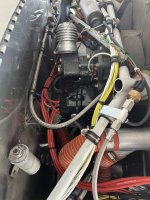
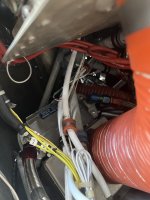
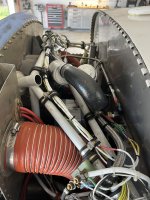
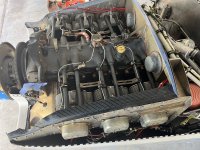
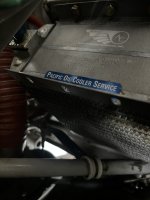
Brian Decker requested the attached pics of my installation.
Good call by Brian.
Zero sealing across the front. The seal is bass ackwards. Deteriorates deltaP across the cylinders and oil cooler.
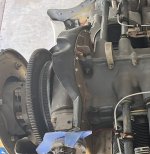
Reversed the seal. Test flight showed no improvement in oil temps.Good call by Brian.
Zero sealing across the front. The seal is bass ackwards. Deteriorates deltaP across the cylinders and oil cooler.
View attachment 74105

It's a process... 
Can we see some pictures of the inside of the upper cowling? We're looking for the "witness marks" that the baffle seals leave if they're set up correctly.
Also, the front ramps that start at the front inside lip of the cowl and extend aft....And...since we're here, how about a side view of the cylinder baffles (bottom).
IMHO and experience, 400°F is too high -- you should be able to achieve temps in the ~340 - 375°F range during a climb at ~110Kias with an OAT in the +20°C range...
From the plans -- note prop governor.
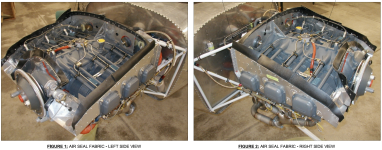
Can we see some pictures of the inside of the upper cowling? We're looking for the "witness marks" that the baffle seals leave if they're set up correctly.
Also, the front ramps that start at the front inside lip of the cowl and extend aft....And...since we're here, how about a side view of the cylinder baffles (bottom).
IMHO and experience, 400°F is too high -- you should be able to achieve temps in the ~340 - 375°F range during a climb at ~110Kias with an OAT in the +20°C range...
From the plans -- note prop governor.
Will do. Thanks again for your help.It's a process...
Can we see some pictures of the inside of the upper cowling? We're looking for the "witness marks" that the baffle seals leave if they're set up correctly.
Also, the front ramps that start at the front inside lip of the cowl and extend aft....And...since we're here, how about a side view of the cylinder baffles (bottom).
IMHO and experience, 400°F is too high -- you should be able to achieve temps in the ~340 - 375°F range during a climb at ~110Kias with an OAT in the +20°C range...
From the plans -- note prop governor.
View attachment 74158
Traveling for a few weeks. Will send more pics when I return.
I haven't tried the viscosity valve. I did a little research into it but never pulled the trigger. Maybe ill give that a shot before pulling the trigger on a different cooler.
This was the 4" scat tube setup that overheated in climbout. The plenum is piano hinge along the sides and back for sealing, and a long the front it's well sealed with red RTV. I've done a couple sessions with a dark hanger and lights inside the plenum to seal anything I can find for leakage around the baffles. Don't have pics with the cooler back on the show planes mount, but it seems to be the best solution so far for getting airflow to the cooler.
Circled in red...is it safe to assume there is a similar hole on the #4 side? In any case - plug it.
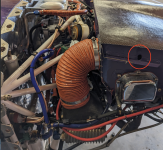

One would think it goes without saying, but I still find this issue: With this type of seal arrangement around the front of the engine, be sure that the 'tunnel' created by the fiberglass diffuser ramps glassed to the inside of the top cowl are closed off. If the 'tunnel' is open, there is a huge leak path through it from the upper cooling plenum into the nose area of the engine.It's a process...
Can we see some pictures of the inside of the upper cowling? We're looking for the "witness marks" that the baffle seals leave if they're set up correctly.
Also, the front ramps that start at the front inside lip of the cowl and extend aft....And...since we're here, how about a side view of the cylinder baffles (bottom).
IMHO and experience, 400°F is too high -- you should be able to achieve temps in the ~340 - 375°F range during a climb at ~110Kias with an OAT in the +20°C range...
From the plans -- note prop governor.
View attachment 74158
