Van's Air Force

The definitive Van's Aircraft support community! Buying, building or flying an RV? Join our exclusive family of mentors and enthusiasts!

P Mag Bearings, Old vs New

Phil Sprang

Well Known Member
Benefactor
I have P mags on my 80 hour Thunderbolt 390. As such, I follow P Mag threads fairly closely. There is a lot of talk about old style bearings vs new style bearings, small vs large bearings etc. it usually is difficult to follow which end is up because no one seemed to know then the changeover occurred.

Today, I stopped at the Hartzell booth at Airventure to get the answer.

If you have SN 8245 or newer, you have the new, bigger bearings.

That is all.
 
God forbid that PowerUp make engineering improvements...I spoke to Ryan at OSH and he spent 20 mins with me showing me the new bearings and the old bearings, and explained the improvements and why they made them. I came away impressed and happy with my choice to have them on my 390. Hopefully, this will cure those suffering from PMag Derangement Syndrome :ROFLMAO:
 
Did you ask if the new bearings actually fail any less than the old bearings?
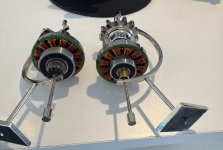
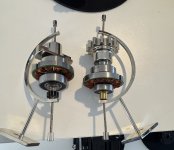
I would say the new bearings will last much longer after seeing the new compared to the old. Much larger and the shaft increased in size. Also, the bearings are a press fit instead of slip fit into the bearing housing. After talking to the Hartzell tech, I think the move to Hartzell is a positive move overall.

Look closely at the unit with the larger bearings. You can see the shaft is also larger.
 

Attachments

  • IMG_8013.jpeg
    IMG_8013.jpeg
    1.2 MB · Views: 97
  • IMG_8012.jpeg
    IMG_8012.jpeg
    1.6 MB · Views: 96
God forbid that PowerUp make engineering improvements...I spoke to Ryan at OSH and he spent 20 mins with me showing me the new bearings and the old bearings, and explained the improvements and why they made them. I came away impressed and happy with my choice to have them on my 390. Hopefully, this will cure those suffering from PMag Derangement Syndrome :ROFLMAO:
PMDS
 
God forbid that PowerUp make engineering improvements...I spoke to Ryan at OSH and he spent 20 mins with me showing me the new bearings and the old bearings, and explained the improvements and why they made them. I came away impressed and happy with my choice to have them on my 390. Hopefully, this will cure those suffering from PMag Derangement Syndrome :ROFLMAO:
Great news on the bearing upgrade. Did Ryan talk about any firmware revisions coming down the road for the 4 cylinder version? I'm actually hoping not as I have mine working exactly the way I want now.
 
I would say the new bearings will last much longer after seeing the new compared to the old. Much larger and the shaft increased in size. Also, the bearings are a press fit instead of slip fit into the bearing housing. After talking to the Hartzell tech, I think the move to Hartzell is a positive move overall.

Look closely at the unit with the larger bearings. You can see the shaft is also larger.
certainly beefier and likely an improvement. did anyone do an analysis to point to the small bearing size as the reason for failure? Always thought the failure was in the axial plane, though maybe the larger shaft with an interference fit addresses that.
 
certainly beefier and likely an improvement. did anyone do an analysis to point to the small bearing size as the reason for failure? Always thought the failure was in the axial plane, though maybe the larger shaft with an interference fit addresses that.
Exactly. What is the root cause of the failures? And is the new size appropriate for the loads, or was this a TLAR solution?
 
...Hopefully, this will cure those suffering from PMag Derangement Syndrome :ROFLMAO:
Depends on which camp of PMDS you are talking about: the faithful, who will will defend the product in the face of decades of unsatisfactory performance, or those who point out the continued unsatisfactory performance in the face of better products?

In any case, PMDS goes away when they stop failing and they develop a curve appropriate to the engine they are bolted to.
 
I have P mags on my 80 hour Thunderbolt 390. As such, I follow P Mag threads fairly closely. There is a lot of talk about old style bearings vs new style bearings, small vs large bearings etc. it usually is difficult to follow which end is up because no one seemed to know then the changeover occurred.

Today, I stopped at the Hartzell booth at Airventure to get the answer.

If you have SN 8245 or newer, you have the new, bigger bearings.

That is all.
Great. Something to look forward to in the future. I may buy a new one for swapping.
 
The smaller bearings were unlikely to have failed due to radial loading. Larger bearings are not necessarily a plus.

Why is it important? A bearing with a low radial load tends to skid the balls rather than roll them.

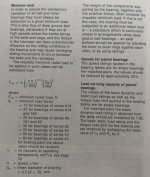
Consult the bearing selection pages in any major manufacturer's catalog. SKF, for example, states the rule of thumb for requisite minimum load is 0.01*C, "C" being basic dynamic load rating (more specifically, see below). Increasing bearing capacity (a larger bearing) also increases the required minimum load.

I am not saying there is something wrong with the new bearing selection, nor am I claiming to know why the old ones developed excessive clearance. I'm just offering some insight...bigger isn't necessarily better.

Bearing Minimum Load.jpg
 
The smaller bearings were unlikely to have failed due to radial loading. Larger bearings are not necessarily a plus.

Why is it important? A bearing with a low radial load tends to skid the balls rather than roll them.

Consult the bearing selection pages in any major manufacturer's catalog. SKF, for example, states the rule of thumb for requisite minimum load is 0.01*C, "C" being basic dynamic load rating (more specifically, see below). Increasing bearing capacity (a larger bearing) also increases the required minimum load.

I am not saying there is something wrong with the new bearing selection, nor am I claiming to know why the old ones developed excessive clearance. I'm just offering some insight...bigger isn't necessarily better.

View attachment 124103
i called one of the bearing makers when i designed my EI pickup. They discussed the same, as i wasn't expecting much radial load. they recommended wave washers on the outer race on one side to create a permanent light axial load to deal with that. they said that was enough to keep the balls spinning as well as preventing the outer race from sppining in its cavity, which is an equally large problem as the PP owners know. bearings are press fit on the shaft and outer races are slip on my setup.

i agree with you that just throwing larger bearings at the problem is far from a gauranteed fix. i still wonder if the axial play that folks find is in the bearing itself.
 
Last edited:
i called one of the bearing makers when i designed my EI pickup. They discussed the same, as i wasn't expecting much radial load. they recommended wave washers on the outer race on one side to create a permanent light axial load to deal with that. they said that was enough to keep the balls spinning as well as preventing the outer race from sppining in its cavity, which is an equally large problem as the PP owners know. bearings are press fit on the shaft and outer races are slip on my setup.

i agree with you that just throwing larger bearings at the problem is far from a gauranteed fix. i still wonder if the axial play that folks find is in the bearing itself.
If you tear down a Slick - it has a wave washer on the outer bearing race, I assume to do just what you mention. The bearing setup in the Slick appears to be pretty stout. I've never run mags, so I can't say if they have a low incidence of bearing issues or not.
 
If you tear down a Slick - it has a wave washer on the outer bearing race, I assume to do just what you mention. The bearing setup in the Slick appears to be pretty stout. I've never run mags, so I can't say if they have a low incidence of bearing issues or not.
My experience is that bearing failures on slicks are pretty low on the list of failure items found. Then again I haven’t done more than 10. Thanks to the huge chunk of iron spinning around, the slick can handle bigger bearings. Plenty of radial load with that much ch mass. My ei unit has bearings that look similar to the original pmag bearings. 1600 trouble free hours now.
 
Last edited:
My experience is that bearing failures on slicks are pretty low on the list of failure items found. Then again I haven’t done more than 10. Thanks to the huge chunk of iron spinning around, the slick can handle bigger bearings. Plenty of radial load with that much ch mass. My ei unit has bearings that look similar to the original pmag bearings. 1600 trouble free hours now.
I have torn apart alternators with smaller bearings than the new pmag versions and the spinning mass has to be 20X with significant radial loads from belt tension . Makes one wonder how much real analysis was done.
 
Great news on the bearing upgrade. Did Ryan talk about any firmware revisions coming down the road for the 4 cylinder version? I'm actually hoping not as I have mine working exactly the way I want now.
We didn't discuss firmware revisions. I was more concerned with whether the PMags upgrades were delaying engine shipments and the answer was no...
 
Back
Top