Van's Air Force

The definitive Van's Aircraft support community! Buying, building or flying an RV? Join our exclusive family of mentors and enthusiasts!

Emergency Landing Troubleshooting

xplane

Member
Hi all, on Canada day I had my first engine failure (suspected fuel starvation) in flight in my RV9A. I am a PPL with limited experience and looking for troubleshooting tips. I have an IO-320-B1A, IFR-rated and IMC permitted (and has been used as such for a very long time). 1700 Air time on airframe and engine, construction 2011.

Pre-flight included checking the breather hoses externally and fuel sump as usual. Taxi and run-up we had some difficulty with the magnetos check and CHT#3 temps since it was such a hot day (31C, 90% RH), we couldn’t get to high RPM and peak mixture to clean the plugs Finally we accepted a drop of 80rpm on each mag. Everything was done on the R tank. During takeoff, we noticed lower fuel pressure at 21 PSI. Historically we are at 26-27 PSI and the pump manufacturer (Tempest #AF15473) recommends 25-30. We turned on the electric fuel pump when we noticed this and the pressure went back up to 25 for the rest of the climb to 1500. Disengaged electric pump as of this altitude.

No indications during cruise, everything was going well. We did some steep turns and stalls. At some point a few minutes before the engine failure, I switched to the L fuel tank (for the first time since engine start). I did two stalls and on the second stall recovery, the engine failure occurred. No CHT/EGT/Oil pressure/Oil temperature indications, but the fuel pressure dropped. My instructor turned on the electric fuel pump and switched the tank back to R. This restarted the engine and we were able to make it down to an airport safely. On the ground, we re-checked the sumps and didn’t find any water or contaminants. A ground run on the next day with the mechanical fuel pump on L tank revealed no issues.

Speaking to a few people and looking at my engine data, we have a few main hypotheses:
1. Left-side breather hose partial blockage
2. Left-side fuel line partial blockage
3. Mechanical fuel pump in the process of failing
4. Possibility that I didn’t push the L fuel valve in completely resulting in partial fuel flow
5. Two people mentioned the possibility of vapour lock in flight? We were at 7500 density altitude, 90-95% humidity, during high nose-up attitude prior to stalls
6. Two people also mentioned the possibility of induction icing in the throttle body?

The mechanic on the ground put a thin metal wire inside the left breather hose and thinks he felt some blockage but wasn’t confident if it was a kink in the line or a real obstruction - diagnosis unclear.

Things I’d consider changing in all cases
1. Mechanical fuel pump is past service life (10 years), should we change this?
2. Engine oil and checking filters just to confirm we didn’t have an actual engine failure

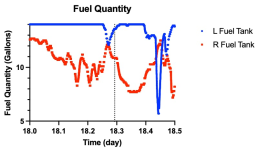
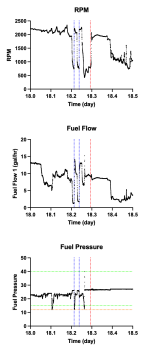
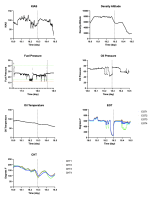
I've pulled the engine data from the EFIS and posted here. The vertical line represents approximately 1 minute post-emergency. Any ideas other than what we're thinking? Where should we start?

**Edit** Fuel quantity 13L/14R
 

Attachments
  • Screenshot 2026-07-03 at 1.35.58 PM.png
    Screenshot 2026-07-03 at 1.35.58 PM.png
    253.6 KB · Views: 49
Last edited:
Speaking to a few people and looking at my engine data, we have a few main hypotheses:
1. Left-side breather hose partial blockage
2. Left-side fuel line partial blockage
3. Mechanical fuel pump in the process of failing
4. Possibility that I didn’t push the L fuel valve in completely resulting in partial fuel flow
5. Two people mentioned the possibility of vapour lock in flight? We were at 7500 density altitude, 90-95% humidity, during high nose-up attitude prior to stalls
6. Two people also mentioned the possibility of induction icing in the throttle body?
1: vent line blockage would take a good bit longer than a couple minutes to cause immediatye starvation. it would sloiwly get worse over time and should take a lot longer than 2 minutes. i suspect you would have seen weeping rivets by now if it were blocked. very easy to test that.

2&3 is where i would start as most probable, with 2 a bit more likely imo. vapor lock doesn't seem likely with the scenario you layed out - immediate resolution with tank swap. icing is possible, but not really that common. it usually happens when you pull back power on hot humid days. Again, doesn't fit very well with the scenario you layed out - it wouldn't immediately restart on the other tank.
 
Last edited:
1: vent line blockage would take a good bit longer than a couple minutes to cause immediatye starvation. it would sloiwly get worse over time and should take a lot longer than 2 minutes, unless it was already under vacuum from the climb. i suspect you would have seen weeping rivets by now if it were blocked. very easy to test that.

2&3 is where i would start as most probable, with 2 a bit more likely imo. vapor lock doesn't seem likely with the scenario you layed out. icing is possible, but not really that common. it usually happens when you pull back power on hot humid days. Again, doesn't fit very well with the scenario you layed out.
We did pull back power twice for the stalls, is your assessment the same? They lasted maybe 30 seconds at a time so very short duration.
 
We did pull back power twice for the stalls, is your assessment the same? They lasted maybe 30 seconds at a time so very short duration.
You have a servo, not a carb. difficult to get carb ice if you don't have a carb. What causes the ice is the rapid cooloing, in part, from latent heat of evaporation from the fuel mixed in the low pressure part of the venturi. No fuel mixed there in a servo.
 
Are you sure the fuel selector valve was 100% in the right spot?
I can't rule out the possibility that I mistakenly had it only halfway in position. I'd like to think that it was but no way to prove it which is why it's in the list of options. I hope it's as simple of an answer as that.
 
Hi all, on Canada day I had my first engine failure (suspected fuel starvation) in flight in my RV9A. I am a PPL with limited experience and looking for troubleshooting tips. I have an IO-320-B1A, IFR-rated and IMC permitted (and has been used as such for a very long time). 1700 Air time on airframe and engine, construction 2011.

Pre-flight included checking the breather hoses externally and fuel sump as usual. Taxi and run-up we had some difficulty with the magnetos check and CHT#3 temps since it was such a hot day (31C, 90% RH), we couldn’t get to high RPM and peak mixture to clean the plugs Finally we accepted a drop of 80rpm on each mag. Everything was done on the R tank. During takeoff, we noticed lower fuel pressure at 21 PSI. Historically we are at 26-27 PSI and the pump manufacturer (Tempest #AF15473) recommends 25-30. We turned on the electric fuel pump when we noticed this and the pressure went back up to 25 for the rest of the climb to 1500. Disengaged electric pump as of this altitude.

No indications during cruise, everything was going well. We did some steep turns and stalls. At some point a few minutes before the engine failure, I switched to the L fuel tank (for the first time since engine start). I did two stalls and on the second stall recovery, the engine failure occurred. No CHT/EGT/Oil pressure/Oil temperature indications, but the fuel pressure dropped. My instructor turned on the electric fuel pump and switched the tank back to R. This restarted the engine and we were able to make it down to an airport safely. On the ground, we re-checked the sumps and didn’t find any water or contaminants. A ground run on the next day with the mechanical fuel pump on L tank revealed no issues.

Speaking to a few people and looking at my engine data, we have a few main hypotheses:
1. Left-side breather hose partial blockage
2. Left-side fuel line partial blockage
3. Mechanical fuel pump in the process of failing
4. Possibility that I didn’t push the L fuel valve in completely resulting in partial fuel flow
5. Two people mentioned the possibility of vapour lock in flight? We were at 7500 density altitude, 90-95% humidity, during high nose-up attitude prior to stalls
6. Two people also mentioned the possibility of induction icing in the throttle body?

The mechanic on the ground put a thin metal wire inside the left breather hose and thinks he felt some blockage but wasn’t confident if it was a kink in the line or a real obstruction - diagnosis unclear.

Things I’d consider changing in all cases
1. Mechanical fuel pump is past service life (10 years), should we change this?
2. Engine oil and checking filters just to confirm we didn’t have an actual engine failure

I've pulled the engine data from the EFIS and posted here. The vertical line represents approximately 1 minute post-emergency. Any ideas other than what we're thinking? Where should we start?

OMG, this is confusing to read.

How can you go through this whole post and say nothing about the level of fuel in the affected tank?
 
Adding to what LR172 said, it's relatively easy to check fuel flow from each tank. Disconnect the fuel inlet to the servo and rig up a piece of tubing to a bucket or fuel container that you can measure. Run the electric pump with the fuel selector on the left tank for a specified period of time, then repeat with the right tank for the same time. The quantities of fuel pumped from each tank should be pretty close to the same. If they're not, something is restricting flow.

Also, in your OP you stated that the instructor turned the electric fuel pump on and switched back to the right tank. Did he leave the electric pump on, or switch it off when normal engine operation resumed? Or were you too puckered up to notice? :rolleyes:
 
You should check for an obstructed vent, not because it’s likely but because it’s so easy (always check easy stuff first). Just slip/tape some vinyl tubing over the vent, stand next to the open fill port, and blow into the tubing. You should hear the bubbles in the tank.
 
Adding to what LR172 said, it's relatively easy to check fuel flow from each tank. Disconnect the fuel inlet to the servo and rig up a piece of tubing to a bucket or fuel container that you can measure. Run the electric pump with the fuel selector on the left tank for a specified period of time, then repeat with the right tank for the same time. The quantities of fuel pumped from each tank should be pretty close to the same. If they're not, something is restricting flow.

Also, in your OP you stated that the instructor turned the electric fuel pump on and switched back to the right tank. Did he leave the electric pump on, or switch it off when normal engine operation resumed? Or were you too puckered up to notice? :rolleyes:
Thanks for the suggestion! I will definitely try that ASAP, great idea.

I was VERY puckered but conscious enough to know that he left the electric on until landing. In fact, at the beginning, the electric pump in itself for about 20 seconds didn't do much. He then turned on R tank, electric still on and after about 5 seconds the engine came back.

For the moment we can't isolate that it's the mechanical pump or the L fuel system, I don't think - until diagnostic testing which will include your suggestion.
 
You should check for an obstructed vent, not because it’s likely but because it’s so easy (always check easy stuff first). Just slip/tape some vinyl tubing over the vent, stand next to the open fill port, and blow into the tubing. You should hear the bubbles in the tank.
This will be checked, thanks!

Maybe my understanding of the vent is flawed, but why would I hear bubbles in the tank? I thought the tank-end of the vent line was above the fuel level, not within it (which would surely let fuel spill out?)

The fuel tank/wings were part of a quick build according to the constructor. How easy would it be to get into the fuel tank-end of the line and blow outwards towards the outside? Or is that a major job?
 
I might have missed it, but which fuel valve do you have? With the brass valve from the hardware store plumbing aisle Vans Aircraft, it's easier to accidentally wind up in-between detents, compared to something like an Andair valve.
Andair valve according to the constructor
 
This will be checked, thanks!

Maybe my understanding of the vent is flawed, but why would I hear bubbles in the tank? I thought the tank-end of the vent line was above the fuel level, not within it (which would surely let fuel spill out?)

The fuel tank/wings were part of a quick build according to the constructor. How easy would it be to get into the fuel tank-end of the line and blow outwards towards the outside? Or is that a major job?
Yes, sorry. You need to have the tank absolutely full. You’ll either hear or see the air bubbles, or the gas itself will rise and overflow. If not full, you can often hear the air entering the tank.
Getting inside a finished tank is a lot of work.
 
Yes, sorry. You need to have the tank absolutely full. You’ll either hear or see the air bubbles, or the gas itself will rise and overflow. If not full, you can often hear the air entering the tank.
Getting inside a finished tank is a lot of work.
I've never heard bubbles during a check, but Bob's method works regardless. I use a piece of about six foot long 3/8" ID clear vinyl hose that fits over the vent fitting nicely. If you have a vent other than what Van's outlines, yours may need something different. With the fuel cap off, you can put one ear to the opening and blow on the vinyl hose--you should hear the air rushing out at the tank opening. You should also be able to judge if there's a restriction by how hard it is to blow in each side. If your cheeks feel like they're gonna pop, then something's not right. Don't use compressed air--blowing on the tube is more than adequate.

If you DO find a restriction, don't panic. At least not yet. The section of vent line that's in the cockpit can be checked/inspected independently from the tank line, which is a pretty easy job. If there is a restriction, it's most likely to be between the vent fitting on the bottom of the fuselage and where it goes into the tank. That can all be looked at without having to open up the tank itself.
 
I've never heard bubbles during a check, but Bob's method works regardless. I use a piece of about six foot long 3/8" ID clear vinyl hose that fits over the vent fitting nicely. If you have a vent other than what Van's outlines, yours may need something different. With the fuel cap off, you can put one ear to the opening and blow on the vinyl hose--you should hear the air rushing out at the tank opening. You should also be able to judge if there's a restriction by how hard it is to blow in each side. If your cheeks feel like they're gonna pop, then something's not right. Don't use compressed air--blowing on the tube is more than adequate.

If you DO find a restriction, don't panic. At least not yet. The section of vent line that's in the cockpit can be checked/inspected independently from the tank line, which is a pretty easy job. If there is a restriction, it's most likely to be between the vent fitting on the bottom of the fuselage and where it goes into the tank. That can all be looked at without having to open up the tank itself.
Thank you so much, I'll follow exactly that
 
You should check for an obstructed vent, not because it’s likely but because it’s so easy (always check easy stuff first). Just slip/tape some vinyl tubing over the vent, stand next to the open fill port, and blow into the tubing. You should hear the bubbles in the tank.
Unless the fuel vent is installed improperly, it is rarely submerged in fuel so your wont see any bubbles.

What you can see when the fuel cap is removed, is fuel vapor boiling out of the open fuel filler. This is a standard testing method during a condition inspection.

In reality, it is unlikely that a plugged tank vent caused the engine stoppage (this is typically more likely with a gravity fed fuel system).

A plugged vent results in the tank skins being compressed inward from external air pressure pretty severely as fuel is drawn from the tank, before the pump stops drawing fuel and causing an engine stoppage.

I have seen tanks that had the internal ribs permanently buckled from the compression of the skins, where an engine stoppage never occurred. I said unlikely.... because I suppose it could occur in a instance where the engine driven fuel pump was failing, and was unable to produce enough pressure delta to cause the tank skin to be compressed inward before fuel pressure fell below the level required to keep the engine running.
 
Not to add to your already big list of things to check but you still haven't mentioned which fuel valve you have. Those of us still using the standard valve supplied by Vans know that sometimes the detents can feel a little vague. It's entirely possible to not be securely in position. Just a thought.
Good luck
danny
 
Not to add to your already big list of things to check but you still haven't mentioned which fuel valve you have. Those of us still using the standard valve supplied by Vans know that sometimes the detents can feel a little vague. It's entirely possible to not be securely in position. Just a thought.
Good luck
danny
It's an Andair valve. I could have sworn that I put it completely into position when switching to the L tank but unfortunately there's no way of me confirming this.
 
Unless the fuel vent is installed improperly, it is rarely submerged in fuel so your wont see any bubbles.

What you can see when the fuel cap is removed, is fuel vapor boiling out of the open fuel filler. This is a standard testing method during a condition inspection.

In reality, it is unlikely that a plugged tank vent caused the engine stoppage (this is typically more likely with a gravity fed fuel system).

A plugged vent results in the tank skins being compressed inward from external air pressure pretty severely as fuel is drawn from the tank, before the pump stops drawing fuel and causing an engine stoppage.

I have seen tanks that had the internal ribs permanently buckled from the compression of the skins, where an engine stoppage never occurred. I said unlikely.... because I suppose it could occur in a instance where the engine driven fuel pump was failing, and was unable to produce enough pressure delta to cause the tank skin to be compressed inward before fuel pressure fell below the level required to keep the engine running.
It was part of a quick build so as far as I know it was done by Vans, according to the builder. The mechanic on the ground indeed looked for skin compression or vacuum hissing when he opened the tank and found nothing hinting at it. For some reason though, he's still convinced that's the problem.
 
Since no one has commented on it - in the graphs on the original post, the fuel pressure drops intermittently at many points in the flight. Does anything think that's an indication that the mechanical pump is failing? Or could it just be a side effect of a blockage?
 
My first inclination is still something preventing/restricting flow from the left tank. The flow test outlined in Post #11 should be able to confirm or eliminate that. Since you're not caught up in Fourth of July activities today, maybe you and your mechanic will be able to take a look.

Looking back at your original post, you mentioned, "Possibility that I didn’t push the L fuel valve in completely resulting in partial fuel flow". With the Andair valves I've seen, you don't need to push the valve in. English may be a second language since you're from Montreal, so maybe that's just the phrasing that's got me there (I'm not trying to be condescending). But I'm just curious about the valve. The Andair valve should be clearly labeled, and they have a big red triangle pointer as the valve handle. You should be able to go all the way to the stops for left or right, lifting the button only to go to the OFF position. That's one of the advantages to this valve, as you can go all the way to the stops without looking.
 
Hi all, on Canada day I had my first engine failure (suspected fuel starvation) in flight in my RV9A. I am a PPL with limited experience and looking for troubleshooting tips. I have an IO-320-B1A, IFR-rated and IMC permitted (and has been used as such for a very long time). 1700 Air time on airframe and engine, construction 2011.

Pre-flight included checking the breather hoses externally and fuel sump as usual. Taxi and run-up we had some difficulty with the magnetos check and CHT#3 temps since it was such a hot day (31C, 90% RH), we couldn’t get to high RPM and peak mixture to clean the plugs Finally we accepted a drop of 80rpm on each mag. Everything was done on the R tank. During takeoff, we noticed lower fuel pressure at 21 PSI. Historically we are at 26-27 PSI and the pump manufacturer (Tempest #AF15473) recommends 25-30. We turned on the electric fuel pump when we noticed this and the pressure went back up to 25 for the rest of the climb to 1500. Disengaged electric pump as of this altitude.

No indications during cruise, everything was going well. We did some steep turns and stalls. At some point a few minutes before the engine failure, I switched to the L fuel tank (for the first time since engine start). I did two stalls and on the second stall recovery, the engine failure occurred. No CHT/EGT/Oil pressure/Oil temperature indications, but the fuel pressure dropped. My instructor turned on the electric fuel pump and switched the tank back to R. This restarted the engine and we were able to make it down to an airport safely. On the ground, we re-checked the sumps and didn’t find any water or contaminants. A ground run on the next day with the mechanical fuel pump on L tank revealed no issues.

Speaking to a few people and looking at my engine data, we have a few main hypotheses:
1. Left-side breather hose partial blockage
2. Left-side fuel line partial blockage
3. Mechanical fuel pump in the process of failing
4. Possibility that I didn’t push the L fuel valve in completely resulting in partial fuel flow
5. Two people mentioned the possibility of vapour lock in flight? We were at 7500 density altitude, 90-95% humidity, during high nose-up attitude prior to stalls
6. Two people also mentioned the possibility of induction icing in the throttle body?

The mechanic on the ground put a thin metal wire inside the left breather hose and thinks he felt some blockage but wasn’t confident if it was a kink in the line or a real obstruction - diagnosis unclear.

Things I’d consider changing in all cases
1. Mechanical fuel pump is past service life (10 years), should we change this?
2. Engine oil and checking filters just to confirm we didn’t have an actual engine failure

I've pulled the engine data from the EFIS and posted here. The vertical line represents approximately 1 minute post-emergency. Any ideas other than what we're thinking? Where should we start?

**Edit** Fuel quantity 13L/14R

With Injected engines, the engine will falter and pretty positively shut down if the fuel pressure at the servo inlet goes below about 15 psi. Your data shows that that happened, therefore the engine shutdown. Probably just bringing the electric pump online would have been all that was required for the engine to resume running, however the instructors training to switch the tank also is valid.
So the main question is why the fuel pressure dropped off. The mechanical fuel pump short comings are thoroughly discussed in these forums, but I will say from personal experience that the mechanical pump doesn’t tolerate any leakage before the pump. That is a leak under suction, that may not even show up under pressure (electric pump on).

This doesn’t mean that you should rule out other things that could restrict fuel flow.
 
1783171795764.png

I expect to go to the plane tomorrow with my mechanic - for now I'm digging into the data.

From the raw data, here's what I gather.

18:15:06 engine begins quitting, 2200 rpm steadily dropping
18:15:52 lowest RPM (engine dead), 419, fuel pressure lowest
18:15:53 Electric fuel pump ON, pressure comes back immediately, fuel flow stabilizes
estimated time R tank switch ~18:17:10
18:17:34 7700, engine RPM sharply rising
18:17:51 Engine back to normal RPM

The period of time between electric pump ON ~90 seconds seems to suggest to me fuel restriction rather than mechanical pump failure. What I don't seem to understand is why, despite fuel flow going back up as of 18:15:53, the engine doesn't come back until 90 seconds later.

The fuel pressure sensor to my understanding is on the mechanical fuel pump itself. Where is the fuel flow sensor?
 
Last edited:
My first inclination is still something preventing/restricting flow from the left tank. The flow test outlined in Post #11 should be able to confirm or eliminate that. Since you're not caught up in Fourth of July activities today, maybe you and your mechanic will be able to take a look.

Looking back at your original post, you mentioned, "Possibility that I didn’t push the L fuel valve in completely resulting in partial fuel flow". With the Andair valves I've seen, you don't need to push the valve in. English may be a second language since you're from Montreal, so maybe that's just the phrasing that's got me there (I'm not trying to be condescending). But I'm just curious about the valve. The Andair valve should be clearly labeled, and they have a big red triangle pointer as the valve handle. You should be able to go all the way to the stops for left or right, lifting the button only to go to the OFF position. That's one of the advantages to this valve, as you can go all the way to the stops without looking.
Likely a language thing. It's 100% and Andair valve, and by 'push in' I meant valve switched towards the left (counterclockwise rotation). I normally do it until I feel a 'stop' in the valve. Your description is what I think I did.
 
For some reason though, he's still convinced that's the problem.
Do your research and trust it. Lots of mechanics with all sorts of bad ideas. Many are great, but don't just accept their diagnosis as fact if it doesn't pass a logical test. vent blockage makes little sense here. but then again, just my opinion. see my point?
 
Last edited:
Since no one has commented on it - in the graphs on the original post, the fuel pressure drops intermittently at many points in the flight. Does anything think that's an indication that the mechanical pump is failing? Or could it just be a side effect of a blockage?
Could be either. Yours are pretty significant. The intermittent nature of those spikes makes a failing pump likely, though vapor issues present the same way and must be considered. However, blockage can also be a chunk of FOD floatining around that only intermittently blocks flow. If my plane, the key here is a tank swap immediately solved the problem and that points me to an issue with that one tank. However, it could be just coincidental. FP was highly intermittent, yet the tank problem was not. Switch to X tank and engine stops. Switch to Y tank and engine starts. Pretty hard to put that on the fuel pump. Though it is also possible the pump does have issues of its own.
 
Here's my strategy to discuss with mechanic.

1. Plug a line to breather hose **EDIT: vent line** and blow in it with someone listening at the cap (posts #13 and #20)
2. Check fuel flow (#11)
3. Check gascolator to see if anything is stuck in there
4. Borescope fuel tanks
5. Change engine oil and filter, ruling out any mechanical engine failure (although this is not at all suspected, it’s something to rule out while we check the rest)
6. Borescope cylinders (above reason)
7. Change fuel pump regardless of what I see above - disassemble and inspect diaphragm
8. If I find nothing, I may have to make the uncomfortable assumption that I didn’t place the L fuel valve properly…
 
Last edited:
It is??? I've never seen this test mentioned before, anywhere, for a CI.
How about in your operating limitations?

From FAR 43, appendix D
(7) All systems—for improper installation, poor general condition, apparent and obvious defects, and insecurity of attachment.
And
(j) Each person performing an annual or 100-hour inspection shall inspect (where applicable) each installed miscellaneous item that is not otherwise covered by this listing for improper installation and improper operation.

Your question highlights, the problem that has always existed in the experimental amateur built world. Builders being given a repairman certificate and authority to do their own condition inspection, with absolutely no training towards gaining skills that someone doing in inspection should have.
Far too many people are blindly following inspection checklist that were produced by others, that often leave out important inspection items.
The fuel tank vents are definitely a system. It is a subsystem of the overall fuel system of the aircraft, but still important.
Advisory circular AC 90–89 has a generic condition inspection checklist that can be used by amateur builders. I am pretty sure one of the line items is to inspect the fuel tank vent system for condition and proper operation. (Edit-found it…. Page a-3, at the back of the current AC90-89c document)
 
Last edited:
Btw
An extremely simple method for inspecting the tank vent system on an RV, is to remove a fuel cap and then use an air nozzle on an air hose to shoot a blast of air directly into the fuel vent inlet, WITH THE AIR NOZZLE HELD 4 TO 6 INCHES AWAY FROM THE INLET OF THE VENT. If the vent line is clear, you will see fuel vapor rising up out of the open fuel filler hole. This method allows for doing the test solo without the need to haveany other special tools.
 
Btw
An extremely simple method for inspecting the tank vent system on an RV, is to remove a fuel cap and then use an air nozzle on an air hose to shoot a blast of air directly into the fuel vent inlet, WITH THE AIR NOZZLE HELD 4 TO 6 INCHES AWAY FROM THE INLET OF THE VENT. If the vent line is clear, you will see fuel vapor rising up out of the open fuel filler hole. This method allows for doing the test solo without the need to haveany other special tools.
You can also fill your tanks to the top and let it sit in the sun for a few minutes. If the vents are open you will see gas peeing out of the vents. That is why it is a good idea to take your bathroom break or restaurant break then fill up with gas before you continue your cross country.
 
You can also fill your tanks to the top and let it sit in the sun for a few minutes. If the vents are open you will see gas peeing out of the vents. That is why it is a good idea to take your bathroom break or restaurant break then fill up with gas before you continue your cross country.
If I do have a blockage in the vent, do I not risk damaging the tanks/wings with the pressure buildup?
 
Back
Top