Van's Air Force

The definitive Van's Aircraft support community! Buying, building or flying an RV? Join our exclusive family of mentors and enthusiasts!

Unreadable TX at high RPM

tgrady10

I'm New Here
Patron
I have a new-to-me RV-4 that I did not build. I tried to pick up flight following on a post MX flight after my recent conditional, but was unreadable by ATC. After chatting with someone at the home airport and a bit of testing, it was determined that transmissions were fine at idle, but mostly static at high RPM. This was confirmed in the air, as I can throttle down and talk to ATC.

The plane has an AEIO-320 with dual P-Mags. Radio is a Flightline FL-760. I also have an old PM1000 intercom that I found to be INOP as I began the process of troubleshooting the COMM issue. I emailed PS and they do not believe that would cause the TX issues. I have a used PM1000II coming to replace the old unit though.

The relation to RPM has me thinking ignition. I sent an email to Hartzell about the P-Mags, but have not heard back. I did find the FAQ on the old P-Mag website and it mentioned spark plug wires not being seated as a potential cause. I pressed on all the wires and found one wire on the spark plug side that clicked once when pressed, and one wire on the P-Mag side that clicked twice when I pushed it in. I fired up the engine and tested the radio on the ground. It was still sending a fair bit of static at 1800 RPM when running up and transmitting on the ground. Have not had a chance to try pickup up flight following at cruise RPM though.

Does anyone have suggestions for troubleshooting steps, or past experience with anything similar?
 
Bad wires would also be my first suspect. I believe the wire kits supplied with the pmags are of marginal quality. Pull each wire off each coil terminal and each plug looking for pitting or wear from arcing. If that is the issue, you can use pliers to squeeze down the terminal arms a bit for a tighter fit. If not, the issue could be a poor connection where the terminal crimps on the wire. Many folks assembling them don’t fully understand how they work and create poor connections.
 
Another simple check is if your automotive spark plugs have the screw on caps - are those caps secure/tight. I've heard rumors that loose caps can also create radio noise. Not verified but seems plausible.
 
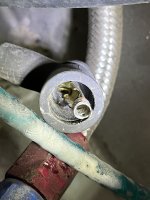
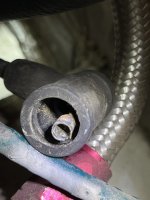
IMG_3210.jpegIMG_3209.jpegI think but cannot confirm that the radio was clean before maintenance. The previous owner and ferry pilot reported no issues, but I only had two way communications while at idle since taking possession in fall.

I did take off the cowl today and looked at plug wires. I found one that I think shows signs of arcing on the P-Mag side. Pictures attached. I did not have anything on hand to clean the corrosion though.
 
View attachment 119599View attachment 119600I think but cannot confirm that the radio was clean before maintenance. The previous owner and ferry pilot reported no issues, but I only had two way communications while at idle since taking possession in fall.

I did take off the cowl today and looked at plug wires. I found one that I think shows signs of arcing on the P-Mag side. Pictures attached. I did not have anything on hand to clean the corrosion though.
Looks like a lot of oxidation. Difficult to tell if there is an arcing evidence, but lake of shiny metal is not good.
 
A set of new plugs with solid tips (not screw on) and a set of new wires is a relatively cheap and easy place to start. Double check all of the P-Mag wire connections while you're there.
 
From the pictures I see:
Scorching on cables
Corrosion
Wrong fasteners
etc..

What other sins are lurking in this airframe?

A buyer of a used car wouldn’t accept it if any of these existed, why do airplanes get a pass?!

Someone is going to get hurt, fiscally and/or physically if “we” don’t do a better job here.

Honestly - it’s time to name & shame the person(s) who did the pre-purchase inspection, and then the previous owner(s), operator(s), builder(s).
 
Thanks for all the suggestions and guidance. Sorry to go quiet for a bit, but I have continued to troubleshoot. Despite the one wire with corrosion, I think the ignition system is no longer a suspect. I believe this because I can no longer transmit at all, even with the engine off. That's progress, of a sort.

To PhatRV, I know that I could transmit readably on the ground at idle before the conditional in May. No idea how long it has been since I could transmit at higher RPM.

I checked all the spark plug wires thanks to advice of lr172. One wire had corrosion, and I replaced it. I used a mirror to look at the PMag where the wire plugs in, and that looked nice and shiny.

This did not fix the problem though. In fact, I now cannot transmit at any power setting, including with the engine shut off. I tried swapping headsets, and that did not change anything. I am still receiving without any issue. When I press the PTT switch, the TX light on the radio turns on, but nothing comes through so far as I can tell. I tried plugging my headphones into a portable radio and could not hear anything transmitting from the ship. I also reversed things and plugged both headset mics into the portable radio and could hear myself just fine through the ship radio RX when transmitting from the headset through the handheld. I am now thinking this issue is either in the PPT switch, grounding somewhere, or the antenna. All of which are outside the scope of my expertise at this time.

I also did get the new (to me) PS1000-II intercom installed. It was a simple plug and play replacement for the 1000, and seems to be functioning without issue. I can hear myself talk in my own ear again, and the EFIS can talk to me. This either did not change the radio transmit problem, or made it worse.

To bjdecker, I am not sure what wrong fastener was pictured? As to scorching, I assume that was on the spark plug wire internals. I suspect that happened after conditional, as that one was not plugged in all three clicks when I checked it to troubleshoot the radio. Everyone that has looked over the plane has called it "an honest airplane", and I don't know enough to refute that at this time. The ferry pilot said it flew great when he brought it up to Wisconsin in the fall. I don't know enough about the plane or system to criticize anyone yet, so I'll hold off while I continue to learn.

Thanks all for the help and suggestions as I continue to work through this.
 
Thanks for all the suggestions and guidance. Sorry to go quiet for a bit, but I have continued to troubleshoot. Despite the one wire with corrosion, I think the ignition system is no longer a suspect. I believe this because I can no longer transmit at all, even with the engine off. That's progress, of a sort.

To PhatRV, I know that I could transmit readably on the ground at idle before the conditional in May. No idea how long it has been since I could transmit at higher RPM.

I checked all the spark plug wires thanks to advice of lr172. One wire had corrosion, and I replaced it. I used a mirror to look at the PMag where the wire plugs in, and that looked nice and shiny.

This did not fix the problem though. In fact, I now cannot transmit at any power setting, including with the engine shut off. I tried swapping headsets, and that did not change anything. I am still receiving without any issue. When I press the PTT switch, the TX light on the radio turns on, but nothing comes through so far as I can tell. I tried plugging my headphones into a portable radio and could not hear anything transmitting from the ship. I also reversed things and plugged both headset mics into the portable radio and could hear myself just fine through the ship radio RX when transmitting from the headset through the handheld. I am now thinking this issue is either in the PPT switch, grounding somewhere, or the antenna. All of which are outside the scope of my expertise at this time.

I also did get the new (to me) PS1000-II intercom installed. It was a simple plug and play replacement for the 1000, and seems to be functioning without issue. I can hear myself talk in my own ear again, and the EFIS can talk to me. This either did not change the radio transmit problem, or made it worse.

To bjdecker, I am not sure what wrong fastener was pictured? As to scorching, I assume that was on the spark plug wire internals. I suspect that happened after conditional, as that one was not plugged in all three clicks when I checked it to troubleshoot the radio. Everyone that has looked over the plane has called it "an honest airplane", and I don't know enough to refute that at this time. The ferry pilot said it flew great when he brought it up to Wisconsin in the fall. I don't know enough about the plane or system to criticize anyone yet, so I'll hold off while I continue to learn.

Thanks all for the help and suggestions as I continue to work through this.
I’m not familiar with the radio type that you have. Does it mount using a tray?
If so, have you removed it from the tray and checked all of the connectors in the tray and the back plane of the radio for condition? Sometimes radio problems are resolved just by removing and receding the radio in the tray and confirming that it is fully inserted.
 
I’m not familiar with the radio type that you have. Does it mount using a tray?
If so, have you removed it from the tray and checked all of the connectors in the tray and the back plane of the radio for condition? Sometimes radio problems are resolved just by removing and receding the radio in the tray and confirming that it is fully inserted.
It is not in a tray.

I started today by pulling the antenna off the belly and checking the connection. Everything looked ok. Next I pulled out the mic jack, and it appeared grounded and connected. Since I can hear myself on the intercom, I do not think this is at issue, but I have now also set (untrained) eyes on it.

Next, I opened up the avionics bay and did some digging. I think I have narrowed this issue down to a loose wire in the 15 pin D-sub clamp housing that plugs into the radio. After disconnecting the cable from the radio and reinstalling, I went from good RX and carrier wave only on TX to no RX or TX at all. I jiggled the wires a bit, and RX came back. I pushed on it a bit more and the PTT switch could again activate the TX light with carrier wave only.

Based on my reading of the manual, specifically page 6 of the PDF (https://www.aircraftspruce.com/catalog/pdf/fl760install.pdf), I think I need to look at pin 2 (microphone ground) and pin 7 (PTT). Though I may start by trying to brush off the pins on the radio side to see if I can get a better connection since I also lost RX today.

I am hesitant to open up the clamp housing for fear that I will never get it all back together again. There are a lot of very small wires in a tight area, and I am not the most graceful in tight spaces. I also have no experience with these types of connectors or the crimping or soldering that may be needed to fix the suspected loose connections.

Hangar neighbor who wired his panel offered to provide any insight, so I will have adult supervision to take apart the D-Sub clamp make sure everything is seated.

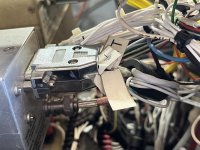
Suspect D-sub connector pictured.
 

Attachments

  • d-sub connector.jpg
    d-sub connector.jpg
    943.4 KB · Views: 37
Last edited:
It is not in a tray.

I started today by pulling the antenna off the belly and checking the connection. Everything looked ok. Next I pulled out the mic jack, and it appeared grounded and connected. Since I can hear myself on the intercom, I do not think this is at issue, but I have now also set (untrained) eyes on it.

Next, I opened up the avionics bay and did some digging. I think I have narrowed this issue down to a loose wire in the 15 pin D-sub clamp housing that plugs into the radio. After disconnecting the cable from the radio and reinstalling, I went from good RX and carrier wave only on TX to no RX or TX at all. I jiggled the wires a bit, and RX came back. I pushed on it a bit more and the PTT switch could again activate the TX light with carrier wave only.

Based on my reading of the manual, specifically page 6 of the PDF (https://www.aircraftspruce.com/catalog/pdf/fl760install.pdf), I think I need to look at pin 2 (microphone ground) and pin 7 (PTT). Though I may start by trying to brush off the pins on the radio side to see if I can get a better connection since I also lost RX today.

I am hesitant to open up the clamp housing for fear that I will never get it all back together again. There are a lot of very small wires in a tight area, and I am not the most graceful in tight spaces. I also have no experience with these types of connectors or the crimping or soldering that may be needed to fix the suspected loose connections.

Skycom in Waukesha is down the road, so I will give them a call tomorrow and talk it over with one of their certified adults before I get myself into deeper water.

Suspect D-sub connector pictured.
I would expect an issue under that db25 cover. Note all of the labels just jammed under the shell. A pretty good sign that the installer was not very experienced. The ferrite choke also means someone in the past was dealing with noise or interference issues and couldn’t find it.
 
I would expect an issue under that db25 cover. Note all of the labels just jammed under the shell. A pretty good sign that the installer was not very experienced. The ferrite choke also means someone in the past was dealing with noise or interference issues and couldn’t find it.
If the local shop can’t figure it out, you can fly down to Chicago and can help you address it.
 
Right after my last post, I realized I had a resource much close than the avionics shop; my hangar neighbor. He is building a Sonex and had just been telling me the other day that he wired up his own panel. He generously agreed to lend some tools and know-how.

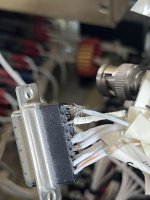
I met him at the airport today and started taking apart the DB15 connector with some supervision. There are a couple wires that have come out of the crimp pins and need to be fixed. At least one of the pins is not wanting to seat in the housing tightly, so I think I will be replacing it at some point. I also need to splice on some extra wire to a couple of wires, as there is not enough slack to comfortably seat the pins without it being in tension and wanting to pull out of either the housing or the crimp pin.

That said, I did get things connected enough to test if the problem was solved. It was not. Thankfully, hangar neighbor can read a wiring diagram, and he really dug into things. We ended up checking continuity one several places and found that the PTT switch does have continuity to the radio, but does NOT have continuity to the pin that needs it on the intercom. The working theory is that somewhere down the wire, it has become disconnected, and is thus not telling the intercom to push signal to the radio when PTT is active. We used a jumper wire to ground in order to test this. When the PTT pin on the intercom was grounded at the same time the actual PTT switch was pressed, I had a working radio again. Without the jumper, it was carrier wave only.

Now begins the process of chasing wires to try and find the disconnect on the PTT to intercom wire. If I cannot find it, the plan it to just splice into the good wire going to the PTT pin on the radio. I also am going to order a new D-Sub female connector and some butt splices to get the radio wiring put back together in a way that stays back together.

Thanks for all the help along the way. It has not been fun to have a broken plane, but I am learning a lot about the aircraft and systems by troubleshooting and fixing things. Picture of the day is the D-Sub connector with the clam shell taken off and one wire that had already come out of its crimp pin.
 

Attachments

  • dsub.jpg
    dsub.jpg
    770.4 KB · Views: 12
Back
Top