Can we summarize results from the three methods for the benefit of others that try making a DIY prop balancer? My conclusion is that the first may work fine for a electrical motor-driven tire balancer but does not work in practice with a combustion engine and prop: even though non-prop vibrations should average out in practice new events keep appearing and so average never converges to actual prop imbalance vibration. First sweep method we tried (Tach-Synchronous Simple Vector Average) much better but still subject to non-prop vibration events. Single-bin DFT the best with possible liability of RPM changing between rotations making measured ips amplitude fall off because of the sharp filter effect of the single-bin DFT method.
Excellent summary. Let me write this up properly:
DIY Prop Balancer — Three Vibration Measurement Methods Compared
Based on a homebuilt aircraft installation: Mazda 13B rotary engine, RWS RD-1C planetary gearbox (2.85:1), wooden propeller, rigid airframe mounting. ADXL355 accelerometer at 4000 Hz ODR, optical tach, ESP32, BLE to Android phone.
Method 1 — Tach-Synchronous Slot Averaging (Balance Mode)
How it works:Each revolution is divided into N angular slots (5° or 10°). Each accelerometer sample is assigned to a slot based on its timestamp relative to the tach pulse. Samples accumulate in their slots indefinitely. The slot with the highest DC-corrected vector magnitude indicates the heavy spot angle. IPS is computed from that peak magnitude.
Outlier rejection: Hard threshold (circular magnitude) during bootstrap phase, then per-slot sigma rejection (2.5σ) using running variance once each slot has sufficient samples.
Strengths:
- Very high angular resolution possible
- Extremely effective at suppressing non-synchronous noise — after millions of samples, anything not phase-locked to prop rotation averages to zero
- Angle measurement is very precise once converged
- Works well for electric motor driven balancers where the noise environment is clean
Weaknesses:
- Requires narrow RPM gate — samples outside target RPM window are discarded
- With a combustion engine, new spurious events keep appearing that are partially phase-coherent with rotation (firing pulses, gear mesh harmonics at near-integer multiples of prop frequency). These never fully average out — the buffer never truly converges to the pure imbalance signal
- Requires long stable runs at a fixed RPM — impractical for in-flight sweep measurements
- Ground runs essentially unusable — prop wash recirculation, ground effect, and airframe resonances on gear add 5–10× more vibration than the actual imbalance signal
Verdict: Works well for electric motor tire balancers. Marginal for combustion engine prop balancing on the ground. Usable in flight at stable cruise RPM after long convergence time (3–6 minutes). Not suitable for RPM sweep measurements.
Method 2 — Tach-Synchronous Simple Vector Average (Sweep Mode v1)
How it works:Within each revolution, all accelerometer samples are summed as raw X and Y values. At the tach pulse, the revolution's accumulated vector sum is committed to a 1-second averager. The 1-second averager produces IPS and angle once per second, allowing continuous logging across a full RPM sweep.
Strengths:
- No RPM gate required — works across any RPM
- One reading per second enables RPM sweep measurements
- Simpler implementation than DFT
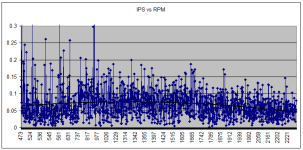
- Revealed the structural resonance near 1100–1300 RPM that was corrupting balance mode measurements
Weaknesses:
- No DC rejection — static acceleration from aircraft pitch and bank angles contaminates the measurement. A 5° bank adds ~0.008G of bias which is comparable to the vibration signal at low imbalance levels
- Non-synchronous vibration events within a revolution add directly to the vector sum without cancellation
- IPS values 6–10× higher than the true 1× synchronous component — includes non-synchronous content
- Angle scatter is high when true imbalance is low, making angle measurement unreliable
- Despite these limitations, successfully revealed the resonance shape (IPS vs RPM curve) that explained anomalous balance mode results
Verdict: Better than Method 1 for sweep measurements. Good for identifying resonances and general vibration trends. Not suitable for precise IPS measurement or reliable angle determination at low imbalance levels.
Method 3 — Single-Bin DFT (Sweep Mode v2)
How it works:For each accelerometer sample, the fractional position within the current revolution is computed from the sample timestamp and tach period (phase = 2π × delta/period). The sample is multiplied by cos(phase) and sin(phase) and accumulated into I (in-phase) and Q (quadrature) sums. At the tach pulse, the revolution's I/Q sums are committed to a 1-second averager. IPS is computed as 2 × √(I²+Q²) / counts × G_to_IPS and angle as atan2(Q, I).
Only the X accelerometer axis is used as the signal input — the single horizontal axis perpendicular to the shaft. The factor of 2 corrects for the DFT's inherent half-amplitude response to a real-valued sinusoid.
Strengths:
- Automatic DC rejection — a constant offset integrated against cos or sin over a complete cycle integrates to exactly zero. Aircraft pitch and bank changes have no effect on the measurement
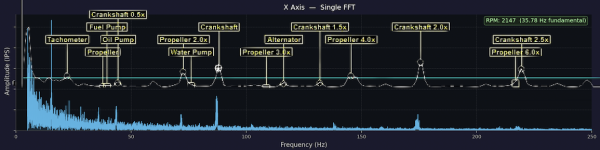
- Frequency selective — only extracts the 1× synchronous component at the exact rotation frequency. All other frequencies (combustion harmonics, gear mesh, aerodynamic noise) are rejected
- IPS values consistent and repeatable across multiple flights
- Successfully confirmed well-balanced prop (0.068 IPS) after correction work
- Confirmed absence of resonance peak once imbalance was reduced
- Works across full RPM range without gating
Weaknesses:
- RPM must be stable within a revolution— the phase calculation assumes constant RPM within each revolution. If RPM changes significantly between the tach pulse and the next tach pulse, the phase reference drifts and the DFT filter becomes less sharp. In practice this means:
- Rapid throttle changes during a sweep degrade accuracy transiently
- Slow, smooth throttle sweeps give the best results
- At stable cruise RPM accuracy is excellent
- Angular resolution depends on signal-to-noise ratio — when true imbalance is very low (0.06–0.09 IPS) the angle becomes unreliable since atan2(Q,I) of a near-zero vector is noise-dominated
- Slightly more complex to implement than Method 2
Verdict: Best method for in-flight prop balancing. Clean IPS measurement, good DC rejection, works across full RPM sweep. The RPM stability requirement is easily met with smooth throttle inputs during sweep and narrow RPM gating during balance mode.
Key Practical Lessons
Ground runs are unreliable for precision balancing on a rigid airframe with a combustion engine. Prop wash recirculation, ground effect, and structural resonances on the landing gear add overwhelming noise. In-flight measurements at cruise altitude in smooth air are essential.
Structural resonances must be identified before balancing. This installation had a resonance near 1100–1300 prop RPM that amplified vibration 6–10× and produced completely misleading balance measurements. The RPM sweep (Methods 2 and 3) revealed this. All balance mode runs at 1100 RPM were corrupted by the resonance — balance corrections based on those measurements were wrong. Balance runs should be done at cruise RPM, well away from any resonance.
Static prop balance first. Dynamic balancing cannot compensate for a statically unbalanced prop — it just adds correction weights that fight the static imbalance. Static balance on a prop balancer before dynamic balancing saves significant time and weight.
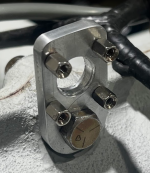
Sensor placement: Mount the accelerometer as close to the prop flange as possible, on the most rigid part of the structure. This installation used the forward tip of the gearbox housing, 1 inch behind the prop flange — ideal. Engine mount isolation attenuates the signal and introduces phase errors.
The sensitivity factor (g·in per IPS) must be measured in the same environment as balancing. A test weight run on the ground gives a different sensitivity factor than in flight. Always do the test weight run in flight at cruise RPM.
Hardware and Software Notes
- ADXL355 at ±2G range, 4000 Hz ODR is well suited. The 3.9µG noise floor is more than adequate. Hardware gravity trim registers simplify the software DC problem in balance mode.
- BOOTSTRAP_THRESH_SQ must use int64 arithmetic — 256000L × 256000L overflows int32 on ESP32 and produces a garbage threshold.
- BLE device name must be ≤5 characters for MIT App Inventor's ConnectToDeviceWithServiceAndName to work.
- MTU negotiation — old Android phones may not support >20 byte BLE notifications regardless of what the ESP32 requests. Design message formats to fit within 20 bytes or split into multiple notifications.
- RPM gate tolerance should be wider than intuition suggests — ±90–100 RPM at 1930 prop RPM allows enough samples while still providing adequate frequency selectivity for balance mode.
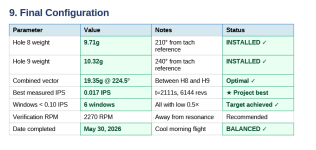
This balancer successfully reduced prop vibration from 0.67 IPS (with undetected resonance corruption) to 0.068 IPS at cruise — a 10× improvement — on a Mazda 13B rotary powered homebuilt aircraft.