Balance it at the RPM you use the most. In other words your cruise RPM somewhere in the range of 5200 - 5400.
If you are only getting 4800 static you need to address prop pitch first. Balancing should come last.
Let me start with thanking you for taking time to respond, while I pick you comment apart.

Your advice which is sage advice, well understood. I did not say I was getting 4800 Static RPM, my poor communication. Let me try again. I said:
"Max Static RPM WOT is about 4800 RPM (rounded down)."
I don't know what WOT Static is not my plane, but 4900-5200 RPM (according to Google). depending on conditions, density altitude, engine condition (airport 500' MSL, summer density altitude can be +1500 ft, engine 100 hrs, 86/87, new plugs, oil, all sensor scan good.).
Why round down? Several reasons:
1) Prop Balancer wants you to specify the RPM and you need to make it and be stable at that RPM. You make a good point I will check his static RPM. Not my plane, but should be checked. Roger that. As a CFI having given owner instruction in this RV-12iS, never did a WOT static run, but look on takeoff roll, and it's good. Will do a WOT Static RPM check Saturday when we go at the Prop balance. I arbitrarily set 4800 RPM as a max, knowing I could will get there. I think 4500-4600 RPM engine will be fine as well, may be better than 4800 RPM?
2) WOT static for a prop balance, my opinion, preference, not right or wrong, is not the gold standard. Regardless of Eng/Prop RPM you get a solution or balance. even if not at your normal cruse RPM. You will gain smoother operations over all if balanced at lower RPM. It is not practical or possible to check cruise RPM on the ground sometimes.
3) Some "shops" do full-power balance (all engines)
assuming it covers the entire RPM range, tying down aircraft, running at maximum static RPM.
Not true. This causes strain, compressed isolators, risks overheating engine and unnecessarily uncomfortable for technician.
Bottom line with the engine straining on the engine mounts, aircraft shaking at MAX WOT STATIC RPM, I submit it is NOT cruise conditions. It may be fine, "work" great, but something a little lower will work just as well, may be better, in my opinion. In some cases it is not practical or possible to get near cruise RPM on the ground. I am going to shoot for 4600-4800 RPM, prop 1900-1975 RPM.
Cessna 152 Type Certificate Data Sheet and the Pilot’s Operating Handbook, the acceptable static RPM range is 2,280 to 2,380 RPM. Red line is ~2550 RPM and common to run 2300-2550 RPM in cruse at altitude. This is stock. The C-152 I balanced has STC prop and STC Engine (Sparrow Hawk) with Min. The minimum static is 2450 RPM, red line of 2700 rpm (max continuous 2550 rpm). I balanced it at 2300 RPM and it was fine. It is technique. I picked a number, stuck with it. You get "A" solution. I can say the C-152 I balanced was noticeably smoother after first run (1.04 to about 0.7). In flight higher RPM's 2550 RPM it feels even smoother. Likely dumb luck. but feel no regret about doing balance at 2300 and not 2450 RPM.
A survey or spectrum of vibration over the full range of RPM's would be best. In the case of ROTAX you get gear case harmonics below 2000-2200 RPM I recall. That is why you idle higher, I use 2000-2200 as my Min RPM on ground, unless for taxi reasons I need to pull the reins in on that mighty 100 poneys.
Some prop/engine combos have YELLOW or stay out RPM/MP... Vibration can be tricky. I don't think there is one perfect number for the Rotax RV-12iS. A balanced prop to "A" RPM is better than no balance at all, as long as it is in level flight RPM range.
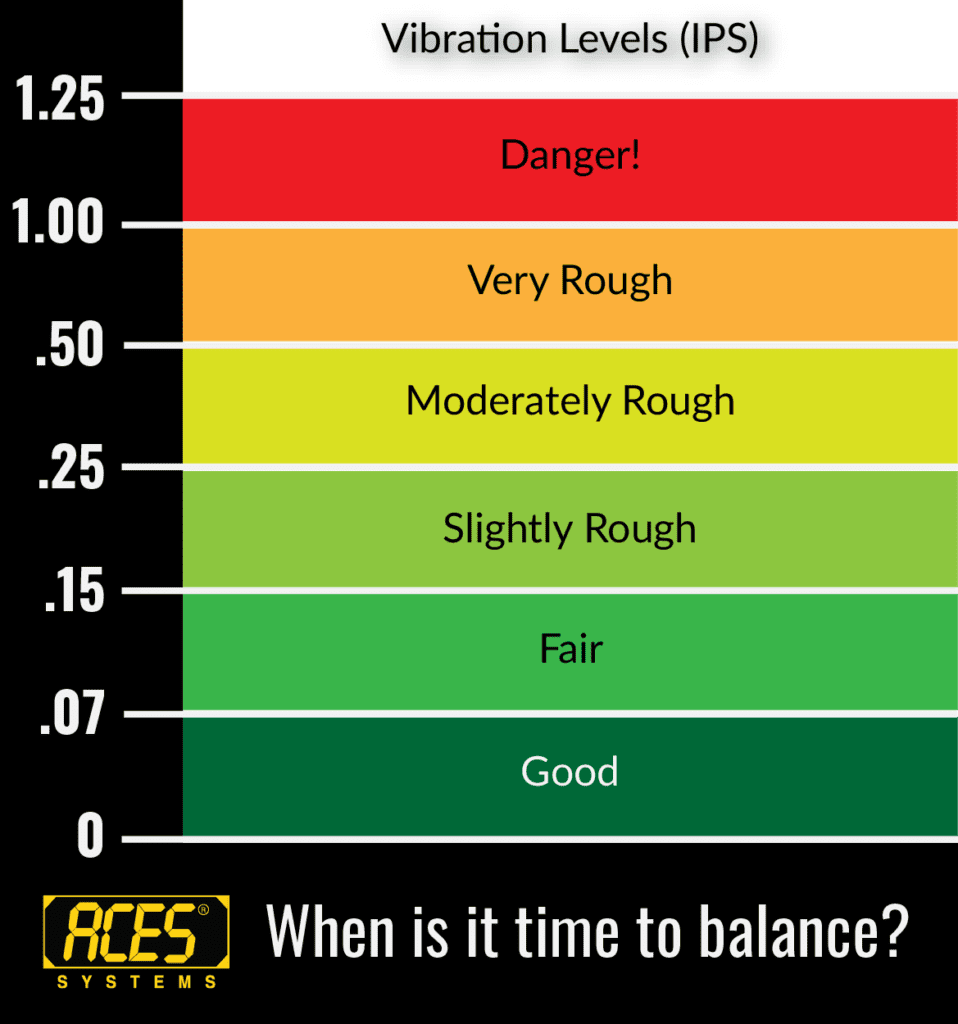
Ground dynamic prop balances do NOT represent cruise conditions, but approximate. NO true way to do an inflight cruse condition prop balance on the ground. Bottom line is take out gross imbalance, shoot for 0.07 ips or less at a reasonable RPM. Depending on airplane max static is well below cruise. Just deal with it. If you want to be a "rocket surgeon or brain scientist"  you would check MANY different RPM's, make a chart and find your best harmonics. Nope not going to do that, at least on this RV-12iS. They do have test equipment that does this for a "mo better" solution. The helicopter guys are experts at balancing rotary wings. aka big props.
Fun fact your engine may be out of balance? The engine and prop prop combo interaction also may be an issue, at one RPM and not another. "Professionals" put one or two additional accelerometers (Lycoming) on engines case and accessory case. All you can hope for is the engine was balanced statically per the overhaul manual, and the prop was statically balanced. What we are doing if fine tuning and making sure there is no gross imbalance of prop or engine or the combo thereof.
The RV-12iS - did one test run got 0.12 ips**, acceptable but not great. The C-152 I balanced started as1.04 ips! Proud to say a flight club's C-152 I am a CFI for, on which I did the prop balance, that started at 1.04 ips, after 4 iterations and splitting weights, 0.04 ips !!!!!
** RV-12iS Did two test runs, one while warming up engine for oil change and got erratic RPM (See Note below). After changing optical sensor location, did 2nd run to check for oil leaks. For grins and giggles, used 4000 rpm / 1646 prop. 0.12 ips. Not balancing at 4000 RPM, just testing. prop balancer equip and set up. 0.12 ips is typical as I understand it for a Rotax 12iS. That is OK, not good or great, just OK and room to improve.
I knocked off the RV-12iS prop balance late in day, hot and exhausted from finishing up a condition inspection. I just want to see it was working. Saturday will start fresh and go through the process of balancing prop. You use spinner back plate attach screws to add washers, until you get your balance. Than you add final weight in back spinner (bolt/nut/washer) in hole you drill. Hole must be burr free, net fit. You have to ratio up the weight due to change or radius. I recall the spinner OD is about 9.75" or 4.875R. The location of permanent weight (bolt, nut, washer) in the backing plate, has 1" less radius I guess (have to measure). I will report the results.
NOTE: Got erratic RPM on first run - I used back of spinner for reflective tape. It worked but got a message it was erratic. I suspect the unpainted aluminum spinner backing plate (not shinny but mat) did not provide the contrast with the reflective tape needed. It "worked" but poorly. I could have painted it black, use tape (changing weight bal) to increase contrast. Nope. On the C-152 prop I balanced in the morning, I used ridged foam blocks, attached with metal tape to engine mount, with optical sensor on top. Reflective tape on back of prop blade. Worked the trick. Fix the RV-12iS RPM issue doing the same, moving it up, and placing reflector on back of prop. Second run RPM was stable. Not use to geared engine, ratio 2.43 : 1. You specify PROP RPM in test Equp, set engine RPM to get prop RPM specified. Not hard but different than a direct drive Lyc.









 Guess better late than never.