Van's Air Force

The definitive Van's Aircraft support community! Buying, building or flying an RV? Join our exclusive family of mentors and enthusiasts!

Fuel system testing: any words of advice?

Steve Crewdog

Well Known Member
Patron
Now that ga$ has gone up in price, we're almost ready to run the engine but want to start with baby steps, like checking the fuel system first. I've replaced all the hoses with new ones, when I bought the tank about 14 years ago I put 5 gallons in it and left it outside in the shade in my backyard, no leaks. But that was then, this is now, so I was thinking about putting 1 gallon of gas in it and letting it sit overnight while I worked on other things that don't make sparks. I've got a big CO2 extinguisher, might put up a couple NO SMOKING signs in the front of the hangar, and have a pedestal fan to blow fresh air into the fuselage and keep vapors out in case of a leak.

Overkill, or am I on the right track?

TIA
 
Are we talking fuel tanks or end-to-end fuel system test? EAA Test Card 0 is a great start. Fairly simple. I recommend Dan's grounding design. Buy a Mr Funnel. Make sure it's not a fake by testing with an ohm meter. They are conductive. Make three ground wires. 1. Alligator to lead fishing weights. Clip to the funnel and hang the weight in the can. 2. Alligator to Aligator short. Connect from funnel to airplane. 3. Alligator to Alligator long. Optional. Connect airplane to earth ground.
The funnel will catch debris when you drain the unusable. You may be surprised. Pump the tanks till they won't flow.
Drain remaining from the sump with a paint measuring cup. That's the unusable.
Fill a 2 gallon can with avgas.
Pour into the tank.
Disconnect the line from the carb or servo. Place the hose into the funnel.
Flip on the pump and start a timer.
Stop at one gallon. Log the time. Pump the rest. Drain and measure remaining fuel. Log it.
Follow the test card for the math. Pump must be able to supply a certain amount based on horse power.
Repeat on tank 2.
Point the nose up as high as practical.
Repeat the tests. No need to measure unusable, but you can.
Log data and do the math.
Others probably have a better plan. Best of luck
 
Last edited:
I am not sure what you are expecting... an explosion??
Expensive gas does not explode any more than inexpensive gas, just sayin.
What Larry said is a good path to follow. I have never quite understood the fuel system check by raising the nose of the plane as much as possible to simulate your most extreme take off attitude. I understand the concept but a more simple way to check is to disconnect the fuel supply hose at the carburetor or fuel controller servo, attach a hose and raise the outlet of that hose by 3 feet to simulate an extreme take off attitude. Its a much safer way to test your system vs jacking up the plane to simulate an extreme climb attitude. Turn on the boost pump and measure the fuel/time it takes for one gallon. Follow the prescribed procedure .
You should see at a minimum two times the flow of the maximum consumption of your engine.
In my case, the IO 540 has a maximum fuel flow rate of around 25GPH. My boost pump delivers 54 gallons per hour with the hose 3 feet above the fuel controller inlet. Good to go!
 
I am not sure what you are expecting... an explosion??
Expensive gas does not explode any more than inexpensive gas, just sayin.
What Larry said is a good path to follow. I have never quite understood the fuel system check by raising the nose of the plane as much as possible to simulate your most extreme take off attitude. I understand the concept but a more simple way to check is to disconnect the fuel supply hose at the carburetor or fuel controller servo, attach a hose and raise the outlet of that hose by 3 feet to simulate an extreme take off attitude. Its a much safer way to test your system vs jacking up the plane to simulate an extreme climb attitude. Turn on the boost pump and measure the fuel/time it takes for one gallon. Follow the prescribed procedure .
You should see at a minimum two times the flow of the maximum consumption of your engine.
In my case, the IO 540 has a maximum fuel flow rate of around 25GPH. My boost pump delivers 54 gallons per hour with the hose 3 feet above the fuel controller inlet. Good to go!
I didn't like it either. I was told it was to make sure your pickups in the tanks would pull gas at high pitch angle. Then the question becomes, who the heck would run down to a gallon or two and climb like a rocket! :LOL:
 
Thanks guys. Osprey is a taildragon so her nose is already pointing up, I meant to bring home the test cards to ready but I was running late for supper so I left it behind. My hangar neighbor just bought a new Cessna so I'm sure he'd appreciate me NOT having an explosion, Ernst.
 
The actual verbiage from pt.23 just says "most critical attitude". That's typically interpreted as the pitch up attitude that result in a power on stall at full power. And yeah, I know that we aren't talking about far23 airplanes, but this is a case where it would be dumb not to follow that requirement.

Anyway, If the system is pump driven, it's supposed to deliver a minimum of 125% of the fuel required at max takeoff power at that attitude.

I agree (and I've said before) that checking head pressure with temporary plumbing run up toward the rafters is the most reasonable way to do this. Guys who try to get the airplane into a high pitch attitude by putting the mains up on car ramps or the tail down in a hole or whatever are fooling themselves if they think that's even close to the max pitch up they're gonna see in flight.

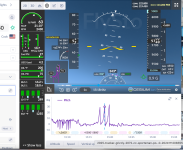
If you're light and overpowered and do the standard 1knot per second airspeed decay, you can get the nose of an RV ridiculously high in a stall entry. Here's screen shot from my phase 1. These were power on stalls at only 60% power because I was light and still getting 30 degree pitch up before the break. On a 25' long airplane that makes the tail 12.5' lower than the nose. Good luck getting that by blocking up the mains and sticking the tail down in a ditch.
 

Attachments

  • Screenshot 2026-05-09 at 6.03.58 AM.png
    Screenshot 2026-05-09 at 6.03.58 AM.png
    1,020.9 KB · Views: 29
Why do we mention raising the discharge line only is adequate?

I think that method isn't totally correct. It's both discharge and suction pressures that can be an issue to test before first flight. Dropping below the net positive suction head of the pump and fluid system can cause cavitation and loss of flow and thus discharge pressure. I'd agree that a more correct method is to drop the suction lines down, as well as raise the discharge, but with the inlet lines in the fuel tank this isn't really possible to do that, so the closest is to tilt the plane as best we can. Am I thinking about this wrong?
 
Now it makes sense. RVs will climb at a very steep angle full power. I didn't understand cavitation was the problem. I don't know of anyone who plumbed the outlet 12' up, or attempted to point the airplane skyward for the test. I understand better now. Thx.
 
Just a side note, if your tanks have been sitting empty for 14 years, I would recommend filling them to the top and draining them to try to flush anything out that may be living in there or has settled in there. Even if they were closed off, it might still be a good idea. You want the tanks as clean as possible before you start running fuel to the engine. After that, flush fuel and dump it out of the hose before the carb or fuel servo. If it's fuel injected, disconnect at the spider as well and flush that line. It only takes the tiniest piece of debris to cause fuel delivery problems. Like really tiny. Even new hoses may have a small spec of debris in them. Yeah, it seems a shame to waste gas by just flushing it out, but it's better than the alternative of having an engine run poorly. With good filtration, you could probably reclaim the fuel you used as a flush agent.
 
Just a side note, if your tanks have been sitting empty for 14 years, I would recommend filling them to the top and draining them to try to flush anything out that may be living in there or has settled in there. Even if they were closed off, it might still be a good idea. You want the tanks as clean as possible before you start running fuel to the engine. After that, flush fuel and dump it out of the hose before the carb or fuel servo. If it's fuel injected, disconnect at the spider as well and flush that line. It only takes the tiniest piece of debris to cause fuel delivery problems. Like really tiny. Even new hoses may have a small spec of debris in them. Yeah, it seems a shame to waste gas by just flushing it out, but it's better than the alternative of having an engine run poorly. With good filtration, you could probably reclaim the fuel you used as a flush agent.


Funny you mention that, when I got to the airport this morning I decided to go full geek and pull the fuel sender to check to see if it worked and played nice with the Dynon, while I had the tank open I borescoped the inside of the tank. Clean as a whistle.

The fuel lines are all new in the last 18 months or less, but I'll still run some gas through them and then check the fuel filter before I run the engine.

While I've got everyone here, the fuel sender has a cork gasket, it looks nice and fresh but I might as well pick up a new piece of cork anyway.
 
Last edited:
I have tested a couple of builds by putting 30 psi air pressure on left, then right. Block the line/hose as far forward as practical. Then pressurize and shut off at the inlet side. Leave it for 24 hrs and you should not have lost any pressure. This has found suction and pressure side leaks. One was even on the fuel pump suction side. There are check valves in the fuel pump so add air from the tank end. As for the tanks, good suggestions already. Suction leaks will show up with low tanks, altitude, and hot days, and after everything is assembled it is a real PITA to test and find the leak.
 
I have tested a couple of builds by putting 30 psi air pressure on left, then right. Block the line/hose as far forward as practical. Then pressurize and shut off at the inlet side. Leave it for 24 hrs and you should not have lost any pressure. This has found suction and pressure side leaks. One was even on the fuel pump suction side. There are check valves in the fuel pump so add air from the tank end. As for the tanks, good suggestions already. Suction leaks will show up with low tanks, altitude, and hot days, and after everything is assembled it is a real PITA to test and find the leak.
I assume you are putting 30 psi of pressure on the fuel lines from the tanks to the servo or carb? Pressurizing the tanks to 30 psi would likely permanently damage them.
 
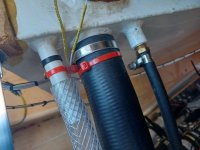
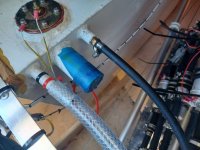
At the risk of being put in the "I'll never get in his airplane." category, here's why I wanted to do incremental, simple testing. Went to add the first tank of gas, it almost immediately overflowed. Let it sit, thought about it. Tried again. Same result. Squeezed the fill hose and could hear/feel gas. Got a piece of scrap wire and ran it down the hose, felt a blockage at about the tank inlet. Nothing on the sight gauge. Could I have....?? Drained the fill hose. Pulled it off.

Embarrassed, but....

The piece of paper is for any seeps, I may not see them tomorrow in the bilge but I will see the stains on the paper.
 

Attachments

  • Not rocket scientists.jpg
    Not rocket scientists.jpg
    73.8 KB · Views: 28
  • Why we test (1).jpg
    Why we test (1).jpg
    123.4 KB · Views: 24
  • Why we test (2).jpg
    Why we test (2).jpg
    145.2 KB · Views: 20
  • Why we test (3).jpg
    Why we test (3).jpg
    161.4 KB · Views: 16
  • Why we test (4).jpg
    Why we test (4).jpg
    92.1 KB · Views: 22
Last edited:
If you're Dynon, the sending units will be one of the last things done with fuel. EAA Test cards recommend first flight with 1/2 tanks. Calibration requires a fill up. Pick you're poison.
I added 2 gal at a time. Each increment, I sticked the tank and logged the result then pressed buttons. Yes, that's 10 times to get full. Then the decision. Drain all the gas, 2 gallons at a time and calibrate the second tank or fill it in 2 gallon increments. Using the latter, you will have two full tanks. The downside is you will have two full tanks. Another potential issue is no place to drain gas if a sender misbehaves.
I used the transfer method and in the end moved 1/2 tank back the the opposite tank so both were at 1/2 tank for first flight. Turns out a friend had a sender problem on his testing and the gas cans came in handy. I used the grounding method I posted before.
20 extra gallons is not a big deal on first fflight. More important is equal weight.
Like I said, Pick your poison.
 
Back
Top