Van's Air Force

The definitive Van's Aircraft support community! Buying, building or flying an RV? Join our exclusive family of mentors and enthusiasts!

Re-attaching fuel tank (spar fasteners)

enigmakv

Well Known Member
I have a small slow leak somewhere in my left fuel tank. The original owner/builder had already pulled the tank off to try to patch it once so at least the paint has already been cut.

I have spent quite a bit of time researching the plans and online to figure out how to remove the tank and am getting close.

On the back of the spar are EIGHTEEN (18) fasteners (3 ea in six locations). I eventually had to disconnect the aileron push rod on the inboard side to get just enough access to the heads of the fasteners while reaching my big hands up through the inspection panels. My arms are cut, my knuckles bleeding but at least I got those bolts out. At least one set of three are between two closely spaced wing structures. All but six of the bolts were very hard to reach and had to be done blindly. Several of the bolts were located such that I could only turn one face at a time due to the wrench contacting internal structures.

My question is, for any of you who have pulled a tank after full assembly/painting, how the F do you reattach the tank at all of those blind/restricted locations?
 
Pull the wingtip, pull the wing root fairings, remove the aileron pushrod, and it isn’t that bad. Wear a shirt with tight fitting long length sleeves to minimize the blood letting. Small ratchets are the tool of choice.
 
I’ve had my 10 tanks on and off a few times because I built ER tanks after first flight.

I used a mini 1/4” drive cordless 90deg ratchet.
It won’t solve all problems but it’ll make short work of 3/4 of the bolts.
There are smaller ones available now than when I did this.
 
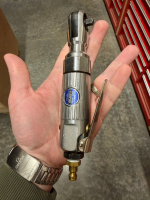
I haven't done this on an RV-14, but I've done it on a couple other RVs and found a small 1/4" drive pneumatic ratchet to be invaluable. (maybe battery-powered ones are also available that will fit, I haven't kept up)
 
I haven't done this on an RV-14, but I've done it on a couple other RVs and found a small 1/4" drive pneumatic ratchet to be invaluable. (maybe battery-powered ones are also available that will fit, I haven't kept up)
This is the answer ^^^^
Doing it this way does not require moving the tool at all. You just need to have a proper length combination of extensions and 3/8” socket.

I didn’t know it was even possible to do it with a regular combination wrench😳
 
To give you a size reference, the one I've got is 6 3/4" long, not including the air fitting. A swivel adapter and lightweight poly hose are helpful here. Small electric ratchets exist, but the Milwaukee ones I've played with are probably 2x the size once you install the battery!

1775572315314.png
 
I didn’t know it was even possible to do it with a regular combination wrench😳
Not easily. I'd start with a box end wrench in some cases turning just one head face at a time. When it was loose enough I'd grab a 2" long socket head that I could twirl with my fingers (don't currently have any kind of socket wrench that could fit up there). Then the last couple turns I'd do with just my fingers so as to not "lose" the bolt or the washer.

"Finding" and aligning the holes when I put the tank back on has me spooked and I am really not looking forward to it.

Also, when reattaching how will I know the bolts are properly set? No way I can see to get a torque wrench up in there.
 
I'd start with a box end wrench in some cases turning just one head face at a time. When it was loose enough I'd grab a 2" long socket head that I could twirl with my fingers (don't currently have any kind of socket wrench that could fit up there).

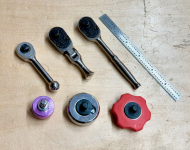
If you're a tool junkie like me, this is your chance to stock up! Here are a few tiny tools that can make this job easier:

1775580285769.png

(all but the purple one are ratchets)

Also, when reattaching how will I know the bolts are properly set? No way I can see to get a torque wrench up in there.

I've done this on a 7 and a 9, so possibly different amount of access from your 14, but I recall being able to get a small click-type torque wrench onto a majority of these bolts. For the really inaccessible ones, you'll just need to use your "calibrated wrist" - an important building skill to develop! ;)
 
If you're a tool junkie like me, this is your chance to stock up! Here are a few tiny tools that can make this job easier:

View attachment 114472

(all but the purple one are ratchets)


I've done this on a 7 and a 9, so possibly different amount of access from your 14, but I recall being able to get a small click-type torque wrench onto a majority of these bolts. For the really inaccessible ones, you'll just need to use your "calibrated wrist" - an important building skill to develop! ;)
Thanks for all of your suggestions. I'll be looking for some of these tools asap.
 
Perfect! Thanks Richard! I hope I never need to remove my tanks but if I do, I'll have this tool ready (assuming I remember I bought it).
 
Haha. Nothing better than finding tools or parts you forgot you bought. Especially after ordering a second one !

Perfect! Thanks Richard! I hope I never need to remove my tanks but if I do, I'll have this tool ready (assuming I remember I bought it).
 
If you're a tool junkie like me, this is your chance to stock up! Here are a few tiny tools that can make this job easier:

View attachment 114472

(all but the purple one are ratchets)
That's pretty much my collection. The star shaped ratchet is good until the bolt starts getting a little tight, then the short handled version.

Also consider extensions. They may allow you to work at a distance that doesn't require you to bend your wrist around a corner.
 
That's pretty much my collection. The star shaped ratchet is good until the bolt starts getting a little tight, then the short handled version.

Also consider extensions. They may allow you to work at a distance that doesn't require you to bend your wrist around a corner.
Something else you can do to make removal easier is to wedge a long strip of AL under the seam where the screws go where the edges are screwed down to the spar. This will raise the dimples out of the countersunk holes and make tank removal a whole lot easier and less chance of scratching the paint.
 
I gifted myself this one when I had to remove a tank on my RV8. It’s not as small as what Matt has, (shown above), but I removed the connection on both ends of my fat aileron push tube and slid it outboard in the wing all the way to the wingtip so it was completely out of the way. No air hose, no extension cord - it was easy with the right ratchet extension (short) to get on every bolt.

 
Something else you can do to make removal easier is to wedge a long strip of AL under the seam where the screws go where the edges are screwed down to the spar. This will raise the dimples out of the countersunk holes and make tank removal a whole lot easier and less chance of scratching the paint.
Yes, the dimples in the tank skin really want to nest into the dimples in the W-1019 splice strip.
 
I gifted myself this one when I had to remove a tank on my RV8. It’s not as small as what Matt has, (shown above), but I removed the connection on both ends of my fat aileron push tube and slid it outboard in the wing all the way to the wingtip so it was completely out of the way. No air hose, no extension cord - it was easy with the right ratchet extension (short) to get on every bolt.

I have the extended-reach 1/4" drive version of this ratchet and I love it. Lets me get into tight, deep spaces. Reversible, variable speed, and plenty of torque. The version Scott has might be better for removing tanks, where you're working by feel at least part of the time. But the stubby air ratchet that Matt suggests is only $71 from ATS (before $hipping).
 
Tooling sounds like it is pretty well covered. I just used 1/4" ratchets & stubby extensions after loosening the bolts with a short 3/8" box end wrench.
To address the other part of your question, yes, reinstallation is a bit of a trick. Don't ask how many times I had to do it. Too many times...
Find several (up to 6) tapered punches to ensure you center the middle bolt in each Z-bracket laterally. I just started each AN-3A with its washer for each location. This leaves the dimples forward from mating into the spar flange. Then use the tapered punches to align the Z-bracket through the spar web holes, both top & bottom bolt. Just start these too and on to the next one. Then I seated the tank skin dimples into the spar flange countersunk drillings, started a few screws as safeties. Back under the wing and tighten the Z-bracket bolts. Last, seat the remaining screws. I hope this helps!
 
Be mindful of the torque for those bolts, and don't overdo it. Don't know about a 14, but on my 7, those are AN3 bolts, with a torque of 20-25 in-lb. You definitely do NOT want to overtorque and snap the head off of one of those bolts. Get a good torque wrench in the 10-50 in-lb range, and use it. It'll go in there, just use an extension.
 
Be mindful of the torque for those bolts, and don't overdo it. Don't know about a 14, but on my 7, those are AN3 bolts, with a torque of 20-25 in-lb. You definitely do NOT want to overtorque and snap the head off of one of those bolts. Get a good torque wrench in the 10-50 in-lb range, and use it. It'll go in there, just use an extension.
They are AN3 bolts in the -14(A), AN3-4A, except for the inboard ones that are installed from the front, which are AN3-5A. Don't forget to add the drag torque of the anchor nuts (nutplates), which is probably in the 5-15 in-lb range. See Section 7-40 of AC43.13-1B and Section 5.20 of Van's Manual Section 5. So you're probably shooting for the 30-40 in-lb range. I'd probably err on the low side, e.g., 30-35 in-lb because the nutplates have already had bolts installed and removed at least once. And if it were me, I'd order a new set of bolts (18 AN3-4A and 3 AN3-5A) from Aircraft Spruce or your favorite hardware supplier. It'll set you back $5.58 plus tax and shipping from Spruce. If you don't have the plans, see Section 18 of the RV-14 KAI.
 
Tooling sounds like it is pretty well covered. I just used 1/4" ratchets & stubby extensions after loosening the bolts with a short 3/8" box end wrench.
To address the other part of your question, yes, reinstallation is a bit of a trick. Don't ask how many times I had to do it. Too many times...
Find several (up to 6) tapered punches to ensure you center the middle bolt in each Z-bracket laterally. I just started each AN-3A with its washer for each location. This leaves the dimples forward from mating into the spar flange. Then use the tapered punches to align the Z-bracket through the spar web holes, both top & bottom bolt. Just start these too and on to the next one. Then I seated the tank skin dimples into the spar flange countersunk drillings, started a few screws as safeties. Back under the wing and tighten the Z-bracket bolts. Last, seat the remaining screws. I hope this helps!
Thanks for this advice. I was hoping for some re-install guidance. Still worried about how that is going to work out.
 
They are AN3 bolts in the -14(A), AN3-4A, except for the inboard ones that are installed from the front, which are AN3-5A. Don't forget to add the drag torque of the anchor nuts (nutplates), which is probably in the 5-15 in-lb range. See Section 7-40 of AC43.13-1B and Section 5.20 of Van's Manual Section 5. So you're probably shooting for the 30-40 in-lb range. I'd probably err on the low side, e.g., 30-35 in-lb because the nutplates have already had bolts installed and removed at least once. And if it were me, I'd order a new set of bolts (18 AN3-4A and 3 AN3-5A) from Aircraft Spruce or your favorite hardware supplier. It'll set you back $5.58 plus tax and shipping from Spruce. If you don't have the plans, see Section 18 of the RV-14 KAI.
It would be so much better if the torque values were listed right there on the plans. I have been x-referencing sources but it is difficult to find correct values.

I did pay for the current USB stick of RV-14 plans and created a complete PDF volume (almost 1000 pages) that I keep in iBooks on my iPad. I can directly search by part/subassembly name, part number, etc. As a non-builder I am coming up to speed on everything related to the build.

I have been researching and indexing the plans-referenced fasteners and creating a catalog. I plan to replace every fastener with a brand new version of the exact spec mentioned in the plans. That way I can know for sure that the right fasteners are in the right place.

For the outside edges along the top and bottom of the spar and the outboard leading edge wrap-around, are there any recommendations of screws to use (stainless, etc.)?? Several of the 76 screws had stripped heads (from the previous removal) and I had to drill out four of them.
 
For the outside edges along the top and bottom of the spar and the outboard leading edge wrap-around, are there any recommendations of screws to use (stainless, etc.)?? Several of the 76 screws had stripped heads (from the previous removal) and I had to drill out four of them.
The KAI call for AN509-8R8, the new part number for which seems to be MS24694-S5. According to the KAI, there are 77 per tank: 58 into the nutplates on the main spar and 19 into the nutplates in the splice strip. See Fig. 1 on page 18-09 of the RV-14 KAI. You might want to acquire a sufficient quantity of these. Buy them in packs of 25 to save some pennies.

These are cadmium plated alloy steel structural screws. The alloy steel ones are about 1.5x as strong as the stainless steel type, which I think is the MS24694C5.

Good for you for getting the plans. You can keep up with the revisions on Van's Service and Support pages.

The torque instructions I've been following are in Van's Manual Section 5, Section 5.20. To do it right with locking fasteners, you have to be able to measure the drag torque of the fasteners (not every one, but enough to get an idea of the range). Being a somewhat naive first-time builder, I spent some money on a dial-type torque wrench with a max torque dial pointer to help with that.
 
Last edited:
They are AN3 bolts in the -14(A), AN3-4A, except for the inboard ones that are installed from the front, which are AN3-5A. Don't forget to add the drag torque of the anchor nuts (nutplates), which is probably in the 5-15 in-lb range. See Section 7-40 of AC43.13-1B and Section 5.20 of Van's Manual Section 5. So you're probably shooting for the 30-40 in-lb range. I'd probably err on the low side, e.g., 30-35 in-lb because the nutplates have already had bolts installed and removed at least once. And if it were me, I'd order a new set of bolts (18 AN3-4A and 3 AN3-5A) from Aircraft Spruce or your favorite hardware supplier. It'll set you back $5.58 plus tax and shipping from Spruce. If you don't have the plans, see Section 18 of the RV-14 KAI.
I have gone down a 2-3 hour rabbit hole today on this "friction drag torque".
AC43.13-1B seems to indicate it applies to nuts ("check the friction drag torque required to turn the NUT").
Vans Section 5.20 states "When tightening fasteners with SELF-LOCKING NUTS the chart values must be modified." again indicating it applies to nuts that you can turn independently.

Do nutplates qualify for this? It seems contrary to both references.

The only way I can see to test for friction drag on these tank-to-spar attachment bolts is to have a sensitive (<20 in-lb) precision indicating torque wrench and then using it to just rotate the bolt (no surface contact) and see what it reads. This could be complicated by stress on the bolt due to how closely aligned the holes are, etc. Plus, doing a search for "compact dial indicator in-lb torque wrench" does not give any viable results for use in the confined space behind the spar.

Have I over thought this one? Shouldn't the tank/spar AN3 bolts just be set at 20-25 in-lb?
 
Yes nutplates do, friction drag applies. A run in nutplate will be slightly lower. Is it a huge deal, not really, in my opinion as long as you add about 10-15 in/lbs you’ll be in the ballpark and won’t be on the low side of the minimum torque, which is what you’re trying to beat.
 
I have a small slow leak somewhere in my left fuel tank. The original owner/builder had already pulled the tank off to try to patch it once so at least the paint has already been cut.

I have spent quite a bit of time researching the plans and online to figure out how to remove the tank and am getting close.

On the back of the spar are EIGHTEEN (18) fasteners (3 ea in six locations). I eventually had to disconnect the aileron push rod on the inboard side to get just enough access to the heads of the fasteners while reaching my big hands up through the inspection panels. My arms are cut, my knuckles bleeding but at least I got those bolts out. At least one set of three are between two closely spaced wing structures. All but six of the bolts were very hard to reach and had to be done blindly. Several of the bolts were located such that I could only turn one face at a time due to the wrench contacting internal structures.

My question is, for any of you who have pulled a tank after full assembly/painting, how the F do you reattach the tank at all of those blind/restricted locations?
Did it by hand (no electric tool) and without removing the aileron pushrod. Just ONE of those 18 bolts took 45 minutes. :ROFLMAO:
 
Did it by hand (no electric tool) and without removing the aileron pushrod. Just ONE of those 18 bolts took 45 minutes. :ROFLMAO:
I feel your pain. Handling an awl in one hole and a bolt in another - with one hand - unseen - with your non dominant hand…

I have no doubt many tanks get reinstalled with bolts missing. Heck I reckon there are plenty of new builds with missing or loose z bracket bolts.

I wouldn’t be too fussed about the running drag of the nutplates under these conditions.
If you’ve built the airframe and got to the point where you’ve got the tank reinstalled for the second time then you can probably use your calibrated wrist on a stubby wrench and be safe.
 
Several years ago I bought a used nutrunner off eBay or from Yardstore (can't remember where) for a few hundred dollars. It's calibrated at 30 in-lbs - so basically perfect for an AN3 bolt into a nutplate or for a nyloc. Makes tank removal/installation much easier, as well as speeds up so many of the torquing tasks elsewhere. Prices have gone up considerably in the past few years, but if you are a tool hound - this is a valuable tool to have. https://www.yardstore.com/atlas-copco-1-4-nutrunner-ltv29-2-used
 
Several years ago I bought a used nutrunner off eBay or from Yardstore (can't remember where) for a few hundred dollars. It's calibrated at 30 in-lbs - so basically perfect for an AN3 bolt into a nutplate or for a nyloc. Makes tank removal/installation much easier, as well as speeds up so many of the torquing tasks elsewhere. Prices have gone up considerably in the past few years, but if you are a tool hound - this is a valuable tool to have. https://www.yardstore.com/atlas-copco-1-4-nutrunner-ltv29-2-used
Can you adjust the torque by adjusting the air pressure delivered to the tool? That would be cool. I like my Milwaukee 2568-20, which has a variable speed trigger. However, it can deliver way too much torque for an AN3 or even AN4 bolt, so I finish tightening with a torque wrench.
 
Back
Top