Van's Air Force

The definitive Van's Aircraft support community! Buying, building or flying an RV? Join our exclusive family of mentors and enthusiasts!

Is this rivet ok?

rrfsgh2

Member
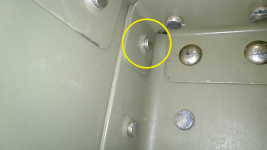
I've got a question for you all. I'm doing the bottom wing skins and the rivet I'm questioning is circled. This rivet helps support the flap bracket.
This is the rivet that connects the bottom skin, rear spar, and flap bracket rib. Is it too flat? Due to it's location I can't measure the height with a caliper, I can't even see it without a camera.

Trying to decide if I should replace it.
1774410324006.png
 
I've got a question for you all. I'm doing the bottom wing skins and the rivet I'm questioning is circled. This rivet helps support the flap bracket.
This is the rivet that connects the bottom skin, rear spar, and flap bracket rib. Is it too flat? Due to it's location I can't measure the height with a caliper, I can't even see it without a camera.

Trying to decide if I should replace it.

View attachment 113331
Leave it alone. You say you can't measure it, if that is the case how are you going to replace it? Probably more damage will be done trying to fix it and it really doesn't look all that bad.
 
I would not mess with that one, either.
The shop head maybe looks a bit smaller than the other -3s by comparison. Those locations with extra layers often have a slightly longer rivet callout, are you sure the right rivet was used? Maybe something to double check as you continue the skin riveting.
Nonetheless I would not drill that out.
 
Nice guy talking: this rivet looks fine to me, leave it alone. The rest is ok. If in doubt use a gage.
Inspector talking: there are marks on the other rivets visible, head and driven side, showing average workmanship (I'm super picky) that say be more careful with your bucking bar or/and gun. Plenty of tricks to achieve better results, could be acquired thru sheetmetal class, previous builder help, etc. Wedges prov taped to bucking bar, tape applied to gun inserts, etc.
 
I would not mess with that one, either.
The shop head maybe looks a bit smaller than the other -3s by comparison. Those locations with extra layers often have a slightly longer rivet callout, are you sure the right rivet was used? Maybe something to double check as you continue the skin riveting.
Nonetheless I would not drill that out.
Yes, this location calls for a -4 length as opposed to most others which are -3.5. I’m positive I used a -4. Thx
 
Nice guy talking: this rivet looks fine to me, leave it alone. The rest is ok. If in doubt use a gage.
Inspector talking: there are marks on the other rivets visible, head and driven side, showing average workmanship (I'm super picky) that say be more careful with your bucking bar or/and gun. Plenty of tricks to achieve better results, could be acquired thru sheetmetal class, previous builder help, etc. Wedges prov taped to bucking bar, tape applied to gun inserts, etc.
Thanks for your reply, this one was in a tricky area that you can’t see while bucking. Hopefully some of the marks you see are actually remnants of black gorilla tape rubbing on parts as I do cover the ends of the bar for riveting shop heads, and I also put gorilla tape on the rivet set for 470 dome rivets. I’m always looking for ways to improve though.

Also, I’d like to learn more about using wedges. I’ve never heard of prov tape. Do you have any more information? Thanks!
 
Last edited:
I would leave it as well. Especially if you're sure you used the appropriate length.

Tip- height is one metric, but width is another. If you can't see the rivet or get to it to measure, an easy way to at least get an idea of where you're at is to press on it for a few seconds and then measure the diameter of the indentation it leaves in your fingertip
 
@rrfsgh2 yep, using at the end of the riveting set sure helps preventing smilies preventing smiles (that was a cheap one, I agree...). I just use painter's tape, which of course has to be replaced every 10th rivet or so. Some use Kapton, Mylar or other exotic stuff, I like the easy to apply tear/off tape I'm using.

For blind bucking bar riveting, I use(d) trash aluminum shims placed at the one end of the bucking bar held by a piece of piece of... painter's tape. The thickness of those shims being a median of worked vs virgin state of the rivet. The same painter's tape is also applied to any corner of the bucking bar that is bound to contact the piece to be riveted.

There are loads of tricks, and also different ways to skin a cat, and you sure know how experienced is acquired... by doing mistakes 😉
 
@rrfsgh2 yep, using at the end of the riveting set sure helps preventing smilies preventing smiles (that was a cheap one, I agree...). I just use painter's tape, which of course has to be replaced every 10th rivet or so. Some use Kapton, Mylar or other exotic stuff, I like the easy to apply tear/off tape I'm using.

For blind bucking bar riveting, I use(d) trash aluminum shims placed at the one end of the bucking bar held by a piece of piece of... painter's tape. The thickness of those shims being a median of worked vs virgin state of the rivet. The same painter's tape is also applied to any corner of the bucking bar that is bound to contact the piece to be riveted.

There are loads of tricks, and also different ways to skin a cat, and you sure know how experienced is acquired... by doing mistakes 😉
“The thickness of those shims being a median of worked vs virgin state of the rivet.” - this is a brilliant idea! Thanks again!
 
One of the biggest things we teach new tech’s on the Commercial side…is STAY IN THE GUN!

Meaning: most damage occurs from letting pressure off the gun and anticipating the release of the trigger…the bucking bar should be dancing lightly in your fingers and with just enough pressure to be “rebounding” against the rivet shop head.

The gun, on the other hand requires pressure on it, firm, direct pressure through the whole burst. Start slow and tease the trigger to full throttle, for 3 and 4 rivets in AD hardness, it’s a bout a “ Thousand one” count so happens fast and most people anticipate the trigger let off with reducing pressure on the gun, use a regulator to reduce the pressure so that full throttle can be used…adjust as required.

DON’T DO THAT.

Stay in the gun for another half second. your rivets (shop heads) will be squarer, more consistent and result in less bucking bar damage. The manufactured heads will be smoother, flusher and less skin marring…

I don’t mean to be critical, but none of those rivets would pass muster for Boeing….not that it matters, they are okay for here, but work to improve your technique. All of what I see there is let off damage.

We use vinyl electrical tape for bucking bar secondary contact issues, but teach techs to position the bar in their fingers, to utilize the tips of their fingers to protect secondary contact wherever possible.

All in all..pretty good job….room for improvement with technique, which is half the fun of this whole building airplanes process!!


BUCK ON!!!!!
 
To quote George Harrison: “Let it Be”
To Quote Charlie Papazion: “Relax, have a Homebrew” (When your done for the day)

-cappy
 
To quote George Harrison: “Let it Be”
To Quote Charlie Papazion: “Relax, have a Homebrew” (When your done for the day)

-cappy
Although Paul McCartney wrote and sang Let it Be, I'm in total agreement with the good Dr when it comes to relaxing with a Homebrew. 😜
 
One of the biggest things we teach new tech’s on the Commercial side…is STAY IN THE GUN!

Meaning: most damage occurs from letting pressure off the gun and anticipating the release of the trigger…the bucking bar should be dancing lightly in your fingers and with just enough pressure to be “rebounding” against the rivet shop head.

The gun, on the other hand requires pressure on it, firm, direct pressure through the whole burst. Start slow and tease the trigger to full throttle, for 3 and 4 rivets in AD hardness, it’s a bout a “ Thousand one” count so happens fast and most people anticipate the trigger let off with reducing pressure on the gun, use a regulator to reduce the pressure so that full throttle can be used…adjust as required.

DON’T DO THAT.

Stay in the gun for another half second. your rivets (shop heads) will be squarer, more consistent and result in less bucking bar damage. The manufactured heads will be smoother, flusher and less skin marring…

I don’t mean to be critical, but none of those rivets would pass muster for Boeing….not that it matters, they are okay for here, but work to improve your technique. All of what I see there is let off damage.

We use vinyl electrical tape for bucking bar secondary contact issues, but teach techs to position the bar in their fingers, to utilize the tips of their fingers to protect secondary contact wherever possible.

All in all..pretty good job….room for improvement with technique, which is half the fun of this whole building airplanes process!!


BUCK ON!!!!!


What if this were Cessna?
 
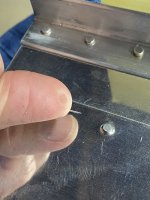
You can measure it if you can touch it. Just stick a finger very firmly on the top and deform your skin, measure with a caliper. Old trick first seen here on VAF. I checked it on the bench and have confidence in the result.Thumb Impression.jpg
 
Last edited:
What if this were Cessna?
If Cessna, you would need to look at their rivet installation specification itself for acceptance/rejection criteria. The specs are written, by Qaulity Engiineers and tend to be pretty un-ambiguous and clearly outline what’s acceptable. I’m not familiar with the Cessna spec, but having owned many Cessna 185’s over the years, can say their rivet quality is pretty good from the factory. As to shop heads on rivets, generally speaking you don’t get a lot of damage when you keep control of both the bucking bar and gun with good technique….anticipating the gun let off causes a lot of damage that is easily avoidable.
 
You can measure it if you can touch it. Just stick a finger very firmly on the top and deform your skin, measure with a caliper. Old trick first seen here on VAF. I checked it on the bench and have confidence in the result.View attachment 113468
For a more specific method, press a piece of clay or play-do onto the rivet and measure that…
 
I asked Van's support the same question once, with a hard to reach rivet similar to this one, and they said "don't sweat every single rivet". A second attempt won't be any better and probably worse -- looks fine to me!
 
I've stated (here?} before. Rivets are a shear application fastener. The important quality is not readily verifiable -> is the shank properly swelled to create a zero tolerance fit? In gross simplification, anything NOT in the stack (shop heads universal heads, etc) is merely along for the ride after installation.

There is nothing magical or mechanically significant about a shop head height of 1/2D or 11/2D relative to shank. It is much easier/faster to apply a quality check to something that can be eye-balled. For type certified aircraft, their quality standards would certainly allow a range for both shop head D and H where a gage would be applied if it fails the first "inspection".

In the words of a famous golf caddy scholar, "I'd play through."
 
I asked Van's support the same question once, with a hard to reach rivet similar to this one, and they said "don't sweat every single rivet". A second attempt won't be any better and probably worse -- looks fine to me!
Also, the chances of inducing more damage when drilling out that rivet are VERY high!!

Many years ago, a builder posted a picture of what he considered to be a 'bad' rivet, and asked the group if it should be replaced. The overwhelming chorus of responses was "leave it alone!!!" Well, he decided to replace it anyway. He ended up drilling out a 'good' rivet first (long story), and when drilling out the 'bad' rivet, it didn't go well and he buggered the hole. He ended up replacing a few parts...
A number of folks had said back then "don't sweat every rivet" as well. And one (my favorite) comment was: wait until he sees that each wing is attached with 4 bolts!!!
 
Back
Top